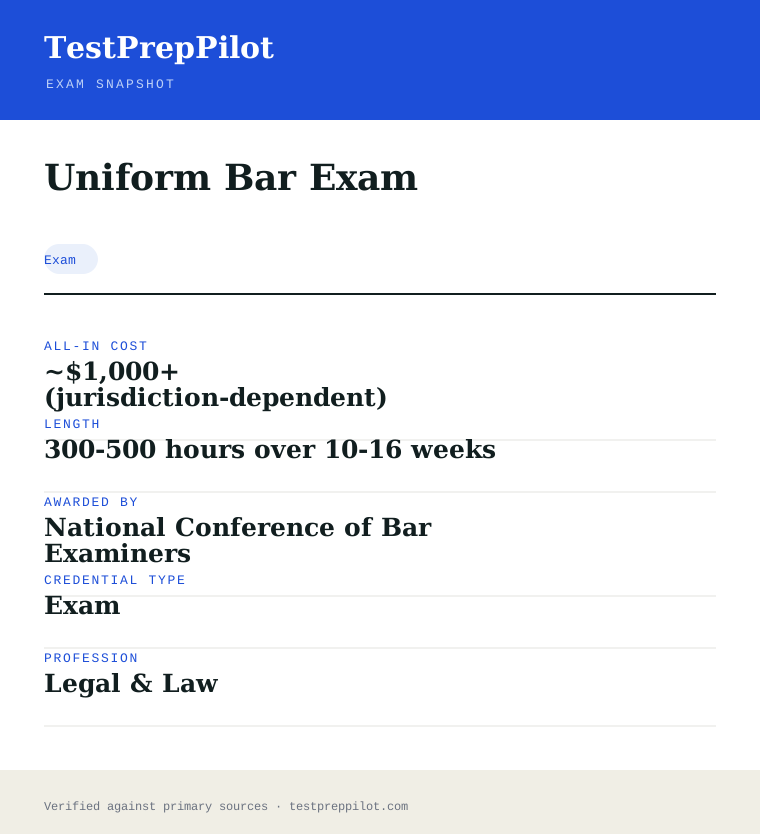
The short version
What is the Uniform Bar Exam and is it worth it?
Uniform Bar Exam is a professional credential administered by National Conference of Bar Examiners. It validates job-ready knowledge and skills in the Legal & Government field and is used for career entry, advancement, or compliance.
- Recognized credential from National Conference of Bar Examiners
- Demonstrates verified competence in Legal & Government
- Supports career advancement and may satisfy licensing or employer requirements
What is it?
What exactly is the Uniform Bar Exam?
Uniform Bar Exam — Legal & Government credential from National Conference of Bar Examiners
A portable two-day bar exam composed of the MBE, MEE and MPT that participating jurisdictions use and score on a common 400-point scale. Offered by National Conference of Bar Examiners, it is designed for candidates who need to demonstrate verified competence in the Legal & Government field. The credential is commonly used for career entry, advancement, regulatory compliance, or employer requirements. Candidates should review the official handbook for eligibility, exam format, and scoring before registering.
The path in brief
- Confirm you meet any eligibility or prerequisites
- Review the official handbook and study materials
- Register and pay through the awarding body or authorized provider
- Schedule and take the exam (test center or online proctoring)
- Receive your score and, if passed, your credential
Before you book
Who is eligible to sit the Uniform Bar Exam?
Eligibility varies; many credentials are open to all, while others require coursework, work experience, or sponsorship.
Who it is for: Professionals and candidates seeking to validate Legal & Government competence.
The test itself
What is the format of the Uniform Bar Exam?
The Uniform Bar Exam is administered by National Conference of Bar Examiners and runs 2 days.
| Administered by | National Conference of Bar Examiners |
|---|---|
| Questions | MBE 200Q + MEE 6 essays + MPT 2 tasks |
| Time limit | 2 days |
| Pass mark | Passing score set by the awarding body; see the official score report |
| Exam fee | ~$1,000+ |
| Format | Proctored, computer-based (test center or online remote proctoring) |
Content outline
What topics are on the Uniform Bar Exam?
The Uniform Bar Exam covers 4 content domains.
Weightings come from the official exam outline. Study time is best allocated in roughly these proportions rather than evenly across domains.
- Substantive law / procedure
Topic area tested on the exam; see the official blueprint for the detailed breakdown.
- Research & writing
Topic area tested on the exam; see the official blueprint for the detailed breakdown.
- Ethics & rules
Topic area tested on the exam; see the official blueprint for the detailed breakdown.
- Practice & compliance
Topic area tested on the exam; see the official blueprint for the detailed breakdown.
The path
How do you register for the Uniform Bar Exam?
- 1
Visit the awarding body’s official website and create an account
- 2
Select the credential and review its specific requirements
- 3
Complete any required eligibility (education, experience, or training)
- 4
Pay the registration fee
- 5
Schedule the exam at a test center or online
- 6
Take the exam and receive your results
The fine print
What are the retake and renewal rules for the Uniform Bar Exam?
- Proctoring & delivery
- Proctored, computer-based delivery (test center or remote online proctoring), varying by exam.
- Retake policy
- Varies by credential — most bodies permit retakes after a waiting period and full or partial fee.
- Score reporting
- Scores are reported per the body’s timeline, typically electronically after the exam.
- Recertification
- Varies; many credentials require renewal every 2–3 years via continuing education or a recertification exam.
What it pays
How much does this credential pay?
$151,160 median for lawyers (BLS OOH, May 2024) — the end-state salary the bar exam gates.
The salary answer for the UBE is the lawyer occupation it gates: the BLS reports a median annual wage of $151,160 for lawyers in May 2024, or $72.67 per hour, in an occupation with 864,800 jobs, and the honest framing is that this median is earned years after the exam, once a JD, the bar, and typically several years of practice are complete. The distribution behind the median matters enormously for bar candidates: the BLS data show the bottom 10 percent of lawyers earning under about $72,780 while the 75th percentile sits near $215,420 and the top of the distribution is suppressed at $239,200 or more, which reflects the wide spread between public-interest and government work on the low end and large-firm and specialised practice on the high end — the salary outcome is a function of employer, market, and practice area far more than of the bar score itself. The BLS projects employment of lawyers to grow 4 percent from 2024 to 2034, about as fast as the average for all occupations, with about 31,500 openings per year, most from replacement need, and it notes competitive pressure on routine legal work from automation and lower-cost providers. The practical takeaway for a UBE candidate is that the headline median is real but remote: the exam’s immediate value is the license itself, because you cannot practice law in the adopting jurisdictions without passing, and the relevant near-term comparison is not the lawyer median but the cost of the exam, the prep course, and the months of full-time study, which candidates should budget before sitting. The wage data also explain why jurisdiction choice matters: a portable UBE score lets a candidate target a jurisdiction with a passing score they can realistically meet, while the earnings opportunity is set by where they later work, not where they passed.
| Measure | Figure | Source / note |
|---|---|---|
| Median annual wage, lawyers | $151,160 | BLS Occupational Outlook Handbook, May 2024 ($72.67/hr) |
| Employment, 2024 | 864,800 jobs | BLS OOH Quick Facts |
| Projected annual openings | ~31,500 per year | BLS OOH Job Outlook, 2024-34 (4% growth) |
| Wage spread | Bottom 10% < $72,780; top suppressed at ≥$239,200 | BLS OEWS May 2024 percentile data |
| Typical entry path | JD + bar exam + admission | The license comes before the salary |
Job growth.4% projected change 2024-34 (about as fast as average), with ~31,500 openings a year, mostly replacement need; the exam cost and study time precede the wage by years.
Your odds
What are the pass rates?
There is no single UBE pass rate — each of the 41 UBE jurisdictions publishes its own results, with first-time-taker pass rates historically spanning a wide range by jurisdiction and cohort; the NCBE aggregates the data rather than publishing one national number.
The direct answer on pass rates is that there is no single national UBE pass rate, and we state that plainly because it is the most common way candidates are misled: the UBE is scored by the NCBE on a 400-point scale and each of the 41 jurisdictions that administer it sets its own minimum passing score — currently ranging from 260 to 280 across jurisdictions, with 266 and 270 the most common thresholds — and each jurisdiction publishes its own pass-rate results, which the NCBE aggregates by administration in its quarterly Bar Examiner statistics rather than collapsing into one national figure. First-time-taker pass rates vary widely by jurisdiction and cohort — historically spanning from roughly the mid-50s to the mid-80s depending on the state and the pool — so any single number quoted as "the UBE pass rate" is either a specific jurisdiction’s figure or an unsourced average, and we deliberately do not invent one. What is verifiable and fixed is the structure and scoring: the UBE is a two-day exam in February and July, worth 400 points, with the MBE (200 multiple-choice questions over six hours, 50 percent of the score), the MEE (six 30-minute essays, 30 percent), and the MPT (two 90-minute tasks, 20 percent), and a candidate passes only by meeting the adopting jurisdiction’s minimum total score. The practical read on the pass-rate landscape: because the score is portable, a candidate who scores at or above the highest threshold they may need — for example 270 or 276 — preserves mobility across UBE jurisdictions, while a candidate aiming only at a 260-state has a lower bar but less transfer flexibility. The UBE is also in transition: the NCBE is phasing in the NextGen UBE beginning July 2026 in a limited set of jurisdictions, so candidates must confirm which exam their target jurisdiction administers.
Read this before quoting the number.No single national UBE pass rate exists; each of the 41 UBE jurisdictions publishes its own results and sets its own minimum passing score (currently 260-280), and first-time-taker pass rates vary widely by jurisdiction and cohort, so no universal pass-rate figure is published.
Source: NCBE — Uniform Bar Examination
Your schedule
How long should I study for it?
400-600 hours over 8-10 weeks full-time (longer if studying around work) of focused study
A realistic UBE study plan runs 400-600 hours over 8-10 weeks of full-time study — the standard commercial prep-course schedule — because the exam covers the seven MBE subjects plus the six MEE subjects plus the two MPT skills, and the largest score gains come from drilling the 200-question MBE format and the timed essays and performance-test tasks. The NCBE materials are the scope map: the MBE tests Civil Procedure, Constitutional Law, Contracts, Criminal Law and Procedure, Evidence, Real Property, and Torts with 175 scored and 25 unscored questions over six hours; the MEE adds Business Associations, Conflict of Laws, Family Law, Trusts and Estates, and Secured Transactions to the MBE subjects across six 30-minute essays; and the MPT is a closed-universe skills test — two 90-minute tasks using a File of facts and a Library of authorities to produce a memo, brief, or letter. The plan should split into a foundation phase (weeks 1-4) covering the seven MBE subjects in weight order with daily mixed MBE drilling, an essay and performance-test phase (weeks 5-7) that writes MEE answers under 30-minute timers and completes MPT tasks under 90-minute timers, and a final phase (weeks 8-10) of full simulated exam days that replicate the two-day schedule. Candidates should confirm their target jurisdiction’s passing score early, because a 260 threshold and a 276 threshold call for different margin planning, and should confirm whether the jurisdiction has moved to the NextGen UBE, which changes the exam entirely. The final two weeks should include at least two full two-day simulated administrations, because the 6-hour MBE day is a stamina event and the writing load of the MEE and MPT day is a separate discipline from multiple-choice speed.
- Weeks 1-250-60 hrs/week
MBE subjects I
- Cover Civil Procedure and Constitutional Law with the commercial outline
- Do 25-50 mixed MBE questions daily with full explanations
- Build a one-page attack sheet per subject
- Weeks 3-450-60 hrs/week
MBE subjects II
- Cover Contracts, Real Property, Evidence, and Criminal Law and Procedure
- Scale MBE drilling to 50-75 questions daily, timing yourself
- Re-drill the question types you miss most
- Weeks 5-655-65 hrs/week
MEE essays
- Study the non-MBE MEE subjects: Business Associations, Family Law, Trusts and Estates
- Write MEE answers under strict 30-minute timers
- Self-grade against the NCBE analyses and the MEE grading rubric
- Week 755-65 hrs
MPT performance tests
- Complete MPT tasks under 90-minute timers using the File and Library
- Practise the memo, brief, and letter formats
- Do a full MEE + MPT day simulation
- Weeks 8-955-65 hrs/week
Full simulated days
- Take a full 200-question MBE day under exact timing
- Take a full 6-essay + 2-MPT day under exact timing
- Analyse the section breakdown and re-drill the weakest subjects
- Week 1040-45 hrs
Readiness and logistics
- Review attack sheets and the MEE and MPT formats you will see
- Light review only — no new material in the final days
- Confirm the test-center location, IDs, and the February or July date
Adjusting the pace
Studying while working.Extend the plan to 14-16 weeks at 25-35 hours a week; protect the daily MBE drilling and the weekly timed essay, and take both full simulated days on weekends.
Retaker with a prior score near the threshold.Skip broad re-review and target the two or three lowest MBE subjects plus the MEE and MPT writing formats, because the marginal points on a near-pass come from the written components.
NextGen UBE jurisdiction.If your target jurisdiction administers the NextGen UBE (beginning July 2026), the MBE/MEE/MPT split above does not apply — confirm the new format and use NextGen-specific prep.
How to study
How do I prepare most effectively?
The dominant prep strategy for the UBE is to make the 200-question MBE the engine of your plan and to treat the MEE and MPT as learnable formats rather than vague essay anxiety, because the MBE is 50 percent of the score and its rule-heavy subjects are the most reliably improvable, while the written components reward format practice more than genius. First, set your target by jurisdiction: look up the minimum passing score for every jurisdiction you might transfer to, and aim for at least the highest threshold you may need, because the portability of a UBE score is one of its main assets. Second, drill MBE questions daily from week one in a mixed format rather than by subject, because the real exam mixes all seven subjects and question-recognition speed is a tested skill; a commercial question bank with full explanations is the standard tool. Third, build attack sheets for the high-yield MBE rules — constitutional standards of review, hearsay exceptions, contracts damages, real-property priorities — because the MBE rewards fast, accurate rule recall more than subtle analysis. Fourth, write MEE answers under a strict 30-minute timer from early in the plan and self-grade against the published NCBE analyses, because the MEE is graded on rule statement, application, and organisation, and feedback is built by writing, not by reading. Fifth, complete MPT tasks under 90-minute timers in each of the common formats — memo, brief, and letter — because the performance test is a closed-universe skills task and is the most coachable component of the exam. Finally, run at least two full two-day simulated administrations, because the 6-hour MBE day and the writing-load day are separate stamina events. A further high-yield tactic is to re-attempt every missed MBE question after a two-week gap, because retrieving the rule proves the learning rather than just the exposure.
Set your target by jurisdiction
Look up each jurisdiction’s minimum passing score (currently 260-280) and aim for the highest threshold you may need, because UBE scores are portable.
Drill MBE questions mixed, daily, from week one
The real exam mixes all seven subjects; recognition speed is a tested skill and a question bank with explanations is the standard tool.
Build attack sheets for high-yield rules
Standards of review, hearsay exceptions, damages, and property priorities reward fast, accurate rule recall.
Write MEE answers under 30-minute timers
Self-grade against the published NCBE analyses; the MEE rewards rule statement, application, and organisation.
Complete MPT tasks in all three formats
Memo, brief, and letter; the closed-universe performance test is the most coachable component.
Run two full two-day simulations
The 6-hour MBE day and the writing-load day are separate stamina events that need rehearsal.
What to buy
Which study resources are worth paying for?
UBE prep resources split into the commercial bar-prep courses, the NCBE official materials, and supplementary drilling tools, and the buying logic is anchored by the NCBE official materials because they are the only source of retired MBE questions, the official MEE questions and analyses, and the MPT items and point sheets — the closest available approximation of the real exam. Commercial bar-prep courses — the dominant multi-week options running from roughly $1,500 to $4,000 depending on the tier and add-ons — bundle lectures, outlines, MBE question banks, essay grading, and a study schedule, and for most first-time takers the structured schedule is the product; the major vendors also offer shorter or self-paced versions at lower prices, and many offer public-interest discounts and payment plans. The NCBE’s own materials — the MBE Study Aids, the MEE and MPT study aids in the BarNow store, and the free sample questions — are inexpensive (typically $30-60 per set) and are the highest-fidelity practice available, which makes them the one purchase every candidate should make even with a full commercial course. Third-party MBE question banks and essay feedback services, roughly $100-400, add volume and analytics for candidates who finish the course early or need extra drilling. The footnote that anchors the comparison: prices below are approximate as of mid-2026 and change frequently, we rank nothing by commission, and the exam fee itself — roughly $300-1,000 depending on the jurisdiction, plus character-and-fitness fees and the MPRE fee — is set by the admitting state and is separate from any prep purchase. A cheap readiness check is the NCBE free sample questions before buying a course, because the diagnostic tells you whether you need the full structured schedule or can move straight to official practice.
| Resource | Price | Format | Best for |
|---|---|---|---|
| NCBE official study aids | ~$30-60 per set | Retired MBE questions, MEE analyses, MPT items | The highest-fidelity practice — essential even with a course |
| Commercial bar-prep course | ~$1,500-4,000 | Lectures, outlines, question bank, schedule, grading | First-time takers wanting a structured full-time schedule |
| Self-paced / shorter course tier | ~$500-1,500 | Recorded lectures + question bank | Retakers and candidates with strong outlines already |
| Third-party MBE question bank | ~$100-400 | Online drilling with analytics | Extra volume after the course question bank is exhausted |
| UBE exam registration | ~$300-1,000 by jurisdiction | State bar admission agency | The real exam; fees vary widely by jurisdiction |
Prices are approximate as of mid-2026 and change frequently; we rank nothing by commission. UBE exam and admission fees are set by each jurisdiction (commonly ~$300-1,000), separate from any prep purchase, and most jurisdictions also require a passing MPRE score and character-and-fitness approval.
Avoid these
What mistakes do candidates most often make?
The most common mistake on the UBE is treating the exam as pure memorisation, because the MBE rewards applying rules to unfamiliar fact patterns and the MEE and MPT reward writing under time pressure, and candidates who read outlines without drilling questions routinely underperform their study hours. The second is neglecting the MPT, the 20 percent performance-test component that requires drafting a memo, brief, or letter from a closed universe of facts and authorities — candidates who treat it as optional lose the most coachable points on the exam, because the MPT rewards format practice rather than substantive knowledge. A third recurring error is under-practising the essay component’s timing: the MEE’s six 30-minute essays are a writing-volume event, and candidates who never write under a timer produce answers that are too thin or too long for the grading rubric. Candidates also routinely fixate on a single jurisdiction’s passing score without understanding portability, missing that a 266-score target forecloses transfer to a 270 or 276 state, when aiming slightly higher preserves mobility at modest marginal cost. Another pattern is studying the MBE subjects by subject in isolation, when the real exam is mixed and question-recognition speed across seven subjects is itself a tested skill. Finally, some candidates sit the exam without confirming which exam their jurisdiction administers — the current UBE or the NextGen UBE arriving in July 2026 — and discover a format mismatch only when the seat is booked, and others ignore the MPRE requirement, which most jurisdictions need before admission and which is a separate exam entirely.
✕Reading outlines without drilling questions
✓Drill MBE questions daily in mixed format and write timed MEE and MPT answers; application is the tested skill, not recall.
✕Neglecting the MPT
✓The performance test is 20% of the score and the most coachable component; practise memo, brief, and letter tasks under 90-minute timers.
✕Never writing essays under a timer
✓The six 30-minute MEE essays are a writing-volume event; write under a timer and self-grade against the NCBE analyses.
✕Targeting one jurisdiction’s passing score blindly
✓Aim for the highest threshold you may need (e.g., 270 or 276) to preserve score portability across UBE jurisdictions.
✕Studying MBE subjects in isolation
✓Drill mixed sets across all seven subjects, because recognition speed across subjects is a tested skill.
✕Ignoring the NextGen and MPRE questions
✓Confirm whether your jurisdiction administers the current UBE or the NextGen UBE, and schedule the MPRE, which most states require before admission.
What you'll face
What question types will I see?
The UBE is a two-day, 400-point exam composed of three components: the Multistate Bar Examination, or MBE (200 multiple-choice questions over six hours in two 3-hour sessions, 50 percent of the score), the Multistate Essay Examination, or MEE (six 30-minute essays, 30 percent), and the Multistate Performance Test, or MPT (two 90-minute tasks, 20 percent). The MBE covers seven subjects — Civil Procedure, Constitutional Law, Contracts, Criminal Law and Procedure, Evidence, Real Property, and Torts — with 175 scored and 25 unscored questions evenly distributed, and each question presents a fact pattern with four answer choices testing rule application rather than rule recall. The MEE covers the MBE subjects plus Business Associations, Conflict of Laws, Family Law, Trusts and Estates, and Secured Transactions, and each essay asks for issue spotting, rule statement, application, and conclusion in a clear structure. The MPT is a closed-universe skills test: each task provides a File of facts and a Library of authorities and asks the candidate to produce a work product such as a memo, brief, or letter, testing lawyering skills rather than memorised doctrine. The MBE is scaled by the NCBE and the written components are scaled to it, and the total is reported on a 400-point scale, with each jurisdiction’s minimum passing score set independently; the MBE’s 25 pretest questions are indistinguishable from the 175 scored items, so candidates should answer every question. Because the UBE is being phased into the NextGen exam beginning July 2026, candidates should confirm which format their jurisdiction administers before studying. The samples below illustrate three of the recurring formats — an MBE rule-application item, an MEE-style prompt, and an MPT-style assignment. The sample items are editor-written illustrations of the published blueprint, not live exam items.
Seven subjects, four-option items testing rule application to fact patterns; 25 of the 200 are unscored pretest questions.
Thirty-minute essays covering MBE subjects plus Business Associations, Conflict of Laws, Family Law, Trusts and Estates, and Secured Transactions; graded on issue spotting, rule, application, and organisation.
Ninety-minute closed-universe drafting tasks — memo, brief, or letter — using a File of facts and a Library of authorities; rewards format practice.
Try these
Q1A state statute requires all commercial trucks to stop at a weigh station within 25 miles of the state border. An out-of-state trucking company challenges the statute. Under which analysis would a court most likely evaluate the statute?
Answer:A
State regulations that burden interstate commerce are analysed under the Dormant Commerce Clause: a nondiscriminatory regulation is upheld if the state interest outweighs the burden on commerce, while a discriminatory one faces a stricter standard. Option B is wrong because Article IV privileges and immunities protects natural persons, not corporations; option C is wrong because full faith and credit concerns judgments and public acts between states; and option D is wrong because a regulatory stop is not a taking of property. This item tests the constitutional framework that anchors the Con Law portion of the MBE.
Q2MEE-style prompt: "A seller agreed in writing to sell a warehouse to a buyer for $2 million, with closing in 60 days. Before closing, the buyer learned the seller had already sold the same warehouse to a third party. Discuss the buyer’s rights and remedies."
Answer:B
A contract for the sale of land is enforceable and a seller’s sale to a third party before closing is a breach. The buyer’s remedies include damages and, because land is unique, specific performance where the third party is not a bona fide purchaser for value protected by recording acts; option A is wrong because a double sale is possible and remedies arise, option C is too narrow because damages and specific performance are available, and option D invents an obligation that does not exist. This item illustrates the MEE’s format: spot the issues, state the rules, and apply them in an organised answer.
Q3MPT-style assignment: "You are a summer associate. Your supervising attorney asks for a memorandum analysing whether a client’s proposed advertising campaign violates the state’s deceptive-trade-practices statute. The File contains the client’s draft campaign; the Library contains the statute and two recent cases."
Answer:B
The MPT requires completing the assigned task — here, a memorandum — using only the File and Library provided: apply the statute and the cases to the client’s facts and reach a conclusion. Option A ignores the closed universe, option C imports outside law that the task did not authorise, and option D avoids the analytical conclusion the assignment requires. This item illustrates why the MPT rewards format practice: the skills are legal analysis, factual application, and clear legal writing, not memorised doctrine.
Samples are editor-written illustrations of the published blueprint, not live exam items.
The big day
What should I expect on exam day?
The UBE is a two-day exam administered in February and July, and the direct exam-day answer is that Day 1 consists of the six MEE essays (three hours) and the two MPT tasks (three hours), and Day 2 consists of the 200-question MBE in two three-hour sessions of 100 questions each, with the MBE worth 50 percent, the MEE 30 percent, and the MPT 20 percent of the 400-point total. Arrive at the test center at least 30 minutes early with the two forms of identification required by your jurisdiction, and expect strict check-in, a controlled room, and a zero-tolerance policy on phones and notes; the MBE is computer-based in most jurisdictions, with some still using answer sheets, so confirm the delivery mode with your jurisdiction in advance. On Day 1, pace the MEE at 30 minutes per essay and the MPT at 90 minutes per task, spending the first minutes of each essay on issue spotting and structure; on Day 2, pace the MBE at roughly 1.8 minutes per question and never leave a question blank, because the 25 unscored pretest items are indistinguishable from the 175 scored items and there is no guessing penalty. The score is reported as a single scaled total out of 400, with the MBE scaled by the NCBE and the written components scaled to it, and results are typically released four to eight weeks after the exam, depending on the jurisdiction. On a pass at or above your target jurisdiction’s minimum, you can transfer the score to other UBE jurisdictions within their published time windows — commonly three to five years; on a fail, the score report and your component breakdown show whether the multiple choice or the written components carried the loss, which should drive any retake. Most jurisdictions also require a passing MPRE score and a successful character-and-fitness review before admission, so those steps should be scheduled in parallel rather than after the bar.
Bring
- Two forms of identification as required by your jurisdiction (typically a government-issued photo ID plus a second ID)
- Your admission ticket and any materials your jurisdiction permits (check the jurisdiction’s instructions)
- Approved comfort items if permitted by the test center
Leave at home
- Phones, smartwatches, and all electronic devices — prohibited in the testing room
- Notes, outlines, and study materials
- Food and drink beyond what the test center permits
- Anything on your jurisdiction’s prohibited-items list
How the day runs
Rules in the room
- The MBE is 200 questions (175 scored + 25 pretest) over six hours; no guessing penalty, so answer every question
- The MEE is six 30-minute essays; the MPT is two 90-minute tasks
- No phones, smartwatches, or notes in the testing room; strict ID and check-in requirements
- MBE is computer-based in most jurisdictions — confirm the delivery mode with your jurisdiction
- A passing MPRE score and character-and-fitness review are required for admission in most jurisdictions
Afterwards.Your score is released as a single scaled total out of 400, typically four to eight weeks after the exam. On a pass at or above your target jurisdiction’s minimum (commonly 260-280), transfer the score to other UBE jurisdictions within their published windows and complete the admission requirements — the MPRE, character-and-fitness approval, and any jurisdiction-specific education or practice component. On a fail, use the component breakdown to decide whether the retake targets the MBE or the written components, and confirm whether your jurisdiction has moved to the NextGen UBE before scheduling.
Reference
What are the key facts about the Uniform Bar Exam?
Uniform Bar Exam is a exam credential; awarded by National Conference of Bar Examiners; the exam fee is ~$1,000+; typical preparation is 300-500 hours over 10-16 weeks; holders typically earn $151,160 (23-1011 Lawyers).
| Credential | Uniform Bar Exam |
|---|---|
| Abbreviation | UBE |
| Type | Exam |
| Profession | Legal & Law |
| Specialty | Bar Exam Components |
| Awarded by | National Conference of Bar Examiners |
| Difficulty | Specialized |
| Typical prep time | 300-500 hours over 10-16 weeks |
| All-in cost | ~$1,000+ (jurisdiction-dependent) |
| Typical salary range | $151,160 (23-1011 Lawyers) |
| Credential | Uniform Bar Exam |
| Awarding body | National Conference of Bar Examiners |
| Exam format | Proctored, computer-based |
| Validity | Score transferable among UBE jurisdictions (typically 3 years) |
| Languages | Varies — see awarding body |
| Scope | National / Multi-state |
| Also known as | UBE |
Real questions
Frequently asked questions about the Uniform Bar Exam
How do I register for the Uniform Bar Exam exam?
Register through National Conference of Bar Examiners's official portal or an authorized test provider (e.g., Pearson VUE or Prometric where applicable). Create an account, select the exam, pay the fee, and schedule a date.
How much does the exam cost?
Fees vary by location and currency. Confirm the current fee on the official registration page before scheduling.
How long is the credential valid, and how do I renew?
Validity varies by credential (commonly 2–3 years). Renewal usually requires continuing education or a recertification exam — see National Conference of Bar Examiners's policy.
What if I do not pass?
Most bodies allow retakes after a waiting period and payment of the full or partial fee. Check National Conference of Bar Examiners's retake policy before rescheduling.
How do I register for a National Conference of Bar Examiners credential?
Register through the official website, select your exam, pay the fee, and schedule a date.
How do I renew a credential?
Renewal policies vary by credential; check the specific program page for requirements and cycles.
In short
Is the Uniform Bar Exam worth it?
- Uniform Bar Exam is awarded by National Conference of Bar Examiners.
- Validates job-ready competence in Legal & Government.
- Registration is through the awarding body or an authorized test provider.
- Renewal and retake policies vary — confirm before scheduling.
Same awarding body
What other credentials does National Conference of Bar Examiners award?
Worth comparing
How does the Uniform Bar Exam compare with similar credentials?
Trust
Where does this information come from?
Everything above is taken from the awarding body's own published material. Fees, question counts and domain weights are revised regularly — check the official page before you pay.
- National Conference of Bar Examiners Awarding body
Research confidence: low · Last reviewed 2026-08