The short version
What is the Multistate Professional Responsibility Examination and is it worth it?
Multistate Professional Responsibility Examination is a professional credential administered by National Conference of Bar Examiners. It validates job-ready knowledge and skills in the Legal & Government field and is used for career entry, advancement, or compliance.
- Recognized credential from National Conference of Bar Examiners
- Demonstrates verified competence in Legal & Government
- Supports career advancement and may satisfy licensing or employer requirements
What is it?
What exactly is the Multistate Professional Responsibility Examination?
Multistate Professional Responsibility Examination — Legal & Government credential from National Conference of Bar Examiners
A two-hour, 60-question multiple-choice exam on legal ethics and professional conduct required for admission to the bar in most U.S. jurisdictions. Offered by National Conference of Bar Examiners, it is designed for candidates who need to demonstrate verified competence in the Legal & Government field. The credential is commonly used for career entry, advancement, regulatory compliance, or employer requirements. Candidates should review the official handbook for eligibility, exam format, and scoring before registering.
The path in brief
- Confirm you meet any eligibility or prerequisites
- Review the official handbook and study materials
- Register and pay through the awarding body or authorized provider
- Schedule and take the exam (test center or online proctoring)
- Receive your score and, if passed, your credential
Before you book
Who is eligible to sit the Multistate Professional Responsibility Examination?
Eligibility varies; many credentials are open to all, while others require coursework, work experience, or sponsorship.
Who it is for: Professionals and candidates seeking to validate Legal & Government competence.
The test itself
What is the format of the Multistate Professional Responsibility Examination?
The Multistate Professional Responsibility Examination is administered by National Conference of Bar Examiners and runs 2 hours and contains 60 questions.
| Administered by | National Conference of Bar Examiners |
|---|---|
| Questions | 60 questions |
| Time limit | 2 hours |
| Pass mark | Passing score set by the awarding body; see the official score report |
| Exam fee | ~$145-160 |
| Format | Proctored, computer-based (test center or online remote proctoring) |
Content outline
What topics are on the Multistate Professional Responsibility Examination?
The Multistate Professional Responsibility Examination covers 4 content domains.
Weightings come from the official exam outline. Study time is best allocated in roughly these proportions rather than evenly across domains.
- Substantive law / procedure
Topic area tested on the exam; see the official blueprint for the detailed breakdown.
- Research & writing
Topic area tested on the exam; see the official blueprint for the detailed breakdown.
- Ethics & rules
Topic area tested on the exam; see the official blueprint for the detailed breakdown.
- Practice & compliance
Topic area tested on the exam; see the official blueprint for the detailed breakdown.
The path
How do you register for the Multistate Professional Responsibility Examination?
- 1
Visit the awarding body’s official website and create an account
- 2
Select the credential and review its specific requirements
- 3
Complete any required eligibility (education, experience, or training)
- 4
Pay the registration fee
- 5
Schedule the exam at a test center or online
- 6
Take the exam and receive your results
The fine print
What are the retake and renewal rules for the Multistate Professional Responsibility Examination?
- Proctoring & delivery
- Proctored, computer-based delivery (test center or remote online proctoring), varying by exam.
- Retake policy
- Varies by credential — most bodies permit retakes after a waiting period and full or partial fee.
- Score reporting
- Scores are reported per the body’s timeline, typically electronically after the exam.
- Recertification
- Varies; many credentials require renewal every 2–3 years via continuing education or a recertification exam.
What it pays
How much does this credential pay?
$151,160 median for lawyers (BLS OOH, May 2024) — the profession the MPRE helps you enter.
The salary answer for the MPRE is the lawyer profession it helps you enter: the BLS reports a median annual wage of $151,160 for lawyers in May 2024, or $72.67 per hour, in an occupation with 864,800 jobs, and the honest framing is that the MPRE is a small and early step toward that figure — a two-hour ethics exam most candidates take during law school, years before the license, the job, and the salary arrive. The distribution behind the lawyer median matters more than the median for planning purposes: the BLS data show the bottom 10 percent of lawyers earning under about $72,780 while the 75th percentile sits near $215,420 and the top of the distribution is suppressed at $239,200 or more, which reflects the enormous spread between public-interest and government roles on the low end and large-firm and specialised practice on the high end. The BLS projects employment of lawyers to grow 4 percent from 2024 to 2034, about as fast as the average for all occupations, with about 31,500 openings per year, most from replacement need. The practical framing for an MPRE candidate is that this exam is a gate rather than a differentiator: the fee (about $160), the two hours, and the prep time are a small investment compared with the bar exam and the JD that surround it, and the real cost of getting the MPRE wrong is schedule friction — a missed passing score delays bar admission because most jurisdictions require the MPRE before admission, and the exam is offered only three times a year. The salary headline, in other words, is the profession’s, not the exam’s: the MPRE itself produces no credential value beyond the passing score, and candidates should weigh its cost and timing against the far larger bar-exam investment it unlocks.
| Measure | Figure | Source / note |
|---|---|---|
| Median annual wage, lawyers | $151,160 | BLS Occupational Outlook Handbook, May 2024 ($72.67/hr) |
| Employment, 2024 | 864,800 jobs | BLS OOH Quick Facts |
| Projected annual openings | ~31,500 per year | BLS OOH Job Outlook, 2024-34 (4% growth) |
| MPRE administrations | 3 per year | March, August, and November, at Pearson VUE centers |
| Salary impact | Indirect — a licensure gate | The MPRE unlocks bar admission; the salary belongs to the lawyer profession |
Job growth.4% projected change 2024-34 for lawyers (about as fast as average), with ~31,500 openings a year; the MPRE itself has no employment outlook — it is a bar-admission gate.
Your odds
What are the pass rates?
The NCBE publishes no single MPRE pass rate — it reports score statistics instead, with a national mean scaled score of 96.6 in 2024 on the 50-150 scale, comfortably above most jurisdictions’ passing thresholds of 75-86.
The direct answer on pass rates is that the NCBE does not publish a single national MPRE pass rate, and we state that plainly: the NCBE reports MPRE score statistics in its annual statistics rather than a universal pass percentage, because there is no universal passing score — each jurisdiction sets its own minimum, currently ranging from 75 to 86 on the 50-150 scaled score, with 80 and 85 the two most common thresholds. The strongest published signal is the score distribution itself: the national mean scaled score was 96.6 in 2024, with individual administrations averaging between 95.6 and 97.1, which sits comfortably above the highest jurisdiction threshold of 86 and strongly suggests the great majority of test-takers clear their state’s bar — but that is an inference from published means, not a published pass rate, and the mean is pulled up by repeat test-takers and does not show what share of first-time takers pass. What is fully verifiable is the exam mechanics: the MPRE is a 60-question, two-hour, computer-based multiple-choice exam offered three times a year, of which 50 questions are scored and 10 are unscored pretest items, scored on a scaled 50-150 scale using equating so that a given scaled score represents the same knowledge across different exam forms, with no penalty for guessing. The passing-score landscape is the practical question: 8 jurisdictions require 75, 20 require 80, 21 require 85, and California and Utah require 86, so a candidate targeting admission in several states should aim for 86 to preserve flexibility, while a candidate licensing only in a 75-state needs far less margin. The exam is required for bar admission in every jurisdiction except Wisconsin and Puerto Rico, and Connecticut and New Jersey accept a law school professional-responsibility course in lieu of a passing score.
Read this before quoting the number.No single MPRE pass rate is published by the NCBE; the published statistics are score-based (national mean 96.6 in 2024 on the 50-150 scale), and whether a score of 75, 80, 85, or 86 passes depends on the jurisdiction, since each sets its own minimum.
Source: NCBE — About the MPRE
Your schedule
How long should I study for it?
20-40 hours over 3-6 weeks of focused study
A realistic MPRE study plan runs 20-40 hours over 3-6 weeks, because the exam is a single two-hour, 60-question multiple-choice test of ethics rules, and the largest score gains come from learning the ABA Model Rules of Professional Conduct in the subject-matter order of the published outline and drilling official-style questions against a target jurisdiction’s passing score. The NCBE MPRE subject-matter outline is the scope map: it lists the tested topics with approximate percentages — conflicts of interest (12-18 percent), the client-lawyer relationship (10-16 percent), litigation and other forms of advocacy (10-16 percent), client confidentiality (6-12 percent), regulation of the legal profession (6-12 percent), competence and malpractice liability (6-12 percent), plus smaller categories such as safekeeping funds, communications about services, different roles of the lawyer, and judicial conduct — so conflicts, confidentiality, and the client-lawyer relationship together account for close to half the exam. The study window should split into a rules-learning phase (weeks 1-3) working the outline in weight order, a drilling phase (week 4) with NCBE and commercial question sets, and a final two weeks of full timed 60-question practice exams. Candidates who have completed a professional-responsibility course in law school should budget the lower end and weight time to drilling; candidates without the course should budget the upper end and add a commercial MPRE course or outline, because the Model Rules are a distinct body of law with specific exceptions that are easily confused. The final two weeks should include at least two full timed practice exams at the real 2-minute-per-question pace, because the 10 unscored pretest items are indistinguishable from the 50 scored items and the pacing plan must treat all 60 questions as if they count. Because the exam is offered only in March, August, and November, the plan should be built backward from the administration date and from any bar-exam admission deadline.
- Weeks 1-28-10 hrs/week
Conflicts, confidentiality, and the client relationship
- Study conflicts of interest (12-18%): concurrent, former-client, and third-party conflicts
- Cover client confidentiality (6-12%) and the client-lawyer relationship (10-16%)
- Build flashcards for the disqualification and informed-consent rules
- Week 38-10 hrs
Advocacy, regulation, and the remaining topics
- Study litigation and advocacy rules (10-16%): trial publicity, candour, fairness
- Cover regulation of the profession, competence, and safekeeping of funds
- Drill the smaller categories: communications, roles of the lawyer, judicial conduct
- Week 410-12 hrs
Drilling and first full exams
- Work NCBE and commercial question sets, categorising every miss
- Take the first full timed 60-question practice exam
- Re-drill the topics that generated most of the misses
- Weeks 5-610-12 hrs
Full exams and readiness
- Take two more full timed practice exams, targeting your jurisdiction’s score plus margin
- Re-drill conflicts and confidentiality — the highest-weight topics
- Confirm registration, the Pearson VUE appointment, and ID requirements
Adjusting the pace
After a professional-responsibility course.Budget the lower end and weight time to drilling; the course covers the Model Rules, so the exam prep is about question format and pacing.
No professional-responsibility course.Budget the upper end and add a commercial MPRE course or outline; the Model Rules are a distinct body of law with specific exceptions worth learning deliberately.
How to study
How do I prepare most effectively?
The dominant prep strategy for the MPRE is to learn the ABA Model Rules of Professional Conduct in the subject-matter order of the NCBE outline and then drill official-style questions under a timer, because the exam tests rule recognition and exception recall more than legal reasoning, and candidates who read outlines without drilling the specific fact patterns routinely confuse the Model Rules with each other. First, download the NCBE subject-matter outline and use it as the checklist: the percentage weights tell you that conflicts of interest, the client-lawyer relationship, and confidentiality together are close to half the exam, so those topics deserve the most time. Second, learn the rules as a system of default rules and exceptions rather than as isolated lists: the exam rewards knowing, for example, when a conflict can be cured by informed consent and when it cannot, and when confidentiality can be breached and when it cannot — and the exceptions are where the high-yield questions live. Third, drill official-style questions daily, because the MPRE items are fact patterns about lawyer behaviour and the closest approximation of the real items is the NCBE sample questions and the commercial question sets that model them; categorise every miss by topic so the second pass targets real weaknesses. Fourth, set your target by jurisdiction early: look up your state’s passing score — commonly 80 or 85 — and aim for at least that threshold plus margin, because the scaled score is equated and the margin is the insurance. Fifth, take full timed practice exams at the real 2-minute-per-question pace, because the 10 unscored pretest items are indistinguishable from the 50 scored items and the pacing plan must treat all 60 questions as if they count. Finally, schedule the exam against the bar-admission timeline: the MPRE is offered only in March, August, and November, and most jurisdictions require a passing score before admission, so register for the administration that leaves room for a retake before your bar results matter.
Study by the subject-matter outline weights
Conflicts, confidentiality, and the client-lawyer relationship are close to half the exam; allocate time by the published percentages.
Learn rules as default-plus-exception systems
The high-yield questions live in the exceptions — when consent cures a conflict and when confidentiality can be breached.
Drill official-style questions and categorise misses
The MPRE items are behaviour fact patterns; categorise every miss by topic so the second pass targets real weaknesses.
Set your target by jurisdiction
Passing scores run 75-86; aim for your state’s threshold plus margin (86 preserves flexibility across every jurisdiction).
Schedule for a retake buffer
The exam runs three times a year; register for an administration that leaves room for a retake before admission.
What to buy
Which study resources are worth paying for?
MPRE prep resources split into the NCBE official materials, commercial MPRE courses and question banks, and free materials, and the buying logic is anchored by the NCBE official set because it is the only source of sample questions and the subject-matter outline written by the exam developer, and both are inexpensive or free. The NCBE publishes the subject-matter outline for free, sells a set of sample questions, and offers a 60-question study set and a value pack in its BarNow store for roughly $20-35, which makes the official materials the highest-fidelity purchase per dollar available for this exam. Commercial MPRE courses and outlines — typically $50-150 — add structured video lessons, condensed rule outlines, and larger question banks, which helps candidates who have not taken a professional-responsibility course or who want a faster, structured path through the Model Rules; some bar-prep vendors bundle MPRE prep free with a full bar-prep course, so candidates already committed to a bar-prep product should check for the bundle before paying separately. Free resources include the NCBE outline, the free sample questions, and law-school professional-responsibility course materials, which cover the same rules the exam tests. The footnote that anchors the comparison: prices below are approximate as of mid-2026 and change frequently, we rank nothing by commission, and the registration fee — documented at $160 by multiple NCBE-adjacent and bar-exam sources, though some 2026 sources quote $185, so the amount should be confirmed at registration — is separate from any prep purchase. A cheap readiness check is the free NCBE sample questions before buying anything, because candidates who recently completed a professional-responsibility course often need only the official study set and timed practice.
| Resource | Price | Format | Best for |
|---|---|---|---|
| NCBE official materials | ~$20-35; outline free | Subject-matter outline + sample questions + study sets | The highest-fidelity practice from the exam developer |
| Commercial MPRE course / outline | ~$50-150 | Video lessons + condensed rules + question bank | Candidates without a professional-responsibility course |
| Bar-prep bundle inclusion | Often free with a full bar-prep course | Included MPRE module | Candidates already committed to a bar-prep product |
| MPRE registration | ~$160 (some 2026 sources quote $185) | NCBE registration + Pearson VUE appointment | The real exam; confirm the current fee at registration |
Prices are approximate as of mid-2026 and change frequently; we rank nothing by commission. The MPRE registration fee is documented at $160 by multiple sources, with some 2026 sources quoting $185, so confirm the amount at registration; additional score reports to extra jurisdictions cost about $30 each.
Avoid these
What mistakes do candidates most often make?
The most common mistake on the MPRE is studying the ABA Model Rules in alphabetical or course order instead of the NCBE subject-matter outline’s weight order, because conflicts of interest, the client-lawyer relationship, and confidentiality together account for close to half the exam, and candidates who spend equal time on every topic under-prepare the half that decides the score. The second is memorising the rules without their exceptions, because the high-yield questions are exactly the fact patterns where an exception applies — when informed consent cures a concurrent conflict, when a confidentiality breach is permitted, when a fee division is allowed — and candidates who learned the default rule alone answer these confidently and wrongly. A third recurring error is mistaking the MPRE for a personal-ethics or common-sense test: the exam tests the Model Rules as a specific body of law, and the morally intuitive answer is frequently the legally wrong one, which is why taking the exam without studying produces scores in the 60s and 70s. Candidates also routinely under-pace the 60 questions, spending more than the two minutes per question that the format allows, when the plan should be to answer all 60 — including the 10 indistinguishable pretest items — with no blanks. Another pattern is failing to confirm the jurisdiction’s passing score before the exam, discovering a 76 in a state that requires 85 only after results arrive, or taking the exam once in law school and letting the score expire under jurisdiction validity windows that vary from a few years to none. Finally, some candidates register without checking whether Connecticut or New Jersey would accept a professional-responsibility course instead, paying the fee and sitting unnecessarily.
✕Studying every topic equally
✓Allocate time by the NCBE outline weights; conflicts, confidentiality, and the client-lawyer relationship are close to half the exam.
✕Memorising rules without exceptions
✓Learn default-plus-exception systems; the high-yield questions test when consent cures a conflict and when confidentiality can be breached.
✕Treating it as a common-sense test
✓The MPRE tests the Model Rules as a specific body of law; the morally intuitive answer is often legally wrong.
✕Under-pacing the 60 questions
✓Answer all 60 at the 2-minute pace, treating the 10 pretest items as if they count; leave no blanks.
✕Ignoring the jurisdiction passing score
✓Look up your state’s threshold (commonly 80 or 85) and its score-validity window before the exam, and aim for threshold plus margin.
✕Registering without checking alternatives
✓Connecticut and New Jersey accept a law-school professional-responsibility course in lieu of the MPRE; confirm before paying the fee.
What you'll face
What question types will I see?
The MPRE is a 60-question, two-hour, computer-based multiple-choice exam administered three times a year at Pearson VUE centers, of which 50 questions are scored and 10 are unscored pretest items, scored on a scaled 50-150 scale using equating, with no penalty for guessing. The questions are four-option items that present fact patterns about lawyer or judge behaviour and ask which rule applies, which conduct is permitted or required, or which action is ethically appropriate, drawn from the ABA Model Rules of Professional Conduct and the ABA Model Code of Judicial Conduct according to the NCBE subject-matter outline — conflicts of interest (12-18 percent), the client-lawyer relationship (10-16 percent), litigation and other forms of advocacy (10-16 percent), client confidentiality (6-12 percent), regulation of the legal profession (6-12 percent), competence and malpractice liability (6-12 percent), and smaller categories including safekeeping of funds, communications about legal services, different roles of the lawyer, transactions with non-clients, and judicial conduct. The scaled score is reported without a section breakdown, so candidates receive a single number whose passing meaning depends entirely on the jurisdiction. The scaled score is equated across administrations so that equivalent performance yields equivalent scaled scores regardless of form difficulty, and the NCBE reports aggregate score statistics, including the national mean, in its annual data rather than a universal pass rate. Because the passing threshold belongs to each jurisdiction, a candidate’s target is set by their state’s minimum, commonly 80 or 85, and the exam is required for bar admission in every jurisdiction except Wisconsin and Puerto Rico. The samples below illustrate three of the recurring formats — a conflicts-of-interest item, a confidentiality item, and a litigation-conduct item. The sample items are editor-written illustrations of the published blueprint, not live exam items.
Fact patterns about concurrent, former-client, and third-party conflicts, with questions on informed consent, disqualification, and waiver.
The duties of competence, communication, and confidentiality, with the exceptions where disclosure or withdrawal is permitted or required.
Candour toward the tribunal, trial publicity, fair treatment of opposing counsel, and the special duties of prosecutors.
Regulation of the profession, safekeeping of client funds, communications about services, roles of the lawyer, and judicial conduct.
Try these
Q1A lawyer is asked to represent two defendants in the same criminal case, and their defences conflict. The lawyer obtained each client’s informed consent after full disclosure. Under the ABA Model Rules, is the representation proper?
Answer:C
Under the Model Rules, a concurrent conflict of interest exists when the representation of one client will be directly adverse to another client, and while informed consent can cure many conflicts, the rule states that the lawyer must reasonably believe they can provide competent and diligent representation — and in litigation where clients are directly adverse, the conflict is nonconsentable. Representing co-defendants whose defences conflict is the classic nonconsentable situation. Option A overstates the power of consent, option B misstates the rule, and option D invents a filing requirement.
Q2A lawyer learns during a representation that a client plans to testify falsely in a civil deposition the following week. Under the ABA Model Rules, what must the lawyer do?
Answer:C
A lawyer who knows a client intends to testify falsely must first remonstrate with the client; if the client persists, the lawyer must seek to withdraw and must refuse to offer or assist the false testimony, and may need to take remedial measures with the tribunal to the extent required by the rules on candour. Option A ignores the candour duty, option D skips the required remonstration step, and option B omits the duty to refuse to participate. The sequence of remonstrate-then-withdraw is a frequent high-yield fact pattern.
Q3A lawyer receives a check in a real-estate closing that includes the client’s funds. Under the ABA Model Rules on safekeeping property, the lawyer must:
Answer:A
The Model Rules require that a lawyer hold client property separate from the lawyer’s own property, deposit client funds in a separate trust account, promptly notify the client of receipt, and deliver funds promptly when the client is entitled to them. Options B and D commingle client funds with the lawyer’s own, which is prohibited, and option C ignores the prompt-notification duty. Safekeeping-of-funds items reward knowing the separate-account rule and its exceptions cold.
Samples are editor-written illustrations of the published blueprint, not live exam items.
The big day
What should I expect on exam day?
The MPRE is a two-hour, 60-question, computer-based exam at a Pearson VUE testing center, and the direct exam-day answer is that you will pace at exactly two minutes per question, treat all 60 questions as if they count — 10 are unscored pretest items you cannot identify — and receive a single scaled score on the 50-150 scale within about five weeks. Arrive at least 30 minutes early with two forms of original, unexpired identification — a government-issued primary ID and a secondary ID such as a credit card or school ID — because photocopies, digital IDs, and expired documents are not accepted, and expect a strict check-in that may include emptying pockets and rolling up sleeves, with phones, smartwatches, and notes stored in a locker. The exam has no scheduled breaks, and the clock does not stop if you need to leave your seat, so treat the two hours as continuous. Because the passing threshold belongs to your jurisdiction — commonly 80 or 85, ranging from 75 to 86 — your target should be set before the exam, and the equated scale means aiming for the threshold plus margin is the only pacing insurance that matters. After the exam, scores are posted to your NCBE account about five weeks later, and you must order a score report to each jurisdiction you are applying to — the registration fee includes one report, and additional reports cost about $30 each. If you do not pass, there is no waiting period beyond the schedule itself: the exam runs three times a year in March, August, and November, so the longest wait is about four months, and many candidates take the exam again in law school if their score falls short. On a pass, keep the score and confirm your jurisdiction’s validity window, because some jurisdictions accept scores earned only within a set number of years before bar admission, and a too-old score may need to be retaken.
Bring
- Original, unexpired government-issued photo ID (driver’s license, passport, state ID)
- A second original, unexpired ID (credit card, bank card, library card, school ID)
- Your NCBE account and registration details for check-in
Leave at home
- Phones, smartwatches, bags, notes, food, and beverages — stored in a locker at the center
- Highlighters, calculators, and study materials (prohibited)
- Anything on the Pearson VUE prohibited-items list
How the day runs
Rules in the room
- Passing is set by your jurisdiction, not by the NCBE — thresholds run 75 to 86 on the 50-150 scale
- 50 of the 60 questions are scored; 10 are unscored pretest items you cannot identify
- No scheduled breaks; the clock does not stop if you leave your seat
- Two original, unexpired IDs are required; photocopies and digital IDs are not accepted
- No guessing penalty — answer every question
Afterwards.Your scaled score posts to your NCBE account about five weeks after the exam, and you must order a score report to each jurisdiction where you seek admission (one report is included; extras cost about $30 each). If your score meets or exceeds your state’s threshold, confirm the jurisdiction’s score-validity window and pair the result with the bar exam and character-and-fitness process; if it falls short, the exam runs three times a year, so register for the next administration — there is no waiting period beyond the schedule.
Reference
What are the key facts about the Multistate Professional Responsibility Examination?
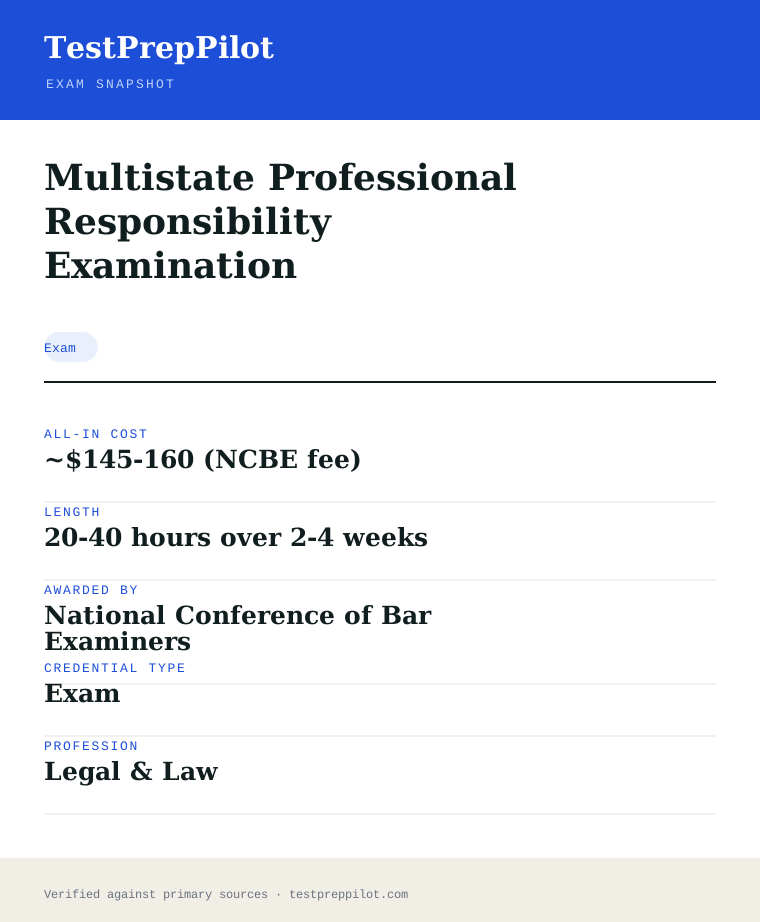
Multistate Professional Responsibility Examination is a exam credential; awarded by National Conference of Bar Examiners; the exam fee is ~$145-160; typical preparation is 20-40 hours over 2-4 weeks; holders typically earn $151,160 (23-1011 Lawyers).
| Credential | Multistate Professional Responsibility Examination |
|---|---|
| Abbreviation | MPRE |
| Type | Exam |
| Profession | Legal & Law |
| Specialty | Bar Exam Components |
| Awarded by | National Conference of Bar Examiners |
| Difficulty | Specialized |
| Typical prep time | 20-40 hours over 2-4 weeks |
| All-in cost | ~$145-160 (NCBE fee) |
| Typical salary range | $151,160 (23-1011 Lawyers) |
| Credential | Multistate Professional Responsibility Examination |
| Awarding body | National Conference of Bar Examiners |
| Exam format | Proctored, computer-based |
| Validity | Score valid for 2 years in most states (verify) |
| Languages | Varies — see awarding body |
| Scope | National / Multi-state |
| Also known as | MPRE, Multistate Professional Responsibility |
Real questions
Frequently asked questions about the Multistate Professional Responsibility Examination
How do I register for the Multistate Professional Responsibility Examination exam?
Register through National Conference of Bar Examiners's official portal or an authorized test provider (e.g., Pearson VUE or Prometric where applicable). Create an account, select the exam, pay the fee, and schedule a date.
How much does the exam cost?
Fees vary by location and currency. Confirm the current fee on the official registration page before scheduling.
How long is the credential valid, and how do I renew?
Validity varies by credential (commonly 2–3 years). Renewal usually requires continuing education or a recertification exam — see National Conference of Bar Examiners's policy.
What if I do not pass?
Most bodies allow retakes after a waiting period and payment of the full or partial fee. Check National Conference of Bar Examiners's retake policy before rescheduling.
How do I register for a National Conference of Bar Examiners credential?
Register through the official website, select your exam, pay the fee, and schedule a date.
How do I renew a credential?
Renewal policies vary by credential; check the specific program page for requirements and cycles.
In short
Is the Multistate Professional Responsibility Examination worth it?
- Multistate Professional Responsibility Examination is awarded by National Conference of Bar Examiners.
- Validates job-ready competence in Legal & Government.
- Registration is through the awarding body or an authorized test provider.
- Renewal and retake policies vary — confirm before scheduling.
Same awarding body
What other credentials does National Conference of Bar Examiners award?
Worth comparing
How does the Multistate Professional Responsibility Examination compare with similar credentials?
Trust
Where does this information come from?
Everything above is taken from the awarding body's own published material. Fees, question counts and domain weights are revised regularly — check the official page before you pay.
- National Conference of Bar Examiners Awarding body
Research confidence: low · Last reviewed 2026-08