Legal & Law • Certification
Certified Notary Signing Agent
Certified Notary Signing Agent — Legal & Government credential from National Notary Association
Researched and maintained by TestPrepPilot Editorial BoardLegal support & administrative certifications desk · Figures last verified August 2026
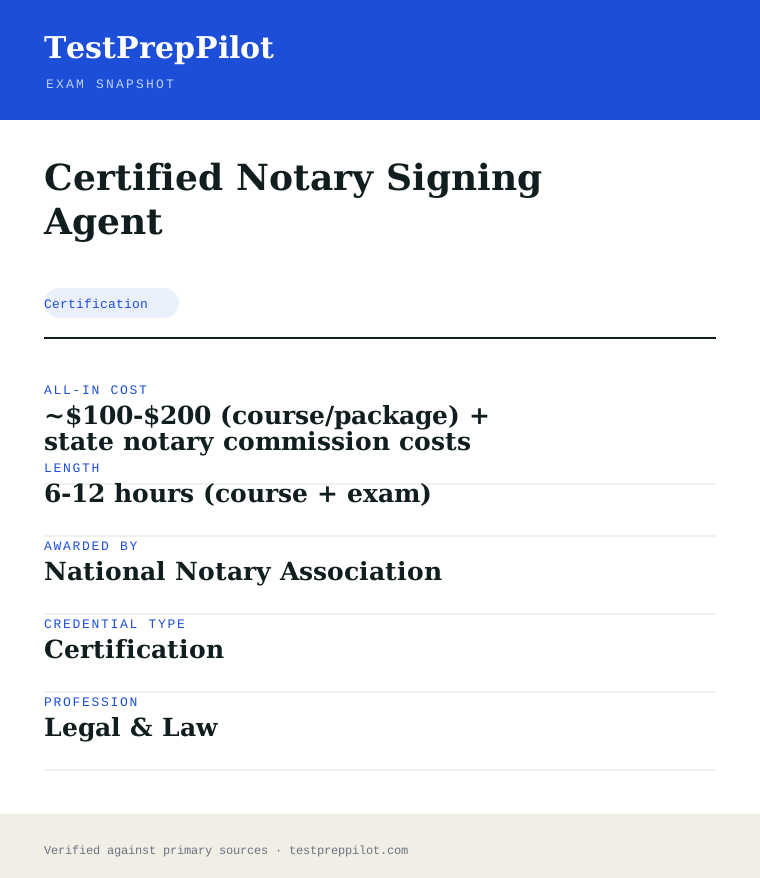
The short version
What is the Certified Notary Signing Agent and is it worth it?
Certified Notary Signing Agent is a professional credential administered by National Notary Association. It validates job-ready knowledge and skills in the Legal & Government field and is used for career entry, advancement, or compliance.
- Recognized credential from National Notary Association
- Demonstrates verified competence in Legal & Government
- Supports career advancement and may satisfy licensing or employer requirements
What is it?
What exactly is the Certified Notary Signing Agent?
Certified Notary Signing Agent — Legal & Government credential from National Notary Association
A Notary Public certification specializing in properly executing and witnessing mortgage and real estate loan document signings. Offered by National Notary Association, it is designed for candidates who need to demonstrate verified competence in the Legal & Government field. The credential is commonly used for career entry, advancement, regulatory compliance, or employer requirements. Candidates should review the official handbook for eligibility, exam format, and scoring before registering.
The path in brief
- Confirm you meet any eligibility or prerequisites
- Review the official handbook and study materials
- Register and pay through the awarding body or authorized provider
- Schedule and take the exam (test center or online proctoring)
- Receive your score and, if passed, your credential
Before you book
Who is eligible to sit the Certified Notary Signing Agent?
Eligibility varies; many credentials are open to all, while others require coursework, work experience, or sponsorship.
Who it is for: Professionals and candidates seeking to validate Legal & Government competence.
The test itself
What is the format of the Certified Notary Signing Agent?
The Certified Notary Signing Agent is administered by National Notary Association and runs ~1 hour.
| Administered by | National Notary Association |
|---|---|
| Questions | ~50 questions |
| Time limit | ~1 hour |
| Pass mark | Passing score set by the awarding body; see the official score report |
| Exam fee | ~$100-$200 |
| Format | Proctored, computer-based (test center or online remote proctoring) |
Content outline
What topics are on the Certified Notary Signing Agent?
The Certified Notary Signing Agent covers 4 content domains.
Weightings come from the official exam outline. Study time is best allocated in roughly these proportions rather than evenly across domains.
- Substantive law / procedure
Topic area tested on the exam; see the official blueprint for the detailed breakdown.
- Research & writing
Topic area tested on the exam; see the official blueprint for the detailed breakdown.
- Ethics & rules
Topic area tested on the exam; see the official blueprint for the detailed breakdown.
- Practice & compliance
Topic area tested on the exam; see the official blueprint for the detailed breakdown.
The path
How do you register for the Certified Notary Signing Agent?
- 1
Visit the awarding body’s official website and create an account
- 2
Select the credential and review its specific requirements
- 3
Complete any required eligibility (education, experience, or training)
- 4
Pay the registration fee
- 5
Schedule the exam at a test center or online
- 6
Take the exam and receive your results
The fine print
What are the retake and renewal rules for the Certified Notary Signing Agent?
- Proctoring & delivery
- Proctored, computer-based delivery (test center or remote online proctoring), varying by exam.
- Retake policy
- Varies by credential — most bodies permit retakes after a waiting period and full or partial fee.
- Score reporting
- Scores are reported per the body’s timeline, typically electronically after the exam.
- Recertification
- Varies; many credentials require renewal every 2–3 years via continuing education or a recertification exam.
What it pays
How much does this credential pay?
$56,620 median for real estate sales agents (BLS, May 2024) — the closest-fit occupation, used only as context: signing agents work as independent contractors paid per assignment, so income is fee-based and varies widely
There is no Bureau of Labor Statistics occupation called "notary signing agent", and we state that plainly: BLS does not measure notary-signing work as its own occupation, so no government median wage exists for it, and signing agents are not employees of a single tracked industry — they are independent contractors who handle loan-document signings for title companies, lenders and signing services. The closest occupational fit by work context is Real Estate Sales Agents, SOC 41-9022, which had a May 2024 median wage of $56,620, with the lowest 10 percent under $28,380 and the highest 10 percent above $126,560 — and we use it only as context, because signing agents work at real-estate and loan closings and their income is transaction-based, exactly like real-estate sales income. The honest framing is that signing-agent income is piece-rate: agents are paid per signing assignment, typically in a range of about $50 to $150 per signing depending on the market, the loan type and the agent’s experience, and annual income depends entirely on volume, travel radius, marketing and the relationships built with title companies and signing services — so a part-time agent may earn a few hundred dollars a month while a full-time producer with a steady pipeline can earn a substantial income, with no BLS number to pin it to. The certification itself produces no wage in any BLS series, and the per-signing rate is set by the market rather than by any government schedule. Read the real-estate figure as context for the closing market the work connects to, and treat the per-assignment rate and the volume achievable in your area as the actual planning numbers for this credential, with the honest caveat that income varies widely and no official median exists.
| Measure | Figure | Source / note |
|---|---|---|
| Median annual wage, real estate sales agents (closest-fit context) | $56,620 | BLS OOH, SOC 41-9022, May 2024 |
| Lowest 10 percent | Under $28,380 | BLS OOH, SOC 41-9022, May 2024 |
| Highest 10 percent | Above $126,560 | BLS OOH, SOC 41-9022, May 2024 |
| Typical per-assignment signing fee | ~$50-$150 | Market rate, varies by region, loan type and agent experience; not a BLS figure |
| The credential itself | No direct occupation | Independent-contractor work; no BLS median exists for signing agents |
Job growth.BLS projects 5% growth for real estate sales agents from 2024 to 2034, about 33,700 openings per year — cited as context for the closing market the work connects to, not as a signing-agent projection.
Source: BLS Occupational Outlook Handbook — Real Estate Sales Agents
Your odds
What are the pass rates?
There is no single national exam — signing-agent certification is provider-based, and the best-known provider (the NNA) publishes an 80% passing score on a 50-question exam rather than a cohort pass rate
The core fact is that "notary signing agent certification" is not one national exam with one published pass rate: it is a provider-based credential that candidates earn after first holding a valid state notary public commission, and different providers set different exam structures and passing scores, so any single pass-rate figure is provider-specific, not a national statistic. The best-known provider, the National Notary Association, publishes the mechanics rather than a cohort pass rate: its Certified Notary Signing Agent path requires completing the NNA signing-agent training, passing a 50-question certification exam with a passing score of 80 percent, and clearing the required background screening. Other providers set their own lines — some materials cite a 75 percent threshold on their own exams — which is exactly why we state that no single national standard exists and no national pass rate is published. The pathway itself is consistent across providers: the state notary commission comes first (governed entirely by your state, with its own education, exam, bond, supplies and filing fees), then the signing-agent training and exam (covering loan documents, notarisation requirements, the signing ceremony, and the professional boundaries of the role — a signing agent may notarise and manage the signing ceremony but may not explain loan terms or give legal advice), and then the background screening that title companies and signing services treat as a trust signal. The practical reading is that the pass line is provider-set and verifiable at the provider — 80 percent for the NNA, other thresholds elsewhere — while no organisation publishes what percentage of candidates pass, and the real gate for working is the state commission and the background screening that precede and accompany the certification.
Read this before quoting the number.No national pass rate exists because signing-agent certification is provider-based: the NNA — the best-known provider — sets an 80% passing score on its 50-question exam, while other providers set their own thresholds (some cite 75%). The certification requires a valid state notary commission first, and no organisation publishes a cohort pass rate.
Source: National Notary Association — Certified Notary Signing Agent program
Your schedule
How long should I study for it?
10-20 hours of signing-agent study over 1-2 weeks (plus the state notary commission education, exam and processing time) of focused study
The notary-signing-agent path has three components that must be sequenced: the state notary commission (which must come first and is governed by the notary’s state), the signing-agent training and exam (typically a few hours of training followed by a provider-set exam), and the background screening — and the long pole is the state commission, not the exam. The state notary commission requires your state’s own education — commonly a state-approved course of several hours (six-hour notary courses are common for new commissions in states like California) — plus the state exam, the bond, the supplies and the filing fee, and the processing time varies by state. The signing-agent training itself is short: the NNA’s certification training covers the signing-agent role — how loan signings work, the documents commonly signed at a closing (the note, the mortgage or deed of trust, the closing disclosure, title documents), the notarisation requirements for each, and the professional practices of appearance, conduct and the limits of the role — and the certification exam is a 50-question multiple-choice test with an 80 percent passing score at the NNA, taken after the training. A defensible preparation plan runs 10 to 20 hours over 1 to 2 weeks once the notary commission is in hand: days one to three, complete the state notary education if not already done and obtain the commission; days four to six, complete the signing-agent training and take notes on the document and notarisation material; day seven, work the practice questions the training provides and take the certification exam; and in parallel, submit the background screening, which has its own fee and processing time. The plan is short because the credential is a training-and-screening certification, not a deep technical exam — the background screening and the state commission are the parts that take calendar time, so start those first.
- Step 1 — State commissionCalendar time varies by state (education is typically 3-6 hours)
Notary public commission
- Obtain or confirm your state notary commission — the required prerequisite
- Complete the state-approved notary education and exam if not already done
- Understand your state’s notarisation rules, bond and filing requirements
- Step 2 — Signing-agent training6
Certification training
- Complete the provider’s signing-agent training (typically a few hours)
- Take notes on the loan documents and which require notarisation
- Learn the role boundaries: notarise and manage the ceremony; never explain loan terms or give legal advice
- Step 3 — Exam and screening4
Certification and background check
- Work the practice questions the training provides
- Take and pass the certification exam (50 questions, 80% at the NNA; provider-set elsewhere)
- Submit the background screening accurately and build your signing-agent profile and marketing
Adjusting the pace
New notary.The state commission is the long pole; start the state education and application weeks before the NNA or provider path, because you cannot certify without the commission.
Experienced notary.Compress the commission step and focus on the loan-document and signing-ceremony material plus the background screening, which is the part that gates working with title companies.
How to study
How do I prepare most effectively?
The signing-agent certification is a training-and-screening credential, so the dominant strategy is to complete the official provider training thoroughly and use its practice questions, because the exam is built from that training, and to start the background screening and state commission early because they take the calendar time. Second, master the boundaries of the role: the exam and the work reward knowing what a signing agent may do — notarise, manage the ceremony, witness and handle documents — versus what they may not do, such as explaining loan terms or offering legal advice; those boundary questions are where candidates lose points, and crossing the line in the work is a compliance and legal risk, not just a test question. Third, learn the documents: loan signings involve a standard set — the note, the mortgage or deed of trust, the closing disclosure, title documents — and familiarity with their purpose and which need notarisation is the core content of both the training and the exam. Fourth, remember that the background screening is part of the credential: errors or omissions on the disclosure slow or block certification, so be accurate and complete. Finally, plan the business side alongside the credential: the certification opens the door, but the work comes from building relationships with title companies and signing services, which care about your screening, your equipment (a reliable printer and scanner), and your reliability on appointment timing and document handling — so invest in the practical side as part of the plan.
Complete the official training
The exam is built from the provider’s training; work the practice questions it provides rather than third-party summaries.
Master the role boundaries
Notarise and manage the ceremony; never explain loan terms or give legal advice. The boundary questions are where candidates lose points, and the boundary itself is a legal risk in the work.
Learn the document set
The note, the mortgage or deed of trust, the closing disclosure and title documents — and which need notarisation — are the core content of the training and the exam.
Be accurate in the screening
The background screening is part of the credential; errors or omissions on the disclosure slow or block certification.
Start the state commission early
The commission is the prerequisite and the long pole — its education, exam, bond and processing time govern the whole timeline.
Plan the business side
The work comes from relationships with title companies and signing services, which care about your screening, your equipment and your reliability — build the practical side alongside the credential.
What to buy
Which study resources are worth paying for?
The signing-agent path has a compact cost structure, and because certification is provider-based, the price you see is the provider’s price. The NNA’s Certified Notary Signing Agent package — training course, exam and background screening — typically runs about $100 to $200, with the exact bundle price varying by promotion; the state notary commission costs vary widely by state, from about $20 to several hundred dollars including the bond, supplies and filing fees. Equipment is a real cost: a printer and scanner, paper and supplies add a few hundred dollars for a working agent, and optional marketing — a website, business cards and directory listings — adds more. Free resources include the NNA’s signing-agent articles and your state’s notary handbook, which are genuinely useful for the boundaries and the state rules. A realistic total budget is $150 to $600 to get certified and minimally equipped. Prices below are list prices as of 2026-08 and change frequently; we rank nothing by commission.
| Resource | Price | Format | Best for |
|---|---|---|---|
| Provider certification package (e.g. NNA) | ~$100-200 | Training + exam + background screening | The certification itself |
| State notary commission | ~$20-300+ by state | State education, exam, bond, supplies and filing | The prerequisite commission |
| State notary handbooks | Free-$30 | Official state publications | State-specific notarisation rules |
| Equipment (printer/scanner) | ~$150-400 | Hardware and supplies | Working as a signing agent — title companies expect reliable document handling |
| Marketing (optional) | $0-300 | Website, cards, directory listings | Building the client pipeline |
List prices as of 2026-08, subject to change; state costs vary widely, and because certification is provider-based, confirm the exact bundle price at the provider you choose. No commission or affiliate ranking is implied.
Avoid these
What mistakes do candidates most often make?
The most common signing-agent mistake is treating the certification as the business: candidates complete the credential and then find no work, because the certification is a ticket, not a pipeline — the work comes from marketing to title companies and signing services, and the income is per assignment. The fix is to build the business plan alongside the certification. The second mistake is crossing the role boundary: signing agents who explain loan terms or give advice risk their certification and their legal exposure; the role is notarisation and ceremony management only. Third, candidates neglect the state-specific rules, assuming the certification overrides state notarisation law — the state commission and its rules govern the notarial acts. Fourth, some candidates skip the background-screening accuracy and then stall on errors in the disclosure. Finally, many candidates under-invest in the practical side — a reliable printer and scanner and clean document handling — and then lose work to better-equipped agents. The credential opens the door; reliability and equipment keep it open.
✕Treating the certification as the business
✓Build the title-company and signing-service relationships alongside the credential. The certification is a ticket, not a pipeline — the income comes from marketing and a steady flow of assignments.
✕Crossing the role boundary
✓Notarise and manage the ceremony; never explain loan terms or give advice. Crossing the line risks both the certification and your legal exposure — it is the exam’s boundary content and the work’s hard rule.
✕Neglecting state rules
✓The state commission and its rules govern the notarial acts, not the certification. Learn your state’s notarisation requirements and keep the commission current.
✕Inaccurate screening disclosures
✓Disclose accurately and completely on the background screening; errors and omissions slow or block certification and gate the title companies that check the record.
✕Under-investing in equipment
✓A reliable printer and scanner, paper handling and clean document management are part of the job — title companies and signing services assign work to agents who execute cleanly.
✕Underestimating the commission lead time
✓The state commission is the prerequisite and the long pole — start its education, exam and application before the provider path, or the certification waits on the state.
What you'll face
What question types will I see?
The signing-agent certification exam is a multiple-choice exam built from the provider’s training — the NNA’s is 50 questions with an 80 percent passing score, while other providers set their own structures — testing the signing-agent role: the loan documents and which require notarisation, the requirements of a proper notarisation (personal appearance, identification, the notarial certificate), the signing ceremony, and the professional boundaries of the role. The exam also covers professional practices — appointment conduct, document handling and the limits of the agent’s authority, including that a signing agent may not explain loan terms or give legal advice. Samples below are editor-written illustrations of the published training content, not live exam items; they show the role-focused style of the real items.
Which documents appear at a signing and which require notarisation, and the elements of a proper notarisation — personal appearance, identification, the notarial certificate.
What a signing agent may and may not do — notarise and manage the ceremony, but never explain loan terms or give legal advice.
Ceremony conduct, identification handling, document handling, and the privacy and security of borrower information.
Try these
Q1At a typical loan signing, which of the following generally requires notarisation?
Answer:A
The mortgage or deed of trust is typically notarised because it is the instrument that is recorded. The closing disclosure, loan application and title insurance documents are signed but not usually notarised. The item tests the document-set knowledge that is the core of the training.
Q2A borrower asks the signing agent to explain the interest rate terms in the note. The appropriate response is to:
Answer:A
A signing agent may not explain loan terms or give legal advice; the appropriate response is to refer the question to the lender or another qualified professional while completing the notarial duties. Explaining terms, refusing the signing or noting the explanation on a certificate each cross the role boundary. This is the boundary item that candidates lose points on and that carries legal risk in the work.
Q3Before notarising a signature, the signing agent must:
Answer:A
A proper notarisation requires the signer to appear personally and the notary to verify identity — typically through acceptable identification. Credit scores, loan-term review and lender approval are not part of the notarial act. The item tests the elements of a proper notarisation, a core content area of the training.
Samples are editor-written illustrations of the published training content, not live exam items.
The big day
What should I expect on exam day?
The signing-agent certification is completed online in most cases: after the provider’s training course, you take the certification exam through the provider’s platform at a time you choose — the NNA’s is a 50-question, timed exam with an 80 percent passing score, while other providers set their own structures — then complete the background screening. Confirm your system and schedule a quiet block, have your notary commission information ready, because the credential is tied to it, and remember the exam is closed-book and drawn from the training. On passing, you receive the certified signing-agent credential and the provider profile tools, and the background screening completes the package that title companies check; on a fail, you can retake after additional study of the training material — the content is finite and the boundary and document items are the predictable clusters. The afterwards is where the work begins: build your profile, prepare your equipment (a reliable printer and scanner, paper handling), and start marketing to title companies and signing services, which typically require the certification plus the cleared screening. Keep your notary commission and any state requirements current, because the certification rides on the commission.
Bring
- Computer with stable internet
- Your provider account and notary commission information
- A quiet block of time for the online exam
- The provider’s required passing score confirmed before you sit
Leave at home
- Distractions — the exam is closed-book and timed
- Any assumption that the certification replaces state notarisation rules
- Any assumption that a single national pass rate exists — the pass line is provider-set
How the day runs
Rules in the room
- The exam is closed-book and timed, taken online through the provider’s platform.
- The certification requires a valid state notary commission first.
- The passing score is provider-set (80% at the NNA on a 50-question exam); no national standard exists.
- The background screening is part of the credential and is what title companies and signing services verify.
Afterwards.On a pass, build your signing-agent profile and marketing while keeping the state commission current, because the certification rides on the commission and the work comes from relationships with title companies and signing services that check your screening and your record. On a fail, retake after additional study of the training material — the content is finite, and the boundary and document-set items are where a retake is won. Whichever way it goes, the honest expectation is per-assignment income: at a typical $50 to $150 per signing, the earnings depend on volume and marketing, not on the certificate alone, and BLS has no median for the work — the $56,620 real-estate-sales-agent figure is only context for the closing market the work connects to. Treat the credential as the entry ticket, the screening as the trust signal, and the marketing and reliability as the actual income drivers.
Reference
What are the key facts about the Certified Notary Signing Agent?
Certified Notary Signing Agent is a certification credential; awarded by National Notary Association; the exam fee is ~$100-$200; typical preparation is 6-12 hours (course + exam); holders typically earn Transaction-based ($75-$200 per signing typical).
| Credential | Certified Notary Signing Agent |
|---|---|
| Abbreviation | NSA |
| Type | Certification |
| Profession | Legal & Law |
| Specialty | Paralegal & Legal Support |
| Awarded by | National Notary Association |
| Difficulty | Specialized |
| Typical prep time | 6-12 hours (course + exam) |
| All-in cost | ~$100-$200 (course/package) + state notary commission costs |
| Typical salary range | Transaction-based ($75-$200 per signing typical) |
| Credential | Certified Notary Signing Agent |
| Awarding body | National Notary Association |
| Exam format | Proctored, computer-based |
| Validity | Renewal with the state notary commission cycle |
| Languages | Varies — see awarding body |
| Scope | National / Multi-state |
| Also known as | NSA, Signing Agent |
Real questions
Frequently asked questions about the Certified Notary Signing Agent
How do I register for the Certified Notary Signing Agent exam?
Register through National Notary Association's official portal or an authorized test provider (e.g., Pearson VUE or Prometric where applicable). Create an account, select the exam, pay the fee, and schedule a date.
How much does the exam cost?
Fees vary by location and currency. Confirm the current fee on the official registration page before scheduling.
How long is the credential valid, and how do I renew?
Validity varies by credential (commonly 2–3 years). Renewal usually requires continuing education or a recertification exam — see National Notary Association's policy.
What if I do not pass?
Most bodies allow retakes after a waiting period and payment of the full or partial fee. Check National Notary Association's retake policy before rescheduling.
How do I register for a National Notary Association credential?
Register through the official website, select your exam, pay the fee, and schedule a date.
How do I renew a credential?
Renewal policies vary by credential; check the specific program page for requirements and cycles.
In short
Is the Certified Notary Signing Agent worth it?
- Certified Notary Signing Agent is awarded by National Notary Association.
- Validates job-ready competence in Legal & Government.
- Registration is through the awarding body or an authorized test provider.
- Renewal and retake policies vary — confirm before scheduling.
Same awarding body
What other credentials does National Notary Association award?
Worth comparing
How does the Certified Notary Signing Agent compare with similar credentials?
Trust
Where does this information come from?
Everything above is taken from the awarding body's own published material. Fees, question counts and domain weights are revised regularly — check the official page before you pay.
- National Notary Association Awarding body
Research confidence: low · Last reviewed 2026-08