Fitness, Wellness & Personal Care • Training
PADI Instructor Development Course
PADI Instructor Development Course — Beauty, Food, Security & Recreation credential from Professional Association of Diving Instructors
Researched and maintained by TestPrepPilot Editorial BoardRecreation, aquatics & dive-instructor certification desk · Figures last verified August 2026
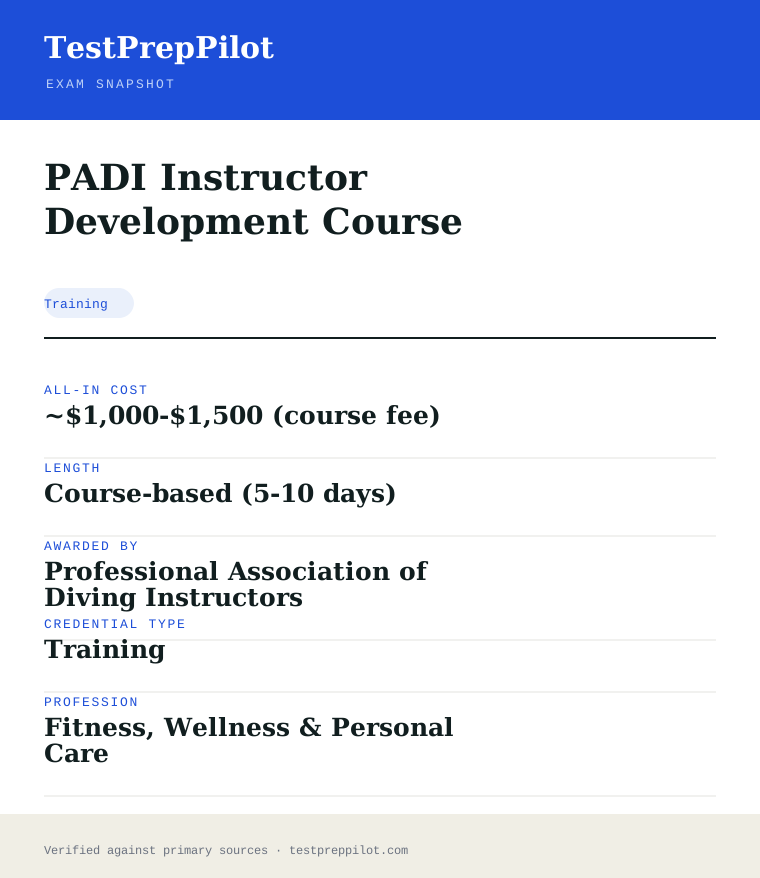
The short version
What is the PADI Instructor Development Course and is it worth it?
PADI Instructor Development Course is a professional credential administered by Professional Association of Diving Instructors. It validates job-ready knowledge and skills in the Beauty, Food, Security & Recreation field and is used for career entry, advancement, or compliance.
- Recognized credential from Professional Association of Diving Instructors
- Demonstrates verified competence in Beauty, Food, Security & Recreation
- Supports career advancement and may satisfy licensing or employer requirements
What is it?
What exactly is the PADI Instructor Development Course?
PADI Instructor Development Course — Beauty, Food, Security & Recreation credential from Professional Association of Diving Instructors
Assistant instructor and open water scuba instructor programme preparing candidates for the PADI Instructor Examination. Offered by Professional Association of Diving Instructors, it is designed for candidates who need to demonstrate verified competence in the Beauty, Food, Security & Recreation field. The credential is commonly used for career entry, advancement, regulatory compliance, or employer requirements. Candidates should review the official handbook for eligibility, exam format, and scoring before registering.
The path in brief
- Confirm you meet any eligibility or prerequisites
- Review the official handbook and study materials
- Register and pay through the awarding body or authorized provider
- Schedule and take the exam (test center or online proctoring)
- Receive your score and, if passed, your credential
Before you book
Who is eligible to sit the PADI Instructor Development Course?
Eligibility varies; many credentials are open to all, while others require coursework, work experience, or sponsorship.
Who it is for: Professionals and candidates seeking to validate Beauty, Food, Security & Recreation competence.
The test itself
What is the format of the PADI Instructor Development Course?
The PADI Instructor Development Course is administered by Professional Association of Diving Instructors and runs 5-10 days.
| Administered by | Professional Association of Diving Instructors |
|---|---|
| Questions | Written + teaching + rescue + dive evaluations |
| Time limit | 5-10 days |
| Pass mark | Passing score set by the awarding body; see the official score report |
| Exam fee | ~$1,000-$1,500 |
| Format | Proctored, computer-based (test center or online remote proctoring) |
Content outline
What topics are on the PADI Instructor Development Course?
The PADI Instructor Development Course covers 4 content domains.
Weightings come from the official exam outline. Study time is best allocated in roughly these proportions rather than evenly across domains.
- Core techniques
Topic area tested on the exam; see the official blueprint for the detailed breakdown.
- Sanitation & safety
Topic area tested on the exam; see the official blueprint for the detailed breakdown.
- Client / guest service
Topic area tested on the exam; see the official blueprint for the detailed breakdown.
- Regulations
Topic area tested on the exam; see the official blueprint for the detailed breakdown.
The path
How do you register for the PADI Instructor Development Course?
- 1
Visit the awarding body’s official website and create an account
- 2
Select the credential and review its specific requirements
- 3
Complete any required eligibility (education, experience, or training)
- 4
Pay the registration fee
- 5
Schedule the exam at a test center or online
- 6
Take the exam and receive your results
The fine print
What are the retake and renewal rules for the PADI Instructor Development Course?
- Proctoring & delivery
- Proctored, computer-based delivery (test center or remote online proctoring), varying by exam.
- Retake policy
- Varies by credential — most bodies permit retakes after a waiting period and full or partial fee.
- Score reporting
- Scores are reported per the body’s timeline, typically electronically after the exam.
- Recertification
- Varies; many credentials require renewal every 2–3 years via continuing education or a recertification exam.
What it pays
How much does this credential pay?
No direct BLS occupation for scuba instruction — dive instructors are paid per course and per dive by dive centres and resorts, and the IDC’s value is earning the internationally recognised PADI instructor rating rather than a wage any government survey measures
There is no Bureau of Labor Statistics occupation called "scuba instructor" or "dive instructor", so the honest answer is that this credential has no direct salary figure and we will not quote a government wage in its place. The closest BLS categories — recreation workers, fitness trainers, or lifeguards — describe different jobs with different pay structures, and citing any of them as "the dive-instructor salary" would be misleading, because dive instruction is paid in a fundamentally different way. The realistic income story for a newly certified PADI Open Water Scuba Instructor is the industry’s pay structure: most instructors work for dive centres, resorts, liveaboards and dive-travel operations, paid per course, per student or per dive day rather than on a national salary schedule, and income varies enormously with location, season, certification level and whether the instructor owns equipment and sells courses. Popular instructor destinations in Southeast Asia, the Caribbean, Egypt and the Mediterranean employ hundreds of instructors on seasonal cycles, while independent instructors build a client base and set their own rates. The IDC’s value is therefore credential-driven rather than wage-driven: earning the PADI instructor rating makes you employable in dive operations worldwide, which is the practical return on a course that costs roughly $1,000 to $2,500 at most providers, plus the separate PADI Instructor Examination and application fees that run several hundred to roughly a thousand dollars more. The caveats are decisive: dive instruction is frequently seasonal, competitive and paid per course, and a brand-new OWSI should expect a build-up period rather than an immediate full-time income. The honest framing is that the credential is the gateway to the dive-professional labour market, and its value is the rating itself, not a wage figure any government data measures.
| Measure | Figure | Source / note |
|---|---|---|
| Direct BLS occupation | None exists | Scuba instruction has no BLS occupational code or wage |
| Typical IDC course fee | ~$1,000-2,500 | Varies by location and provider; Malta and Thailand run lower, US and Cozumel providers higher |
| PADI Instructor Examination and application fees | ~$825-1,100 combined (approximate) | Paid directly to PADI, separate from the course fee |
| Typical total IDC + IE outlay | ~$2,500-4,200 | Includes course, eLearning materials, examination and application fees; excludes travel and living costs |
Job growth.No BLS projection exists for dive instruction; the industry pays per course and per dive, and the credential’s value is the internationally recognised PADI instructor rating that makes you employable in dive operations worldwide
Your odds
What are the pass rates?
PADI publishes no pass rate for the Instructor Examination — but the examination standards are published: 75% on the dive theory and standards exams, with teaching, rescue and dive-skill components graded to PADI’s published standards
PADI does not publish pass-rate statistics for the Instructor Examination, so no global pass-rate figure exists to quote and we will not estimate one — the IE is an assessment conducted by an independent PADI Examiner against published standards rather than a scored admission exam with published outcomes, and individual dive centres report their own candidate results, not an industry-wide rate. What is published and verifiable is the examination structure and its standards. The IE is a two-day assessment run by a PADI Examiner sent from PADI, and it evaluates you against the same criteria the IDC used: two written exams — the dive theory exam, a closed-book test of five sections (Physics, Physiology, Equipment, Skills and Environment, and the Recreational Dive Planner), 12 questions per section in 90 minutes with a 75-percent pass required in each section, and the PADI Systems, Standards and Procedures exam, 50 open-book questions in 90 minutes with a 75-percent pass; a knowledge development teaching presentation in the classroom; a confined water teaching presentation plus a demonstration of five Open Water Diver skills; an open water teaching presentation; and Rescue Exercise 7, the unresponsive-diver-at-the-surface rescue, which is a pass-or-fail evaluation. Professionalism and attitude are assessed throughout. Because there is no pass rate to guide planning, the practical reading of the published standards is that the written exams are the most mechanical component — 75 percent per section is achievable with study of the dive theory and the PADI Instructor Manual — while the teaching presentations and the rescue evaluation are the components that separate prepared candidates, and they reward having rehearsed the exact structures the IDC taught.
Read this before quoting the number.No global pass rate is published by PADI. The 75% standards on the dive theory and standards exams, the closed-book and open-book formats, the 90-minute timing and the teaching, rescue and skill components are the published examination standards this narrative relies on instead.
Source: PADI — Instructor Development Course and Instructor Examination
Your schedule
How long should I study for it?
60-100 hours of preparation plus the multi-day IDC and two-day IE of focused study
Plan for four to six weeks of preparation before the course and a further eight to ten weeks for the whole pathway, because the Instructor Development Course itself is a multi-day program — typically seven to ten days of in-person training covering the Assistant Instructor and Open Water Scuba Instructor programs, preceded by self-paced IDC eLearning — followed by the two-day Instructor Examination. The prerequisites are the first milestone: PADI Divemaster certification (or a leadership-level certification with another recognised organisation), a minimum age of 18, at least six months as a certified diver, 60 logged dives to begin the IDC and 100 by the time you sit the IE, Emergency First Response primary and secondary care training within the past 24 months, and a physician-signed medical statement within the past 12 months. The preparation that most improves your outcome is dive-theory fluency before the course starts: the IE’s dive theory exam is 12 closed-book questions in each of five sections — Physics, Physiology, Equipment, Skills and Environment, and the Recreational Dive Planner — with a 75-percent pass required per section, and candidates who arrive having worked the Diving Knowledge Workbook and the IDC eLearning are the ones who clear it comfortably. The in-person IDC then builds the teaching and watermanship skills the IE evaluates: confined water and open water teaching presentations, the five-skill demonstration, and Rescue Exercise 7. Plan the logistics as well as the content: IDC courses are run by PADI Course Directors at authorised dive centres worldwide, course fees range from roughly $1,000 to $2,500 depending on location and provider, and the PADI IE and application fees are paid separately to PADI.
- Weeks 1-26-8 hrs/week
Prerequisites and dive-theory fluency
- Confirm every prerequisite: Divemaster certification, age 18+, six months as a certified diver, 60 dives logged, current EFR training, current medical statement
- Work the Diving Knowledge Workbook and the IDC eLearning before the course begins
- Study the five theory sections — Physics, Physiology, Equipment, Skills and Environment, and the Recreational Dive Planner
- Log your dives toward the 100 required by the IE if you are short
- Weeks 3-46-8 hrs/week
Standards and teaching structure
- Learn the PADI Systems, Standards and Procedures content and how to navigate the PADI Instructor Manual — the open-book exam is built on it
- Study the knowledge development presentation structure you will deliver at the IE
- Review the confined water and open water teaching structures: briefing, demonstration, practice and correction
- Rehearse Rescue Exercise 7 — the unresponsive-diver-at-the-surface rescue — with your divemaster skills fresh
- The IDC itselfFull course days
AI and OWSI programs (typically 7-10 days)
- Complete the in-person IDC through the Assistant Instructor and Open Water Scuba Instructor programs
- Deliver your teaching presentations in confined water, classroom and open water to your Course Director’s standard
- Complete the watermanship and five-skill demonstrations at demonstration quality
- Use the Course Director’s feedback to close the gaps before the IE
- The Instructor ExaminationTwo full days
Two days with a PADI Examiner
- Sit the closed-book dive theory exam (5 sections, 12 questions each, 90 minutes, 75% per section)
- Sit the open-book standards exam (50 questions, 90 minutes, 75%)
- Deliver the knowledge development, confined water and open water teaching presentations
- Complete the five-skill demonstration and Rescue Exercise 7; professionalism is assessed throughout
Adjusting the pace
Current PADI Divemaster with strong dive theory.Four to six weeks of preparation focused on the teaching presentations and Rescue Exercise 7, which the IDC builds and the IE evaluates; dive theory is revision if your Divemaster knowledge is current.
Divemaster from another organisation.Add time to confirm your leadership-level certification is accepted and to bridge the PADI-specific standards content, because the open-book standards exam tests the PADI system specifically.
Studying while working.Budget the full ten to twelve weeks with the IDC eLearning front-loaded, because the in-person IDC and IE are fixed blocks of days and the self-paced theory is the only part you can compress.
How to study
How do I prepare most effectively?
The strategy that reliably succeeds at the PADI Instructor Examination is "arrive fluent in dive theory, able to navigate the Instructor Manual, and rehearsed on every teaching presentation — because the IE evaluates the same structures the IDC taught", and the single biggest error is treating the written exams as the whole test when the teaching, rescue and dive-skill components carry equal weight. The IE’s written standards are the most mechanical part to prepare: the closed-book dive theory exam requires 75 percent in each of five sections — Physics, Physiology, Equipment, Skills and Environment, and the Recreational Dive Planner — which is achievable by working the Diving Knowledge Workbook and the IDC eLearning until each section is comfortably above the threshold, and the open-book standards exam rewards knowing how to navigate the PADI Instructor Manual rather than memorising it. The second proven approach is rehearsing the teaching presentations exactly as the IE will evaluate them: a knowledge development presentation in the classroom, a confined water teaching presentation where you brief, demonstrate and correct a skill, and an open water teaching presentation — and the candidates who pass are the ones who have delivered these structures repeatedly to their Course Director. Third, practise the five-skill demonstration and Rescue Exercise 7 to demonstration quality, because the rescue evaluation is pass-or-fail. Fourth, treat the IDC as the test and the IE as the verification: the Course Director’s feedback during the IDC is the gap-closing data, and a candidate who has internalised it walks into the IE over-prepared rather than hopeful.
Front-load dive-theory fluency
The IE’s closed-book dive theory exam requires 75% in each of five sections — Physics, Physiology, Equipment, Skills and Environment, and the RDP. Work the Diving Knowledge Workbook and IDC eLearning until every section clears the threshold comfortably, so the written component is won before the course ends.
Learn to navigate the Instructor Manual
The standards exam is open-book and requires 75%, so the skill tested is navigation: knowing where the PADI Systems, Standards and Procedures live and how to find them fast. Practise finding answers in the manual until it is a path, not a search.
Rehearse every teaching presentation
The IE evaluates a knowledge development presentation, a confined water teaching presentation and an open water teaching presentation. Deliver these structures repeatedly to your Course Director during the IDC — the candidates who pass are the ones who have rehearsed, not improvised.
Practise the rescue and skills to demonstration quality
Rescue Exercise 7, the unresponsive-diver-at-the-surface rescue, is pass-or-fail, and the five-skill demonstration must be at demonstration quality. Rehearse both in the water before the IE — these are physical skills that do not improve by reading.
Treat the IDC as the test
The IE uses the same evaluation criteria as the IDC, so the Course Director’s feedback is your gap-closing data. Use the IDC to fix everything the Director flags, and the IE becomes a verification rather than a surprise.
What to buy
Which study resources are worth paying for?
The PADI IDC buying decision is dominated by two separate costs: the course fee, which is set by the dive centre or Course Director and typically ranges from roughly $1,000 to $2,500 depending on location and provider, and the PADI fees paid directly to PADI — the Instructor Examination fee and the instructor application fee, which together run several hundred to roughly a thousand dollars in most regions. The IDC eLearning CrewPak, the materials package containing the Diving Knowledge Workbook, the Guide to Teaching and the instructor materials, is a separate cost at most providers, typically several hundred dollars, and some providers bundle it into the course fee. The table below compares the main options with prices current to this review. Because the course fee and the PADI fees are separate and the course fee varies sharply by location, the practical first step is comparing total cost across providers — and remembering that a cheaper course in one country can still carry the same PADI IE fees, which are set by PADI rather than by the provider.
| Resource | Price | Format | Best for |
|---|---|---|---|
| IDC course fee (dive centre / Course Director) | ~$1,000-2,500 | Multi-day in-person course plus eLearning | The course itself — required, and the fee varies most by location |
| IDC eLearning CrewPak (materials) | ~$700-1,600 depending on provider and bundling | Digital materials package | The Diving Knowledge Workbook, Guide to Teaching and instructor materials |
| PADI Instructor Examination fee | ~$825-1,100 (approximate, varies by region) | Paid directly to PADI | The two-day IE conducted by a PADI Examiner |
| PADI instructor application fee | ~$235-290 (approximate, varies by region) | Paid directly to PADI | Processing your instructor application with PADI |
| Emergency First Response Instructor course | ~$150-400 depending on provider | One-day course | Required before the IE; many IDC packages include or bundle it |
Prices checked 2026-08 in USD before tax; course fees vary sharply by location and provider, PADI examination and application fees are paid directly to PADI and vary by region, and the realistic total outlay including course, materials, examination and application fees is roughly $2,500-4,200 excluding travel and living costs.
Avoid these
What mistakes do candidates most often make?
The most common PADI IDC mistakes come from underestimating the pathway’s two-part structure: arriving at the course without dive-theory fluency and treating the written exams as the whole test, when the teaching, rescue and dive-skill components carry equal weight at the IE. Candidates also routinely short the prerequisites — sitting the IDC without the 100 logged dives the IE requires — under-rehearse the teaching presentations, and underestimate the separate PADI fees, discovering that the course fee is only part of the total cost.
✕Arriving without dive-theory fluency
✓The IE’s closed-book theory exam requires 75% in each of five sections. Work the Diving Knowledge Workbook and IDC eLearning before the course so the theory is revision, not a first exposure, and the written component is won before the IE arrives.
✕Treating the written exams as the whole test
✓The IE also evaluates a knowledge development presentation, confined water and open water teaching presentations, a five-skill demonstration and the pass-or-fail Rescue Exercise 7. Rehearse all of them to demonstration quality — the written exams are the mechanical part, not the deciding part.
✕Sitting the IDC without the dive prerequisites
✓You need 60 logged dives to begin the IDC and 100 by the time you sit the IE, plus a current medical statement and current EFR training. Confirm all of them before committing, because the course and examination fees are spent regardless.
✕Under-rehearsing the teaching presentations
✓The IE evaluates the same teaching structures the IDC taught — briefing, demonstration, practice and correction. Deliver them repeatedly to your Course Director until the structure is reflex, because a candidate who has rehearsed walks in over-prepared.
✕Budgeting only the course fee
✓The IDC course fee is separate from the PADI IE fee, the application fee and the eLearning CrewPak. Plan the full outlay — roughly $2,500-4,200 excluding travel — before you commit, because the PADI fees are paid directly to PADI and do not move with the course price.
What you'll face
What question types will I see?
The PADI Instructor Examination is a two-day assessment conducted by an independent PADI Examiner, and its components are the published standards rather than a scored admission format. The written component has two exams: the dive theory exam, a closed-book test of five sections — Physics, Physiology, Equipment, Skills and Environment, and the Recreational Dive Planner — with 12 multiple-choice questions per section completed in 90 minutes and a 75-percent passing score required in each section, and the PADI Systems, Standards and Procedures exam, 50 open-book multiple-choice questions completed in 90 minutes with a 75-percent passing score, using the PADI Instructor Manual as reference. The practical component evaluates the same structures the IDC taught: a knowledge development teaching presentation in the classroom; a confined water teaching presentation where you brief, demonstrate and correct a skill, plus a demonstration of five Open Water Diver skills; an open water teaching presentation; and Rescue Exercise 7, the unresponsive-diver-at-the-surface rescue, which is a pass-or-fail evaluation. Professionalism, attitude and general diving skills are assessed throughout the two days. Because the written exams set the same 75-percent bar in every section, a candidate who is strong in one section and weak in another still fails the weak section — so preparation must cover all five theory sections plus the standards content rather than leaning on strengths. The samples below are editor-written illustrations of the question styles in the PADI theory and standards content, not live exam items.
Physics, Physiology, Equipment, Skills and Environment, and the Recreational Dive Planner, in 90 minutes. The most mechanical component and the one most candidates can win by studying the workbook.
PADI Systems, Standards and Procedures answered with the PADI Instructor Manual as reference in 90 minutes. Rewards knowing how to navigate the manual, not memorising it.
A short classroom teaching presentation on an assigned topic, delivered to the Examiner and fellow candidates — the classroom half of the teaching evaluation.
Teach one assigned confined water skill with briefing, demonstration and correction, and demonstrate five Open Water Diver skills at demonstration quality.
Teach in open water with a student making a pre-assigned mistake, then perform Rescue Exercise 7, the unresponsive-diver-at-the-surface rescue — a pass-or-fail evaluation.
Try these
Q1According to dive theory, as ambient pressure increases during descent, the volume of a flexible gas-filled container (Boyle’s law) will:
Answer:B
Boyle’s law states that at constant temperature, the volume of a gas is inversely proportional to its pressure — so as ambient pressure increases during descent, the volume of a flexible gas-filled container decreases. A is wrong because volume and pressure are linked, not independent. C inverts the relationship. D is wrong because the change is continuous with pressure, not a fixed doubling per metre — the largest relative volume changes occur in the first few metres.
Q2During an open water teaching presentation, a student acting as a participant fails to equalise and surfaces before completing the skill. What is the instructor’s correct response?
Answer:B
When a participant surfaces early during an open water teaching session, the instructor’s first responsibility is the student’s safety — end the presentation as needed, ensure the student is safe, and manage the situation before continuing. A is wrong because continuing while a student is unwell or has surfaced early ignores the primary duty of care. C is wrong because forcing a prompt descent on a student who failed to equalise compounds the problem. D is wrong because ignoring an early surfacing is both unsafe and professionally unacceptable.
Q3In the PADI Standards and Procedures exam, a candidate is asked to find the maximum student-to-instructor ratio for a specific course. Where is this information found?
Answer:B
Course standards, including student-to-instructor ratios, are defined in the PADI Instructor Manual course standards sections — which is exactly why the exam is open-book and why navigation of the manual is the skill being tested. A is wrong because the RDP tables govern dive planning, not course ratios. C is wrong because the workbook is a learning tool, not the standards source. D is wrong because a dive centre’s marketing materials are not the authoritative standards source.
Samples are editor-written illustrations of the published blueprint, not live exam items.
The big day
What should I expect on exam day?
The PADI Instructor Examination is a two-day assessment conducted by a PADI Examiner sent from PADI, and exam day is the verification of everything the IDC taught: the written exams on day one — the closed-book dive theory exam, five sections of 12 questions in 90 minutes with 75 percent required in each, and the open-book standards exam, 50 questions in 90 minutes with 75 percent — followed by the knowledge development presentation and the confined water teaching presentation and skill circuit, and on day two the open water teaching presentation and Rescue Exercise 7, with professionalism and attitude assessed throughout. Arrive with your PADI materials — the Instructor Manual, your IDC materials and your logbook showing the 100 dives required by the IE — and treat the practical presentations as the core of the assessment, because the Examiner evaluates the same structures the IDC taught. Plan the logistics as well as the content: the IE fee and the application fee are paid directly to PADI and are separate from your course fee, and the examination is scheduled by your Course Director with PADI. During the written exams, pace the 90 minutes per exam and remember the 75-percent standard applies per theory section, not across the exam as a whole. During the presentations, deliver the structure — briefing, demonstration, practice and correction — rather than improvising, and approach Rescue Exercise 7 as the pass-or-fail physical evaluation it is.
Bring
- Your PADI Instructor Manual and IDC materials, including the materials the open-book standards exam references
- Your logbook and proof of the 100 logged dives required by the IE
- A valid photo ID matching your registration, and your PADI professional number
- Proof of your current EFR training and your current medical statement
- Confirmation of the IE schedule, the PADI fees paid, and the dive centre’s logistics
Leave at home
- Any assumption that the IE is easier than the IDC — the Examiner verifies the same standards the Course Director taught
- Improvisation in the presentations — deliver the taught structure of briefing, demonstration, practice and correction
- Under-rehearsed rescue skills — Rescue Exercise 7 is pass-or-fail and physical
- Unpaid or unconfirmed PADI fees — the IE and application fees are separate from the course fee
- Anything that makes you late, because the two-day schedule is fixed and the Examiner’s time is structured
How the day runs
Rules in the room
- The IE is a two-day assessment conducted by an independent PADI Examiner.
- The dive theory exam is closed-book: 5 sections x 12 questions in 90 minutes, with a 75% passing score required in each section.
- The standards exam is open-book: 50 questions in 90 minutes with a 75% passing score, using the PADI Instructor Manual.
- You must have 100 logged dives, current EFR training and a current medical statement by the time you sit the IE.
- The teaching presentations — knowledge development, confined water and open water — are evaluated against the standards the IDC taught.
- Rescue Exercise 7 is a pass-or-fail evaluation, and professionalism and attitude are assessed throughout.
- The IE fee and the instructor application fee are paid directly to PADI, separate from the course fee.
Afterwards.After the two-day IE, your teaching status is activated within roughly two weeks once PADI processes the results and your application, and you are then a PADI Open Water Scuba Instructor able to teach and certify PADI courses worldwide — which is the credential’s practical value, since the PADI system is the most widely recognised recreational-diving standard globally. The honest career picture is that dive instruction is paid per course and per dive by dive centres, resorts and liveaboards, with income varying by location, season and how much you sell and teach, so the realistic path is to build experience and course counts early rather than expecting an immediate full-time income. Because the credential has no direct BLS occupation and no published pass rate, the measures of success are employability in dive operations worldwide and the progression beyond the entry instructor rating — toward Master Scuba Diver Trainer, speciality instructor ratings and, eventually, the Course Director path. Keep your PADI professional status current, log your teaching activity and continue your professional development, because in dive instruction the credential is the door and the courses you teach are the career.
Reference
What are the key facts about the PADI Instructor Development Course?
PADI Instructor Development Course is a training credential; awarded by Professional Association of Diving Instructors; the exam fee is ~$1,000-$1,500; typical preparation is Course-based (5-10 days); holders typically earn Dive-instruction income varies widely.
| Credential | PADI Instructor Development Course |
|---|---|
| Abbreviation | IDC |
| Type | Training |
| Profession | Fitness, Wellness & Personal Care |
| Specialty | Fitness, Sport & Recreation |
| Awarded by | Professional Association of Diving Instructors |
| Difficulty | Entry to Applied |
| Typical prep time | Course-based (5-10 days) |
| All-in cost | ~$1,000-$1,500 (course fee) |
| Typical salary range | Dive-instruction income varies widely |
| Credential | PADI Instructor Development Course |
| Awarding body | Professional Association of Diving Instructors |
| Exam format | Proctored, computer-based |
| Validity | PADI instructor certification valid 2 years (renewal) |
| Languages | Varies — see awarding body |
| Scope | National / Multi-state |
Real questions
Frequently asked questions about the PADI Instructor Development Course
How do I register for the PADI Instructor Development Course exam?
Register through Professional Association of Diving Instructors's official portal or an authorized test provider (e.g., Pearson VUE or Prometric where applicable). Create an account, select the exam, pay the fee, and schedule a date.
How much does the exam cost?
Fees vary by location and currency. Confirm the current fee on the official registration page before scheduling.
How long is the credential valid, and how do I renew?
Validity varies by credential (commonly 2–3 years). Renewal usually requires continuing education or a recertification exam — see Professional Association of Diving Instructors's policy.
What if I do not pass?
Most bodies allow retakes after a waiting period and payment of the full or partial fee. Check Professional Association of Diving Instructors's retake policy before rescheduling.
How do I register for a Professional Association of Diving Instructors credential?
Register through the official website, select your exam, pay the fee, and schedule a date.
How do I renew a credential?
Renewal policies vary by credential; check the specific program page for requirements and cycles.
In short
Is the PADI Instructor Development Course worth it?
- PADI Instructor Development Course is awarded by Professional Association of Diving Instructors.
- Validates job-ready competence in Beauty, Food, Security & Recreation.
- Registration is through the awarding body or an authorized test provider.
- Renewal and retake policies vary — confirm before scheduling.
Same awarding body
What other credentials does Professional Association of Diving Instructors award?
Worth comparing
How does the PADI Instructor Development Course compare with similar credentials?
Trust
Where does this information come from?
Everything above is taken from the awarding body's own published material. Fees, question counts and domain weights are revised regularly — check the official page before you pay.
Research confidence: low · Last reviewed 2026-08