Fitness, Wellness & Personal Care • Certification
NRA Range Safety Officer
NRA Range Safety Officer — Beauty, Food, Security & Recreation credential from National Rifle Association
Researched and maintained by TestPrepPilot Editorial BoardRecreation & safety certifications desk · Figures last verified August 2026
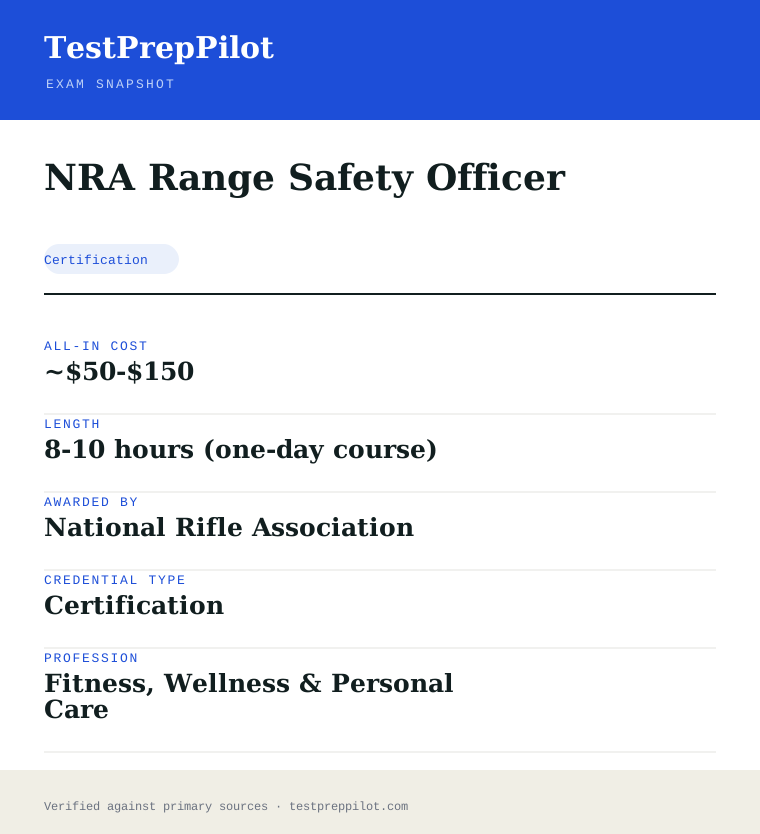
The short version
What is the NRA Range Safety Officer and is it worth it?
NRA Range Safety Officer is a professional credential administered by National Rifle Association. It validates job-ready knowledge and skills in the Beauty, Food, Security & Recreation field and is used for career entry, advancement, or compliance.
- Recognized credential from National Rifle Association
- Demonstrates verified competence in Beauty, Food, Security & Recreation
- Supports career advancement and may satisfy licensing or employer requirements
What is it?
What exactly is the NRA Range Safety Officer?
NRA Range Safety Officer — Beauty, Food, Security & Recreation credential from National Rifle Association
Course and assessment covering range standard operating procedures, firing line commands, stoppages and emergency response. Offered by National Rifle Association, it is designed for candidates who need to demonstrate verified competence in the Beauty, Food, Security & Recreation field. The credential is commonly used for career entry, advancement, regulatory compliance, or employer requirements. Candidates should review the official handbook for eligibility, exam format, and scoring before registering.
The path in brief
- Confirm you meet any eligibility or prerequisites
- Review the official handbook and study materials
- Register and pay through the awarding body or authorized provider
- Schedule and take the exam (test center or online proctoring)
- Receive your score and, if passed, your credential
Before you book
Who is eligible to sit the NRA Range Safety Officer?
Eligibility varies; many credentials are open to all, while others require coursework, work experience, or sponsorship.
Who it is for: Professionals and candidates seeking to validate Beauty, Food, Security & Recreation competence.
The test itself
What is the format of the NRA Range Safety Officer?
The NRA Range Safety Officer is administered by National Rifle Association and runs 8-10 hours (one day).
| Administered by | National Rifle Association |
|---|---|
| Questions | No written exam — course completion and evaluation |
| Time limit | 8-10 hours (one day) |
| Pass mark | Passing score set by the awarding body; see the official score report |
| Exam fee | ~$175 |
| Format | Proctored, computer-based (test center or online remote proctoring) |
Content outline
What topics are on the NRA Range Safety Officer?
The NRA Range Safety Officer covers 4 content domains.
Weightings come from the official exam outline. Study time is best allocated in roughly these proportions rather than evenly across domains.
- Core techniques
Topic area tested on the exam; see the official blueprint for the detailed breakdown.
- Sanitation & safety
Topic area tested on the exam; see the official blueprint for the detailed breakdown.
- Client / guest service
Topic area tested on the exam; see the official blueprint for the detailed breakdown.
- Regulations
Topic area tested on the exam; see the official blueprint for the detailed breakdown.
The path
How do you register for the NRA Range Safety Officer?
- 1
Visit the awarding body’s official website and create an account
- 2
Select the credential and review its specific requirements
- 3
Complete any required eligibility (education, experience, or training)
- 4
Pay the registration fee
- 5
Schedule the exam at a test center or online
- 6
Take the exam and receive your results
The fine print
What are the retake and renewal rules for the NRA Range Safety Officer?
- Proctoring & delivery
- Proctored, computer-based delivery (test center or remote online proctoring), varying by exam.
- Retake policy
- Varies by credential — most bodies permit retakes after a waiting period and full or partial fee.
- Score reporting
- Scores are reported per the body’s timeline, typically electronically after the exam.
- Recertification
- Varies; many credentials require renewal every 2–3 years via continuing education or a recertification exam.
What it pays
How much does this credential pay?
No direct BLS occupation exists — the closest fit is recreation workers ($35,850 median, BLS May 2024), with an explicit caveat
There is no Bureau of Labor Statistics occupation called "Range Safety Officer", and we state that plainly: the RSO is a volunteer or part-time professional role at shooting ranges, training organisations and events, so no government wage exists for it. The closest occupational fit by work context is Recreation Workers, SOC 39-9032, which had a May 2024 median wage of $35,850, with the lowest 10 percent under $24,380 and the highest 10 percent above $57,300 — and we use it only as context, because most RSO work is voluntary or bundled into other roles rather than a standalone salaried occupation. BLS counted 314,800 recreation worker jobs in 2024 and projects a 9 percent decline from 2024 to 2034, with about 41,400 openings a year. The honest framing: the RSO credential's value is not a wage but the authority to perform the safety role — many ranges require an RSO on duty, shooting clubs need certified officers for events, and the certification is often a volunteer-role requirement rather than a paid position. Read the recreation figure as context for the facility-role market the credential connects to, and treat the RSO as a responsibility credential, not a career wage.
| Measure | Figure | Source / note |
|---|---|---|
| Median annual wage, recreation workers (closest-fit context) | $35,850 | BLS OOH, SOC 39-9032, May 2024 |
| Lowest 10 percent | Under $24,380 | BLS OOH, SOC 39-9032, May 2024 |
| Highest 10 percent | Above $57,300 | BLS OOH, SOC 39-9032, May 2024 |
| Typical RSO compensation | Often volunteer; paid roles vary by range | Market observation, not a BLS figure |
Job growth.BLS projects a 9 percent decline for recreation workers from 2024 to 2034, about 41,400 openings per year — cited as context, not as an RSO wage series.
Source: BLS Occupational Outlook Handbook - Recreation Workers
Your odds
What are the pass rates?
NRA publishes no pass rate — the RSO credential is earned by completing the course, and the NRA certifies on course completion
The NRA does not publish cohort pass rates for the Range Safety Officer course, and third-party estimates are not official data, so we do not treat them as authoritative. What the NRA does publish is the structure: the RSO credential is earned by completing the NRA Range Safety Officer course — an instructor-led program of roughly 8-10 hours, typically delivered in a single day — which covers the range safety officer's role: range rules and procedures, firearm safety fundamentals, the RSO's duties during live-fire activities, and the incident-response responsibilities. The course includes both classroom instruction and practical range work, and the NRA certifies candidates who complete the course successfully, with the instructor verifying the candidate's performance. The absence of a published pass rate is not an absence of standards: the course is a training-and-performance credential, and the practical component means the instructor verifies that the candidate can perform the role, not just recite the material. The practical reading: preparation is about engaging with the course and the range exercises, and the real gate after certification is the range's willingness to accept the credential and the candidate's judgement in the role.
Read this before quoting the number.The NRA certifies on successful course completion and publishes no cohort pass rate.
Your schedule
How long should I study for it?
8-10 hours of course instruction (plus light pre-course review) of focused study
The NRA Range Safety Officer credential is earned by completing the one-day RSO course — roughly 8-10 hours of instruction covering the range rules, the firearm-safety fundamentals, the RSO's duties during live fire, and incident response — with both classroom and practical range components. Because the credential is course-based, the plan is a participation and preparation plan, not an exam study plan. Step one: obtain the NRA RSO student handbook or course outline in advance, and review the range rules and the firearm-safety fundamentals so the classroom portion is reinforcement, not first exposure. Step two: attend the full course — the classroom instruction, the range exercises and the practical evaluations — and ask questions about the scenarios the instructor presents, because the course rewards engagement. Step three: after certification, study the range's specific rules if you are taking the credential for a particular range, since the NRA certification is the base and each facility adds its own procedures. The plan is short because the credential is a one-day course; the value is in the role you perform with it, not in extended preparation.
- Before the course2
Pre-course review
- Review the RSO handbook or course outline
- Refresh the firearm-safety fundamentals
- Prepare questions on the scenarios
- The course (1 day)8
Instruction and range work
- Classroom: rules, duties and incident response
- Range exercises and practical evaluation
- Course completion and certification
- After certificationVaries
Facility specifics
- Learn the range's specific rules and procedures
- Shadow an experienced RSO if possible
- Begin performing the role
Adjusting the pace
Experienced shooter.The safety fundamentals are familiar; focus on the RSO duties, range management and incident response.
Range employee.The course is often employer-funded; coordinate with your range for the credential they require.
How to study
How do I prepare most effectively?
The RSO credential rewards understanding the safety role, so the dominant strategy is engaging with the course material and the range exercises rather than memorising: the course covers the RSO's duties during live fire — monitoring shooters, enforcing range rules, stopping unsafe acts and responding to incidents — and the instructor verifies the candidate can perform the role. Second, master the firearm-safety fundamentals (the NRA's three fundamental rules and the safety practices) before the course, so the classroom portion builds on them. Third, take the incident-response scenarios seriously: the course presents situations an RSO must handle, and the judgement they reward is the core of the role. Fourth, after certification, study the specific range's rules, because the NRA credential is the base certification and each facility adds its own procedures. Finally, treat the credential as a responsibility, not a decoration: the RSO is the person who stops unsafe acts, and the certification carries that authority.
Engage with the range exercises
The instructor verifies the role, not just the material.
Master the safety fundamentals
The NRA fundamentals are the base the whole course builds on.
Take the incident scenarios seriously
Response judgement is the core of the RSO role.
Learn the facility specifics
The NRA credential is the base; each range adds its own rules.
Treat it as a responsibility
The RSO is the person who stops unsafe acts.
What to buy
Which study resources are worth paying for?
RSO prep is inexpensive because the credential is a one-day course. The NRA Range Safety Officer course typically costs $50-$150 depending on the instructor and location, and the fee includes the course materials and the certification. The NRA's firearm-safety publications and the course outline are the references; some instructors provide the student handbook in the fee. Free resources include the NRA's firearm-safety fundamentals pages. A realistic total budget is $50 to $200 including the course. Prices below are list prices as of mid-2026 and change frequently; we rank nothing by commission.
| Resource | Price | Format | Best for |
|---|---|---|---|
| NRA RSO course | $50-$150 | One-day instructor-led course | The credential itself |
| Course materials/handbook | Often included | Printed or digital | The classroom reference |
| NRA safety publications | Free-$20 | Official materials | The safety fundamentals base |
| Employer or club sponsorship | Varies | Coordinated through the range | Range employees and club volunteers |
List prices as of mid-2026, subject to change; course fees vary by instructor; no commission or affiliate ranking is implied.
Avoid these
What mistakes do candidates most often make?
The most common RSO mistake is treating the course as a checkbox: candidates who attend passively finish certified but unprepared to actually perform the role — stopping unsafe acts, managing a range and responding to incidents. The fix is active engagement with the scenarios and range exercises. The second mistake is neglecting the facility specifics: the NRA credential is the base certification, and each range adds its own rules; candidates who assume the credential covers everything arrive at a new range without its procedures. Third, some candidates forget the RSO's core duty — the authority and obligation to stop unsafe acts — and treat the role as a monitor rather than an enforcer. Fourth, candidates skip the pre-course review and meet the safety fundamentals cold. Finally, treating the certification as a personal badge rather than a responsibility to the shooters on the range misses the point of the credential.
✕Attending passively
✓Engage with the scenarios; the instructor verifies the role.
✕Ignoring facility specifics
✓The NRA credential is the base; learn each range's rules.
✕Forgetting the authority to stop
✓Stopping unsafe acts is the RSO's core duty.
✕Skipping the pre-course review
✓The safety fundamentals are the base; review them first.
✕Treating it as a badge
✓The credential is a responsibility to the shooters on the range.
What you'll face
What question types will I see?
The NRA RSO program has no written exam in the traditional sense — the credential is earned by completing the course, and the instructor evaluates the candidate through the classroom participation, the range exercises and the practical performance. The course presents range-safety scenarios the candidate must reason through, and the samples below are editor-written illustrations of the kind of scenario judgements an RSO is evaluated on, not exam questions.
Handling unsafe acts, range violations and incidents.
Performing the monitoring and response duties on the range.
Try these
Q1During live fire, an RSO notices a shooter pointing a firearm downrange while moving it toward other shooters. The most appropriate action is:
Answer:A
The RSO's core duty is stopping unsafe acts immediately — a muzzle not pointed downrange is a priority stop. Deferring to the cease-fire, reporting later or moving others each leave the unsafe condition in place.
Q2A shooter refuses to follow the range's eye-and-ear-protection rule. The RSO should:
Answer:A
Range rules are enforced uniformly; the RSO must require compliance and stop the shooter if they will not comply. Exceptions, ignoring or delegation each undermine the safety rules the RSO exists to enforce.
Q3An RSO is alone on the range when a shooter is injured. The most appropriate response is to:
Answer:A
Incident response begins with stopping the firing, securing the firearms and calling for emergency help — the structured response the course covers. Continuing fire, self-report or leaving the range each worsen the situation.
Samples are editor-written illustrations of the course's scenario evaluations, not exam questions — the RSO is certified on course completion.
The big day
What should I expect on exam day?
There is no "exam day" for the NRA RSO credential in the traditional sense — the certification is earned by completing the one-day course. The practical checklist is the course session: confirm the date, time and what to bring (typically your own firearm for the range exercises if the course requires it), and attend the full session — classroom instruction, range exercises and the practical evaluation. The instructor certifies candidates who complete the course successfully. The afterwards is where the credential becomes a role: if you are taking the RSO for a specific range, learn that facility's rules and procedures, shadow an experienced RSO where possible, and begin performing the monitoring and response duties. Treat the credential as the authority and obligation to keep shooters safe, and keep the certification card for verification.
Bring
- Valid identification for the course registration
- Any equipment the course requires (check with the instructor)
- A focus on the safety role, not just the certificate
Leave at home
- Any assumption that the credential replaces a facility's specific rules
How the day runs
Rules in the room
- The credential is earned by completing the one-day course
- The practical range component is part of the evaluation
- Each range adds its own rules to the NRA base certification
Afterwards.On completion, receive the NRA RSO certification, learn the facility's specific rules and begin the monitoring and response role.
Reference
What are the key facts about the NRA Range Safety Officer?
NRA Range Safety Officer is a certification credential; awarded by National Rifle Association; the exam fee is ~$175; typical preparation is 8-10 hours (one-day course); holders typically earn Varies — often volunteer; no direct BLS series.
| Credential | NRA Range Safety Officer |
|---|---|
| Abbreviation | RSO |
| Type | Certification |
| Profession | Fitness, Wellness & Personal Care |
| Specialty | Fitness, Sport & Recreation |
| Awarded by | National Rifle Association |
| Difficulty | Entry to Applied |
| Typical prep time | 8-10 hours (one-day course) |
| All-in cost | ~$50-$150 |
| Typical salary range | Varies — often volunteer; no direct BLS series |
| Credential | NRA Range Safety Officer |
| Awarding body | National Rifle Association |
| Exam format | Proctored, computer-based |
| Validity | The NRA certification does not expire. |
| Languages | Varies — see awarding body |
| Scope | National / Multi-state |
Real questions
Frequently asked questions about the NRA Range Safety Officer
How do I register for the NRA Range Safety Officer exam?
Register through National Rifle Association's official portal or an authorized test provider (e.g., Pearson VUE or Prometric where applicable). Create an account, select the exam, pay the fee, and schedule a date.
How much does the exam cost?
Fees vary by location and currency. Confirm the current fee on the official registration page before scheduling.
How long is the credential valid, and how do I renew?
The NRA RSO certification is earned on course completion and does not expire; each range adds its own rules to the base credential.
What if I do not pass?
Most bodies allow retakes after a waiting period and payment of the full or partial fee. Check National Rifle Association's retake policy before rescheduling.
How do I register for a National Rifle Association credential?
Register through the official website, select your exam, pay the fee, and schedule a date.
How do I renew a credential?
Renewal policies vary by credential; check the specific program page for requirements and cycles.
In short
Is the NRA Range Safety Officer worth it?
- NRA Range Safety Officer is awarded by National Rifle Association.
- Validates job-ready competence in Beauty, Food, Security & Recreation.
- Registration is through the awarding body or an authorized test provider.
- Renewal and retake policies vary — confirm before scheduling.
Same awarding body
What other credentials does National Rifle Association award?
Worth comparing
How does the NRA Range Safety Officer compare with similar credentials?
Trust
Where does this information come from?
Everything above is taken from the awarding body's own published material. Fees, question counts and domain weights are revised regularly — check the official page before you pay.
Research confidence: low · Last reviewed 2026-08