The short version
What is the ACE Certified Personal Trainer and is it worth it?
ACE Certified Personal Trainer is a professional credential administered by American Council on Exercise. It validates job-ready knowledge and skills in the Beauty, Food, Security & Recreation field and is used for career entry, advancement, or compliance.
- Recognized credential from American Council on Exercise
- Demonstrates verified competence in Beauty, Food, Security & Recreation
- Supports career advancement and may satisfy licensing or employer requirements
What is it?
What exactly is the ACE Certified Personal Trainer?
ACE Certified Personal Trainer — Beauty, Food, Security & Recreation credential from American Council on Exercise
NCCA-accredited personal trainer examination built around the ACE Integrated Fitness Training model and client rapport. Offered by American Council on Exercise, it is designed for candidates who need to demonstrate verified competence in the Beauty, Food, Security & Recreation field. The credential is commonly used for career entry, advancement, regulatory compliance, or employer requirements. Candidates should review the official handbook for eligibility, exam format, and scoring before registering.
The path in brief
- Confirm you meet any eligibility or prerequisites
- Review the official handbook and study materials
- Register and pay through the awarding body or authorized provider
- Schedule and take the exam (test center or online proctoring)
- Receive your score and, if passed, your credential
Before you book
Who is eligible to sit the ACE Certified Personal Trainer?
Eligibility varies; many credentials are open to all, while others require coursework, work experience, or sponsorship.
Who it is for: Professionals and candidates seeking to validate Beauty, Food, Security & Recreation competence.
The test itself
What is the format of the ACE Certified Personal Trainer?
The ACE Certified Personal Trainer is administered by American Council on Exercise and runs 3 hours (180 minutes) and contains 150 (125 scored + 25 unscored pretest items) questions.
| Administered by | American Council on Exercise |
|---|---|
| Questions | 150 (125 scored + 25 unscored pretest items) |
| Time limit | 3 hours (180 minutes) |
| Pass mark | Passing score set by the awarding body; see the official score report |
| Exam fee | $499 for the exam alone (study-package pricing varies) |
| Format | Proctored, computer-based (test center or online remote proctoring) |
Content outline
What topics are on the ACE Certified Personal Trainer?
The ACE Certified Personal Trainer covers 4 content domains.
Weightings come from the official exam outline. Study time is best allocated in roughly these proportions rather than evenly across domains.
- Core techniques
Topic area tested on the exam; see the official blueprint for the detailed breakdown.
- Sanitation & safety
Topic area tested on the exam; see the official blueprint for the detailed breakdown.
- Client / guest service
Topic area tested on the exam; see the official blueprint for the detailed breakdown.
- Regulations
Topic area tested on the exam; see the official blueprint for the detailed breakdown.
The path
How do you register for the ACE Certified Personal Trainer?
- 1
Visit the awarding body’s official website and create an account
- 2
Select the credential and review its specific requirements
- 3
Complete any required eligibility (education, experience, or training)
- 4
Pay the registration fee
- 5
Schedule the exam at a test center or online
- 6
Take the exam and receive your results
The fine print
What are the retake and renewal rules for the ACE Certified Personal Trainer?
- Proctoring & delivery
- Proctored, computer-based delivery (test center or remote online proctoring), varying by exam.
- Retake policy
- Varies by credential — most bodies permit retakes after a waiting period and full or partial fee.
- Score reporting
- Scores are reported per the body’s timeline, typically electronically after the exam.
- Recertification
- Varies; many credentials require renewal every 2–3 years via continuing education or a recertification exam.
What it pays
How much does this credential pay?
$46,180 median for fitness trainers and instructors (BLS, May 2024)
As with every personal-training credential, there is no Bureau of Labor Statistics occupation literally named "personal trainer", so any precise figure tied to that title is a job-board aggregate rather than government data. The correct official fit is Fitness Trainers and Instructors, because the ACE CPT authorizes exactly that work: one-on-one and small-group training, client assessment, and program design. That occupation had a May 2024 median wage of $46,180, with the lowest 10 percent under $27,580 and the highest 10 percent over $82,050. The distribution is genuinely wide and worth reading carefully: an ACE-certified trainer at a corporate gym on hourly floor time sits near the bottom, while a trainer who builds a private client roster, adds a specialization, or runs their own studio moves toward the top decile — the credential is the entry requirement, not the income ceiling. BLS counted 370,100 such jobs in 2024 and projects 12 percent growth from 2024 to 2034, much faster than the average for all occupations, driven by preventive-health and active-aging demand. That growth is expected to generate roughly 74,200 openings a year, almost all replacement and expansion rather than brand-new employers. The honest takeaway for an ACE candidate is the same as for any CPT candidate: the certificate gets you past the employer minimum, but the wage gap above the median is earned through client retention, business skill, and stacked specializations, not by the pass alone. ACE is NCCA-accredited and broadly equivalent in standing to the NASM CPT, so the labor-market profile is the same occupation — choose between them on curriculum and delivery fit, not on a different salary outcome, because BLS does not separate them.
| Measure | Figure | Source / note |
|---|---|---|
| Median annual wage, fitness trainers and instructors | $46,180 | BLS Occupational Outlook Handbook, May 2024 ($22.20/hr) |
| Lowest 10 percent | less than $27,580 | BLS OOH Pay tab, May 2024 |
| Highest 10 percent | more than $82,050 | BLS OOH Pay tab, May 2024 |
| Employment, 2024 | 370,100 jobs | BLS OOH Quick Facts, 2024 |
| Projected annual openings | ~74,200 per year | BLS OOH Job Outlook, 2024-34 — replacement and growth openings |
Job growth.12% projected growth 2024-34 (much faster than average); ~74,200 openings a year. ACE and NASM sit in the same BLS occupation, so pick between them on curriculum fit rather than salary, which BLS does not split by certificate.
Source: BLS Occupational Outlook Handbook — Fitness Trainers and Instructors
Your odds
What are the pass rates?
ACE does not publish a pass rate at all
The American Council on Exercise does not publish any pass-rate statistic for the CPT exam — not an audited one and not even a marketing claim in the way NASM floats an ~85 percent figure. We state this plainly: there is no official number to cite, and any percentage you encounter in forums or from prep vendors is an estimate, not an ACE figure, so we have left it out rather than repeat it. What ACE does publish is the structural detail that actually matters for planning. The exam is pass/fail against a scaled cut score of 500 on a 700-800 scale (ACE scales from 200 to 800, with 500 the minimum to pass), built from 125 scored items plus 25 unscored pretest items embedded invisibly among the 150 questions. Because the pretest items are indistinguishable, you cannot tell which questions count, so the only safe strategy is to treat every item as scored. The retake schedule is the other published fact: a failed first attempt may be re-sat after a one-day wait, and the retake fee is $249 unless your study package bundled one. ACE also offers a 90-day eligibility window from the date you purchase the exam to actually sit it, which is tighter than some competitors’ windows and is a planning input in its own right. The practical reading is that the exam is eminently passable on a single prepared attempt — the item style rewards applied judgement about client onboarding, programming and risk management — and that the cost of under-preparing is a paid retake plus the waiting-period tax, so the incentive to prepare once and properly is high.
Read this before quoting the number.ACE publishes no pass rate of any kind — not audited, not marketing. We have deliberately left the pass-rate field empty and report only the published 500/800 cut score, the 25 unscored pretest items, and the retake schedule instead.
Source: ACE — Certified Personal Trainer exam information and candidate handbook
Your schedule
How long should I study for it?
90-110 hours of focused study
Two eligibility gates and one tight window shape the plan before any studying begins. ACE requires candidates to be at least 18, to hold a high school diploma or equivalent, and to hold a current CPR/AED certification with a live skills component — that CPR/AED card is mandatory to sit and is not taught inside the curriculum. Separately, once you purchase the exam you have a 90-day window to take it, which is shorter than several competitors’ windows, so the schedule below assumes you buy the exam only when you are ready to commit the hours, not as a vague future intention. The current ACE CPT exam content outline has four domains: Client Onboarding and Assessments (23%), Program Design and Implementation (31%), Program Modification and Progression (27%), and Risk Management, Professional Conduct and Ethical Business Practices (19%). The weighting is the planning key: Program Design and Implementation plus Program Modification and Progression together are 58 percent of the exam, so the candidate who spends their time on anatomy trivia and skims the programming decisions will lose the most cheap points. ACE frames training through its Integrated Fitness Training (IFT) model — a progressive system moving clients from stability and mobility, through movement load, to performance — which is the conceptual backbone of the two large domains. The plan runs eight weeks at roughly 11-13 hours a week, comfortably inside the 90-day window, and assumes you can practise movements and assessments on a real or simulated client; if you cannot, use a mirror and recorded reps, because ACE items are scenario-based and hinge on recognising movement quality.
- Week 111-13 hrs
Eligibility, IFT model and domain map
- Confirm age, education and CPR/AED status; book the CPR/AED skills course if you lack it
- Map the four domains to 23/31/27/19 and set a study budget that follows those numbers
- Learn the ACE Integrated Fitness Training (IFT) model end to end: stability/mobility, movement, load and performance
- Build a glossary of ACE-specific terms (functional movement, movement system categories, adherence) you will meet throughout
- Weeks 2-311-13 hrs/week
Domain 1 — Client Onboarding and Assessments (23%)
- The client interview, health-history and risk stratification, including when to refer to a physician
- Static and dynamic posture assessment, movement screens, and cardiorespiratory and body-composition methods
- Goal setting and building the trainer-client relationship and rapport
- Turn an assessment finding into the first programming decision — ACE links onboarding directly to design
- Weeks 4-512-14 hrs/week
Domain 2 — Program Design and Implementation (31%)
- Apply the IFT model to write phase-appropriate programs: exercise selection, order, sets, reps, rest
- Resistance, cardiorespiratory, balance, core and flexibility programming within one coherent plan
- Cueing and instruction for major movement patterns; regressions and progressions
- Build complete sample programs for a beginner, an intermediate and a senior client so the model is automatic
- Week 611-13 hrs
Domain 3 — Program Modification and Progression (27%)
- Recognise when and how to progress load, volume and complexity along the IFT continuum
- Modify for special populations: older adults, youth, pregnancy, and common orthopedic limitations
- Troubleshoot a stalled client and adjust the plan rather than restarting it
- Practise "client plateaus — what do you change first" scenarios, which ACE asks heavily
- Week 710-12 hrs
Domain 4 — Risk Management, Professional Conduct and Ethics (19%)
- Scope of practice: what a trainer may advise on nutrition (general guidance only) and when to refer out
- Informed consent, liability, documentation and emergency response
- Professional conduct, client confidentiality and the business-ethics line items ACE tests
- Drill the ethics and referral items — they are easy points and frequently overstepped from habit
- Week 810-12 hrs
Timed full exams and gap closing
- Three timed 150-question practice exams completed in one 3-hour sitting
- Re-drill every IFT progression and modification decision you missed, not just the concept name
- Final pass over scope-of-practice and risk-management items — the cheapest points on the paper
- Confirm CPR/AED card is current and ID matches your ACE account; leave one light review day
Adjusting the pace
Kinesiology or exercise-science student.Four to five weeks. Your assessment and physiology knowledge is solid, but ACE tests its own IFT model and the onboarding-to-design link, so do not coast on generic science — candidates who do lose points treating the blueprint as general knowledge.
Career changer with no fitness background.Ten to twelve weeks at 9 hrs/week. Add two weeks before Week 1 on movement literacy; you must name movements and read posture fluently, and ACE scenario items assume that vocabulary is automatic. Pair study with gym time to watch real coaching.
Already NASM- or ACSM-certified, adding ACE.Five to six weeks. You know the science and the cueing; the gap is ACE’s IFT framework and its four-domain weighting, plus the specific ethics and risk-management phrasing. Learn the model and the terminology and you will convert quickly.
How to study
How do I prepare most effectively?
ACE writes a scenario exam in the same spirit as NASM but with its own framework, and the highest-leverage preparation is learning to think in the IFT model rather than memorising definitions. The exam rewards applied judgement about onboarding, programming and modification, so the strategies below are ordered by score impact, and the top two cost nothing.
Internalise the IFT model as a progression map
ACE’s Integrated Fitness Training model underpins the two largest domains (Program Design 31% and Modification 27%, together 58%). You must move a client from stability and mobility, through loaded movement, to performance without hesitation, and know which variable to change at each step. Drill the order and the decision rule — given a client’s status, identify the correct IFT stage and the next program adjustment — because items routinely give you the client and ask "what now".
Practise the onboarding-to-design link
ACE deliberately connects Domain 1 (onboarding and assessment, 23%) to Domain 2 (design, 31%). An assessment finding should drive the first programming choice, not sit as isolated trivia. Build a table: each assessment, the implication, and the resulting first exercise or regression. This single connection covers a large share of applied items and is where rote learners lose points.
Secure the scope-of-practice and ethics points
Domain 4 (19%) is the easiest points on the paper and the most often dropped from habit. A trainer gives general healthy-eating guidance and refers out for individualized meal plans or medical nutrition therapy; the "helpful" answer that writes a diet is wrong. Memorise the referral and consent lines — they appear across the ethics domain and are pure, cheap marks.
Rehearse one- or two-sentence coaching answers
ACE scenario items are compact and implication-heavy. Practise stating a fault and its correction, or a progression and its rationale, aloud in a single sentence using precise vocabulary. This exposes the gaps passive reading hides and matches the scoring style on test day.
Use ACE’s own practice exam for wording
ACE item phrasing favours "most appropriate", "first", and "best describes", and leans on applied judgement. Third-party banks vary in fidelity. Spend at least one of your three practice exams on ACE’s own platform so the real wording is not a surprise, while using third-party banks for volume and speed.
Respect the 90-day window and CPR/AED gate
You have 90 days from exam purchase to sit, and a current CPR/AED card with a live skills component is mandatory. Buy the exam when you are ready to commit the hours, and verify the card is current and your ID matches your ACE account the week you schedule — both are hard gates that cost seats.
What to buy
Which study resources are worth paying for?
ACE sells the exam on its own or bundled with study packages, so the buying decision is whether to buy the standalone voucher or add a study track — and, if bundled, whether to include the exam at the $99 add-on price or pay $499 for the exam separately later. The decision that actually moves your pass probability is whether you need ACE’s structured curriculum or can self-pace with a third-party question bank; degree holders often self-pace, while career changers benefit from a guided track plus a good bank.
| Resource | Price | Format | Best for |
|---|---|---|---|
| ACE CPT study packages (Essential/Plus/Pro) | Bundled pricing at acefitness.org; the exam is often a ~$99 add-on | Digital and/or print curriculum plus practice exam | Candidates who want ACE’s own structured path mapped to the four domains |
| ACE CPT exam voucher alone | ~$499 standalone | Meazure Learning test centre or online proctor | Candidates who already have a curriculum and only need the seat |
| ACE CPT retake | $249 per attempt | Same delivery as the first sit | Budget for it only if you under-prepare; the 90-day window is tight |
| ACE Candidate Handbook (free) | Free from ACE | PDF rules and format reference | The authoritative source for domains, weights and retake policy |
| Third-party practice banks (e.g., Pocket Prep, Trainer Academy) | ~$15-40/month | Mobile and web quiz banks | Volume drilling and speed; pair with ACE’s own practice exam for wording |
| CPR/AED course with live skills | ~$50-100 | In-person or blended | Mandatory eligibility requirement, taught outside the curriculum |
Prices checked 2026-08 in USD before promotions; ACE runs periodic discounts, so confirm at acefitness.org before buying. We do not rank by commission. Renewal is $129 for one credential and requires 20 CECs over the two-year cycle.
Avoid these
What mistakes do candidates most often make?
ACE is passable, but the failure modes are predictable and almost all come from treating ACE as generic fitness knowledge rather than its own IFT-framed blueprint. The six below cover the recurring traps; the theme is that candidates lose the most where ACE’s framework differs from what they already "know" from another cert or from the gym floor.
✕Studying science instead of the IFT model
✓Domains 2 and 3 are 58 percent of the paper and are built entirely on the Integrated Fitness Training model. Candidates with a strong science background over-invest in physiology and under-invest in the IFT progression logic — exactly where ACE concentrates applied items. Budget study time by the published 23/31/27/19 weightings, and drill "given this client, what is the next IFT step" until it is reflexive.
✕Treating scenario items as definitions
✓ACE asks what you do next for a described client, not what a term means. Practise the decision, not the definition. When you miss an item, write the one-sentence action it wanted, not the concept name, and the ACE pattern becomes visible.
✕Overstepping scope of practice on nutrition
✓A trainer gives general healthy-eating guidance and refers out for individualized meal plans or medical nutrition therapy. Items test this line precisely, and the over-helping answer is the classic trap. Lock the boundary and collect easy Domain-4 points.
✕Blowing the 90-day exam window
✓Unlike longer competitor windows, ACE gives you 90 days from exam purchase to sit. Candidates who buy the voucher "to lock in a price" and study loosely blow the window and pay again. Buy the exam only when your eight-week plan is about to start, so the deadline paces you.
✕Arriving without a current CPR/AED card
✓The CPR/AED certification with a live skills component is a hard eligibility gate, outside the curriculum. Candidates who let it lapse or take an online-only version without the skills check are turned away. Verify the card is current and skills-checked before you book.
✕Forgetting the invisible unscored items
✓Twenty-five of the 150 questions are unscored pretest items mixed in indistinguishably. You cannot identify them, so treating any item as "probably experimental" risks dropping real points. Answer every item as if it scores, and do not waste time guessing which are pretest.
What you'll face
What question types will I see?
The exam is 150 questions in a 3-hour sitting, of which 125 are scored and 25 are unscored pretest items embedded without identification. It is pass/fail against a scaled cut score of 500 on ACE’s 200-800 scale, delivered through Meazure Learning either at a test centre or via online proctoring. The items are almost entirely scenario-based multiple choice: ACE gives you a client — age, assessment findings, goals, training history — and asks for the most appropriate action, regression, progression, or identification of a movement fault, very much in the same spirit as NASM but framed through ACE’s Integrated Fitness Training model. There is no practical or performance component in the written exam; hands-on skill is assessed by employers, not by this test, which is why rehearsing the decision in words matters more than rehearsing the lift. The four current domains and weights are Client Onboarding and Assessments (23%), Program Design and Implementation (31%), Program Modification and Progression (27%), and Risk Management, Professional Conduct and Ethical Business Practices (19%). Because the unscored items are invisible, pacing is simple: move steadily, answer every item as if it counts, and flag uncertainties to review if time allows rather than freezing on any single scenario. Three hours for 150 items is a comfortable pace, so the risk is second-guessing, not running out of clock.
A described client with assessment or goal context, asking for the next best action, regression, progression, or fault identification. Distractors are plausible coach responses that skip a step or overstep scope.
Given a client status, identify the correct IFT stage or the next program variable to change. Requires the IFT progression to be reflexive.
Asks where the trainer’s authority ends — nutrition advice, medical referral, consent, documentation. The over-helping answer is the classic trap.
An assessment finding leads to the first programming decision, testing the link ACE builds deliberately between onboarding and design.
Try these
Q1A 68-year-old client with controlled hypertension and no resistance-training history wants to improve daily function. Using ACE’s Integrated Fitness Training model, the most appropriate starting emphasis is:
Answer:B
ACE’s IFT model begins older or deconditioned clients in the stability and mobility phase to establish safe, quality movement before load is added. A (maximal strength), C (high-intensity circuits) and D (Olympic lifts) all skip that foundation and raise risk for a 68-year-old novice, even one medically controlled. The exam repeatedly tests that the first IFT step is always movement quality before load or performance, regardless of the client’s goal.
Q2During a movement screen, a client’s shoulders round forward and the head juts forward in standing posture. According to ACE principles, which pair of tissues is most likely overactive and should be inhibited first?
Answer:B
Rounded shoulders with forward head posture reflects an overactive (shortened) pectorals and upper trapezius/neck extensors, with underactive lower traps and deep neck flexors. ACE’s correction sequence is inhibit the overactive tissue first (B), then activate and integrate the underactive tissue (the lower traps and rhomboids in A are the underactive ones to strengthen, not inhibit). C and D describe posterior-chain muscles not primary drivers of this upper-body pattern.
Q3A client asks you to create a detailed daily meal plan with specific calorie and macronutrient targets for fat loss. Within ACE’s defined scope of practice, you should:
Answer:C
A CPT may give general, science-based healthy-eating education but must refer clients to a registered dietitian or physician for individualized meal plans, calorie prescription or medical nutrition therapy. C is exactly that boundary. A oversteps scope. B is too absolute — general guidance is allowed. D still crosses into individualized prescription. ACE tests this line heavily, and the instinct to "help" is the wrong answer.
Samples are editor-written illustrations of the published blueprint, not live exam items.
The big day
What should I expect on exam day?
Three hours, 150 questions, delivered through Meazure Learning at a test centre or via online proctoring. The format is pass/fail against a scaled 500 on ACE’s 200-800 scale, with 25 unscored pretest items mixed invisibly into the form. As with every CPT exam, the most common reason a qualified candidate loses the seat is administrative, not technical: ACE requires a current CPR/AED certification with a live skills component to be eligible, and the name on your government ID must match your ACE account exactly. Confirm both the week before you schedule, not the morning of. At the centre you are checked in, seated, and given the full three hours; the clock does not stop for unscheduled breaks, so use the restroom first. The exam is computer-delivered and you can flag items to review before submitting — clear the items you are confident on, flag the scenario items that need a second read, and come back if time remains. Three hours for 150 items is a generous pace, so the failure mode is not the clock but second-guessing well-rehearsed IFT and assessment items; trust your first read on those.
Bring
- Two forms of identification, one a government-issued photo ID, with the name matching your ACE account exactly
- Your current CPR/AED card showing a live skills component — eligibility is checked
- Your ACE confirmation number or candidate ID in case check-in cannot locate the booking
- For online proctoring: a private room, working webcam and microphone, and a phone for check-in
- A removable layer; centre temperatures vary and you cannot leave for a jacket
Leave at home
- Phones, smartwatches, fitness trackers and earbuds — secured in a locker at a centre
- All notes, textbooks, flashcards and printed study aids
- Your own paper and pens; the centre provides an erasable noteboard if one is permitted
- Bags, coats (beyond what you wear), food and drink beyond what the centre allows
- Any other person in the room for online proctoring; the session is recorded
How the day runs
Rules in the room
- Pass/fail against a scaled 500 on ACE’s 200-800 scale; 125 scored items plus 25 unscored pretest items mixed invisibly.
- Two forms of ID required, one government-issued with photo, names matching your ACE account exactly.
- A current CPR/AED certification with a live skills component is mandatory eligibility, checked before seating.
- You may flag items and review them before submitting; the clock does not stop for unscheduled breaks.
- Retake: a failed first attempt may be re-sat after a one-day wait; the retake fee is $249 unless bundled.
- NCCA-accredited; maintain with 20 CECs over the two-year cycle ($129 renewal for one credential).
Afterwards.Your pass or fail is delivered on screen when you submit. On a pass, ACE issues the CPT credential and you can claim the digital badge; the certification must be maintained with 20 CECs over a two-year cycle at a $129 renewal for one credential, so log the renewal date the day you pass and bank CECs from real work rather than scrambling at expiry. On a fail, the retake schedule is the key fact: you may re-sit after only a one-day wait, but each attempt costs $249 unless your package bundled one, and the 90-day window from original exam purchase may already be exhausted — you will likely need to repurchase the exam. Do not book the immediate retake out of frustration; instead identify whether you missed the IFT progression logic, the onboarding-to-design link, or the scope-of-practice lines, and drill that specific gap for a few days. The most common single weakness is over-investing in physiology and under-investing in the IFT model and modification decisions, which together are 58 percent of the exam — re-balance your study time by the published domain weights before you pay to sit again.
Reference
What are the key facts about the ACE Certified Personal Trainer?
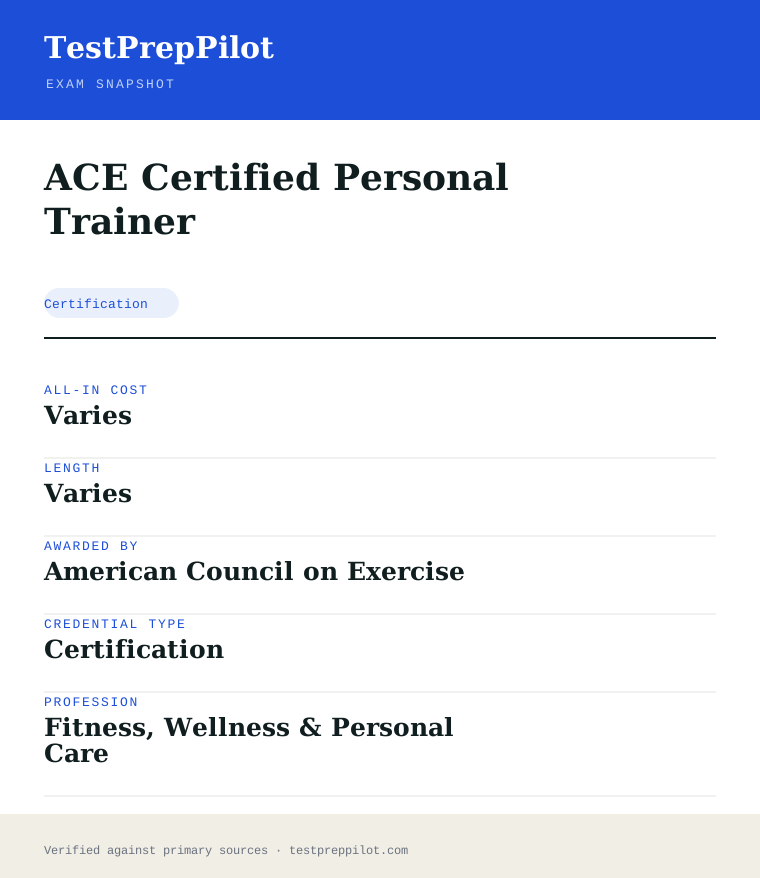
ACE Certified Personal Trainer is a certification credential; awarded by American Council on Exercise; the exam fee is $499 for the exam alone (study-package pricing varies); typical preparation is Varies.
| Credential | ACE Certified Personal Trainer |
|---|---|
| Abbreviation | ACE-CPT |
| Type | Certification |
| Profession | Fitness, Wellness & Personal Care |
| Specialty | Fitness, Sport & Recreation |
| Awarded by | American Council on Exercise |
| Difficulty | Entry to Applied |
| Typical prep time | Varies |
| All-in cost | Varies |
| Credential | ACE Certified Personal Trainer |
| Awarding body | American Council on Exercise |
| Exam format | Proctored, computer-based |
| Validity | 2 years — renew with 20 continuing education credits (CECs) for $129 per credential; no recertification exam. |
| Languages | Varies — see awarding body |
| Scope | National / Multi-state |
Real questions
Frequently asked questions about the ACE Certified Personal Trainer
How do I register for the ACE Certified Personal Trainer exam?
Register through American Council on Exercise's official portal or an authorized test provider (e.g., Pearson VUE or Prometric where applicable). Create an account, select the exam, pay the fee, and schedule a date.
How much does the exam cost?
Fees vary by location and currency. Confirm the current fee on the official registration page before scheduling.
How long is the credential valid, and how do I renew?
ACE CPT credentials are valid for 2 years and are renewed by earning 20 continuing education credits (CECs) and paying a $129 renewal fee per credential; there is no recertification exam, so the renewal is driven by CEUs rather than a second sit.
What if I do not pass?
Most bodies allow retakes after a waiting period and payment of the full or partial fee. Check American Council on Exercise's retake policy before rescheduling.
How do I register for a American Council on Exercise credential?
Register through the official website, select your exam, pay the fee, and schedule a date.
How do I renew a credential?
Renewal policies vary by credential; check the specific program page for requirements and cycles.
In short
Is the ACE Certified Personal Trainer worth it?
- ACE Certified Personal Trainer is awarded by American Council on Exercise.
- Validates job-ready competence in Beauty, Food, Security & Recreation.
- Registration is through the awarding body or an authorized test provider.
- Renewal and retake policies vary — confirm before scheduling.
Same awarding body
What other credentials does American Council on Exercise award?
Worth comparing
How does the ACE Certified Personal Trainer compare with similar credentials?
Trust
Where does this information come from?
Everything above is taken from the awarding body's own published material. Fees, question counts and domain weights are revised regularly — check the official page before you pay.
Research confidence: low · Last reviewed 2026-08