Fitness, Wellness & Personal Care • Certification
Yoga Alliance Registered Yoga Teacher 200
Yoga Alliance Registered Yoga Teacher 200 — Beauty, Food, Security & Recreation credential from Yoga Alliance
Researched and maintained by TestPrepPilot Editorial BoardFitness & wellness credentialing desk · Figures last verified August 2026
The short version
What is the Yoga Alliance Registered Yoga Teacher 200 and is it worth it?
Yoga Alliance Registered Yoga Teacher 200 is a professional credential administered by Yoga Alliance. It validates job-ready knowledge and skills in the Beauty, Food, Security & Recreation field and is used for career entry, advancement, or compliance.
- Recognized credential from Yoga Alliance
- Demonstrates verified competence in Beauty, Food, Security & Recreation
- Supports career advancement and may satisfy licensing or employer requirements
What is it?
What exactly is the Yoga Alliance Registered Yoga Teacher 200?
Yoga Alliance Registered Yoga Teacher 200 — Beauty, Food, Security & Recreation credential from Yoga Alliance
Registry credential granted after a 200-hour registered school programme; Yoga Alliance registers teachers rather than testing them. Offered by Yoga Alliance, it is designed for candidates who need to demonstrate verified competence in the Beauty, Food, Security & Recreation field. The credential is commonly used for career entry, advancement, regulatory compliance, or employer requirements. Candidates should review the official handbook for eligibility, exam format, and scoring before registering.
The path in brief
- Confirm you meet any eligibility or prerequisites
- Review the official handbook and study materials
- Register and pay through the awarding body or authorized provider
- Schedule and take the exam (test center or online proctoring)
- Receive your score and, if passed, your credential
Before you book
Who is eligible to sit the Yoga Alliance Registered Yoga Teacher 200?
Eligibility varies; many credentials are open to all, while others require coursework, work experience, or sponsorship.
Who it is for: Professionals and candidates seeking to validate Beauty, Food, Security & Recreation competence.
The test itself
What is the format of the Yoga Alliance Registered Yoga Teacher 200?
The Yoga Alliance Registered Yoga Teacher 200 is administered by Yoga Alliance and runs 200 training hours.
| Administered by | Yoga Alliance |
|---|---|
| Questions | Training assessments, no exam |
| Time limit | 200 training hours |
| Pass mark | Passing score set by the awarding body; see the official score report |
| Exam fee | $2,000-4,000 |
| Format | Proctored, computer-based (test center or online remote proctoring) |
Content outline
What topics are on the Yoga Alliance Registered Yoga Teacher 200?
The Yoga Alliance Registered Yoga Teacher 200 covers 4 content domains.
Weightings come from the official exam outline. Study time is best allocated in roughly these proportions rather than evenly across domains.
- Core techniques
Topic area tested on the exam; see the official blueprint for the detailed breakdown.
- Sanitation & safety
Topic area tested on the exam; see the official blueprint for the detailed breakdown.
- Client / guest service
Topic area tested on the exam; see the official blueprint for the detailed breakdown.
- Regulations
Topic area tested on the exam; see the official blueprint for the detailed breakdown.
The path
How do you register for the Yoga Alliance Registered Yoga Teacher 200?
- 1
Visit the awarding body’s official website and create an account
- 2
Select the credential and review its specific requirements
- 3
Complete any required eligibility (education, experience, or training)
- 4
Pay the registration fee
- 5
Schedule the exam at a test center or online
- 6
Take the exam and receive your results
The fine print
What are the retake and renewal rules for the Yoga Alliance Registered Yoga Teacher 200?
- Proctoring & delivery
- Proctored, computer-based delivery (test center or remote online proctoring), varying by exam.
- Retake policy
- Varies by credential — most bodies permit retakes after a waiting period and full or partial fee.
- Score reporting
- Scores are reported per the body’s timeline, typically electronically after the exam.
- Recertification
- Varies; many credentials require renewal every 2–3 years via continuing education or a recertification exam.
What it pays
How much does this credential pay?
Expect yoga-teacher earnings in the fitness-instructor range — $46,180 median (BLS, May 2024) — with most RYT-200 teachers combining classes with other income, and pay heavily dependent on studio revenue share and private clients
The direct answer is that an RYT-200 (Registered Yoga Teacher, 200-hour) credential does not have its own BLS occupation, but the closest category, fitness trainers and instructors (SOC 39-9031), earned a May 2024 median annual wage of $46,180, with the lowest 10 percent under about $23,000 and the highest 10 percent above about $77,000. The honest framing is that the yoga-teaching income distribution is wide and right-skewed: most RYT-200 teachers teach part-time — a few classes a week at $30 to $60 per class at studios, or $15 to $30 per head in revenue-share models — while full-time teachers build private-client books, workshops, and retreats that can push earnings well above the median. BLS counted about 856,000 fitness trainers and instructors in 2024 and projects about 13 percent employment growth from 2024 to 2034, much faster than average, reflecting continued demand for fitness instruction. The credential’s role is positional: Yoga Alliance registration is the industry-standard baseline that studios and employers check when hiring, but it is a registry, not a licence — it certifies that you completed a 200-hour training from a registered yoga school, not that you are a licensed professional. The practical read is to treat the 200-hour training as the entry investment (typically $2,000 to $4,000 over several months), expect earnings to be modest at first and highly variable, and plan the income stack — studio classes, privates, workshops, and corporate or online offerings — before you quit a day job. The 200-hour credential is also the prerequisite for the 300-hour advanced training that leads to RYT-500 and higher-rate teaching, so the long-term income path runs through continued training and specialisation.
| Measure | Figure | Source / note |
|---|---|---|
| Median annual wage, fitness trainers & instructors | $46,180 | BLS Occupational Outlook Handbook, May 2024 (SOC 39-9031) |
| Lowest 10 percent | less than $23,500 | BLS OOH, May 2024 |
| Highest 10 percent | more than $77,000 | BLS OOH, May 2024 |
| Projected growth, 2024-34 | +13% | BLS Employment Projections |
| The credential itself | Registry, not a licence | Yoga Alliance registers completed 200-hour trainings |
Job growth.BLS projects about 13% growth for fitness trainers and instructors from 2024 to 2034, much faster than average, with roughly 90,000 annual openings.
Your odds
What are the pass rates?
There is no pass rate — RYT-200 is a training-hour credential, not an exam; completion of a Yoga Alliance-registered 200-hour program is what registers you, and no national test exists
The core fact is that there is no RYT-200 exam and therefore no pass rate: the Registered Yoga Teacher credential is a registration, not a certification earned by testing. To register as RYT-200 you must complete a 200-hour teacher training at a Yoga Alliance-registered yoga school (RYS), covering the organisation’s curriculum standards — techniques, training and practice; teaching methodology; anatomy and physiology; yoga philosophy, lifestyle, and ethics; and practicum — and the school assesses your completion through its own in-training evaluations, including teaching practice, rather than through any national examination. Because Yoga Alliance is a voluntary registry (not a government licence), "passing" means your training provider confirms you completed the hours and met its requirements, and then you pay the registration fee to be listed. What is published and matters instead is the standards document: the 200-hour curriculum breakdown, the requirement that trainings include supervised teaching practice, and the ethics expectations. The practical implication is that your choice of training school is the single decision that determines your credential’s quality — a well-regarded school with rigorous teaching practice prepares you to actually teach, while a fast, low-contact "certification" may leave you registered but unemployable. The honest advice is to vet the RYS (check the lead trainer’s experience, observe a class, ask about teaching-practice hours) as seriously as you would vet a professional exam prep, because the credential’s value lives in the training itself. Note also that Yoga Alliance registration is a registry of trainings completed, and its standards evolve — check the current requirements on the official site before enrolling, since curriculum hour allocations have been revised in recent years.
Read this before quoting the number.No exam or pass rate exists; registration is based on completing a 200-hour training at a registered school.
Your schedule
How long should I study for it?
200 training hours over 3-6 months + daily personal practice of focused study
Plan for a 200-hour training program spread over 3 to 6 months (the standard formats are multi-weekend intensives, 8-to-10-week evening courses, or month-long immersions), plus 20 to 40 hours of independent practice between sessions, and expect the training itself to be the credential — there is no final exam to cram for. The Yoga Alliance 200-hour curriculum allocates hours across five categories: techniques, training and practice (asana, pranayama, meditation); teaching methodology (sequencing, cueing, adjustments); anatomy and physiology; yoga philosophy, lifestyle, and ethics; and practicum (teaching practice with feedback). The most effective study approach is to treat the training as apprenticeship: practise daily, teach mock classes as early as the program allows, and journal your teaching feedback. Before the training starts, build a baseline practice of 2 to 3 sessions per week so you can engage with the physical material rather than chase it; the single biggest cause of student struggle is arriving under-practised. During the training, keep a teaching log — every sequence you practise teaching, every adjustment you try, every piece of cueing feedback — because the practicum hours are what employers ask about in interviews. After graduation, register with Yoga Alliance (registration is separate from the training and carries its own fee and annual renewal), then start the income-building phase: sub classes at studios, teach free community classes to build references, and set up a private-client and online offering. Budget the first 6 to 12 months as the ramp where earnings are thin, because that is the phase most new teachers underestimate.
- Before training15
Practice baseline
- Practise yoga 2-3x per week
- Attend classes at the school you plan to train with
- Read one anatomy or philosophy book
- Training months200
200-hour curriculum
- Complete all technique and methodology modules
- Log teaching-practice hours with feedback
- Practise daily and journal feedback
- After graduation20
Registration + income
- Register with Yoga Alliance
- Sub classes and teach community classes
- Build private and online offerings
Adjusting the pace
RYT-300 / RYT-500.Advanced registrations requiring additional training hours (300 or 500 total), typically for teachers specialising or teaching teacher trainings.
Specialty certifications.Yin, prenatal, restorative, and other niche trainings that stack on the 200-hour base.
How to study
How do I prepare most effectively?
The strategy that makes a 200-hour training worth its cost is "practise before, teach early, and log everything," and the single biggest error is choosing a school for convenience or price without vetting the lead trainer and teaching-practice component. A second proven approach is starting the teaching habit inside the training: volunteer for mock teaching from week one, because the practicum hours and feedback loops are where the skill is built, and employers hire from demonstrated teaching ability, not the certificate. Third, build a personal practice journal and teaching log — sequences, cueing language, adjustments, and student questions — because those notes become your lesson library for your first years of teaching. Fourth, study the anatomy and philosophy modules rather than coasting through them; employers and students both probe these in interviews, and the difference between a well-prepared new teacher and a certificate-holder shows exactly there. Fifth, use the training to define a niche (restorative, vinyasa, beginners, seniors) so you graduate with a marketable identity instead of "generic yoga teacher." Finally, treat registration as the beginning: Yoga Alliance registration is an annual renewal with continuing-education expectations, and studios increasingly ask about continuing education, so plan your first advanced or specialty training within the first two years.
Vet the school, not just the price
The lead trainer’s experience and teaching-practice hours determine the credential’s real value.
Teach from week one
Mock teaching and feedback loops build the skill employers actually hire for.
Keep a teaching log
Sequences, cueing, and adjustments become your first lesson library.
Study anatomy and philosophy deeply
Employers and students probe both; the gap shows in interviews.
Graduate with a niche
A defined specialisation makes you marketable instead of generic.
What to buy
Which study resources are worth paying for?
The 200-hour training is the dominant cost — typically $2,000 to $4,000 — and the registry fee is a smaller recurring cost, so the comparison below separates the training itself, the registration, and the continuing-education stack, with prices current to this review. The buying rule is to spend the budget on a rigorous registered school with real teaching practice, and treat the registry fee as the small ongoing cost of being listed.
| Resource | Price | Format | Best for |
|---|---|---|---|
| 200-hour teacher training (RYS) | ~$2,000-4,000 | 3-6 month program | The credential itself |
| Yoga Alliance registration | ~$50-115/yr | Online registry | Being listed as RYT-200 |
| Continuing education workshops | ~$100-500 each | Workshops/short trainings | Renewal requirements + specialisation |
| 300-hour advanced training | ~$3,000-6,000 | Long-form program | RYT-500 pathway |
| Business/marketing courses for teachers | ~$50-300 | Online courses | Building private and online income |
Prices approximate and dated to this review; only trainings at Yoga Alliance-registered schools qualify for registration.
Avoid these
What mistakes do candidates most often make?
The most common mistake is choosing a 200-hour program on price or convenience and discovering the teaching-practice component is thin — the credential registers you, but the training determines whether anyone hires you. The second is treating graduation as the finish line rather than the start of the income ramp, then quitting when the first months pay little. A third recurring error is neglecting the practicum and feedback process, graduating without real teaching reps, and freezing in a first studio sub. Candidates also routinely skip the business side — no private-client pipeline, no online presence, no niche — and then compete with generic teachers for the same low-rate studio classes. Finally, many new teachers let registration lapse or skip continuing education, losing the RYT listing that studios check.
✕Buying the cheapest training
✓Vet the school’s teaching-practice hours and lead trainer before enrolling.
✕Expecting immediate income
✓Plan a 6-12 month ramp: subs, community classes, privates, online.
✕Skipping the practicum reps
✓Teach mock classes from week one; hire happens from demonstrated ability.
✕Ignoring the business side
✓Build a niche, private pipeline, and online presence during training.
✕Letting registration lapse
✓Keep registration current and plan continuing education for renewal.
What you'll face
What question types will I see?
There is no written exam for RYT-200, so "question types" here describe what training schools actually assess: teaching-practice demonstrations (you sequence and teach a class to peers), written assignments on sequencing and philosophy, anatomy quizzes, and feedback-based practical evaluations during the practicum. The standards define what schools must cover, and a rigorous school will test your ability to cue, adjust, and sequence, not just your attendance. The samples below are editor-written illustrations of the kinds of assessment common in 200-hour trainings, not live exam items.
Teaching a full or partial class to peers with trainer feedback.
Designing class sequences for defined goals and populations.
Quizzes on movement, alignment, and contraindications.
Written reflection on philosophy and professional ethics.
Assessment of asana, pranayama, and meditation practice.
Try these
Q1Which teaching cue is most appropriate for guiding students into a safe forward fold?
Answer:B
Lengthening the spine on the inhale and hinging from the hips protects the lower back — the core of safe cueing.
Q2A student reports a wrist injury. Which adjustment is most appropriate?
Answer:A
Modifying or removing wrist-bearing poses respects the injury and keeps the student practising safely.
Q3What is the primary purpose of the practicum component in a 200-hour training?
Answer:B
The practicum exists to build teaching skill through supervised teaching practice and feedback.
Samples are editor-written illustrations of common training assessments, not live exam items.
The big day
What should I expect on exam day?
There is no single exam day for RYT-200 — the credential is earned through the training program’s ongoing assessments, ending typically in a final teaching practicum where you teach a full class to peers and trainers, plus any written components your school requires. The core expectations: attend the training’s required hours (attendance records matter to the school and to Yoga Alliance), complete the practicum teaching hours with feedback, and satisfy the school’s final assessments. On final-practicum day, arrive with a prepared sequence, arrive early to set up, and expect to teach the full class as your trainer evaluates cueing, adjustments, pacing, and student safety. After the school confirms completion, you register with Yoga Alliance: create an account, pay the registration fee, and submit your training credentials for listing as RYT-200. Keep your training certificate and any transcripts, since studios and employers ask for proof. The most useful habits: rehearse your final sequence twice in the week before, practise the cueing aloud, and on the day, teach the class rather than narrate it — presence is what the evaluator grades.
Bring
- Your prepared sequence and class plan
- Comfortable teaching attire
- Training log and practicum records
Leave at home
- Notes you plan to read during the final practicum
- The assumption that attendance alone completes the credential
How the day runs
Rules in the room
- Training must be at a Yoga Alliance-registered school
- Practicum hours required with feedback
- Registration carries an annual renewal
Afterwards.Completing the training and registering yields RYT-200 status; the listing is renewable annually and is the baseline studios check when hiring.
Reference
What are the key facts about the Yoga Alliance Registered Yoga Teacher 200?
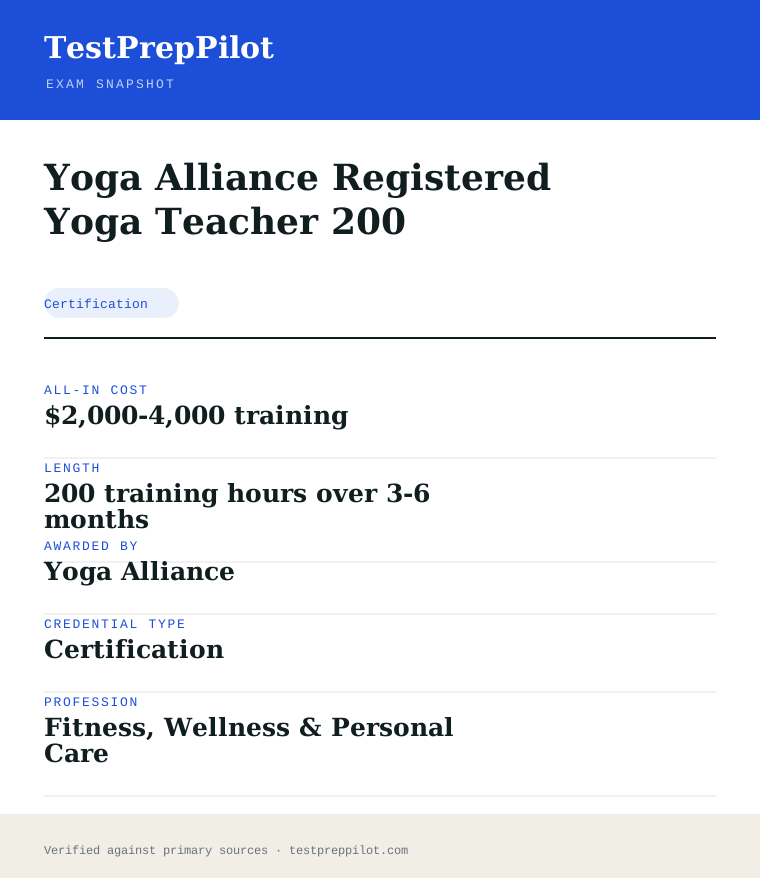
Yoga Alliance Registered Yoga Teacher 200 is a certification credential; awarded by Yoga Alliance; the exam fee is $2,000-4,000; typical preparation is 200 training hours over 3-6 months; holders typically earn $46,180 median, fitness trainers (BLS May 2024).
| Credential | Yoga Alliance Registered Yoga Teacher 200 |
|---|---|
| Abbreviation | RYT 200 |
| Type | Certification |
| Profession | Fitness, Wellness & Personal Care |
| Specialty | Fitness, Sport & Recreation |
| Awarded by | Yoga Alliance |
| Difficulty | Entry to Applied |
| Typical prep time | 200 training hours over 3-6 months |
| All-in cost | $2,000-4,000 training |
| Typical salary range | $46,180 median, fitness trainers (BLS May 2024) |
| Credential | Yoga Alliance Registered Yoga Teacher 200 |
| Awarding body | Yoga Alliance |
| Exam format | Proctored, computer-based |
| Validity | Renewable annually with Yoga Alliance |
| Languages | Varies — see awarding body |
| Scope | National / Multi-state |
Real questions
Frequently asked questions about the Yoga Alliance Registered Yoga Teacher 200
How do I register for the Yoga Alliance Registered Yoga Teacher 200 exam?
Register through Yoga Alliance's official portal or an authorized test provider (e.g., Pearson VUE or Prometric where applicable). Create an account, select the exam, pay the fee, and schedule a date.
How much does the exam cost?
Fees vary by location and currency. Confirm the current fee on the official registration page before scheduling.
How long is the credential valid, and how do I renew?
Validity varies by credential (commonly 2–3 years). Renewal usually requires continuing education or a recertification exam — see Yoga Alliance's policy.
What if I do not pass?
Most bodies allow retakes after a waiting period and payment of the full or partial fee. Check Yoga Alliance's retake policy before rescheduling.
How do I register for a Yoga Alliance credential?
Register through the official website, select your exam, pay the fee, and schedule a date.
How do I renew a credential?
Renewal policies vary by credential; check the specific program page for requirements and cycles.
In short
Is the Yoga Alliance Registered Yoga Teacher 200 worth it?
- Yoga Alliance Registered Yoga Teacher 200 is awarded by Yoga Alliance.
- Validates job-ready competence in Beauty, Food, Security & Recreation.
- Registration is through the awarding body or an authorized test provider.
- Renewal and retake policies vary — confirm before scheduling.
Trust
Where does this information come from?
Everything above is taken from the awarding body's own published material. Fees, question counts and domain weights are revised regularly — check the official page before you pay.
Research confidence: low · Last reviewed 2026-08