Fitness, Wellness & Personal Care • Certification
NASM Performance Enhancement Specialist
NASM Performance Enhancement Specialist — Beauty, Food, Security & Recreation credential from National Academy of Sports Medicine
Researched and maintained by TestPrepPilot Editorial BoardFitness & personal-training certification desk · Figures last verified August 2026
The short version
What is the NASM Performance Enhancement Specialist and is it worth it?
NASM Performance Enhancement Specialist is a professional credential administered by National Academy of Sports Medicine. It validates job-ready knowledge and skills in the Beauty, Food, Security & Recreation field and is used for career entry, advancement, or compliance.
- Recognized credential from National Academy of Sports Medicine
- Demonstrates verified competence in Beauty, Food, Security & Recreation
- Supports career advancement and may satisfy licensing or employer requirements
What is it?
What exactly is the NASM Performance Enhancement Specialist?
NASM Performance Enhancement Specialist — Beauty, Food, Security & Recreation credential from National Academy of Sports Medicine
Sport performance specialisation covering periodisation, power development, agility training and athlete testing protocols. Offered by National Academy of Sports Medicine, it is designed for candidates who need to demonstrate verified competence in the Beauty, Food, Security & Recreation field. The credential is commonly used for career entry, advancement, regulatory compliance, or employer requirements. Candidates should review the official handbook for eligibility, exam format, and scoring before registering.
The path in brief
- Confirm you meet any eligibility or prerequisites
- Review the official handbook and study materials
- Register and pay through the awarding body or authorized provider
- Schedule and take the exam (test center or online proctoring)
- Receive your score and, if passed, your credential
Before you book
Who is eligible to sit the NASM Performance Enhancement Specialist?
Eligibility varies; many credentials are open to all, while others require coursework, work experience, or sponsorship.
Who it is for: Professionals and candidates seeking to validate Beauty, Food, Security & Recreation competence.
The test itself
What is the format of the NASM Performance Enhancement Specialist?
The NASM Performance Enhancement Specialist is administered by National Academy of Sports Medicine and runs 120 minutes and contains 100 questions.
| Administered by | National Academy of Sports Medicine |
|---|---|
| Questions | 100 questions |
| Time limit | 120 minutes |
| Pass mark | Passing score set by the awarding body; see the official score report |
| Exam fee | ~$499 |
| Format | Proctored, computer-based (test center or online remote proctoring) |
Content outline
What topics are on the NASM Performance Enhancement Specialist?
The NASM Performance Enhancement Specialist covers 4 content domains.
Weightings come from the official exam outline. Study time is best allocated in roughly these proportions rather than evenly across domains.
- Core techniques
Topic area tested on the exam; see the official blueprint for the detailed breakdown.
- Sanitation & safety
Topic area tested on the exam; see the official blueprint for the detailed breakdown.
- Client / guest service
Topic area tested on the exam; see the official blueprint for the detailed breakdown.
- Regulations
Topic area tested on the exam; see the official blueprint for the detailed breakdown.
The path
How do you register for the NASM Performance Enhancement Specialist?
- 1
Choose your packageabout 10 minutes
Select CNC Self-Study or CNC Premium Self-Study on nasm.org. There are no prerequisites, so you can enroll immediately.
- 2
Create your account and payat purchase
Set up your NASM account, choose a one-time payment or a monthly plan (often from ~$49/month), and gain course access for five years.
- 3
Complete the coursework4–6 weeks typical
Work through the digital lessons, videos, animations, and downloadable handouts covering nutrition science, behavior change, and practical coaching.
- 4
Use the practice quizzesself-paced
Check your readiness with the built-in practice quizzes before attempting the final exam.
- 5
Take the final exam90 minutes
Within 365 days of enrollment, take the 100-question, 90-minute, open-book exam online from your computer. Score 70% or higher; you have up to 3 attempts.
- 6
Download your certificateimmediate
On passing, you receive your digital certificate and badge and earn 1.9 NASM CEUs, which also apply to NASM/AFAA recertifications.
The fine print
What are the retake and renewal rules for the NASM Performance Enhancement Specialist?
- Proctoring & delivery
- None. The CNC exam is online and open-book, taken from your own computer within a 90-minute timer. It is not administered at a third-party testing center.
- Retake policy
- You are allowed up to three (3) exam attempts within your 365-day exam enrollment window at no extra charge. If you do not pass after three attempts, additional retests can be purchased by contacting NASM.
- Score reporting
- Your pass/fail result and score appear on screen immediately after the exam. Your certificate and CEU record are posted to your NASM account.
- Recertification
- The NASM-CNC must be renewed every two (2) years. Per NASM's terms and conditions, renewal is completed by purchasing and passing the NASM-CNC renewal exam, which offers three attempts and a 365-day enrollment. NASM One membership waives the recertification fee.
- Refunds & rescheduling
- NASM offers a refund within 14 days of purchase for many products if you are not satisfied (see the NASM refund policy). Once the exam is started or completed, refund eligibility may end; confirm current terms on nasm.org.
Context
Nutrition credentials compared
| Credential | Issuer | Prereqs | Exam | Renewal | |
|---|---|---|---|---|---|
| NASM-CNC | NASM | None | 100 Q · 90 min · open-book · 70% | 2 yr (renewal exam) | |
| NASM-CPT | NASM | None | 120 Q · 120 min · 70% | 2 yr (2.0 CEU + fee) | |
| RDN | CDR / Academy of Nutrition and Dietetics | Master's + ACEND internship | CDR registration exam | Every 5 yr (75 CPE) | |
| Precision Nutrition L1 | Precision Nutrition | None | Online, self-paced, open-book | No expiration |
What it pays
How much does this credential pay?
$46,180 median for fitness trainers and instructors (BLS, May 2024) — SOC 39-9031
The direct answer is that fitness trainers and instructors, SOC 39-9031, earned a median of $46,180 per year in May 2024, the most recent BLS Occupational Employment and Wage Statistics survey, and it is the correct series to cite for a NASM PES because BLS classifies by job duties and there is no separate "performance enhancement specialist" occupation. That median deserves two honest readings before a PES candidate uses it. First, the distribution is wide — the lowest 10 percent earned less than $27,580 and the highest 10 percent more than $82,050 — and the top of that range is disproportionately occupied by trainers with specialisations, business skills and independent client bases, which is precisely where the PES credential is aimed. NASM's own 2026 survey of 1,133 active personal trainers found that trainers who added the PES reported earning about 22 percent more than peers, a figure NASM publishes and we repeat as NASM's claim rather than an independent finding. Second, the BLS wage data reflects employer wages and substantially understates what established independent trainers and online coaches earn by setting their own session rates, so the real earnings line for a working specialist sits above the median for those who build the client base. The employment picture is strong: BLS projects 12 percent growth for the occupation from 2024 to 2034, much faster than the average for all occupations, with about 74,200 openings a year, driven by the continuing expansion of gyms, studios, corporate wellness programmes and the general emphasis on exercise as preventive health. Where the PES sits in that picture is as an advanced specialisation rather than an entry credential: it is designed for an already-certified trainer — the recommended background is the NASM-CPT or an equivalent accredited certification, a health-and-fitness degree, or a related credential — and its value is that it moves a trainer up the pricing ladder from general fitness toward athletic-performance coaching, where the athlete and client base pay premium rates.
| Measure | Figure | Source / note |
|---|---|---|
| Median annual wage, fitness trainers and instructors | $46,180 | BLS Occupational Outlook Handbook, May 2024 (SOC 39-9031) |
| Lowest 10 percent | less than $27,580 | BLS OOH Pay tab, May 2024 |
| Highest 10 percent | more than $82,050 | BLS OOH Pay tab, May 2024 |
| Employment, 2024 | 370,100 jobs | BLS OOH Quick Facts, 2024 |
| Projected annual openings | ~74,200 per year | BLS OOH Job Outlook, 2024-34 — 12% growth |
Job growth.12% projected change 2024-34 (much faster than average) with ~74,200 openings a year; the PES is an advanced specialisation that targets the premium-performing end of the occupation, where NASM reports a ~22% earnings premium
Source: BLS Occupational Outlook Handbook — Fitness Trainers and Instructors
Your odds
What are the pass rates?
NASM publishes no pass rate for the PES — what it publishes is the format (100 questions, 90 minutes, open-book) and the passing score (70%)
There is no published pass rate for the NASM Performance Enhancement Specialist exam, because NASM does not release pass statistics for its specialisations, and we are not going to supply an invented one — the "just below 50 percent" figures that circulate online are estimates with no official source and contradict the exam's design. What NASM does publish, on its official pages, is the complete exam specification, and it is unusually generous relative to most professional exams: 100 multiple-choice questions, a 90-minute time limit, a minimum passing score of 70 percent, an open-book format taken online inside your student portal, and up to three attempts. Three design facts explain why NASM can afford to be open about this and why pass-rate anxiety is misplaced. First, the open-book format changes what the exam measures: it is a comprehension-and-application check over the OPT model and performance-science content rather than a memory exam, so the 70 percent threshold tests that you understand and can apply the material, not that you have memorised it. Second, the three-attempt policy is inclusive — you have a full year from purchase to take the exam and three chances to clear the 70 percent line, and additional retests can be purchased — so the relevant question is not "what percentage pass" but "what does a disciplined candidate need to pass," which is a 70 percent score on an open-book, 100-question exam that you can take three times. Third, the credential is an advanced specialisation, not an NCCA-accredited certification like the NASM-CPT, and NASM positions the exam accordingly: it is the gate at the end of the course you just studied, not a market-wide filter. The practical planning number is therefore the 70 percent passing score itself: aim to score 80 percent or better on the practice quizzes and an untimed self-test before taking the timed exam, use the open-book advantage deliberately by knowing where the material lives in the course, and treat the three attempts as a designed feature rather than a safety net you will need.
Read this before quoting the number.NASM publishes no pass rate for the PES exam. The published figures are the format (100 questions, 90 minutes, open-book, online) and the passing score (70%), with up to three attempts within a year of purchase. Third-party pass-rate estimates are unofficial and not reproduced here.
Source: NASM — Performance Enhancement Specialization exam details
Your schedule
How long should I study for it?
60-100 hours over 6-10 weeks, plus the one-year exam window with three attempts of focused study
Plan six to ten weeks and roughly 60 to 100 hours of study, and start from the premise that the NASM PES is a comprehension exam over one unified framework — the Optimum Performance Training (OPT) model — rather than a collection of trivia, so the study plan should follow the course's own logic. The course is fully online and self-paced with five years of content access from purchase, and the exam is 100 multiple-choice questions in 90 minutes, open-book, with a 70 percent passing score and up to three attempts within a year of purchase; most candidates finish the program in six to eight weeks while working. The recommended background matters: NASM states there are no required prerequisites but recommends an NASM-CPT certification, an accredited health-and-fitness certification, a health or fitness degree, or a related credential, so if you hold none of those, add study time on the fundamentals. Follow the course sections in order — coaching and sport psychology; an introduction to sport science built on the OPT model and biomechanics; assessments, testing and monitoring; the components of the integrated training model across flexibility, power, speed, strength and recovery; program design with periodisation and biomotor development; and nutrition and supplementation — and keep a running map of where each topic sits in the course, because the open-book exam rewards knowing the material's location as much as its content. In the final two weeks, switch to exam mode: retake the end-of-section quizzes until they are near-perfect, then take the timed 100-question exam with the course open, and use the three-attempt allowance deliberately — a first attempt that reveals your weak areas is a diagnostic, not a failure, as long as you close the gaps before the next attempt. Budget your time so you reach exam-ready inside the first several months rather than drifting to the edge of the one-year exam window, and remember the credential does not expire once earned — NASM states the PES never expires — so the one-year deadline is for taking the exam, not for maintaining the credential afterward.
- Weeks 1-28-10 hrs/week
Foundations — coaching, psychology, and sport science
- Study the coaching and sport-psychology section: building trust, motivation, and ethical coaching
- Learn the OPT model and biomechanics — the framework every later section plugs into
- Map each topic to its place in the course so the open-book exam can be navigated fast
- Take the section quizzes and note every miss
- Weeks 3-58-10 hrs/week
Assessments and the integrated training model
- Study assessments, testing and monitoring: how to evaluate an athlete and tailor programming
- Cover the integrated training model across flexibility, power, speed, strength, and recovery
- Drill the components of the OPT model — stabilisation, strength, and power phases
- Connect each assessment result to the programming decision it drives
- Weeks 6-78-10 hrs/week
Program design, nutrition, and supplementation
- Study program design: periodisation, biomotor development, and sport-specific planning
- Cover performance nutrition: intake, hydration, and evidence-based supplementation
- Complete the remaining sections and retake every quiz until near-perfect
- Build a one-page map of the whole course for open-book navigation
- Weeks 8-106-8 hrs/week
Exam readiness — timed runs and the three-attempt plan
- Take the timed 100-question exam once with the course open as a diagnostic run
- Close every gap the first attempt revealed before the second attempt
- Re-study the highest-weight areas — program design and the OPT model
- Take the exam again until you clear 70% comfortably; the third attempt is a designed backup
Adjusting the pace
NASM-CPT holder adding the PES.Six to eight weeks. The CPT already gives you the assessment and programming fundamentals; spend the recovered time on the performance-specific content — power development, sport-science application, and the Maximal Power phase of the OPT model.
Training athletes without a certification.Ten to twelve weeks at 6 hrs/week. NASM lists no required prerequisites but recommends a certification or degree; add two weeks on the assessment and programming fundamentals the PES assumes, and use the three attempts as designed.
How to study
How do I prepare most effectively?
The strategy that reliably passes the NASM PES is "learn the OPT model until you can apply it, build a navigation map for the open-book exam, and use the three attempts as a designed diagnostic sequence," because the exam is an open-book comprehension test, not a memory contest, and the candidates who fail are almost always the ones who memorise chapter headings without connecting the framework. The single biggest error is treating an open-book exam as easier than a closed-book one — it is only easier if you know where the material lives, and a candidate who has not built a navigation map will spend the 90-minute clock searching the course instead of answering. The design that should drive the plan is the one NASM publishes: 100 multiple-choice questions, 90 minutes, open-book, online, with a 70 percent passing score and up to three attempts within a year of purchase — so the exam is a speed-and-navigation test layered on a comprehension test, and every study session should build both. The OPT model is the organising framework the entire course plugs into: stabilisation, strength, and power phases, and the assessments that place an athlete in the right phase, so a candidate who can apply the model to a scenario — given an athlete's assessment, which phase and which programme — has most of the application questions answered in advance. The navigation map is the second pillar: as each section is studied — coaching and sport psychology, sport science, assessments, the integrated training model, program design, and nutrition — its location in the course should be noted, because the open-book format rewards jumping straight to the right part of the course rather than searching it. The three attempts are the third pillar: with a year of access and three sittings, the first attempt can legitimately be a diagnostic that reveals the weak sections, and the candidates who treat it that way — closing gaps between attempts — clear the 70 percent line comfortably. The CEU value is a bonus for trainers with other credentials: 1.9 NASM CEUs and 2.0 ACE CECs, which matter for maintaining an NASM-CPT or ACE certification while the PES itself never expires.
Master the OPT model as the organising framework
The entire course plugs into the Optimum Performance Training model — stabilisation, strength, and power phases, and the assessments that place a client in the right phase. If you can apply the model to a scenario — given an athlete's assessment, which phase and programme — most of the exam's application questions answer themselves.
Build a navigation map for the open-book format
The exam is open-book, so the skill is knowing where content lives, not just what it says. As you study each section, note its chapter and section on a one-page course map. In the timed 90-minute exam, the candidates who move fast are the ones who can jump straight to the right part of the course rather than searching.
Run the first attempt as a diagnostic, not a verdict
You have a year from purchase and three attempts. Use the first timed attempt to reveal your weak areas — an open-book 70-percent line makes a sub-70 first run a study list, not a failure. Close the gaps and re-sit; the three-attempt design exists for exactly this.
Apply the content to athletes, not just definitions
The exam tests application — assessing an athlete, designing a sport-specific programme, choosing the right phase and progression. Study each concept by asking "what decision does this drive for an athlete?" rather than by memorising the definition, because the scenario questions outnumber the vocabulary questions.
Drill the quiz bank until it is near-perfect
The end-of-section quizzes are the closest thing to the exam you will see before sitting it. Retake them until they are near-perfect, and treat every miss as a signal to re-study that section, not to move on. The course content, the quizzes and the exam are the same material in different shapes.
What to buy
Which study resources are worth paying for?
The buying decision for the NASM PES is simple because the official course is the product: NASM sells the Performance Enhancement Specialization as a self-paced online program that includes the instructional content, study guides, practice quizzes, and the exam itself, so the primary purchase is the program, not a stack of third-party books. NASM's current pricing is built around monthly payment plans — the official store lists roughly $89 per month, and promotional plans can run $49-71 per month depending on the offer — while pay-in-full and bundle options vary by promotion and third-party education partners list the program around $895; the task of a candidate is to confirm the current total on the NASM store rather than trust any single figure, because the list price quoted in an older guide is the least reliable number in this table. The exam is included in the program price, you have a year to take it and five years of content access, and the credential does not expire once earned — which removes the renewal economics that dominate most certification budgets, because the PES has no renewal fee and no CEU maintenance cycle of its own. Because the exam is open-book and drawn from the course, no external prep is strictly necessary, and the buying rule is to spend on the program first and on third-party guides only if a specific section needs extra drilling — the course-provided quizzes are the closest rehearsal to the exam, and they come with the price of admission. The CEU value is real for trainers maintaining other credentials: the PES is worth 1.9 NASM CEUs, 2.0 ACE CECs, and other accepted credits, which matters for recertification planning and makes the program effectively two investments in one — the PES credential itself plus CEUs that feed the CPT or another certification a trainer already holds.
| Resource | Price | Format | Best for |
|---|---|---|---|
| NASM PES program (course + exam) | ~$49-89/month payment plans; pay-in-full bundles vary (~$500-900) | 100% online, self-paced, with the exam included | The credential itself — confirm the current total on the NASM store |
| NASM PES exam retakes beyond the three included | Per-retake fee (confirm current) | Online, open-book, timed | Only needed if you exhaust the three included attempts |
| NASM One membership | Membership pricing | Online CEU library and community | Maintaining other NASM credentials and banking CEUs |
| Third-party PES study guides and question banks | ~$30-100 | Digital | Supplemental drilling; not required for an open-book exam |
| Course-provided quizzes and section materials | Included in the program | Online within the course | The primary preparation — the exam draws from the same content |
Prices checked 2026-08 in USD and approximate; NASM pricing changes frequently and varies by payment plan and bundle, so confirm the current total on the NASM store before purchase. The exam is included in the program price with three attempts within a year of purchase. We do not rank by commission.
Avoid these
What mistakes do candidates most often make?
The mistakes that cost NASM PES candidates points cluster around the exam's design rather than its difficulty: treating an open-book exam as trivial and failing to build navigation skill, memorising definitions instead of learning to apply the OPT model, ignoring the one-year exam window until it is nearly closed, and walking into the timed 90-minute format without a practice run. None of these is a knowledge gap — every one is a process error the course's design already accounts for, and each one is common enough that it explains most of the difference between candidates who pass on the first attempt and candidates who use all three. The open-book error is the most common because the format invites complacency: an open-book exam still has a 90-minute clock and a 70 percent line, and it is only easier if you know where the content lives, so a candidate who never built a navigation map spends the exam searching the course and runs out of minutes. The memorisation error is the most consequential because it targets the wrong skill: the exam tests application — given an athlete's assessment, which phase, which programme, which progression — and definitions without the OPT model framework collapse on the scenario items. The one-year-window error is the most expensive per unit of neglect: NASM gives you a year from purchase to take the exam, most candidates finish the program in six to eight weeks, and an un-taken exam inside the window means repurchasing the program. The pacing error is the most mechanical: 100 questions in 90 minutes is under a minute per question, and a candidate who has never run the timed format meets the clock for the first time on the scored attempt. Add the two credential-errors — assuming the PES renews like the 2-year CPT cycle when NASM states it never expires, and forgetting that the program's 1.9 NASM / 2.0 ACE CEUs feed the other certifications the trainer already holds — and the list covers the full arc of the exam's design. Every one of these is fixable with a navigation map, OPT-model practice, and one timed rehearsal.
✕Treating the open-book format as a licence not to study
✓An open-book exam still has a 90-minute clock and a 70-percent line, and it is only easier if you know where the content lives. Build a one-page navigation map as you study, learn the OPT model until you can apply it, and practise the timed format — the candidates who fail are the ones who expect the open book to do the thinking.
✕Memorising definitions instead of learning application
✓The exam tests application — given an athlete's assessment, which phase, which programme, which progression. Study each concept by asking what decision it drives rather than memorising its wording, and drill the scenario style on the section quizzes, where the same content appears as decisions rather than definitions.
✕Letting the one-year exam window drift shut
✓You have a year from purchase to take the exam and five years of content access, and NASM's own guidance says most candidates finish in six to eight weeks. Block the study weeks early, sit the first attempt while the course is fresh, and keep the window front of mind — an expired window means repurchasing the program, and it is the easiest deadline on this page to miss.
✕Taking the timed exam without a practice run
✓100 questions in 90 minutes, open-book, is a pace-and-navigation test as much as a knowledge test. Run one timed session before the real attempt, with the course open, so you learn where your time goes — candidates who skip this meet the 90-minute pressure for the first time on the scored attempt.
✕Assuming the PES needs recertification like the CPT
✓NASM states the PES credential never expires once earned — it is not renewed on the 2-year CPT cycle, and it is an advanced specialisation rather than an NCCA-accredited certification. The one-year limit is for taking the exam; after you pass, the credential is yours, and its CEU value (1.9 NASM, 2.0 ACE) is what you bank toward other credentials.
What you'll face
What question types will I see?
The NASM PES exam is 100 multiple-choice questions, timed at 90 minutes, taken online and open-book, with a 70 percent passing score and up to three attempts within a year of purchase. The questions are drawn from the six course sections — coaching and sport psychology; introduction to sport science (the OPT model and biomechanics); assessments, testing and monitoring; the components of the integrated training model; program design; and nutrition and supplementation — and they come in two practical families: knowledge items that test the concepts and terminology of performance science, and application items that present an athlete, an assessment result, or a training goal and ask which phase, programme, or progression is correct. The application family is the more important one, because the exam is designed to certify that a trainer can use the OPT model, not just recite it, and the open-book format shifts the challenge toward speed and navigation: knowing where each topic lives in the course is as valuable as knowing the fact itself. The pacing mathematics are straightforward — 100 questions in 90 minutes is just under a minute per question — which is generous for an open-book exam if your navigation map is built, and punishing if you search the course for every answer. With every question equal and no penalty for guessing, the discipline is to answer everything and flag the slow ones; a blank is a guaranteed miss, and the 70 percent line is exactly 70 correct answers. The section quizzes are the closest rehearsal to the exam, and the three-attempt allowance makes the first sitting a legitimate diagnostic if you use the score feedback to close gaps before the next one.
Concepts and vocabulary from the six sections — OPT model phases, biomechanics terms, assessment categories, and nutrition principles.
An athlete, an assessment result, or a training goal, asking which phase, programme, progression, or coaching decision is correct — the family that rewards understanding the OPT model.
Connecting an assessment to a programming decision, periodisation choices, and sport-specific planning across the training model.
Try these
Q1An athlete in the Maximal Power phase of the NASM OPT model is best trained with which emphasis?
Answer:B
The Maximal Power phase, which the PES adds to the OPT model, uses superset techniques pairing a strength exercise with a power exercise to develop explosive, athletic power. A describes the stabilisation end of the model, C is a base-building approach outside the phase's purpose, and D contradicts the integrated, athletic emphasis — the item rewards knowing what each OPT phase is actually for.
Q2A trainer is assessing a client who wants to return to sport after an injury. Which assessment emphasis is most appropriate before designing the programme?
Answer:B
Assessments, testing and monitoring are the correct first step: they establish movement quality, current capability and readiness, and every programming decision flows from that baseline — especially for a return-to-sport client. A risks loading someone before their readiness is known, C ignores the movement data that matters most for return to sport, and D reverses the order the model teaches.
Q3Which of the following best describes periodisation in the context of the NASM performance programme?
Answer:B
Periodisation is the systematic variation of training variables — volume, intensity, and phase focus — across time to drive adaptation and bring an athlete to a peak at the intended moment. A mistakes variety for periodisation, C is the opposite of systematic variation, and D conflates tapering with periodisation, which plans the taper as one deliberate phase rather than an absence of training.
Samples are editor-written illustrations of the published blueprint, not live exam items.
The big day
What should I expect on exam day?
The NASM PES exam is taken online, inside your student portal, as a timed 100-question multiple-choice test with a 90-minute clock, an open-book format, and a 70 percent passing score, with up to three attempts within a year of purchase — so the "exam day" is a supervised hour and a half at your own computer, and the preparation that matters is environmental. Confirm before you start that your device, browser and connection are reliable, that the exam software or portal works on the exact machine you will use, and that you have a quiet, interruption-free space for the full 90 minutes; a dropped connection or an interrupted session is the kind of event that turns a prepared attempt into a retake. Have the course open in the format you practised with — the exam is open-book, so your navigation map and the course materials are legitimate tools, and the candidates who perform best are the ones who rehearsed moving through them under time pressure. Keep a clock visible and pace at just under a minute per question, answer everything — there is no penalty for guessing and 70 percent is exactly 70 correct answers — and flag the slow application items for a second pass rather than sitting on them. You have a year from purchase and three attempts, so the first sitting can legitimately be a diagnostic if you are honest about the feedback: if you clear 70 percent comfortably, the credential is earned on the spot and NASM states the PES never expires; if you land below the line, the attempt has still mapped your weak areas, and the second attempt, taken after targeted review, is the one that should settle it. Prepare the room, prepare the navigation, and treat the 90 minutes as a deliberate open-book performance rather than a memory sprint.
Bring
- The course materials and your one-page navigation map — the exam is open-book
- A reliable computer, browser and connection, tested on the exact setup you will use
- A clock or timer visible for the 90-minute pacing
- A quiet, private space with no interruptions for the full session
- Your student-portal login and the exam access confirmed before starting
Leave at home
- Interruptions — phones silenced, doors closed, and the full 90 minutes blocked out
- The assumption that an open-book exam needs no navigation practice
- Guessing without answering — every blank is a guaranteed miss and there is no penalty for guessing
- Cramming immediately before; the open-book design rewards a calm, mapped session
- Nothing else — this is a home-based exam, so your tools are the ones you prepared
How the day runs
Rules in the room
- 100 multiple-choice questions, 90 minutes, open-book, online, with a 70% passing score.
- Up to three attempts are included within one year of purchase; additional retests can be purchased.
- There is no penalty for guessing — answer every question; blanks score as misses.
- The credential does not expire once passed — NASM states the PES never requires renewal.
- The program content is accessible for five years from purchase, so materials remain available after you pass.
Afterwards.Your score appears when you submit, and the outcome is binary against the 70 percent line: a pass earns the Performance Enhancement Specialist credential on the spot, and NASM states plainly that the PES never expires, so there is no renewal cycle, no CEU maintenance fee and no recertification exam to plan around — the one-year deadline was for taking the exam, not for keeping the credential. On a miss, the first attempt has still earned you a diagnostic: review the areas that cost you the line, re-study them in the course, and re-sit inside the two remaining attempts, because the design assumes the sequence. After the credential, the practical payoff is the one the survey data points to — NASM's 2026 survey of 1,133 trainers reported that PES holders earn about 22 percent more than peers — and the specialisation positions a trainer for the athletic-performance end of a growing occupation, median $46,180 (BLS, May 2024) with 12 percent projected growth, where the premium client base rewards the performance-coaching skills the exam certifies.
Reference
What are the key facts about the NASM Performance Enhancement Specialist?
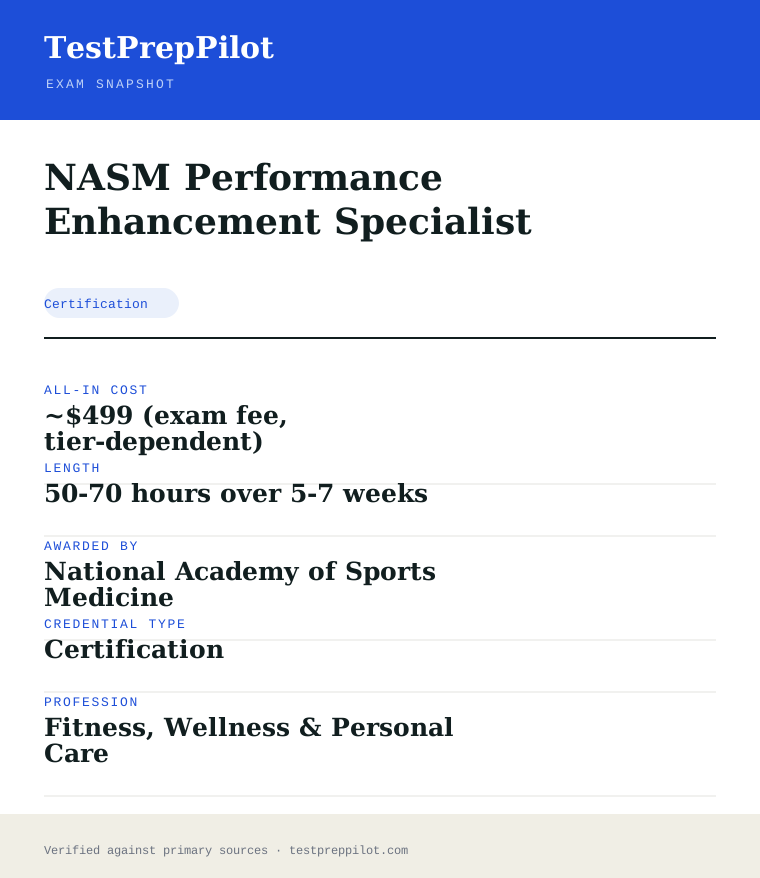
NASM Performance Enhancement Specialist is a certification credential; awarded by National Academy of Sports Medicine; the exam fee is ~$499; typical preparation is 50-70 hours over 5-7 weeks; holders typically earn $25,000-$65,000 (39-9031 median $46,180).
| Credential | NASM Performance Enhancement Specialist |
|---|---|
| Abbreviation | NASM-PES |
| Type | Certification |
| Profession | Fitness, Wellness & Personal Care |
| Specialty | Fitness, Sport & Recreation |
| Awarded by | National Academy of Sports Medicine |
| Difficulty | Entry to Applied |
| Typical prep time | 50-70 hours over 5-7 weeks |
| All-in cost | ~$499 (exam fee, tier-dependent) |
| Typical salary range | $25,000-$65,000 (39-9031 median $46,180) |
| Credential | NASM Performance Enhancement Specialist |
| Awarding body | National Academy of Sports Medicine |
| Exam format | Proctored, computer-based |
| Validity | Valid 2 years (renewal with CEUs) |
| Languages | Varies — see awarding body |
| Scope | National / Multi-state |
Real questions
Frequently asked questions about the NASM Performance Enhancement Specialist
How do I register for the NASM Performance Enhancement Specialist exam?
Register through National Academy of Sports Medicine's official portal or an authorized test provider (e.g., Pearson VUE or Prometric where applicable). Create an account, select the exam, pay the fee, and schedule a date.
How much does the exam cost?
Fees vary by location and currency. Confirm the current fee on the official registration page before scheduling.
How long is the credential valid, and how do I renew?
Validity varies by credential (commonly 2–3 years). Renewal usually requires continuing education or a recertification exam — see National Academy of Sports Medicine's policy.
What if I do not pass?
Most bodies allow retakes after a waiting period and payment of the full or partial fee. Check National Academy of Sports Medicine's retake policy before rescheduling.
Does the NASM-CNC make me a Registered Dietitian?
No. The CNC is a coaching specialization within a defined scope of practice. A Registered Dietitian Nutritionist (RDN) requires a master's degree, an ACEND-accredited supervised practice, and passing the CDR registration exam, and can provide medical nutrition therapy.
Can I take the exam from home?
Yes. The CNC exam is online, open-book, and timed at 90 minutes — you take it from your own computer, with no test center or proctor required.
How long do I have to finish?
You have five years of course access from purchase and must complete the exam within one year (365 days) of your enrollment date. Up to three attempts are included.
In short
Is the NASM Performance Enhancement Specialist worth it?
- NASM Performance Enhancement Specialist is awarded by National Academy of Sports Medicine.
- Validates job-ready competence in Beauty, Food, Security & Recreation.
- Registration is through the awarding body or an authorized test provider.
- Renewal and retake policies vary — confirm before scheduling.
Same awarding body
What other credentials does National Academy of Sports Medicine award?
Worth comparing
How does the NASM Performance Enhancement Specialist compare with similar credentials?
Trust
Where does this information come from?
Everything above is taken from the awarding body's own published material. Fees, question counts and domain weights are revised regularly — check the official page before you pay.
- National Academy of Sports Medicine certification programme Programme rules
Research confidence: low · Last reviewed 2026-08