The short version
What is the Massage and Bodywork Licensing Examination and is it worth it?
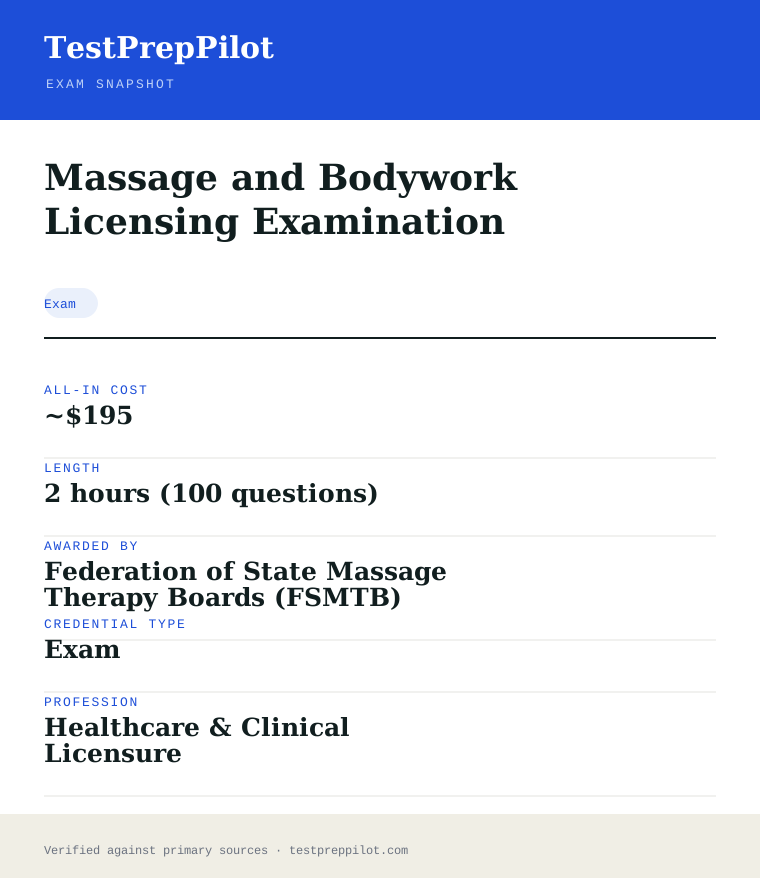
Massage and Bodywork Licensing Examination is a professional credential administered by Federation of State Massage Therapy Boards (FSMTB). It validates job-ready knowledge and skills in the Healthcare (Clinical) field and is used for career entry, advancement, or compliance.
- Recognized credential from Federation of State Massage Therapy Boards (FSMTB)
- Demonstrates verified competence in Healthcare (Clinical)
- Supports career advancement and may satisfy licensing or employer requirements
What is it?
What exactly is the Massage and Bodywork Licensing Examination?
Massage and Bodywork Licensing Examination — Healthcare (Clinical) credential from Federation of State Massage Therapy Boards (FSMTB)
National examination required for massage therapist licensure in most U.S. states. Offered by Federation of State Massage Therapy Boards (FSMTB), it is designed for candidates who need to demonstrate verified competence in the Healthcare (Clinical) field. The credential is commonly used for career entry, advancement, regulatory compliance, or employer requirements. Candidates should review the official handbook for eligibility, exam format, and scoring before registering.
The path in brief
- Confirm you meet any eligibility or prerequisites
- Review the official handbook and study materials
- Register and pay through the awarding body or authorized provider
- Schedule and take the exam (test center or online proctoring)
- Receive your score and, if passed, your credential
Before you book
Who is eligible to sit the Massage and Bodywork Licensing Examination?
Eligibility varies; many credentials are open to all, while others require coursework, work experience, or sponsorship.
Who it is for: Professionals and candidates seeking to validate Healthcare (Clinical) competence.
The test itself
What is the format of the Massage and Bodywork Licensing Examination?
The Massage and Bodywork Licensing Examination is administered by Federation of State Massage Therapy Boards (FSMTB) and runs 2 hours and contains 100 questions.
| Administered by | Federation of State Massage Therapy Boards (FSMTB) |
|---|---|
| Questions | 100 |
| Time limit | 2 hours |
| Pass mark | Passing score set by the awarding body; see the official score report |
| Exam fee | Varies by location and currency — confirm on the official registration page |
| Format | Proctored, computer-based (test center or online remote proctoring) |
Content outline
What topics are on the Massage and Bodywork Licensing Examination?
The Massage and Bodywork Licensing Examination covers 4 content domains.
Weightings come from the official exam outline. Study time is best allocated in roughly these proportions rather than evenly across domains.
- Clinical knowledge
Topic area tested on the exam; see the official blueprint for the detailed breakdown.
- Diagnosis & treatment
Topic area tested on the exam; see the official blueprint for the detailed breakdown.
- Patient safety
Topic area tested on the exam; see the official blueprint for the detailed breakdown.
- Professional practice
Topic area tested on the exam; see the official blueprint for the detailed breakdown.
The path
How do you register for the Massage and Bodywork Licensing Examination?
- 1
Visit the awarding body’s official website and create an account
- 2
Select the credential and review its specific requirements
- 3
Complete any required eligibility (education, experience, or training)
- 4
Pay the registration fee
- 5
Schedule the exam at a test center or online
- 6
Take the exam and receive your results
The fine print
What are the retake and renewal rules for the Massage and Bodywork Licensing Examination?
- Proctoring & delivery
- Proctored, computer-based delivery (test center or remote online proctoring), varying by exam.
- Retake policy
- Varies by credential — most bodies permit retakes after a waiting period and full or partial fee.
- Score reporting
- Scores are reported per the body’s timeline, typically electronically after the exam.
- Recertification
- Varies; many credentials require renewal every 2–3 years via continuing education or a recertification exam.
What it pays
How much does this credential pay?
$57,400 median for massage therapists (BLS, May 2024)
There is no Bureau of Labor Statistics occupation called "MBLEx" — the Massage and Bodywork Licensing Examination is the licensing exam used by most states that license massage therapists, and the wage question belongs to the occupation you enter with it. The closest official BLS occupation is Massage Therapists, SOC 31-9011, which had a May 2024 median wage of $57,400, with the lowest 10 percent under $28,700 and the highest 10 percent above $94,470. The fit is direct: passing the MBLEx (or the state-approved alternative) plus the state requirements licenses you to practice massage, and BLS counted 168,300 massage therapist jobs in 2024, projecting 18 percent growth from 2024 to 2034 — much faster than the average for all occupations — with about 20,400 openings a year. The limitation to state plainly: the BLS median covers all massage therapists, licensed or not, and massage income is session- and tip-based, so the median blends part-time and full-time practitioners; established therapists with a client book earn above the median, while new licensees building a practice earn below it. Read the number as the market for the occupation the licence unlocks, and note that employment setting — spa, clinic or self-employed — drives the range as much as skill.
| Measure | Figure | Source / note |
|---|---|---|
| Median annual wage, massage therapists | $57,400 | BLS OOH, SOC 31-9011, May 2024 |
| Lowest 10 percent | Under $28,700 | BLS OOH, SOC 31-9011, May 2024 |
| Highest 10 percent | Above $94,470 | BLS OOH, SOC 31-9011, May 2024 |
| Projected openings per year | ~20,400 | BLS OOH, SOC 31-9011, 2024-2034 |
Job growth.BLS projects 18 percent growth for massage therapists from 2024 to 2034, about 20,400 openings per year.
Source: BLS Occupational Outlook Handbook - Massage Therapists
Your odds
What are the pass rates?
FSMTB publishes the format and passing-standard structure, and reports pass rates by year in its annual data
The Federation of State Massage Therapy Boards (FSMTB) publishes pass-rate information for the MBLEx in its annual reports, and the reported first-attempt pass rate has historically clustered in the roughly 65-75 percent range in recent cycles; we present it as the board's own reporting, noting the figure varies by year. What the FSMTB also publishes is the format: the MBLEx has 100 scored multiple-choice questions with a 2-hour time limit (110 minutes of testing time including the tutorial), delivered by computer at PSI testing centres, and the result is reported as pass/fail. The exam content follows the published exam blueprint: anatomy and physiology; kinesiology; pathology, contraindications, areas of caution and special populations; benefits and physiological effects of techniques; client assessment, treatment planning and documentation; ethics, boundaries, laws and regulations; and guidelines for professional practice. The practical reading: the published pass rate reflects a demanding licensure exam, and the strongest predictor of success is structured preparation — candidates who complete an accredited massage program (600-1,000 hours typically) and drill the blueprint with practice exams pass at higher rates than the overall cohort.
Read this before quoting the number.FSMTB publishes pass-rate data that varies by year; the figure above is the recent reported range, not a fixed number.
Source: FSMTB - Massage and Bodywork Licensing Examination (MBLEx)
Your schedule
How long should I study for it?
80-140 hours over 8-12 weeks (after an accredited program) of focused study
The MBLEx is a 100-question, 2-hour exam built on the published blueprint: anatomy and physiology, kinesiology, pathology and contraindications, the benefits and effects of techniques, client assessment and treatment planning, ethics and law, and professional practice. A defensible plan runs 80 to 140 hours over 8 to 12 weeks, ideally on top of an accredited massage program. Weeks 1-3: anatomy and physiology and kinesiology — the bones, muscles, origins and insertions, and joint movements — the largest content area, using flashcards for the muscle names and actions. Weeks 4-5: pathology and contraindications — the conditions that affect treatment decisions and the areas of caution. Weeks 6-7: techniques and client care — the benefits and effects of the modalities, client assessment, documentation and treatment planning. Weeks 8-9: ethics, laws and professional practice — the scope of practice, boundaries and the state regulations. Weeks 10-12: practice-exam drilling in volume and full timed practice exams at the real format. The plan is science-heavy because the anatomy and pathology items dominate; candidates who memorise techniques but skip the science fail the largest block.
- Weeks 1-340
Anatomy, physiology, kinesiology
- Bones, muscles, origins, insertions and actions
- Joint movements and the body systems
- Flashcards for muscle terminology
- Weeks 4-525
Pathology and contraindications
- Conditions and their treatment implications
- Areas of caution and special populations
- Contraindication scenarios
- Weeks 6-725
Techniques and client care
- Benefits and effects of the modalities
- Client assessment and documentation
- Treatment planning
- Weeks 8-920
Ethics, law, practice
- Scope of practice and boundaries
- Laws, regulations and professional practice
- Ethics scenarios
- Weeks 10-1225
Drill and mocks
- Practice-exam drilling in volume
- Two full timed practice exams
- Review weak blueprint areas
Adjusting the pace
Recent massage-program graduate.The anatomy and technique content is fresh; focus study on pathology, ethics and the exam format.
Transferring from another state.Confirm whether your state accepts the MBLEx or requires an alternative; the study plan is unchanged.
How to study
How do I prepare most effectively?
The MBLEx rewards systematic coverage of the science-heavy blueprint, so the dominant strategy is anatomy-first study: the muscle names, origins, insertions and actions, and the kinesiology concepts, are the largest content area, and flashcards are the most effective tool for them. Second, learn the pathology and contraindication material as decision rules: the exam asks which condition changes the treatment or is an area of caution, so practise scenario items rather than memorising lists. Third, master the ethics and law block deliberately — scope of practice, boundaries and the state regulations are a distinct tested area that candidates focused on technique often miss. Fourth, use MBLEx-style practice exams and hold yourself to 80 percent-plus on practice, because the licensure pass line leaves little margin. Finally, take at least two full timed practice exams at the real 100-question, 2-hour format; the stamina and the exam interface are part of the test.
Study anatomy first
Muscles, origins, insertions and actions are the largest content area.
Learn pathology as decisions
Which condition changes treatment or is an area of caution.
Drill ethics and law
Scope of practice, boundaries and regulations are a distinct block.
Hold to 80%+ on practice
The licensure pass line leaves little margin.
Run two full timed mocks
100 questions in 2 hours; the stamina is part of the test.
What to buy
Which study resources are worth paying for?
MBLEx prep costs are dominated by the training program, not the exam materials. Accredited massage programs run roughly $5,000 to $15,000 depending on the institution and the state's required hours (commonly 600-1,000). Exam materials are modest: the FSMTB exam blueprint (free), MBLEx study guides ($40-$100), anatomy flashcards ($20-$50) and practice-exam products ($30-$100). Many schools bundle review materials with the program. The exam fee is about $195 plus the state's licensing fee. A realistic total budget is $5,500 to $16,000 including the program. Prices below are list prices as of mid-2026 and change frequently; we rank nothing by commission.
| Resource | Price | Format | Best for |
|---|---|---|---|
| FSMTB exam blueprint | Free | Official PDF | The authoritative scope; read it first |
| Accredited massage program | $5,000-$15,000 | Classroom + clinical hours | The training-hour requirement and core learning |
| MBLEx study guides | $40-$100 | Printed or digital book | Structured blueprint coverage |
| Anatomy flashcards and practice exams | $20-$100 | Flashcards and online practice | Muscle terminology and exam-style drilling |
| MBLEx exam | ~$195 | Computer-based exam | The licensure gate |
List prices as of mid-2026, subject to change; the MBLEx fee is about $195; no commission or affiliate ranking is implied.
Avoid these
What mistakes do candidates most often make?
The most common MBLEx mistake is studying techniques and skipping the science: candidates who memorise modalities but cannot name muscles or identify contraindications fail the largest content blocks. The fix is anatomy-first study. The second mistake is treating pathology as a memorisation list instead of learning the decision rules; the exam asks what changes in treatment, so practise scenarios. Third, candidates under-prepare ethics and law, a distinct tested block. Fourth, some candidates never take a timed practice exam and misjudge the 2-hour pace. Finally, candidates who do not complete an accredited program first arrive at the exam without the clinical foundation and the state-hour requirement; confirm the education path before studying for the test.
✕Studying techniques, not science
✓Anatomy, kinesiology and pathology are the largest blocks; study them first.
✕Memorising pathology lists
✓Learn the decision rules: what changes treatment or is an area of caution.
✕Skipping ethics and law
✓Scope of practice and regulations are a distinct tested block.
✕Never timing a practice exam
✓100 questions in 2 hours; run two timed practice exams.
✕Skipping the accredited program
✓The program provides the clinical foundation and the state-hour requirement.
What you'll face
What question types will I see?
The MBLEx is a 100-question multiple-choice exam in 2 hours. The items span the blueprint with heavy concentration on anatomy and physiology, kinesiology, and pathology and contraindications, plus client care, ethics and law. Many items are scenario-based — a client presentation or treatment situation followed by the correct assessment, technique decision or contraindication. Samples below are editor-written illustrations of the published blueprint, not live exam items; they show the clinical-decision style of the real items.
Muscles, actions, joints and body systems.
Conditions, areas of caution and treatment decisions.
Assessment, documentation, boundaries and regulations.
Try these
Q1Which muscle is the primary mover in shoulder abduction?
Answer:A
The deltoid is the primary abductor of the shoulder. The biceps flexes the elbow, the pectoralis major adducts and internally rotates the arm, and the trapezius moves the scapula.
Q2A client reports a recent deep-vein thrombosis. The appropriate massage-therapy response is:
Answer:A
Deep-vein thrombosis is a serious contraindication for massage; the therapist should not treat and should refer the client to their provider. Massaging the affected leg, ignoring the condition or applying heat each risk dislodging the clot.
Q3When a client asks a therapist to keep a session confidential from their physician, the therapist's best response is guided by:
Answer:A
Therapist conduct is guided by professional boundaries and documentation standards: medical contraindications and safety concerns should be communicated to the appropriate providers, and confidentiality follows professional practice rules. The client's request alone, spa policy or unconditional preference do not override professional duties.
Samples are editor-written illustrations of the published blueprint, not live exam items.
The big day
What should I expect on exam day?
The MBLEx is a 100-question, 2-hour computer-based exam at a PSI testing centre. Bring the required identification matching your registration and your exam confirmation; personal items go in the locker. Arrive early — late arrivals may forfeit the appointment and fee. Pace at about 66 seconds per item, flag uncertain items for review, and finish with time to spare. Your result is reported as pass/fail after the exam, and the FSMTB sends your score to the state board you designated. If you do not pass, the retake policy defines the waiting period and the reduced retake fee. On a pass, the MBLEx result is used for state licensure, and you complete any remaining state requirements before the licence is issued. The afterwards matters: confirm your state's application steps, because the licence is issued by the state board, not by the FSMTB.
Bring
- Required identification matching your registration
- Exam confirmation
Leave at home
- Phone, smartwatch and all electronics
- Notes and study materials
- Personal bags beyond what the centre allows
How the day runs
Rules in the room
- The exam is computer-based and closed book
- 100 questions in 2 hours; the clock does not pause
- The licence is issued by your state board after the remaining requirements
Afterwards.On a pass, complete the state licensure application. On a fail, retake per the FSMTB policy after additional blueprint study.
Reference
What are the key facts about the Massage and Bodywork Licensing Examination?
Massage and Bodywork Licensing Examination is a exam credential; awarded by Federation of State Massage Therapy Boards (FSMTB); the exam fee is Varies by location and currency — confirm on the official registration page; typical preparation is 2 hours (100 questions); holders typically earn $29,000-$94,000.
| Credential | Massage and Bodywork Licensing Examination |
|---|---|
| Abbreviation | MBLEx |
| Type | Exam |
| Profession | Healthcare & Clinical Licensure |
| Specialty | Other Clinicians |
| Awarded by | Federation of State Massage Therapy Boards (FSMTB) |
| Difficulty | Advanced |
| Typical prep time | 2 hours (100 questions) |
| All-in cost | ~$195 |
| Typical salary range | $29,000-$94,000 |
| Credential | Massage and Bodywork Licensing Examination |
| Awarding body | Federation of State Massage Therapy Boards (FSMTB) |
| Exam format | Proctored, computer-based |
| Validity | The MBLEx result is used for state licensure; the licence renews per state. |
| Languages | Varies — see awarding body |
| Scope | National / Multi-state |
| Also known as | Massage Licensure Exam |
Real questions
Frequently asked questions about the Massage and Bodywork Licensing Examination
How do I register for the Massage and Bodywork Licensing Examination exam?
Register through Federation of State Massage Therapy Boards (FSMTB)'s official portal or an authorized test provider (e.g., Pearson VUE or Prometric where applicable). Create an account, select the exam, pay the fee, and schedule a date.
How much does the exam cost?
Fees vary by location and currency. Confirm the current fee on the official registration page before scheduling.
How long is the credential valid, and how do I renew?
The MBLEx result is used for state licensure, and the licence renews on your state's cycle; the exam result itself does not expire for licensing purposes.
What if I do not pass?
Most bodies allow retakes after a waiting period and payment of the full or partial fee. Check Federation of State Massage Therapy Boards (FSMTB)'s retake policy before rescheduling.
How do I register for a Federation of State Massage Therapy Boards (FSMTB) credential?
Register through the official website, select your exam, pay the fee, and schedule a date.
How do I renew a credential?
Renewal policies vary by credential; check the specific program page for requirements and cycles.
In short
Is the Massage and Bodywork Licensing Examination worth it?
- Massage and Bodywork Licensing Examination is awarded by Federation of State Massage Therapy Boards (FSMTB).
- Validates job-ready competence in Healthcare (Clinical).
- Registration is through the awarding body or an authorized test provider.
- Renewal and retake policies vary — confirm before scheduling.
Trust
Where does this information come from?
Everything above is taken from the awarding body's own published material. Fees, question counts and domain weights are revised regularly — check the official page before you pay.
Research confidence: low · Last reviewed 2026-08