Healthcare & Clinical Licensure • Certification
ANCC Family Nurse Practitioner Certification
ANCC Family Nurse Practitioner Certification — Healthcare (Clinical) credential from American Nurses Credentialing Center (ANCC)
Researched and maintained by TestPrepPilot Editorial BoardAdvanced practice nursing & clinical credentials desk · Figures last verified August 2026
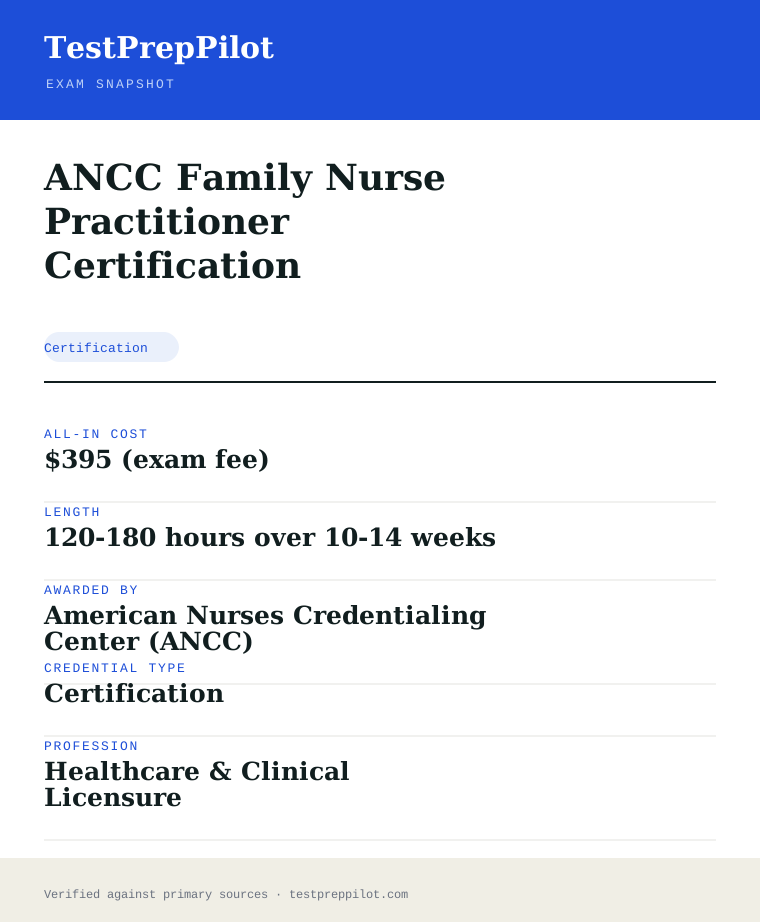
The short version
What is the ANCC Family Nurse Practitioner Certification and is it worth it?
ANCC Family Nurse Practitioner Certification is a professional credential administered by American Nurses Credentialing Center (ANCC). It validates job-ready knowledge and skills in the Healthcare (Clinical) field and is used for career entry, advancement, or compliance.
- Recognized credential from American Nurses Credentialing Center (ANCC)
- Demonstrates verified competence in Healthcare (Clinical)
- Supports career advancement and may satisfy licensing or employer requirements
What is it?
What exactly is the ANCC Family Nurse Practitioner Certification?
ANCC Family Nurse Practitioner Certification — Healthcare (Clinical) credential from American Nurses Credentialing Center (ANCC)
National certification exam for family nurse practitioners credentialed through the American Nurses Credentialing Center. Offered by American Nurses Credentialing Center (ANCC), it is designed for candidates who need to demonstrate verified competence in the Healthcare (Clinical) field. The credential is commonly used for career entry, advancement, regulatory compliance, or employer requirements. Candidates should review the official handbook for eligibility, exam format, and scoring before registering.
The path in brief
- Confirm you meet any eligibility or prerequisites
- Review the official handbook and study materials
- Register and pay through the awarding body or authorized provider
- Schedule and take the exam (test center or online proctoring)
- Receive your score and, if passed, your credential
Before you book
Who is eligible to sit the ANCC Family Nurse Practitioner Certification?
Eligibility varies; many credentials are open to all, while others require coursework, work experience, or sponsorship.
Who it is for: Professionals and candidates seeking to validate Healthcare (Clinical) competence.
The test itself
What is the format of the ANCC Family Nurse Practitioner Certification?
The ANCC Family Nurse Practitioner Certification is administered by American Nurses Credentialing Center (ANCC) and runs 3.5 hours and contains 150 questions.
| Administered by | American Nurses Credentialing Center (ANCC) |
|---|---|
| Questions | 150 questions |
| Time limit | 3.5 hours |
| Pass mark | Passing score set by the awarding body; see the official score report |
| Exam fee | $395 |
| Format | Proctored, computer-based (test center or online remote proctoring) |
Content outline
What topics are on the ANCC Family Nurse Practitioner Certification?
The ANCC Family Nurse Practitioner Certification covers 4 content domains.
Weightings come from the official exam outline. Study time is best allocated in roughly these proportions rather than evenly across domains.
- Clinical knowledge
Topic area tested on the exam; see the official blueprint for the detailed breakdown.
- Diagnosis & treatment
Topic area tested on the exam; see the official blueprint for the detailed breakdown.
- Patient safety
Topic area tested on the exam; see the official blueprint for the detailed breakdown.
- Professional practice
Topic area tested on the exam; see the official blueprint for the detailed breakdown.
Study materials
Which study guide should you use for the ANCC Family Nurse Practitioner Certification?
Start with the exam sponsor's official content outline. If you also want one structured resource to work through, these are the Mometrix titles that match this exam.

Affiliate links We may earn a commission if you buy through these links, at no extra cost to you. Mometrix has no say in what our exam guides cover. How we make money.
The path
How do you register for the ANCC Family Nurse Practitioner Certification?
- 1
Visit the awarding body’s official website and create an account
- 2
Select the credential and review its specific requirements
- 3
Complete any required eligibility (education, experience, or training)
- 4
Pay the registration fee
- 5
Schedule the exam at a test center or online
- 6
Take the exam and receive your results
The fine print
What are the retake and renewal rules for the ANCC Family Nurse Practitioner Certification?
- Proctoring & delivery
- Proctored, computer-based delivery (test center or remote online proctoring), varying by exam.
- Retake policy
- Varies by credential — most bodies permit retakes after a waiting period and full or partial fee.
- Score reporting
- Scores are reported per the body’s timeline, typically electronically after the exam.
- Recertification
- Varies; many credentials require renewal every 2–3 years via continuing education or a recertification exam.
What it pays
How much does this credential pay?
$132,050 median for nurse anesthetists, nurse midwives and nurse practitioners (BLS, May 2024)
The direct answer is that the BLS group that contains family nurse practitioners — Nurse Anesthetists, Nurse Midwives, and Nurse Practitioners — had a May 2024 median wage of $132,050, and the nurse practitioner occupation on its own (SOC 29-1171) carried a median of $129,210, so an FNP-BC holder is benchmarking against an occupation with a six-figure national median. Two caveats matter when reading the number. First, BLS classifies by job duties rather than by certificate, so the figure describes nurse practitioners as an occupation, not FNP-BC holders specifically — but since the FNP-BC is the dominant board certification for primary-care NPs, it is a fair benchmark. Second, the distribution is wide and setting-sensitive: pay varies by state, by employer, and by whether the NP works in primary care, acute care or a specialty, and the lowest 10 percent of the occupation sits well below the median while the highest 10 percent is well above it. BLS counted 382,700 jobs in the APRN group in 2024 and projects 35 percent growth from 2024 to 2034 — much faster than average — with about 32,700 openings a year, making this one of the strongest demand profiles in healthcare. The credential itself matters to that trajectory: the FNP-BC is an entry requirement for virtually every NP position, so the exam fee is the gate to the occupation, and the salary benchmark is the role, not the certificate. The honest framing is that the FNP-BC does not create the wage — it is the entry ticket to an occupation with a $132,050 median and sustained double-digit growth.
| Measure | Figure | Source / note |
|---|---|---|
| Median annual wage, nurse anesthetists, nurse midwives & nurse practitioners | $132,050 | BLS OOH, May 2024 |
| Median annual wage, nurse practitioners (SOC 29-1171) | $129,210 | BLS OOH / OEWS, May 2024 |
| Lowest 10 percent (APRN group) | Below $92,480 | BLS OOH Pay tab, May 2024 |
| Highest 10 percent (APRN group) | Above $201,970 | BLS OOH Pay tab, May 2024 |
| Employment, 2024 | 382,700 jobs | BLS OOH Quick Facts, 2024 |
| Projected growth, 2024-34 | 35% (much faster than average) | BLS OOH Job Outlook, ~32,700 openings/year |
Job growth.BLS projects 35 percent growth for nurse anesthetists, nurse midwives and nurse practitioners from 2024 to 2034 — much faster than the 3 percent average — with about 32,700 openings a year.
Source: BLS Occupational Outlook Handbook - Nurse Anesthetists, Nurse Midwives, and Nurse Practitioners
Your odds
What are the pass rates?
ANCC publishes pass rates — the FNP-BC first-time pass rate was 83 percent in 2024 (7,751 first-time candidates)
The direct answer is that ANCC publishes certification pass rates, and for the FNP-BC the 2024 data shows an 83 percent first-time pass rate across 7,751 first-time candidates — not the roughly 70 percent figure that circulates in older online posts. The trend matters more than the single year: ANCC’s published data shows the FNP-BC first-time pass rate at 87 percent in 2021, 86 percent in 2022, 85 percent in 2023 and 83 percent in 2024, so the number has declined steadily for several years and candidates should not assume the older, higher figures still hold. The exam itself is 175 questions — 150 scored plus 25 unscored pretest items — in a 3.5-hour window, scored on a 0-500 scale with a passing scaled score of 350, and it is delivered by computer at Prometric testing centres year-round within a 120-day testing window. The pass rate is published for first-time candidates and includes all eligible degree pathways, which matters because the pool mixes graduates of different program types; ANCC notes the proportion of candidates from different program backgrounds affects the aggregate rate. The honest reading is that an 83 percent first-time rate is high in absolute terms but has been drifting down, and the exam’s broader scope — clinical content plus professional role, research and policy — is the differentiator from the more purely clinical AANP exam. Renewal is every 5 years, and the exam fee is $395 for non-members, $295 for ANA members and $340 for AANP members.
Read this before quoting the number.ANCC publishes pass rates in its certification data. The 2024 FNP-BC first-time pass rate is 83 percent, down from 87 percent in 2021; the older ~70 percent figure is not supported by ANCC’s published data.
Source: ANCC - Family Nurse Practitioner Certification (FNP-BC)
Your schedule
How long should I study for it?
100-150 hours over 8-12 weeks (6-8 weeks for a recent graduate) of focused study
The FNP-BC is a broad competency exam — 175 questions (150 scored plus 25 pretest) in 3.5 hours, covering the full primary-care lifespan — so the plan must be weighted to clinical management across all patient populations while also covering the non-clinical content that distinguishes ANCC from the AANP exam. The ANCC content domains emphasise assessment, diagnosis, planning, implementation and evaluation of care, plus professional role, research and policy content; a realistic plan runs 100 to 150 hours across 8 to 12 weeks for a candidate coming off a full FNP program, or 6 to 8 weeks for a recent graduate still in test-taking shape. Weeks one and two should baseline: one full-length practice exam under real timing, then a domain-by-domain score log. Weeks three through seven should build the clinical core — lifespan primary care, women’s health, pediatrics, geriatrics, acute presentations, pharmacotherapeutics and diagnostic reasoning — using question banks organised by system and population, because the exam rewards applied clinical decision-making rather than recall. Weeks eight and nine should cover the ANCC-specific content candidates under-prepare: professional role, healthcare policy and delivery systems, and research and evidence-based practice. Weeks ten through twelve should be timed practice exams and error-log review, because the 3.5-hour format is a stamina event and the 25 unscored pretest items make pacing important. Candidates who pass tend to be the ones who ran at least three full timed sittings and closed their domain gaps rather than re-reading notes.
- Weeks 1-216 hrs
Baseline and domain mapping
- Take one full-length timed practice exam and log scores by content domain
- Identify your weakest populations and systems from the baseline
- Review the ANCC test content outline and item weighting
- Set a weekly hour budget and a target score above the 350 passing scaled score
- Weeks 3-712 hrs/week
Clinical core across the lifespan
- Work lifespan primary care: well adult, women’s health, pediatric, geriatric and acute presentations
- Drill diagnostic reasoning and differential diagnosis for common presentations
- Master pharmacotherapeutics: drug classes, interactions, contraindications and prescribing safety
- Use question banks organised by system and population; log every miss and re-read the rationale
- Weeks 8-910 hrs/week
ANCC-specific content
- Study the professional role: scope of practice, collaboration, professional standards and ethics
- Cover healthcare policy and delivery systems: insurance mechanisms, reimbursement and federal policy
- Review research and evidence-based practice: study designs, levels of evidence and applying research to practice
- This is the content that distinguishes the ANCC exam from the AANP exam — do not skip it
- Weeks 10-1210-12 hrs/week
Timed exams and gap closing
- Take at least three full 3.5-hour timed practice exams under test conditions
- Re-lab every miss by domain rather than re-reading it
- Final pass over pharmacotherapeutics and the ANCC-specific content
- One quiet day before the exam
Adjusting the pace
Recent FNP graduate.Six to eight weeks at 15-20 hrs/week; you are already in clinical reasoning shape, so weight the plan to the ANCC-specific role, policy and research content and timed exams.
Working NP re-certifying.Ten to twelve weeks at 8-10 hrs/week, weighted to your practice population first and your weakest domains second; your day job covers much of the clinical core.
Choosing between ANCC and AANP.The AANP FNP-C is more purely clinical (150 questions, 3 hours); the ANCC FNP-BC adds role, policy and research content. Choose by your strengths and program emphasis.
How to study
How do I prepare most effectively?
The strategy that reliably moves FNP-BC scores is "weight clinical decision-making across the lifespan, cover the ANCC-specific content, and run full-length timed exams", and the single biggest error is focusing on recall questions while the exam rewards applied management. Second, learn the content domains and weight study to the largest ones first — assessment, diagnosis, planning, implementation and evaluation — then layer on pharmacotherapeutics, which threads through every domain. Third, study the ANCC-specific areas deliberately: professional role, healthcare policy and delivery systems, and research and evidence-based practice are the content that separates the FNP-BC from the AANP exam and the areas candidates under-prepare. Fourth, use question banks as the primary tool and treat every miss as a curriculum pointer, re-reading the rationale and the guideline behind it rather than memorising the answer. Fifth, run at least three full 3.5-hour timed sittings, because the format is a stamina event and the 25 unscored pretest items mean you cannot let up on any item. Finally, manage the logistics early: apply for the exam with a 120-day testing window, confirm your eligibility documents (RN license, FNP master’s/post-graduate certificate/DNP from an accredited program, 500 faculty-supervised clinical hours, three APRN core courses), and use the member pricing if you belong to ANA or AANP.
Weight applied clinical decision-making
The exam tests management — assessment, diagnosis, planning, implementation, evaluation — across the lifespan. Study how to manage a presentation, not just what it is called.
Study the ANCC-specific content
Professional role, healthcare policy and delivery systems, and research and evidence-based practice distinguish the FNP-BC from the AANP exam. Candidates who skip these lose a share of the paper.
Use question banks as the core tool
Treat every miss as a curriculum pointer and re-read the rationale and the guideline behind it. Volume plus rationale review beats re-reading textbooks.
Master pharmacotherapeutics
Drug classes, interactions, contraindications and prescribing safety thread through every clinical domain and are high-yield, learnable points.
Run three full timed sittings
The 3.5-hour format with 25 unscored pretest items is a stamina and pacing event. Full-length rehearsals are the honest readiness signal.
Manage eligibility and pricing early
Confirm your RN license, accredited FNP program, 500 supervised clinical hours and three APRN core courses, and use ANA or AANP member pricing before applying.
What to buy
Which study resources are worth paying for?
FNP-BC preparation splits into four buckets: the free ANCC materials, question-bank and review courses, textbooks, and the exam fee itself. The ANCC exam page and test content outline are free and authoritative for structure and content domains; the ANCC also publishes the pass-rate data used on this page. The dominant commercial tools are NP-specific question banks and review courses — UWorld, Rosh Review and similar platforms dominate because the exam rewards applied clinical reasoning, and their case-based rationales are the highest-yield study resource. Comprehensive review books such as Fitzgerald and the Barkley review materials are the traditional structured option, and are strongest when paired with a question bank. The exam fee is $395 for non-members, $295 for ANA members and $340 for AANP members, and the member discounts can exceed the cost of membership, which is a legitimate money-saving step. A defensible budget is $300 to $800 for prep on top of the exam fee, depending on whether you buy a question-bank subscription, a review course, or both. Prices below are current as of mid-2026 and change frequently; we rank nothing by commission.
| Resource | Price | Format | Best for |
|---|---|---|---|
| ANCC exam page and test content outline | Free | Official page and PDF outline | Structure, content domains and eligibility — start here |
| UWorld FNP question bank | $150-$250 | Online case-based questions with rationales | Applied clinical reasoning and volume — the highest-yield tool |
| Rosh Review FNP | $150-$250 | Online adaptive question bank | Candidates who want spaced repetition and progress tracking |
| Fitzgerald / Barkley review courses | $400-$800 | Video and live review with materials | Structured candidates who want a taught syllabus plus a question bank |
| FNP review textbooks | $50-$120 | Print or eBook | Reference depth behind the question bank |
| Exam registration | $395 non-member; $295 ANA; $340 AANP | Computer-based, 3.5 hours, Prometric | The exam itself — the member discount can exceed membership cost |
Prices current as of mid-2026 and subject to change; ANCC fees include a $140 non-refundable administrative fee. No commission or affiliate ranking is implied.
Avoid these
What mistakes do candidates most often make?
The most common mistake on the FNP-BC is studying recall-heavy content while the exam rewards applied clinical management: candidates who can define a condition but cannot manage the presenting patient in the question lose the items that matter. The fix is to study presentation-to-management flows. The second mistake is skipping the ANCC-specific content — professional role, policy and research — because it feels non-clinical; it is a real share of the paper and where candidates under-prepare. Third, candidates mismanage pacing on the 3.5-hour, 175-item format and rush the final third of the exam; full timed sittings are the fix. Fourth, candidates ignore the 25 unscored pretest items and waste energy trying to identify them; they are indistinguishable by design. Fifth, many candidates sit before closing their weakest domains, drawn by a high published pass rate; the 83 percent figure includes candidates who are not representative of your preparation level. Finally, candidates miss the eligibility details — the 500 supervised clinical hours and three APRN core courses are hard requirements, and an application that fails eligibility wastes time and money.
✕Studying recall when the exam tests management
✓Study presentation-to-management flows: for every condition, know assessment, diagnosis, plan, implementation and evaluation.
✕Skipping role, policy and research content
✓Professional role, healthcare policy and delivery systems, and evidence-based practice are a real share of the FNP-BC — study them deliberately.
✕Mismanaging the 3.5-hour format
✓Run at least three full timed sittings; the 175-item format punishes candidates who never rehearsed the full window.
✕Trying to identify the 25 pretest items
✓Treat all 175 items as scored; pretests are indistinguishable by design and all require the same effort.
✕Sitting before closing weak domains
✓The published 83 percent first-time rate is not your personal probability. Re-sit practice exams until every domain is above your target before booking.
✕Overlooking eligibility requirements
✓Confirm 500 supervised clinical hours, three APRN core courses and program accreditation before applying — eligibility failure wastes the fee and the window.
What you'll face
What question types will I see?
The FNP-BC is a 175-question exam — 150 scored plus 25 unscored pretest items — delivered by computer in 3.5 hours, scored on a 0-500 scale with a passing score of 350. ANCC states the exam is competency-based and all questions are multiple-choice; the dominant style is clinical case-based, where you are given a patient presentation, history and findings and asked for the most likely diagnosis, the most appropriate treatment, or the next best step. A meaningful share of items test the ANCC-specific domains — research and evidence-based practice, health policy and delivery systems, and the professional role — with questions such as interpreting a study design or applying a guideline. There are no essay or simulation items on the FNP-BC. The exam is weighted across assessment, diagnosis, planning, implementation and evaluation of care, and pharmacotherapeutics threads through the clinical items. The samples below are editor-written illustrations of the published blueprint, not live exam items; they show the case-based phrasing and the distinction between the clinical and the role-policy-research items.
A patient presentation with history and findings; the item asks the most likely diagnosis, most appropriate treatment, or next best step.
Drug selection, dosing, interactions, contraindications and prescribing safety within a clinical scenario.
Interpreting study designs, levels of evidence, and applying research to clinical decisions.
Scope of practice, collaboration, insurance and reimbursement mechanisms, and professional standards.
Try these
Q1A 58-year-old woman presents with a 3-week history of fatigue, cold intolerance and weight gain. Physical exam shows dry skin, a delayed reflex relaxation phase and a slightly enlarged thyroid. Which laboratory finding is most consistent with this presentation?
Answer:A
The presentation is classic primary hypothyroidism, in which the pituitary responds to low thyroid hormone output by raising TSH, so TSH is elevated while free T4 is low. B describes hyperthyroidism. C is not the pattern of primary hypothyroidism. D is not a physiologic pattern and would be inconsistent with the presentation.
Q2An NP is reviewing a clinical guideline based on a systematic review of randomized controlled trials. Which statement about this evidence is correct?
Answer:B
A systematic review of randomized controlled trials represents a high level of evidence for a clinical question. A is wrong because expert opinion is a lower level of evidence. C is wrong because such evidence is the foundation for practice guidelines. D is wrong because evidence informs, rather than replaces, clinical judgment.
Q3A 45-year-old man with type 2 diabetes and hypertension is on metformin and lisinopril. He reports a dry, hacking cough that began after a dose increase. Which medication adjustment is most appropriate?
Answer:A
A dry cough is a well-known adverse effect of ACE inhibitors such as lisinopril; switching to an angiotensin receptor blocker (ARB) resolves the cough while preserving the renin-angiotensin blockade. B is wrong because metformin is not the cause of the cough. C is wrong because a beta blocker is not the appropriate response to an ACE-inhibitor cough. D is wrong because the cough is a real, common adverse effect that warrants a change.
Samples are editor-written illustrations of the published FNP-BC blueprint, not live exam items.
The big day
What should I expect on exam day?
On exam day you check in at a Prometric testing centre with two forms of valid identification — one government-issued with photo and signature — and the computer presents 175 multiple-choice questions against a 3.5-hour clock, with the 25 unscored pretest items indistinguishable from the 150 scored ones, so answer every item. You receive an immediate pass/fail notification at the centre, and the official score report follows within days from ANCC; your scaled score on the 0-500 scale, with 350 as the pass line, is on the official report. The exam is delivered year-round within a 120-day testing window, so you choose the date; arrive at least 30 minutes early with the two forms of ID, and leave phones, bags and personal items in the provided locker. There is no scheduled break, so plan to stay in the seat for the full window. The pacing priority is to keep a steady tempo — roughly 90 seconds per item — and flag uncertain items rather than dwelling, leaving the last 15-20 minutes to return to flagged questions. If you fail, ANCC’s retesting policy requires a waiting period before reapplication, and the official score report’s domain breakdown is the diagnostic tool for targeting the retake. The afterwards matters as much as the pass: the FNP-BC credential is valid for 5 years and is renewed by meeting the renewal requirements in place at the time, so diary the expiry and the continuing-education requirement the week you pass.
Bring
- Two forms of valid government-issued identification, one with photo and one with signature, matching your registration name
- Appointment confirmation and any documents required at check-in
- Comfortable, layered clothing for a 3.5-hour seated session
Leave at home
- Phones, smartwatches and all electronics — stored in the provided locker
- Notes, books and study materials
- Personal food and drink beyond what the centre permits
- Bags and coats where centre policy requires
How the day runs
Rules in the room
- Two forms of valid identification required, one government-issued with photo
- No personal electronics or study materials in the testing room
- No scheduled break — the clock runs continuously
- 175 questions (150 scored + 25 pretest) in 3.5 hours; passing scaled score 350 of 500
- Exam is offered year-round within a 120-day testing window
Afterwards.On a pass, your FNP-BC credential is valid for 5 years, and renewal requires meeting the requirements in place at the time — maintain your RN license and complete the continuing-education requirement, and diary the expiry the week you pass. On a fail, wait out ANCC’s retesting period, use the official score report’s domain breakdown to target the retake, and re-sit within your testing eligibility.
Reference
What are the key facts about the ANCC Family Nurse Practitioner Certification?
ANCC Family Nurse Practitioner Certification is a certification credential; awarded by American Nurses Credentialing Center (ANCC); the exam fee is $395; typical preparation is 120-180 hours over 10-14 weeks; holders typically earn $90,000-$150,000 (29-1151 median $132,050).
| Credential | ANCC Family Nurse Practitioner Certification |
|---|---|
| Abbreviation | FNP-BC |
| Type | Certification |
| Profession | Healthcare & Clinical Licensure |
| Specialty | Nursing |
| Awarded by | American Nurses Credentialing Center (ANCC) |
| Difficulty | Advanced |
| Typical prep time | 120-180 hours over 10-14 weeks |
| All-in cost | $395 (exam fee) |
| Typical salary range | $90,000-$150,000 (29-1151 median $132,050) |
| Credential | ANCC Family Nurse Practitioner Certification |
| Awarding body | American Nurses Credentialing Center (ANCC) |
| Exam format | Proctored, computer-based |
| Validity | Renewal every 5 years with CE and practice hours |
| Languages | Varies — see awarding body |
| Scope | National / Multi-state |
Real questions
Frequently asked questions about the ANCC Family Nurse Practitioner Certification
How do I register for the ANCC Family Nurse Practitioner Certification exam?
Register through American Nurses Credentialing Center (ANCC)'s official portal or an authorized test provider (e.g., Pearson VUE or Prometric where applicable). Create an account, select the exam, pay the fee, and schedule a date.
How much does the exam cost?
Fees vary by location and currency. Confirm the current fee on the official registration page before scheduling.
How long is the credential valid, and how do I renew?
Validity varies by credential (commonly 2–3 years). Renewal usually requires continuing education or a recertification exam — see American Nurses Credentialing Center (ANCC)'s policy.
What if I do not pass?
Most bodies allow retakes after a waiting period and payment of the full or partial fee. Check American Nurses Credentialing Center (ANCC)'s retake policy before rescheduling.
How do I register for a American Nurses Credentialing Center (ANCC) credential?
Register through the official website, select your exam, pay the fee, and schedule a date.
How do I renew a credential?
Renewal policies vary by credential; check the specific program page for requirements and cycles.
In short
Is the ANCC Family Nurse Practitioner Certification worth it?
- ANCC Family Nurse Practitioner Certification is awarded by American Nurses Credentialing Center (ANCC).
- Validates job-ready competence in Healthcare (Clinical).
- Registration is through the awarding body or an authorized test provider.
- Renewal and retake policies vary — confirm before scheduling.
Trust
Where does this information come from?
Everything above is taken from the awarding body's own published material. Fees, question counts and domain weights are revised regularly — check the official page before you pay.
Research confidence: low · Last reviewed 2026-08