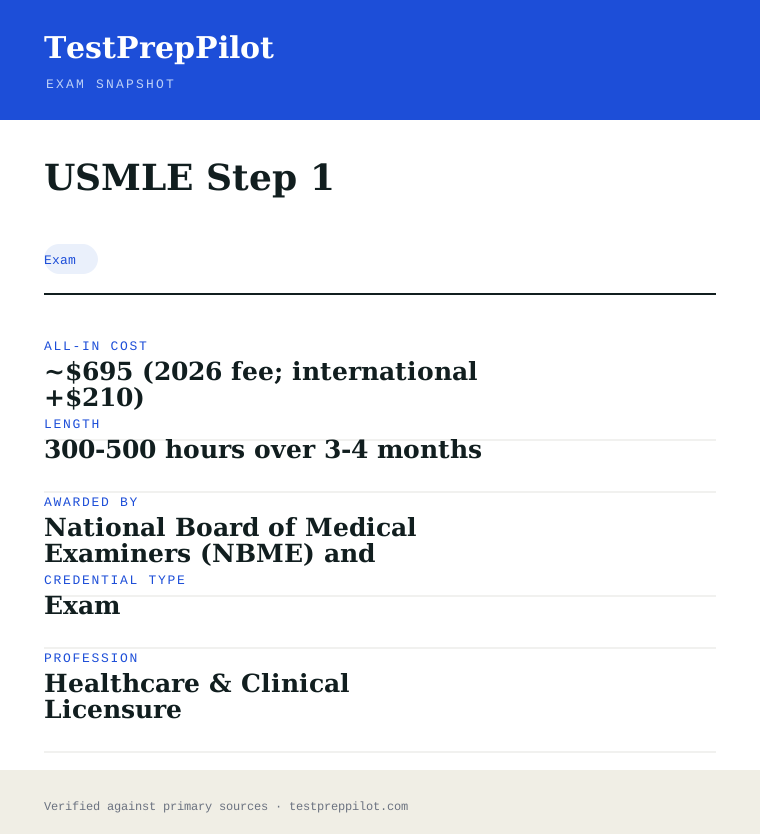
The short version
What is the USMLE Step 1 and is it worth it?
USMLE Step 1 is a professional credential administered by National Board of Medical Examiners (NBME) and Federation of State Medical Boards (FSMB). It validates job-ready knowledge and skills in the Healthcare (Clinical) field and is used for career entry, advancement, or compliance.
- Recognized credential from National Board of Medical Examiners (NBME) and Federation of State Medical Boards (FSMB)
- Demonstrates verified competence in Healthcare (Clinical)
- Supports career advancement and may satisfy licensing or employer requirements
What is it?
What exactly is the USMLE Step 1?
USMLE Step 1 — Healthcare (Clinical) credential from National Board of Medical Examiners (NBME) and Federation of State Medical Boards (FSMB)
Computer-based exam assessing basic biomedical and clinical science knowledge required for medical licensure in the United States. Offered by National Board of Medical Examiners (NBME) and Federation of State Medical Boards (FSMB), it is designed for candidates who need to demonstrate verified competence in the Healthcare (Clinical) field. The credential is commonly used for career entry, advancement, regulatory compliance, or employer requirements. Candidates should review the official handbook for eligibility, exam format, and scoring before registering.
The path in brief
- Confirm you meet any eligibility or prerequisites
- Review the official handbook and study materials
- Register and pay through the awarding body or authorized provider
- Schedule and take the exam (test center or online proctoring)
- Receive your score and, if passed, your credential
Before you book
Who is eligible to sit the USMLE Step 1?
Eligibility varies; many credentials are open to all, while others require coursework, work experience, or sponsorship.
Who it is for: Professionals and candidates seeking to validate Healthcare (Clinical) competence.
The test itself
What is the format of the USMLE Step 1?
The USMLE Step 1 is administered by National Board of Medical Examiners (NBME) and Federation of State Medical Boards (FSMB) and runs ~8 hours.
| Administered by | National Board of Medical Examiners (NBME) and Federation of State Medical Boards (FSMB) |
|---|---|
| Questions | ~280 questions across 7 blocks |
| Time limit | ~8 hours |
| Pass mark | Passing score set by the awarding body; see the official score report |
| Exam fee | ~$695 |
| Format | Proctored, computer-based (test center or online remote proctoring) |
Content outline
What topics are on the USMLE Step 1?
The USMLE Step 1 covers 4 content domains.
Weightings come from the official exam outline. Study time is best allocated in roughly these proportions rather than evenly across domains.
- Clinical knowledge
Topic area tested on the exam; see the official blueprint for the detailed breakdown.
- Diagnosis & treatment
Topic area tested on the exam; see the official blueprint for the detailed breakdown.
- Patient safety
Topic area tested on the exam; see the official blueprint for the detailed breakdown.
- Professional practice
Topic area tested on the exam; see the official blueprint for the detailed breakdown.
The path
How do you register for the USMLE Step 1?
- 1
Visit the awarding body’s official website and create an account
- 2
Select the credential and review its specific requirements
- 3
Complete any required eligibility (education, experience, or training)
- 4
Pay the registration fee
- 5
Schedule the exam at a test center or online
- 6
Take the exam and receive your results
The fine print
What are the retake and renewal rules for the USMLE Step 1?
- Proctoring & delivery
- Proctored, computer-based delivery (test center or remote online proctoring), varying by exam.
- Retake policy
- Varies by credential — most bodies permit retakes after a waiting period and full or partial fee.
- Score reporting
- Scores are reported per the body’s timeline, typically electronically after the exam.
- Recertification
- Varies; many credentials require renewal every 2–3 years via continuing education or a recertification exam.
What it pays
How much does this credential pay?
Physicians and surgeons earned a median of $239,200 or more per year, SOC 29-1210 (BLS Occupational Outlook Handbook, May 2024 — the median is top-coded at $239,200)
The USMLE Step 1 is a component of the United States Medical Licensing Examination, taken by US medical students and by international medical graduates pursuing US residency, and it is a licensing gate rather than a job credential — so the salary story runs through the physician career it unlocks, and that career is the highest tier BLS documents. The BLS Occupational Outlook Handbook reports that physicians and surgeons earned a median annual wage equal to or greater than $239,200 in May 2024 — the median is top-coded at $239,200, meaning the published figure is a floor, not the actual median — with employment of 839,000, a projected 3 percent change from 2024 to 2034, and roughly 23,600 openings a year. Because the physician median is top-coded, BLS publishes mean wages for specialties instead, and those make the distribution clear: in May 2024 the mean annual wages included pediatric surgeons at $450,810, cardiologists at $432,490, anesthesiologists at $336,640, emergency medicine physicians at $320,700, psychiatrists at $269,120, general internal medicine physicians at $262,710, family medicine physicians at $256,830 and pediatricians at $222,340 — a wide spread driven by specialty and practice setting, not by test scores. The honest chain: Step 1 is reported pass/fail, so no score maps to a wage, and BLS classifies workers by occupation, not by exam performance — the connection runs from passing Step 1 (and Step 2 CK) through the residency match and specialty choice, and specialty is the dominant income driver. For candidates, the direct economics of Step 1 are the fee — $695 for 2026 for US and Canadian examinees, plus a $210 regional surcharge for testing outside the US and Canada — and the preparation investment, set against an occupation whose published median is at least $239,200 and whose specialties range widely above and below that floor.
| Measure | Figure | Source / note |
|---|---|---|
| Median annual wage, physicians and surgeons | $239,200 or more | BLS OOH, May 2024 — the median is top-coded at $239,200, so the figure is a floor |
| Reference: mean wage, family medicine physicians | $256,830 | BLS OOH, May 2024 |
| Reference: mean wage, general internal medicine physicians | $262,710 | BLS OOH, May 2024 |
| Employment, 2024 | 839,000 jobs | BLS OOH Quick Facts, 2024 |
| Projected change, 2024-34 | +3% (as fast as average) | BLS OOH Job Outlook, 2024-34; ~23,600 openings per year |
Job growth.+3% projected change 2024-34 for physicians and surgeons, with roughly 23,600 openings a year; Step 1 is the licensing gate into the occupation, and the earnings trajectory follows the specialty chosen in the residency match rather than the exam result.
Source: BLS Occupational Outlook Handbook — Physicians and Surgeons
Your odds
What are the pass rates?
Step 1 has reported pass/fail only since January 2022, and no numeric score is published — the USMLE does publish performance data by examinee group, and US MD senior first-time pass rates have been roughly 90-93% in recent years, with IMG rates lower
The direct answer requires two separate facts, because Step 1 sits in the middle of the exam’s biggest change in decades: since examinations taken on or after 26 January 2022, Step 1 is reported pass/fail only — no numeric score is given to examinees, medical schools or residency programs, so the old "what score do I need" question has been replaced by a pass line, and the underlying passing standard corresponds to a scaled score of 196 that is not reported. The USMLE program does publish annual performance data, and the closest thing to official pass rates are the first-time pass rates by examinee group: US MD seniors have passed Step 1 on the first attempt at roughly 90 to 93 percent in recent years, with US DO seniors somewhat lower and international medical graduates lower still — commonly in the high 70s to mid 80s — and these are cohort statistics published by the USMLE, not individual predictions. Two implications follow from the pass/fail change. First, the strategic role of the exam shifted: before 2022 residency programs filtered applications by the numeric score, and now, with the score gone, programs have reweighted Step 2 CK and the rest of the application, which is why students are sometimes told the pass/fail change made Step 1 "lower stakes" — but the USMLE’s own data show first-time pass rates actually declined somewhat in the years after the transition, and a failure still carries real consequences for the match timeline and the application. Second, the exam itself remains the same length and difficulty — up to 280 items in an 8-hour day — and examinees typically need roughly 60 percent of items correct to pass, a figure the USMLE has described as approximate and varying by form. The honest planning rule is to treat pass/fail as meaning "passing is the only outcome that matters," but not as permission to prepare casually, because the pass line is real and the consequences of a fail are real.
Read this before quoting the number.Step 1 has been reported pass/fail only since January 2022, and no numeric score is published to examinees or programs. The USMLE publishes first-time pass rates by examinee group in its annual performance data — recent US MD senior rates have been roughly 90-93% with IMG rates lower — and these are cohort statistics, not individual predictions. The passing standard corresponds to a not-reported scaled score of 196, and examinees typically need roughly 60% of items correct, varying by form.
Your schedule
How long should I study for it?
350-500 hours over a 6-10 week dedicated period (50-70 hrs/week) of focused study
A realistic Step 1 study plan is a dedicated block of 6 to 10 weeks at 50 to 70 hours a week — the classic "dedicated" period at the end of the preclinical curriculum — because Step 1 is up to 280 single-best-answer items testing the integrated basic sciences in clinical vignettes, and the passing standard under pass/fail scoring still requires a serious, sustained pass of the material rather than a cram. The structure to plan against is published: a one-day, approximately 8-hour examination, with up to 280 multiple-choice items in seven 60-minute blocks (up to 40 items per block) for examinations before 14 May 2026, and fourteen 30-minute blocks (up to 20 items per block) with a minimum 55 minutes of break time for examinations on or after that date, when the new test-delivery software arrives — the total question count and exam-day length do not change. The most effective sequence: first, take a baseline self-assessment (an NBME practice form or the official practice material) early in the dedicated period, and set the study plan around the weakest organ systems and disciplines rather than a generic review; second, work the highest-yield content deliberately — pathology, physiology and pharmacology dominate the blueprint, and the integrated clinical vignettes reward understanding mechanisms and disease associations over isolated facts — while doing daily practice questions, because the vignette style and the reasoning patterns are learned through volume; third, use the NBME self-assessments as progress checks, because they are the closest predictor of readiness and the USMLE’s free practice materials give format familiarity; fourth, build stamina with full simulated exams — at least three or four under the real block structure you will face, whether seven 60-minute blocks or fourteen 30-minute blocks — because an 8-hour day punishes candidates who never trained the endurance; and fifth, taper in the final week rather than adding content. Budget the $695 fee (2026), register through NBME for US and Canadian students or through FSMB for international graduates, and note the attempt limits: a maximum of four lifetime attempts per Step, with no more than three attempts in any 12-month period.
- Week 150-60 hrs
Baseline and blueprint
- Take a baseline NBME or official self-assessment and log weaknesses by organ system and discipline
- Set the study plan around the integrated content outline, not a generic review
- Confirm your eligibility window, registration, and the block structure you will face on your test date
- Weeks 2-755-70 hrs/week
High-yield content and daily questions
- Work pathology, physiology and pharmacology — the dominant disciplines — in clinical-vignette context
- Do 80-120 practice questions daily with full review of every answer, including the wrong options
- Cover biochemistry, microbiology, immunology, anatomy, genetics and biostatistics through the same vignette lens
- Weeks 7-855-65 hrs/week
Progress checks and full exams
- Take NBME self-assessments to track readiness and identify remaining gaps
- Run two or three full simulated exams under the real block structure and timing
- Re-drill the organ systems or disciplines still dragging the performance
- Weeks 9-1040-50 hrs/week
Targeted gaps and taper
- One or two more full exams under real conditions
- Targeted review of the weakest areas only
- Taper the workload in the final days and protect sleep
Adjusting the pace
Weak baseline (low NBME score at start).Extend the dedicated period to 10-12 weeks and start with a content pass on the weakest organ systems before adding heavy question volume. The pass line is real, and a weak baseline needs repair before it needs polishing.
Strong baseline (approaching readiness at start).Compress to 6-7 weeks and lean on daily questions and full simulated exams rather than content review. Your job is maintaining the pass margin and building the 8-hour stamina.
International medical graduate.Plan 10-14 weeks and budget extra time for the format transition and any content gaps from the home curriculum. Confirm the FSMB registration route and the $210 international surcharge, and note that IMG first-time pass rates run lower than US MD rates.
How to study
How do I prepare most effectively?
The most effective Step 1 strategies centre on question volume with deliberate review, because the exam tests the integrated basic sciences through clinical vignettes and the reasoning patterns are learned through working thousands of items — the standard UWorld pass (or an equivalent high-quality question bank) is the near-universal backbone of preparation. Strategy one: make daily practice questions the core — 80 to 120 items a day with a full review of every answer, including why each incorrect option is wrong, because the review is where the vignette reasoning is actually taught. Strategy two: use the NBME self-assessments and the official USMLE practice materials as progress checks, because they are the closest predictors of readiness — take one at baseline, one mid-dedicated-period, and one or two near the end, and let them direct the final weeks. Strategy three: weight pathology, physiology and pharmacology heavily — they dominate the blueprint — and study them in a clinical context, learning mechanisms and disease associations rather than isolated facts, because the pass line rewards the ability to reason from a vignette. Strategy four: train the 8-hour day deliberately with full simulated exams under the exact block structure you will face — seven 60-minute blocks before 14 May 2026, fourteen 30-minute blocks on or after that date — including the break plan, because stamina and the ability to start fresh on each block are testable skills. Strategy five: review the incorrect options rather than just the correct answer, because the item explanations are where the differential-diagnosis and mechanism thinking is demonstrated. Finally, manage the pass/fail reality honestly: passing is the only reported outcome, but the pass line corresponds to roughly 60 percent of items correct and first-time pass rates are not 100 percent, so the pass/fail format is not a reason to prepare casually — it is a reason to protect the margin.
Make the question bank the backbone
80-120 practice questions daily with a full review of every answer, including why each incorrect option is wrong. The vignette style and the reasoning patterns are learned through volume, and the review is where the mechanism thinking is demonstrated.
Use NBME self-assessments as progress checks
They are the closest predictors of readiness. Take one at baseline, one at mid-dedicated-period, and one or two near the end, and let the results direct the final weeks rather than studying by feel.
Weight the dominant disciplines
Pathology, physiology and pharmacology dominate the blueprint. Study them in a clinical context — mechanisms, disease associations and how the vignette points to the diagnosis — because the pass line rewards reasoning from a presentation, not isolated recall.
Train the 8-hour day under your block structure
Run full simulated exams under the exact format you will face — seven 60-minute blocks before 14 May 2026, fourteen 30-minute blocks on or after that date — including the break plan. The ability to reset and perform on each block is a testable skill, and the 8-hour stamina must be trained.
Review the wrong options, not just the right answer
The item explanations are where the differential and mechanism thinking is demonstrated. A review that stops at the correct answer forfeits the teaching in every distractor you chose and every one you almost chose.
Protect the pass margin, not the pass/fail illusion
Passing is the only reported outcome, but the pass line is real — roughly 60 percent of items correct, varying by form — and first-time pass rates are not 100 percent. The pass/fail format removes the score chase, not the preparation.
What to buy
Which study resources are worth paying for?
The Step 1 resource market is consolidated and expensive, but the core purchases are standard and the buying logic is simple: a question bank first, NBME self-assessments second, and content resources third, because the exam tests vignette reasoning and the question bank is where that reasoning is built. The dominant question bank is UWorld — a subscription typically running several hundred dollars for a 90-to-180-day period covering the full Step 1 bank with detailed explanations — and it is the near-universal first purchase; Amboss is the main alternative and supplement, with a similar price range. The NBME self-assessments, roughly $60 each, are the closest predictors of readiness and are a standard purchase for progress checks; the official USMLE practice materials, including the free sample items and the interactive testing experience for the new software, provide format familiarity at no cost. On the content side, First Aid for the USMLE Step 1 (roughly $50-60) is the standard rapid-review text, the Anki decks — notably the community decks — are free or low-cost tools for spaced-repetition retention, and video lectures (Pathoma for pathology, Sketchy for microbiology and pharmacology, roughly $100-200) are common supplements. Total spending for a typical student runs from several hundred to over a thousand dollars once the exam fee — $695 for 2026 — is included. The honest ranking: the question bank first, NBME self-assessments second, a content review source third, and tutoring ($100-plus per hour) only for students with a specific stubborn deficit. Prices here are current as of 2025-26 and change annually; we rank nothing by commission.
| Resource | Price | Format | Best for |
|---|---|---|---|
| UWorld Step 1 question bank | ~$300-500 for a 90-180 day subscription | Online question bank with explanations | The standard backbone — where vignette reasoning is built |
| NBME Step 1 self-assessments | ~$60 each | Online scored self-assessments | The closest predictors of readiness; use as progress checks |
| Official USMLE practice materials and interactive testing experience | Free | Online | Format familiarity — especially the new software for exams on or after 14 May 2026 |
| First Aid for the USMLE Step 1 and Anki decks | ~$50-60 for First Aid; decks free-$20 | Print text and flashcard app | Structured rapid review and spaced-repetition retention |
| Video lecture supplements (Pathoma, Sketchy, Boards and Beyond) | ~$100-200 | Streaming video | Explaining the high-yield pathology, microbiology and pharmacology content |
| The Step 1 exam itself | $695 (2026) plus a $210 international surcharge outside the US/Canada | One-day, ~8-hour exam at a Prometric centre | Required — the licensing gate |
Prices dated 2025-26 and change annually; include the $695 exam fee in planning. We do not rank by commission.
Avoid these
What mistakes do candidates most often make?
The most common Step 1 mistake is misreading the pass/fail change as a reason to reduce preparation — the exam still tests up to 280 items in an 8-hour day against a real pass line, and first-time pass rates are not 100 percent, so candidates who prepare casually because "it is only pass/fail" fail at rates the USMLE’s own data document. The second is passive content review without question volume: reading textbooks and watching lectures without daily practice questions builds recognition of topics, not the vignette reasoning the exam actually tests. A third recurring error is skipping the NBME self-assessments and walking into the real exam with no calibrated sense of readiness, when those assessments are the closest predictors available. Candidates also routinely ignore the incorrect options in their reviews, forfeiting the teaching in every distractor, and many never train the 8-hour day, discovering on test day that an eight-hour session with block-by-block reset is a different endurance problem than an hour of questions. Under the new software, candidates also fail to check which block structure applies to their test date — seven 60-minute blocks before 14 May 2026, fourteen 30-minute blocks on or after — and then rehearse the wrong format. Finally, some candidates over-fixate on the old numeric-score norms from before 2022, chasing a "target score" that no longer exists and misallocating energy that should go into protecting the pass margin. And a quiet but common error is mismanaging the day itself: candidates who never practise finishing a block early to bank break time, or who carry a missed item from a closed block into the next one, convert an otherwise adequate preparation into a tired, error-prone back half of the exam — the block-closing rule and the break strategy need rehearsal, not discovery.
✕Treating pass/fail as a reason to under-prepare
✓Pass/fail removes the score chase, not the pass line — the exam still tests up to 280 items in an 8-hour day, the pass standard corresponds to roughly 60% of items correct, and first-time pass rates are not 100%. Prepare to protect the margin, not to chase a number.
✕Passive review without daily questions
✓The exam tests vignette reasoning, which is built through volume. Do 80-120 practice questions daily with full review — reading alone builds recognition of topics, not the reasoning the exam rewards.
✕Skipping NBME self-assessments
✓The NBME assessments are the closest predictors of readiness. Take one at baseline, mid-dedicated-period and near the end — avoiding them for fear of a low result forfeits the most useful calibration data you can get.
✕Reviewing only the correct answer
✓Review every answer, including why each incorrect option is wrong. The explanations are where the mechanism and differential thinking is demonstrated, and a review that stops at the right answer forfeits most of the learning.
✕Rehearsing the wrong block structure
✓Check your test date: examinations before 14 May 2026 use seven 60-minute blocks; examinations on or after that date use fourteen 30-minute blocks with the new software. Train full exams in the format you will actually face, including the break plan.
✕Chasing pre-2022 numeric score norms
✓No numeric score is reported to anyone since January 2022. Studying toward a remembered "target score" misallocates energy; the reported outcome is pass or fail, so calibrate readiness with NBME pass predictors and protect the pass margin instead.
What you'll face
What question types will I see?
Step 1 is a one-day, approximately 8-hour computer-based examination of up to 280 multiple-choice items, each a single-best-answer question presented as a clinical vignette — a patient presentation with history, physical findings and often laboratory or imaging data, followed by one best answer among distractors — delivered at Prometric test centres. The block structure changes on 14 May 2026: examinations before that date use seven 60-minute blocks of up to 40 items each with a minimum 45 minutes of break time and a 15-minute optional tutorial; examinations on or after that date use fourteen 30-minute blocks of up to 20 items each with a minimum 55 minutes of break time and a 5-minute optional tutorial, delivered on the new test software — the total item count and exam-day length do not change. The content follows the USMLE integrated content outline organised by organ system and by process, spanning anatomy, physiology, biochemistry, pathology, pharmacology, microbiology, immunology, genetics and behavioural science, and the questions are weighted toward pathology, physiology and pharmacology. The item style is single best answer — the classic Step 1 vignette, plus abstract-and-research-style items that mimic journal abstracts and data interpretation, and multimedia items using images, radiographs, ECGs and pathology slides. Examinees can review items only within the current block and cannot return to previous blocks once closed. The exam has been reported pass/fail only since January 2022, with the passing standard corresponding to a not-reported scaled score of 196 and examinees typically needing roughly 60 percent of items correct, varying by form. The samples below are editor-written illustrations of the published item format, not live exam items.
A patient presentation with history, findings and data; choose the best single answer among distractors. Tests integrated reasoning across systems and disciplines.
Items mimicking scientific abstracts or study designs, asking you to interpret data tables, graphs or statistical findings — the biostatistics and epidemiology content lives here.
Images, pathology slides, radiographs, ECGs and other findings embedded in the vignette — the visual diagnosis questions that reward exposure to the images.
Try these
Q1A 58-year-old man with hypertension presents with sudden severe headache and blurred vision. Blood pressure is 210/120 mm Hg. Funduscopic exam shows papilledema. Which is the most appropriate next step?
Answer:B
Severe hypertension with papilledema indicates a hypertensive emergency with end-organ damage, which requires immediate blood-pressure control in a monitored setting — admission and treatment are the correct next step. A delays management of an emergency. C is appropriate for non-urgent outpatient management but is unsafe here. D is wrong because a urine culture does not address hypertensive emergency. The item illustrates the classic Step 1 vignette: a presentation with findings pointing to a diagnosis and management decision, testing integrated reasoning rather than isolated recall.
Q2A 32-year-old woman at 28 weeks gestation reports persistent headache and sees spots in her vision. Blood pressure is 165/105 mm Hg, and urine protein is 2+. Which diagnosis is most consistent with these findings?
Answer:B
New-onset hypertension with proteinuria after 20 weeks gestation defines preeclampsia, and the visual symptoms signal severe features requiring urgent management. A is wrong because gestational diabetes is a glucose disorder, not a hypertensive proteinuric syndrome. C is wrong because a UTI does not explain hypertension and proteinuria at this level. D is wrong because the blood pressure and proteinuria findings point to a pregnancy-specific disorder rather than a simple migraine. The item tests the mechanism-and-diagnosis reasoning that dominates the exam — recognising the disorder from the pattern of findings.
Q3A 5-year-old boy presents with a barking cough and stridor that worsens at night. Which condition is most likely?
Answer:B
A barking cough and stridor that worsen at night in a young child are classic for croup (laryngotracheobronchitis), typically viral and managed supportively. A is wrong because bacterial pneumonia presents with fever, cough and focal findings, not the classic barking cough and nocturnal stridor. C is wrong because asthma is characterised by wheezing and bronchospasm, not stridor. D is wrong because a foreign body typically presents with sudden onset of symptoms after a choking episode, not the nocturnal pattern described. The item illustrates how Step 1 tests recognising the classic presentation — the pattern that points to the answer before the options are read.
Samples are editor-written illustrations of the published blueprint, not live exam items.
The big day
What should I expect on exam day?
Step 1 is a one-day, approximately 8-hour computer-based examination of up to 280 single-best-answer items, administered at Prometric test centres on an appointment within your three-month eligibility window, and the block structure depends on your test date: seven 60-minute blocks of up to 40 items with a minimum 45 minutes of break time and a 15-minute optional tutorial before 14 May 2026, or fourteen 30-minute blocks of up to 20 items with a minimum 55 minutes of break time and a 5-minute tutorial on or after that date, when the new test-delivery software applies. The first thing to confirm is the name on your scheduling permit: it must match your government-issued photo ID exactly, because a mismatch means you will not be permitted to take the exam, and there is no day-of correction. Bring your scheduling permit and a valid, unexpired government-issued photo ID; the Prometric centre provides scratch paper and the testing software includes any needed tools. Leave phones, smartwatches, notes and personal belongings in the locker — personal electronics are prohibited, and the room is monitored. Arrive at least 30 minutes early so check-in and the tutorial are complete before the first block. During the exam, you can review items only within the current block and cannot return to previous blocks once closed, so use the block’s time — 60 minutes or 30 minutes depending on your format — deliberately, flagging within-block items you want to revisit before the block ends, and bank your break time by finishing blocks early because the minimum break allotment can only grow. Budget the optional tutorial strategically and, under the new software, work through the practice interface in advance so the first block is not the first time you see it. Results typically post within three to four weeks through your USMLE account, reported as pass or fail only.
Bring
- Your scheduling permit and a current, unexpired government-issued photo ID — the name must match exactly
- Confirmation of your test centre address and appointment time
- Snacks and water for the break time — stored per the centre’s rules, since break minutes are yours
- Familiarity with the testing interface you will use — run the appropriate interactive testing experience in advance
Leave at home
- Phones, smartwatches, fitness trackers and all personal electronics
- Notes, books and study materials — the centre provides scratch paper
- Any item not permitted by Prometric’s test-centre rules, to be stored in the locker
- Anything that could delay check-in — arrive early so ID verification and the tutorial are complete before the first block
How the day runs
Rules in the room
- The exam is up to 280 single-best-answer items in a one-day, approximately 8-hour session at a Prometric centre.
- Before 14 May 2026: seven 60-minute blocks of up to 40 items, minimum 45 minutes of break time, 15-minute optional tutorial.
- On or after 14 May 2026: fourteen 30-minute blocks of up to 20 items, minimum 55 minutes of break time, 5-minute optional tutorial, on the new test software.
- You can review items only within the current block; once a block closes you cannot return to it.
- Your scheduling permit name must match your government-issued ID exactly — a mismatch means you cannot test.
- The result is reported as pass or fail only; no numeric score is given to examinees or programs since January 2022.
- Attempt limits: a maximum of four lifetime attempts per Step, with no more than three attempts in any 12-month period.
Afterwards.Your result posts to your USMLE account roughly three to four weeks after the test, reported as pass or fail only, and the immediate next step on a pass is confirming your school or residency pathway — for US students the score is not sent to programs, which is exactly why Step 2 CK and the rest of the application carry more weight in the match than they did before 2022. On a fail, use the USMLE’s performance feedback and the exam-day experience to diagnose the gap, re-train with the NBME self-assessments until they predict a pass, and re-sit within the attempt limits — a maximum of four lifetime attempts per Step and no more than three in any 12-month period — while confirming the block structure on your new test date if it falls on or after 14 May 2026. The pass/fail format does not change the exam’s place in the career: passing Step 1 is the licensing gate into the physician occupation that BLS documents at a May 2024 median of $239,200 or more, with specialty and practice setting — not the exam result — driving the earnings trajectory from there.
Reference
What are the key facts about the USMLE Step 1?
USMLE Step 1 is a exam credential; awarded by National Board of Medical Examiners (NBME) and Federation of State Medical Boards (FSMB); the exam fee is ~$695; typical preparation is 300-500 hours over 3-4 months; holders typically earn $150,000-$300,000+ (29-1210 Physicians).
| Credential | USMLE Step 1 |
|---|---|
| Abbreviation | Step 1 |
| Type | Exam |
| Profession | Healthcare & Clinical Licensure |
| Specialty | Physician |
| Awarded by | National Board of Medical Examiners (NBME) and Federation of State Medical Boards (FSMB) |
| Difficulty | Advanced |
| Typical prep time | 300-500 hours over 3-4 months |
| All-in cost | ~$695 (2026 fee; international +$210) |
| Typical salary range | $150,000-$300,000+ (29-1210 Physicians) |
| Credential | USMLE Step 1 |
| Awarding body | National Board of Medical Examiners (NBME) and Federation of State Medical Boards (FSMB) |
| Exam format | Proctored, computer-based |
| Validity | PASS/FAIL since 2022; score report valid for residency application windows |
| Languages | Varies — see awarding body |
| Scope | National / Multi-state |
| Also known as | United States Medical Licensing Examination Step 1 |
Real questions
Frequently asked questions about the USMLE Step 1
How do I register for the USMLE Step 1 exam?
Register through National Board of Medical Examiners (NBME) and Federation of State Medical Boards (FSMB)'s official portal or an authorized test provider (e.g., Pearson VUE or Prometric where applicable). Create an account, select the exam, pay the fee, and schedule a date.
How much does the exam cost?
Fees vary by location and currency. Confirm the current fee on the official registration page before scheduling.
How long is the credential valid, and how do I renew?
Validity varies by credential (commonly 2–3 years). Renewal usually requires continuing education or a recertification exam — see National Board of Medical Examiners (NBME) and Federation of State Medical Boards (FSMB)'s policy.
What if I do not pass?
Most bodies allow retakes after a waiting period and payment of the full or partial fee. Check National Board of Medical Examiners (NBME) and Federation of State Medical Boards (FSMB)'s retake policy before rescheduling.
How do I register for a National Board of Medical Examiners (NBME) and Federation of State Medical Boards (FSMB) credential?
Register through the official website, select your exam, pay the fee, and schedule a date.
How do I renew a credential?
Renewal policies vary by credential; check the specific program page for requirements and cycles.
In short
Is the USMLE Step 1 worth it?
- USMLE Step 1 is awarded by National Board of Medical Examiners (NBME) and Federation of State Medical Boards (FSMB).
- Validates job-ready competence in Healthcare (Clinical).
- Registration is through the awarding body or an authorized test provider.
- Renewal and retake policies vary — confirm before scheduling.
Trust
Where does this information come from?
Everything above is taken from the awarding body's own published material. Fees, question counts and domain weights are revised regularly — check the official page before you pay.
Research confidence: low · Last reviewed 2026-08