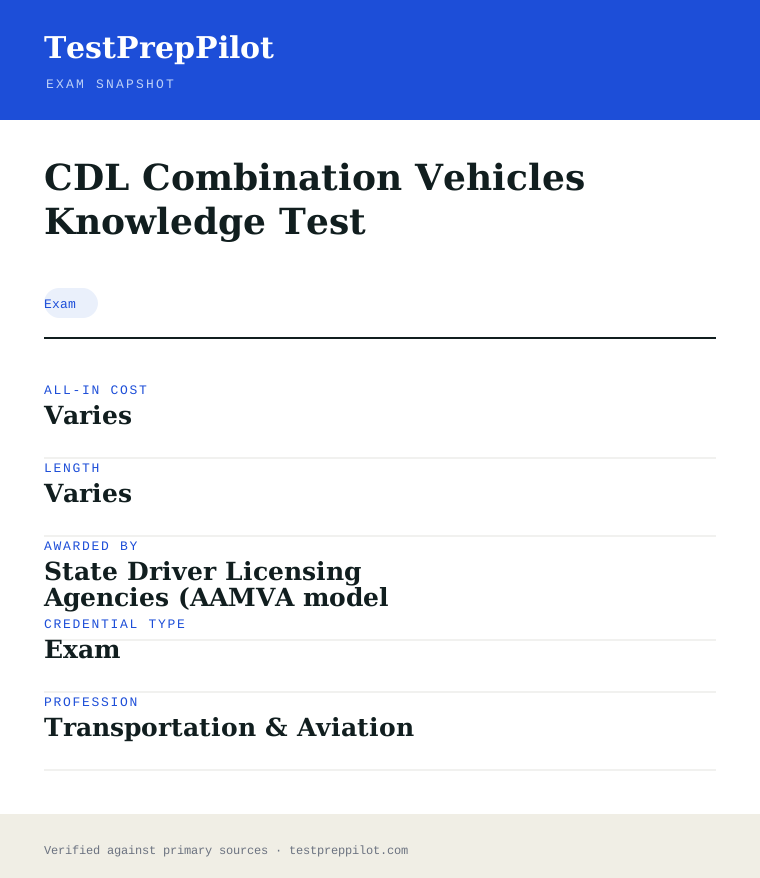
The short version
What is the CDL Combination Vehicles Knowledge Test and is it worth it?
CDL Combination Vehicles Knowledge Test is a professional credential administered by State Driver Licensing Agencies (AAMVA model curriculum). It validates job-ready knowledge and skills in the Transportation, Aviation & Maritime field and is used for career entry, advancement, or compliance.
- Recognized credential from State Driver Licensing Agencies (AAMVA model curriculum)
- Demonstrates verified competence in Transportation, Aviation & Maritime
- Supports career advancement and may satisfy licensing or employer requirements
What is it?
What exactly is the CDL Combination Vehicles Knowledge Test?
CDL Combination Vehicles Knowledge Test — Transportation, Aviation & Maritime credential from State Driver Licensing Agencies (AAMVA model curriculum)
Class A knowledge test covering coupling and uncoupling, trailer air lines, rollover prevention and combination vehicle inspection. Offered by State Driver Licensing Agencies (AAMVA model curriculum), it is designed for candidates who need to demonstrate verified competence in the Transportation, Aviation & Maritime field. The credential is commonly used for career entry, advancement, regulatory compliance, or employer requirements. Candidates should review the official handbook for eligibility, exam format, and scoring before registering.
The path in brief
- Confirm you meet any eligibility or prerequisites
- Review the official handbook and study materials
- Register and pay through the awarding body or authorized provider
- Schedule and take the exam (test center or online proctoring)
- Receive your score and, if passed, your credential
Before you book
Who is eligible to sit the CDL Combination Vehicles Knowledge Test?
Eligibility varies; many credentials are open to all, while others require coursework, work experience, or sponsorship.
Who it is for: Professionals and candidates seeking to validate Transportation, Aviation & Maritime competence.
The test itself
What is the format of the CDL Combination Vehicles Knowledge Test?
The CDL Combination Vehicles Knowledge Test is administered by State Driver Licensing Agencies (AAMVA model curriculum) and runs ~30 minutes (state-set).
| Administered by | State Driver Licensing Agencies (AAMVA model curriculum) |
|---|---|
| Questions | ~20 (state-set) |
| Time limit | ~30 minutes (state-set) |
| Pass mark | Passing score set by the awarding body; see the official score report |
| Exam fee | State-set, commonly $10-$100 for the knowledge test |
| Format | Proctored, computer-based (test center or online remote proctoring) |
Content outline
What topics are on the CDL Combination Vehicles Knowledge Test?
The CDL Combination Vehicles Knowledge Test covers 4 content domains.
Weightings come from the official exam outline. Study time is best allocated in roughly these proportions rather than evenly across domains.
- Regulations & procedures
Topic area tested on the exam; see the official blueprint for the detailed breakdown.
- Systems & operations
Topic area tested on the exam; see the official blueprint for the detailed breakdown.
- Safety & emergency
Topic area tested on the exam; see the official blueprint for the detailed breakdown.
- Navigation & logistics
Topic area tested on the exam; see the official blueprint for the detailed breakdown.
The path
How do you register for the CDL Combination Vehicles Knowledge Test?
- 1
Visit the awarding body’s official website and create an account
- 2
Select the credential and review its specific requirements
- 3
Complete any required eligibility (education, experience, or training)
- 4
Pay the registration fee
- 5
Schedule the exam at a test center or online
- 6
Take the exam and receive your results
The fine print
What are the retake and renewal rules for the CDL Combination Vehicles Knowledge Test?
- Proctoring & delivery
- Proctored, computer-based delivery (test center or remote online proctoring), varying by exam.
- Retake policy
- Varies by credential — most bodies permit retakes after a waiting period and full or partial fee.
- Score reporting
- Scores are reported per the body’s timeline, typically electronically after the exam.
- Recertification
- Varies; many credentials require renewal every 2–3 years via continuing education or a recertification exam.
What it pays
How much does this credential pay?
$57,440 median for heavy and tractor-trailer truck drivers (BLS, May 2024)
The Combination Vehicles knowledge test exists for one reason: it is the federal prerequisite to a Group A Commercial Learner’s Permit, which is the licence class that lets you drive a tractor-trailer — the combination of a powered unit and one or more trailers that defines the largest, and generally best-paid, segment of the driving workforce. The closest BLS occupation is therefore Heavy and Tractor-trailer Truck Drivers (SOC 53-3032), and there is no separate "combination driver" series, so any salary figure branded that way is a job-board aggregate rather than government data. That occupation had a May 2024 median of $57,440, with the lowest 10 percent under $38,640 and the highest 10 percent over $78,800; the spread is wider here than in many driving roles because a Class A combination licence is the credential that most reliably lets an experienced driver move into higher-paying freight — flatbed, tanker, specialized haul — where the top decile sits. The employment base is large and stable: 2,235,100 jobs in 2024, projected to grow about 4 percent to 2,324,400 by 2034, adding roughly 89,300 net jobs, with about 237,600 openings a year from growth plus replacement. The durability is the argument for investing in the combination endorsement: freight that must move as a tractor-trailer does not shrink in a soft economy, and the combination licence is what unlocks it. Be precise about what BLS does and does not say, though: the wage series describes the occupation by job duties, not by licence class, so these numbers do not prove that a new Class A holder starts at the median — they describe the destination the Group A CLP leads toward, after the skills test and the experience that follows.
| Measure | Figure | Source / note |
|---|---|---|
| Median annual wage, heavy and tractor-trailer truck drivers | $57,440 | BLS Occupational Outlook Handbook, May 2024 |
| Lowest 10 percent | less than $38,640 | BLS OEWS May 2024 (10th percentile) |
| 25th percentile | $47,230 | BLS OEWS May 2024 |
| 75th percentile | $65,520 | BLS OEWS May 2024 |
| Highest 10 percent | more than $78,800 | BLS OEWS May 2024 (90th percentile) |
| Employment, 2024 | 2,235,100 jobs | BLS OOH Quick Facts, 2024 |
| Projected annual openings | ~237,600 per year | BLS OOH Job Outlook, 2024-34 — growth plus replacement |
Job growth.+4% projected change 2024-34 (growth), ~237,600 openings a year; the Combination Vehicles knowledge test is the federal gate to the Group A (tractor-trailer) licence behind this occupation.
Source: BLS Occupational Outlook Handbook — Heavy and Tractor-trailer Truck Drivers
Your odds
What are the pass rates?
FMCSA and the states publish the 80 percent cut score — 49 CFR 383.135 — but no national pass rate
As with every CDL knowledge test, the federal government fixes the passing line and publishes no pass rate. 49 CFR 383.135(a)(1) requires at least 80 percent correct on each knowledge test, and 49 CFR 383.135(a)(3) adds a stake that is unique to this exam: an applicant who fails the combination vehicle knowledge test "may not be issued a commercial learner’s permit or commercial driver’s license that authorizes… operation of a combination of vehicles in Group A." In plain terms, failing the Combination Vehicles test does not just mean retaking one sub-test — it means you cannot be issued a Group A CLP at all, so if your goal is a tractor-trailer (Class A) licence, this is a gate you cannot route around by taking a different knowledge test. The 80 percent line itself is a flat floor with no curve: if your state writes the exam as 20 questions, you need 16 correct, and 15 is a fail with no rounding. States set the question count and retake terms themselves; many permit a prompt retake for a fee. As with the General Knowledge test, the federal prerequisites sit upstream: ELDT theory must be in the FMCSA Training Provider Registry before a first-time Class A applicant may sit the test (effective 7 February 2022), and a passing score yields only a CLP, after which the 14-day skills-test waiting period of 49 CFR 383.25(e) applies. The point worth stressing is that combination-vehicle failure is more consequential than a mere percentage miss because of the Group A bar — so candidates aiming at Class A should treat this test as non-optional rather than as an optional add-on to the General Knowledge exam.
Read this before quoting the number.No national or state pass-rate statistic is published by FMCSA or any state DMV/SDLA for the Combination Vehicles knowledge test. We have deliberately left the pass-rate table empty rather than estimate one. What is verifiable is the 80 percent cut score in 49 CFR 383.135 and, specifically for this exam, the Group A restriction in 49 CFR 383.135(a)(3); the narrative above covers those instead.
Source: eCFR — 49 CFR Part 383 (knowledge tests, CLP, and 80% standard)
Your schedule
How long should I study for it?
8-15 hours of reading and timed practice of focused study
The Combination Vehicles knowledge test draws on Section 6 of your state’s CDL manual (Combination Vehicles), which sits on top of the General Knowledge material because it is taken as part of the same CLP application. The federal knowledge areas are fixed in 49 CFR 383.111(c)(1) through (c)(3): they cover safe operation of combination vehicles, coupling and uncoupling, and inspecting combinations. The first planning decision is to confirm you actually need this test — it is mandatory for a Group A (combination/tractor-trailer) CLP, but irrelevant if you will only drive a straight truck or bus (Class B) or a combination under 26,001 lbs (Class C). If you do need Group A, you will almost always sit this exam together with the General Knowledge test and, if your tractor has air brakes, the Air Brakes test — so schedule one combined study block rather than three separate ones. The plan below assumes a computer-delivered, multiple-choice exam; a common configuration is 20 questions requiring 16 correct (80 percent), but your state sets the count. Because the combination material is smaller and more physical than General Knowledge, the study window is shorter, but the failure rate is high among candidates who underestimate the coupling/uncoupling and rearward-amplification concepts, which are counter-intuitive and tested heavily. Total elapsed time is short; the risk is not volume but the specific dynamics — rollover likelihood when loaded, rearward amplification in doubles and triples, and the colour-coded air lines — that do not appear on any car-licence test.
- Day 1-22-3 hrs
Section 6.1 — Driving combination vehicles safely
- Read the rollover material: a fully loaded rig is roughly ten times more likely to roll over than an empty one, so speed control in turns and on ramps is the dominant safety theme
- Master rearward amplification: the rear trailer in a double swings out more in a turn, and the figure is about 2.0 for doubles and about 3.5 for triples — keep extra space and slow for the condition
- Learn the special risks of doubles/triples and the need for extra following and stopping distance
- Take your state’s practice items for combination safety and record misses
- Day 3-42-3 hrs
Section 6.2–6.3 — Combination air brakes and ABS
- Know the two air lines by colour and function: the service line (blue) carries the braking signal, the emergency line (red) supplies air and controls the emergency/trailer brakes
- Glad hands, the tractor protection valve (closes at roughly 20-45 psi), and why the trailer hand valve is for testing only and must never be used for parking
- ABS on combination vehicles: what the malfunction lamp means and that ABS does not shorten stopping distance, only helps maintain steering control
- Distinguish this from the standalone Air Brakes knowledge test if your tractor has air brakes
- Day 5-62-3 hrs
Section 6.4–6.5 — Coupling, uncoupling and inspection
- Coupling: position, lock the kingpin, connect air lines (glad hands), connect electrical, raise landing gear, charge the system, and check for air leaks
- Uncoupling: chock wheels, lower landing gear, disconnect air/electric, pull clear — know the safe order
- Inspecting combinations: the fifth wheel, the coupling, the air hoses, the trailer connections and the rear of the last trailer
- Rehearse the sequence as a numbered checklist; questions ask "what is done first/last"
- Day 72-3 hrs
Full-length practice and gap closing
- Two or three timed practice exams at your state’s question count
- Re-read only the chapters where you missed items, especially coupling order and the air-line colours
- Confirm ELDT is logged before booking and that you are taking this with the General Knowledge (and Air Brakes, if needed) tests on one CLP
Adjusting the pace
First-time Class A applicant, ELDT not done.Add the ELDT step before booking. The DMV will refuse the knowledge test until your ELDT theory is in the FMCSA Training Provider Registry; complete the registered provider’s course and verify the entry first.
Class B driver adding combination (Group A).Often a focused 3-4 day block. You already hold the General Knowledge base; concentrate on Section 6’s combination-specific dynamics and the coupling/uncoupling sequence, which are new to you.
Planning doubles/triples endorsement later.Note that Doubles/Triples is a separate endorsement knowledge test, not this one. Passing Combination Vehicles qualifies you for Group A generally; the doubles/triples endorsement is an additional exam you will schedule separately.
How to study
How do I prepare most effectively?
The Combination Vehicles test rewards a different kind of memory than General Knowledge: less statutory wording and more physical sequence and counter-intuitive dynamics. Candidates who treat it as "more driving common sense" consistently miss the coupling order, the air-line colour roles, and especially rearward amplification and the loaded-rollover multiplier — the three concepts that do not match a car driver’s intuition and are therefore weighted heavily.
Drill the coupling and uncoupling order as a fixed checklist
Questions repeatedly ask what is done first or last: for coupling, position and lock the kingpin, connect the air lines (glad hands) and electrical, raise the landing gear, charge the system and check for leaks; for uncoupling, chock, lower the gear, disconnect air and electric, then pull clear. Memorise the order as numbered steps, because the exam tests sequence, not just that you "know how to hook up."
Learn the two air lines by colour and function, not by guess
The service line is blue and carries the braking signal; the emergency line is red and supplies air while controlling the emergency and trailer brakes. The tractor protection valve closes at roughly 20-45 psi to protect the tractor’s air. The trailer hand valve is for testing only and must never be used to hold or park the trailer. These colour/function pairings are near-guaranteed items.
Internalise the two counter-intuitive dynamics
A fully loaded combination is about ten times more likely to roll over than an empty one, so the exam hammers speed-in-turns discipline; and rearward amplification means the last trailer swings widest — about 2.0 for doubles and about 3.5 for triples. Keep extra space and slow for the condition. These numbers are the highest-value, most-missed facts on the exam because they contradict casual intuition.
Sit this with General Knowledge (and Air Brakes) on one CLP
Because all three are part of the same Group A CLP application, scheduling them together saves a trip and a fee cycle. Study them as one block but keep three distinct question stacks, since mixing air-brake facts into combination items (or vice versa) is a common source of wrong answers.
Treat the Group A gate as non-optional
Under 49 CFR 383.135(a)(3), failing this test means you cannot be issued a Group A CLP at all — it is not a retryable side-quest but the actual gate to tractor-trailer driving. If Class A is your goal, weight your prep toward the concepts you find least intuitive rather than the ones that feel familiar.
Clear ELDT before you book
For a first-time Class A applicant the FMCSA Training Provider Registry entry is a hard prerequisite. Verify it is logged — not merely that a course was completed — before you pay, because a missing entry means a refused test and a forfeited fee.
What to buy
Which study resources are worth paying for?
As with the General Knowledge test, the authoritative source is free: your state’s CDL manual Section 6 plus its official practice items. Paid resources add value mainly as repetition or as structured ELDT courses. Be wary of any product quoting a "combination pass rate," since that figure is not published by any government and is the vendor’s own practice-test metric, not an official outcome.
| Resource | Price | Format | Best for |
|---|---|---|---|
| Your state DMV CDL manual, Section 6 (Combination Vehicles) | Free | PDF / web from the issuing state | The only source the test is written from — read it end to end |
| Your state DMV official practice tests | Free | Web or app | Wording that tracks the real question bank; do these before any paid set |
| Registered ELDT theory course (if first-time) | Varies by provider, commonly $0-300 | Online, logged to the FMCSA registry | Mandatory prerequisite before the DMV seats a first-time Class A applicant |
| Commercial CDL prep apps (e.g. driving-tests.org, CDL Prep) | Free tier; ~$5-15/mo for premium | Mobile app, large question volume | Repetition once the official material is clean |
| CDL study guidebooks with a combination chapter | ~$15-30 | Print or eBook | A portable summary if you will not open the PDF; confirm it matches your state |
| CDL training school combination module | Often bundled into tuition; standalone $50-150 | Classroom or online | Candidates who want a deadline and hands-on coupling demos |
Prices checked 2026-08 in USD before tax and vary by state and provider. State DMV manuals and practice tests are free and authoritative; commercial "pass rate" claims are vendor-internal and not official. We do not rank by commission.
Avoid these
What mistakes do candidates most often make?
The avoidable failures on the Combination Vehicles test cluster around three errors: underestimating its importance (it is the Group A gate), mixing it with the Air Brakes test, and failing to learn the sequence-based and dynamics-based facts that the exam actually probes. The version and prerequisite errors below waste the most money.
✕Not realising this test is the Group A gate
✓Under 49 CFR 383.135(a)(3), failing the combination vehicle knowledge test means you may not be issued a Group A CLP — i.e. no tractor-trailer licence at all. Candidates who think of it as an optional add-on to General Knowledge under-prepare and then discover the failure blocks their entire career goal. If Class A is your aim, treat it as the central exam of the three.
✕Conflating Combination Vehicles with the Air Brakes test
✓They are separate knowledge exams with separate 80 percent requirements. Combination Vehicles covers coupling, rearward amplification and combination air lines; Air Brakes covers the brake system itself. Mixing the two while studying causes wrong answers on both. Keep distinct stacks, and if your tractor has air brakes, sit both but review them separately.
✕Guessing the coupling/uncoupling sequence
✓The exam asks what is done first or last, not whether you "understand hooking up." Memorise the fixed order: coupling positions and locks the kingpin, connects air (glad hands) and electric, raises landing gear, charges and leak-checks; uncoupling chocks, lowers gear, disconnects, then pulls clear. A rehearsed checklist converts a whole cluster of sequence items.
✕Assuming the air lines are interchangeable
✓The service line is blue (braking signal) and the emergency line is red (air supply and emergency/trailer brake control), and the trailer hand valve is for testing only — never for parking. Swapping their roles is a classic wrong answer, and the tractor protection valve closing at 20-45 psi is a specific number the exam expects you to know.
✕Applying car-driving intuition to rollover and rearward amplification
✓A fully loaded combination rolls over about ten times more often than an empty one, and the last trailer amplifies rearward (roughly 2.0 for doubles, 3.5 for triples). Candidates who "drive by feel" underestimate turns and following distance and miss the highest-weighted dynamics questions. Learn the numbers; they are tested directly.
✕Forgetting ELDT before booking
✓Since 7 February 2022 a first-time Class A applicant must have ELDT theory logged in the FMCSA Training Provider Registry before the DMV administers the test. Verify the registry entry — not just course completion — before you pay, or the test is refused and the fee forfeited.
What you'll face
What question types will I see?
The Combination Vehicles knowledge test is multiple-choice and delivered by computer at a state DMV/SDLA as part of the Group A CLP application; there is no practical component at the knowledge stage. The federal baseline is 80 percent under 49 CFR 383.135, with states setting the exact question count; a common configuration is 20 questions requiring 16 correct, but verify your state’s number. Under 49 CFR 383.133 the state must use FMCSA pre-approved (AAMVA 2005 CDL Test System) items and may offer the test in another language or orally but not via a translator. Items are single-best-answer, frequently sequence-based ("what is done first") or dynamics-based (rollover, rearward amplification, air-line roles). The worked samples below are editor-written illustrations of the published blueprint (49 CFR 383.111(c) knowledge areas), not live exam items. Because the 80 percent floor is flat with no curve, your only task is to push the correct count above the line, so answer the quick sequence items immediately and bank them.
Drawn from Section 6 wording — air-line colours, valve pressures, rollover multipliers, rearward amplification figures. Distractors are real, nearby facts, so partial familiarity is punished.
Asks the correct order of hook-up or drop. These reward a rehearsed numbered checklist rather than general understanding.
Select all that apply from a short list (e.g. steps of a safe uncouple); scoring is typically all-or-nothing.
A described doubles/triples or loaded-turn situation asks for the safe action; rewards knowing the rollover and rearward-amplification numbers rather than estimating.
Try these
Q1When coupling a tractor-trailer, after you have backed the tractor under the trailer and locked the kingpin, what should you do next?
Answer:B
The safe coupling sequence is: position and lock the kingpin, then connect the air lines (glad hands) and the electrical cable, then raise the landing gear, then charge the system and check for air leaks. A raises the gear before the lines are connected, which is out of order; C is backwards — you connect the lines to supply air, you do not disconnect them; D pulls forward before the connection is made and verified. Sequence questions like this are common and reward a memorised checklist over intuition.
Q2A double and a triple are each being backed through the same sharp turn at the same speed. Compared with the double, the rear trailer of the triple will:
Answer:C
Rearward amplification is the phenomenon where the last trailer in a combination swings out more widely in a turn, and it is greater for triples than for doubles — roughly 2.0 for doubles and about 3.5 for triples. So the triple’s rear trailer swings out more, which is why extra following and turning space is required for longer combinations. A and B contradict the amplification figures; D is wrong because ABS affects brake modulation and steering control, not the physical swing of the rear trailer. This is the most-missed dynamics concept on the exam.
Q3On a combination vehicle, the trailer hand valve (the "trailer brake" valve in the cab) should be used:
Answer:B
The trailer hand valve is for testing the trailer brakes only and must never be used for parking or as a normal brake, because using it to hold a parked trailer can drain the trailer’s air and release the spring brakes unexpectedly. A is exactly the prohibited use; C misidentifies it as the service brake (the foot valve is); D describes the opposite of its function. This colour/function fact — blue service line, red emergency line, hand valve for test only — is a recurring item.
Samples are editor-written illustrations of the published blueprint (49 CFR 383.111(c) knowledge areas), not live exam items.
The big day
What should I expect on exam day?
The Combination Vehicles knowledge test is taken at a state DMV/SDLA, by computer, as part of your Group A CLP application — there is no vehicle on exam day, only documents and a terminal. The two things that go wrong most often are paperwork and misunderstanding the stakes: candidates arrive without the exact REAL-ID-era identity/residency documents, or they do not realise that failing this specific test blocks a Group A CLP entirely under 49 CFR 383.135(a)(3). Build your day around clearing ELDT verification first and having the document list in hand, because a refused test is a forfeited fee and, for a Class A seeker, a blocked path. Where this exam differs from General Knowledge is its consequence: the 80 percent line is the same flat federal floor, but the prize or penalty is the Group A gate. Plan the skills-test booking before you leave, because the 14-day waiting period of 49 CFR 383.25(e) starts the moment the CLP is issued.
Bring
- Proof of identity, lawful presence, Social Security number and state residency per your DMV’s REAL-ID document list
- Confirmation that ELDT theory is logged in the FMCSA Training Provider Registry (first-time Class A applicants)
- Correct fee for the CLP application, knowledge tests (General, Combination, and Air Brakes if needed) and any endorsements
- Corrective lenses if required to meet the federal vision standard
- Your CLP application confirmation number if booked online
Leave at home
- Phones, smartwatches and earbuds — secured before entering the testing area
- Notes, cheat sheets, the manual, or any printed material
- Bags, coats and food beyond what the office permits; lockers are typically provided
- A translator or interpreter — 49 CFR 383.133 permits oral/foreign-language administration but not a third-party interpreter
- Any expectation of leaving as a licensed Class A driver — you leave with a CLP, supervised only
How the day runs
Rules in the room
- Passing standard is 80 percent on the knowledge test per 49 CFR 383.135 — a flat floor, no curve, no rounding.
- Per 49 CFR 383.135(a)(3), failing this test means you may not be issued a Group A CLP or CDL at all — it gates tractor-trailer driving.
- First-time Class A applicants must have ELDT theory logged in the FMCSA Training Provider Registry before the test is administered.
- A passing score yields a CLP, not a CDL; a licensed CDL holder must supervise you whenever you drive.
- Under 49 CFR 383.25(e) you must wait at least 14 days after CLP issuance before taking the skills (road) test.
- The CLP is valid for a limited period — commonly up to 180 days and never beyond one year under 49 CFR 383.25(c); check your state’s term.
- States may offer the test in another language or orally under 49 CFR 383.133, but a third-party interpreter is not permitted.
- Retake policy, question count and fee are set by the state, not by federal rule; verify all three with your DMV.
Afterwards.On a pass (with General Knowledge also cleared, and Air Brakes if your tractor requires it) you leave with a Group A CLP and the 14-day skills-test clock running, plus a CLP validity window you must diary immediately — let it lapse and you re-take the knowledge tests. If you intend doubles/triples work, note that is a separate endorsement knowledge test scheduled later; clearing Combination Vehicles qualifies you for Group A generally but does not by itself authorise doubles/triples. On a fail, the consequence is sharper than for General Knowledge: under 49 CFR 383.135(a)(3) you cannot be issued a Group A CLP until you pass, so rebook deliberately — re-read the specific Section 6 chapters where you missed items and re-run official practice until clean, because the 80 percent line is unforgiving and a one-question shortfall is a full failure. And keep your real preparation in English: a 2025 federal English-proficiency enforcement standard (effective 25 June 2025, 49 CFR 391.11(b)(2), CVSA out-of-service) means that however the knowledge test was administered, you can be placed out of service on the road if you cannot demonstrate English proficiency — so the combination dynamics you memorise should be solid in English even where your state permits another testing language.
Reference
What are the key facts about the CDL Combination Vehicles Knowledge Test?
CDL Combination Vehicles Knowledge Test is a exam credential; awarded by State Driver Licensing Agencies (AAMVA model curriculum); the exam fee is State-set, commonly $10-$100 for the knowledge test; typical preparation is Varies.
| Credential | CDL Combination Vehicles Knowledge Test |
|---|---|
| Abbreviation | Combination |
| Type | Exam |
| Profession | Transportation & Aviation |
| Specialty | Commercial Driving & Road |
| Awarded by | State Driver Licensing Agencies (AAMVA model curriculum) |
| Difficulty | Regulated / Specialized |
| Typical prep time | Varies |
| All-in cost | Varies |
| Credential | CDL Combination Vehicles Knowledge Test |
| Awarding body | State Driver Licensing Agencies (AAMVA model curriculum) |
| Exam format | Proctored, computer-based |
| Validity | Knowledge-test results are typically valid 6-12 months while your CLP is active; the CDL itself renews every 4-8 years per state. |
| Languages | Varies — see awarding body |
| Scope | National / Multi-state |
| Also known as | Combination Vehicles Test |
Real questions
Frequently asked questions about the CDL Combination Vehicles Knowledge Test
How do I register for the CDL Combination Vehicles Knowledge Test exam?
Register through State Driver Licensing Agencies (AAMVA model curriculum)'s official portal or an authorized test provider (e.g., Pearson VUE or Prometric where applicable). Create an account, select the exam, pay the fee, and schedule a date.
How much does the exam cost?
Fees vary by location and currency. Confirm the current fee on the official registration page before scheduling.
How long is the credential valid, and how do I renew?
CDL knowledge-test results are typically valid only while your commercial learner's permit is active — commonly 6-12 months depending on the state — after which you must retake the test. The CDL itself renews on your state's licence cycle (commonly every 4-8 years).
What if I do not pass?
Most bodies allow retakes after a waiting period and payment of the full or partial fee. Check State Driver Licensing Agencies (AAMVA model curriculum)'s retake policy before rescheduling.
How do I register for a State Driver Licensing Agencies (AAMVA model curriculum) credential?
Register through the official website, select your exam, pay the fee, and schedule a date.
How do I renew a credential?
Renewal policies vary by credential; check the specific program page for requirements and cycles.
In short
Is the CDL Combination Vehicles Knowledge Test worth it?
- CDL Combination Vehicles Knowledge Test is awarded by State Driver Licensing Agencies (AAMVA model curriculum).
- Validates job-ready competence in Transportation, Aviation & Maritime.
- Registration is through the awarding body or an authorized test provider.
- Renewal and retake policies vary — confirm before scheduling.
Same awarding body
What other credentials does State Driver Licensing Agencies (AAMVA model curriculum) award?
Worth comparing
How does the CDL Combination Vehicles Knowledge Test compare with similar credentials?
Trust
Where does this information come from?
Everything above is taken from the awarding body's own published material. Fees, question counts and domain weights are revised regularly — check the official page before you pay.
Research confidence: low · Last reviewed 2026-08