Transportation & Aviation • Training
Part 107 Small UAS Recurrent Training
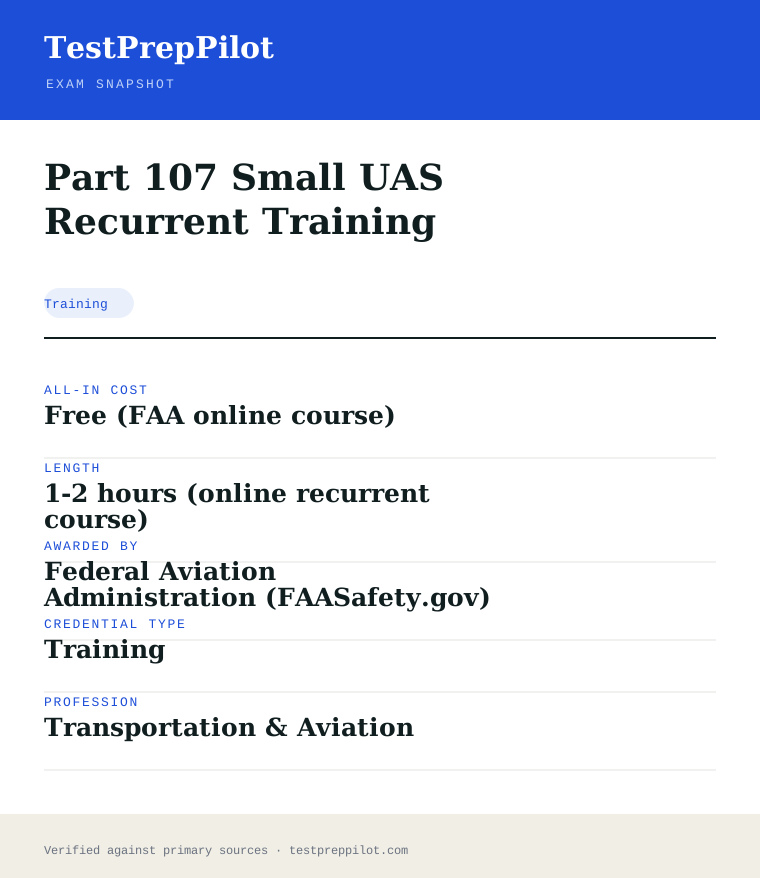
Part 107 Small UAS Recurrent Training — Transportation, Aviation & Maritime credential from Federal Aviation Administration (FAASafety.gov)
Researched and maintained by TestPrepPilot Editorial BoardAviation & FAA certification desk · Figures last verified August 2026
The short version
What is the Part 107 Small UAS Recurrent Training and is it worth it?
Part 107 Small UAS Recurrent Training is a professional credential administered by Federal Aviation Administration (FAASafety.gov). It validates job-ready knowledge and skills in the Transportation, Aviation & Maritime field and is used for career entry, advancement, or compliance.
- Recognized credential from Federal Aviation Administration (FAASafety.gov)
- Demonstrates verified competence in Transportation, Aviation & Maritime
- Supports career advancement and may satisfy licensing or employer requirements
What is it?
What exactly is the Part 107 Small UAS Recurrent Training?
Part 107 Small UAS Recurrent Training — Transportation, Aviation & Maritime credential from Federal Aviation Administration (FAASafety.gov)
Free online course remote pilots complete every 24 calendar months to keep Part 107 certificate privileges current. Offered by Federal Aviation Administration (FAASafety.gov), it is designed for candidates who need to demonstrate verified competence in the Transportation, Aviation & Maritime field. The credential is commonly used for career entry, advancement, regulatory compliance, or employer requirements. Candidates should review the official handbook for eligibility, exam format, and scoring before registering.
The path in brief
- Confirm you meet any eligibility or prerequisites
- Review the official handbook and study materials
- Register and pay through the awarding body or authorized provider
- Schedule and take the exam (test center or online proctoring)
- Receive your score and, if passed, your credential
Before you book
Who is eligible to sit the Part 107 Small UAS Recurrent Training?
Eligibility varies; many credentials are open to all, while others require coursework, work experience, or sponsorship.
Who it is for: Professionals and candidates seeking to validate Transportation, Aviation & Maritime competence.
The test itself
What is the format of the Part 107 Small UAS Recurrent Training?
The Part 107 Small UAS Recurrent Training is administered by Federal Aviation Administration (FAASafety.gov) and runs ~15-30 minutes.
| Administered by | Federal Aviation Administration (FAASafety.gov) |
|---|---|
| Questions | Course completion (no exam) |
| Time limit | ~15-30 minutes |
| Pass mark | Passing score set by the awarding body; see the official score report |
| Exam fee | Free |
| Format | Proctored, computer-based (test center or online remote proctoring) |
Content outline
What topics are on the Part 107 Small UAS Recurrent Training?
The Part 107 Small UAS Recurrent Training covers 4 content domains.
Weightings come from the official exam outline. Study time is best allocated in roughly these proportions rather than evenly across domains.
- Regulations & procedures
Topic area tested on the exam; see the official blueprint for the detailed breakdown.
- Systems & operations
Topic area tested on the exam; see the official blueprint for the detailed breakdown.
- Safety & emergency
Topic area tested on the exam; see the official blueprint for the detailed breakdown.
- Navigation & logistics
Topic area tested on the exam; see the official blueprint for the detailed breakdown.
The path
How do you register for the Part 107 Small UAS Recurrent Training?
- 1
Visit the awarding body’s official website and create an account
- 2
Select the credential and review its specific requirements
- 3
Complete any required eligibility (education, experience, or training)
- 4
Pay the registration fee
- 5
Schedule the exam at a test center or online
- 6
Take the exam and receive your results
The fine print
What are the retake and renewal rules for the Part 107 Small UAS Recurrent Training?
- Proctoring & delivery
- Proctored, computer-based delivery (test center or remote online proctoring), varying by exam.
- Retake policy
- Varies by credential — most bodies permit retakes after a waiting period and full or partial fee.
- Score reporting
- Scores are reported per the body’s timeline, typically electronically after the exam.
- Recertification
- Varies; many credentials require renewal every 2–3 years via continuing education or a recertification exam.
What it pays
How much does this credential pay?
ALC-677 confers no wage — it is a free FAA compliance course that refreshes your Part 107 operating currency; BLS has no occupation for small-UAS pilots, so no official salary figure exists for drone work
The direct answer is that ALC-677 has no salary story, and the honest framing is that it is not a credential that moves pay — it is a free, online regulatory compliance course that a Part 107 remote pilot completes every 24 calendar months to refresh the aeronautical-knowledge recency required by 14 CFR 107.65 before operating commercially under Part 107. The Bureau of Labor Statistics does not publish an occupation for small-unmanned-aircraft-system pilots, so there is no official median wage for drone work — any site quoting a "drone pilot salary" is quoting job-board aggregates or vendor surveys, not government data, and those figures vary wildly with the type of work. The closest BLS categories are in manned aviation — airline pilots and commercial pilots — but they do not isolate drone operations, and quoting them here would mislead, so we do not. What is verifiable is the economic structure around this training: the course is free, the FAA certificate itself does not expire, and the only cost is the time to complete the modules, which is exactly why recurrent compliance is cheap compared with the initial Part 107 knowledge test at a testing centre (60 questions, 2 hours, roughly $175, taken once to earn the certificate). Actual earnings for drone work depend on the market, the employer or client, the type of operations — real-estate photography, inspection, mapping, agriculture, film — and whether the pilot is an employee or a contractor, so the honest planning advice is to price jobs locally rather than chase a national figure. The practical value of completing ALC-677 on time is not a raise; it is the legal right to keep accepting paid Part 107 work at all, because a pilot whose 24-calendar-month currency has lapsed is grounded for commercial purposes until the course is completed.
| Measure | Figure | Source / note |
|---|---|---|
| Course cost | $0 | Free online course on the FAA Safety Team (FAASTeam) Learning Center at FAASafety.gov |
| Frequency | Every 24 calendar months | 14 CFR 107.65 aeronautical-knowledge recency for Part 107 privileges |
| BLS occupation for small-UAS pilots | None published | BLS does not isolate drone pilots as an occupation; no official wage figure exists |
| Reference: initial Part 107 knowledge test | ~$175, once | 60 questions, 2 hours, at an FAA-approved testing centre — taken once to earn the certificate |
| Certificate expiry | Does not expire | The Remote Pilot Certificate is permanent; only the 24-month knowledge currency lapses without recurrent training |
Job growth.No BLS projection exists for small-UAS pilots as an occupation. The demand context is the growing commercial use of drones across real estate, inspection, agriculture and public safety, but earnings and employment are not tracked by BLS in a way that produces an official figure.
Source: FAA — Become a Certificated Remote Pilot (Part 107 recurrent requirements)
Your odds
What are the pass rates?
There is no pass rate to report — ALC-677 is a completion-based training course, not a scored exam; your currency is restored by finishing the course and receiving the completion certificate
The direct answer is that ALC-677 has no published pass rate because it is not a scored examination — it is a free, self-paced online training course on the FAA Safety Team Learning Center, and the FAA’s recurring-currency requirement is satisfied by course completion, not by passing a proctored test at a testing centre. The FAA eliminated the in-person proctored recurrent knowledge test for Part 107 pilots and replaced it with online recurrent training, so there is no exam-day pass line, no test-centre fee, and no official pass-rate statistic anywhere in the program. What the course does include, in the FAA’s own design, is a knowledge check or review at the end of the modules that is open-book — you may reference the course material while working through it — and that you may retake as many times as needed until you complete it, which is why the completion requirement is usually described as confirming you have worked through the content rather than as a scored barrier. Because there is no score and no pass rate, the statistics that matter are entirely different: the recency window of 24 calendar months, calculated to the last day of the month 24 months after your qualifying event — your initial knowledge-test pass, eligible initial Part 61 online training, or your last recurrent training completion — and the fact that completing the course early simply starts the next 24-month window from the new completion month, per the FAA’s guidance. The practical implication is that "pass rate" thinking does not apply: plan the course as a 2-3 hour block of reading, complete the modules and the review, download the certificate of completion, and carry it as proof of current aeronautical knowledge when you fly. The only real failure mode is letting the 24-calendar-month window lapse, which grounds you for commercial work until you finish the course.
Read this before quoting the number.ALC-677 has no published pass rate because it is a completion-based online course rather than a scored exam; the FAA replaced the proctored recurrent knowledge test with this free training. The relevant facts are the 24-calendar-month recency window under 14 CFR 107.65, the open-book course review with unlimited retakes, and the completion certificate that is your proof of currency.
Source: FAA — Recurrent Training Courses for Drone Pilots Available Online
Your schedule
How long should I study for it?
2-3 hours, completed within your 24-calendar-month currency window of focused study
The study plan for ALC-677 is short by design — budget roughly 2 to 3 hours of focused time to read the course modules and complete the open-book review, done in one sitting or two, with no days of preparation required — because this is a refresher course whose job is to update your knowledge of current Part 107 regulations, airspace, weather, night operations, Remote ID and operational safety, not to teach you to fly drones. The critical planning step comes before the course, not during it: calculate your 24-calendar-month deadline correctly, because the window ends on the last day of the month 24 months after your qualifying event, not exactly 730 days later — a pilot who passed the initial knowledge test on 10 April 2024 remained current through 30 April 2026, and could not exercise Part 107 privileges from 1 May 2026 without completing qualifying recurrent training. Decide which course you are eligible for before you start: ALC-677 is the standard recurrent course for anyone holding a Part 107 Remote Pilot Certificate, current or lapsed, while ALC-515 is a shorter alternative limited to Part 107 pilots who also hold a Part 61 certificate with a current flight review — if you are a Part 61 pilot whose flight review has lapsed, take ALC-677. On the day, create a free FAASafety.gov account if you do not have one, find ALC-677 in the course catalogue, work through the modules at your own pace — the course is self-paced and can be completed from any internet-connected device — complete the open-book review, and download the certificate of completion immediately. One habit that prevents the most common failure: set a calendar reminder about a month before your deadline, and treat the course as done when the certificate is saved, because the FAA may ask for it during a ramp check, and every day past the window is a day you cannot legally accept paid work.
- Before you start30-45 min
Verify eligibility and calculate the deadline
- Confirm you hold a Part 107 Remote Pilot Certificate, or that you are a Part 61 pilot choosing between ALC-677 and ALC-515 based on a current flight review
- Calculate your 24-calendar-month window to the last day of the corresponding month, not 730 days
- Create or log in to your free FAASafety.gov account and locate ALC-677 in the course catalogue
- Course day2-3 hrs
Complete the modules and the review
- Work through the modules covering current regulations, airspace, weather, night operations, Remote ID and operational safety
- Complete the open-book knowledge review at the end of the course — you may reference the material and retake as needed
- Download and save the certificate of completion immediately
- After completion15 min
Record the new window
- Note the new 24-calendar-month window that starts from this completion month
- Save a backup copy of the certificate in an easily reachable place for ramp checks
- Set a reminder for about a month before the next deadline
Adjusting the pace
Part 61 pilot with a current flight review.You may take the shorter ALC-515 recurrent course instead of ALC-677. Confirm your flight review is current before relying on it — if it has lapsed, use ALC-677.
Currency already lapsed.The course is identical and free whether you are current or lapsed. Complete ALC-677 as soon as possible; there is no penalty beyond the days you cannot exercise Part 107 privileges.
Prefer to review before the course.Read the Part 107 rule summary and the Remote Pilot Small Unmanned Aircraft Systems Airman Certification Standards on the FAA site first, so the course modules reinforce rather than introduce the material.
How to study
How do I prepare most effectively?
The strategy that matters for ALC-677 is mostly calendar management and only slightly study, because the course is a free, open-book refresher whose completion — not a score — restores your Part 107 currency, so the real preparation is knowing your deadline, protecting the time, and understanding what the course is designed to do. First, compute the 24-calendar-month window correctly: it ends on the last day of the month 24 months after your qualifying event, so 10 April 2024 buys you through 30 April 2026, and completing the course early starts the next window from the new completion month — meaning there is no benefit to waiting and real risk in it. Second, plan the 2 to 3 hours as a scheduled block rather than "someday this week," because the course must be read through and the modules take uninterrupted attention; candidates who defer find the window has closed. Third, when you do sit down, read for currency rather than for novelty — the content updates since your last training, particularly Remote ID requirements and night-operation rules, are where the course is most likely to contain material you do not already know, and the open-book review at the end is simply a check that you have worked through it. Fourth, treat the certificate of completion as an operational document: download it, save a backup, and keep it where you can produce it during a ramp check or an employer’s compliance audit, because the FAA can ask for it and your proof of currency is the certificate, not your plastic certificate card. Finally, build the reminder system now — a calendar alert about a month before the next deadline — because the entire economic cost of missing this course is the loss of the legal right to accept paid Part 107 work until it is completed, which is a much larger loss than the course itself could ever cost.
Compute the window to the last day of the month
Under 14 CFR 107.65 the recency window is 24 calendar months, ending on the last day of the month 24 months after your qualifying event — not 730 days. A test passed 10 April 2024 keeps you current through 30 April 2026. Get this calculation wrong and you will ground yourself unknowingly.
Schedule the 2-3 hours like an appointment
The course is self-paced but requires uninterrupted reading through the modules. Book the block in your calendar a month ahead of the deadline, so the window never closes while you are "about to" do it.
Read for what changed, not what you know
The modules refresh your knowledge of the current regulations, and the material most likely to be new is Remote ID compliance, night-operation lighting rules, and recent airspace changes. Spend your attention where the course updates, not where you already operate daily.
Treat the certificate as an operational document
Download and back up the certificate of completion. It is your proof of current aeronautical knowledge during ramp checks and employer audits — the plastic Remote Pilot Certificate does not expire, but the currency record is the certificate you carry or can produce.
Set the next reminder immediately
The moment you complete the course, add a calendar alert for about a month before the new deadline. The cost of lapsed currency — days or weeks of being unable to legally accept paid work — dwarfs the 2-3 hours this course takes.
What to buy
Which study resources are worth paying for?
There is essentially nothing to buy for ALC-677, and the buying decision here is really about which official resources to read alongside the free course, because the course itself is free, the FAA materials that explain the requirement are free, and the only private products worth considering are supplementary study aids that cost roughly the same as a coffee. The required resource is the course itself: ALC-677 on the FAA Safety Team Learning Center at FAASafety.gov, at no cost, for any Part 107 certificate holder. The FAA materials that make the course easy are also free: the Become a Certificated Remote Pilot page explains the two recurrent options and the 24-month rule, the Remote Pilot Small Unmanned Aircraft Systems Airman Certification Standards explains the knowledge the certificate implies, and the FAA news announcement on recurrent training documents when and why the proctored recurrent test was replaced by the online course. For pilots who want structured review before or alongside the course, the cheap private options are Part 107 recurrent-training review courses and practice-question apps from drone-training vendors, typically $10 to $50, which quiz the same regulatory material in a multiple-choice format — useful if you want to test yourself on the content, but not required, because the course itself is open-book and completion-based. The honest rule: spend the $0 on the FAA course first and read the three free FAA pages, buy a private review product only if you want a self-test of the material before the course, and remember that no product, free or paid, replaces the certificate of completion — that certificate, from the FAA’s own platform, is the only record the FAA counts.
| Resource | Price | Format | Best for |
|---|---|---|---|
| ALC-677 on the FAASTeam Learning Center (FAASafety.gov) | Free | Self-paced online course with modules and an open-book review | Required — the course that restores your 24-month currency |
| FAA Become a Certificated Remote Pilot page | Free | Official FAA web page on the two recurrent options and the 24-month rule | Confirming eligibility for ALC-677 versus ALC-515 and the recency deadline |
| Remote Pilot Small UAS Airman Certification Standards (FAA) | Free | Official PDF / FAA web page | Understanding the knowledge base the certificate implies, before or after the course |
| Private Part 107 recurrent review courses and quiz apps | ~$10-50 | Video or quiz app | Optional self-testing of the regulatory material; not required because the course is open-book and completion-based |
The FAA course is free and completion-based, so no paid product is required. Prices for private review aids are approximate and dated to 2026; we do not rank by commission.
Avoid these
What mistakes do candidates most often make?
The most common mistake on ALC-677 is a calendar error, not a knowledge error: pilots calculate the 24-calendar-month window as 730 days and ground themselves unknowingly, when the correct calculation is to the last day of the month 24 months after the qualifying event — a pilot current through 30 April cannot fly from 1 May even if exactly 730 days have not passed. The second is taking the wrong course: Part 61 pilots who also hold a remote pilot certificate often click ALC-515 — the shorter course for Part 61 pilots with a current flight review — without checking that their flight review is actually current, and the course does not count if it is not; the standard ALC-677 is the safe choice for anyone whose Part 61 flight review has lapsed. A third recurring error is treating the open-book knowledge review as an exam to study for and then deferring it, when it is a completion gate that can be retaken freely and the real risk is never sitting down to finish the course at all. Candidates also forget that completing the course early starts the next 24-month window from the new completion month, so there is no benefit to waiting until the deadline. Many pilots finish the course but never download the certificate, and then have no proof of currency when an employer or an FAA inspector asks for it. Finally, some pilots confuse this recurrent course with the initial knowledge test — a 60-question, 2-hour, roughly $175 test at a testing centre — and prepare as if they were re-sitting an exam, when the recurrent path is a free course with no test-centre visit.
✕Calculating the 24-month window as 730 days
✓The window ends on the last day of the month 24 months after your qualifying event, not exactly two years from the date. A pilot current through 30 April is grounded from 1 May. Compute it to the month and set the reminder a month before that date.
✕Taking ALC-515 without a current Part 61 flight review
✓ALC-515 only counts for Part 61 pilots whose flight review is current. If your flight review has lapsed, or you are unsure, take the standard ALC-677 — it is the same free cost and the safe eligibility choice.
✕Treating the course review as an exam to defer
✓The open-book review is a completion gate with unlimited retakes — you may reference the material as you work. The real failure is never finishing the course, so schedule the 2-3 hours and complete it well before the deadline.
✕Waiting until the deadline to complete the course
✓Completing early starts the next 24-month window from the new completion month, so finishing a month ahead costs you nothing and removes the risk of a lapse. There is no benefit to waiting.
✕Not downloading the completion certificate
✓The certificate of completion is your proof of current aeronautical knowledge for ramp checks and employer audits. Download it, back it up, and keep it reachable — the plastic Remote Pilot Certificate does not expire, but the course certificate is the currency record.
✕Confusing the recurrent course with the initial knowledge test
✓The initial Part 107 test is a 60-question, 2-hour, roughly $175 proctored exam at a testing centre, taken once. Recurrent training is a free online course with no test-centre visit and no scored pass line — prepare for the course by scheduling time, not by re-studying for an exam.
What you'll face
What question types will I see?
ALC-677 is a completion-based online course rather than a scored examination, so it does not have the question mix of a test — but the course does include a knowledge review at the end that works through the same categories of content the modules cover, in an open-book, unlimited-retake format, and it is worth knowing what those categories are so you can focus your reading. The content areas are current Part 107 regulations and operational rules, airspace classifications and controlled-airspace authorisation, weather effects on small-UAS performance, emergency procedures, crew resource management, night operations including anti-collision lighting requirements, and Remote ID compliance. Because the review is open-book and retakeable, the honest way to describe it is as a structured check that you have worked through the modules rather than as a scored barrier — there is no pass-rate statistic, no scaled score, and no comparison with other candidates. The practical skill the course actually builds is recognition of the current rules: being able to answer, from the updated material, whether a given operation needs a Remote ID broadcast module, what the night-operation lighting rule requires, and when a controlled-airspace authorisation applies. The single most useful preparation is reading the course modules with attention to what changed since your last training — Remote ID and night operations are the two areas that most often contain genuinely new material for returning pilots — and then completing the review, referencing the material as needed, until it is done. The sample items below are editor-written illustrations of the kind of knowledge-check questions the course format uses, not live exam items and not scored items on any official examination.
Current Part 107 requirements: who may operate, what the remote pilot in command is responsible for, and how the rules apply to a given commercial operation.
Controlled versus uncontrolled airspace, the classes of airspace, and when an FAA airspace authorisation or a specific operational approval is required.
Weather effects on small-UAS performance and battery life, emergency procedures, and the crew coordination practices that keep operations safe.
Anti-collision lighting requirements for night operations and the three standard Remote ID compliance paths, plus FAA authorisations where they apply.
Try these
Q1A remote pilot in command plans a night operation under Part 107. Which of the following is required for the operation to be legal?
Answer:B
Under the current Part 107 rules, remote pilots may operate at night without a waiver if the small unmanned aircraft is equipped with anti-collision lighting visible for at least three statute miles, and the pilot has the appropriate night-operations knowledge — which recurrent training refreshes. A is the outdated answer: the night-operation waiver requirement was removed by the Operations Over People rule, which is why night operations are now a standard course topic rather than a waiver process. C is wrong because Part 107 does not require a person aboard the aircraft — the aircraft is unmanned. D is wrong because a flight plan is not universally required for Part 107 operations; controlled-airspace authorisation depends on where the operation occurs, not on a blanket flight-plan requirement.
Q2A pilot’s Part 107 aeronautical-knowledge currency lapses because the 24-calendar-month window passes without completing recurrent training. What happens to the Remote Pilot Certificate?
Answer:C
The Remote Pilot Certificate does not expire; what lapses is the aeronautical-knowledge recency that 14 CFR 107.65 requires before operating under Part 107. The pilot is grounded for Part 107 purposes until qualifying recurrent training — the free online course — is completed, after which the 24-month window restarts. A is wrong because there is no automatic six-month suspension; currency is simply absent. B is wrong because the initial knowledge test does not need to be retaken — the recurrent course restores currency regardless of how long it has lapsed. D is wrong because Part 107 privileges are commercial privileges; the certificate does not "remain valid" for one category over another once currency is gone.
Q3Which of the following statements about Remote ID compliance is most accurate under the current rules?
Answer:B
The Remote ID rule offers three standard compliance paths — a standard Remote ID broadcast module installed on the aircraft, an FAA-approved broadcast module attached to the aircraft, or operation within an FAA-recognised identification area — plus limited FAA authorisations where the standard paths do not apply. A is wrong because altitude does not determine the Remote ID requirement. C is wrong because Remote ID applies to operations under Part 107 regardless of certificate holding. D is wrong because the rule is not limited to airport proximity; it applies to the aircraft’s operation wherever it flies. This question style — recognising the current compliance paths — is exactly the kind of updated content recurrent training exists to refresh.
Samples are editor-written illustrations of the published blueprint, not live exam items.
The big day
What should I expect on exam day?
There is no exam day for ALC-677 in the traditional sense — the course is a self-paced online training completed from any internet-connected device through the FAA Safety Team Learning Center at FAASafety.gov, with no test centre, no proctor, no scheduled seat and no fee — but there is a completion day, and the habits that make it go right are the same as for any compliance deadline. The week before, log in to FAASafety.gov, confirm your account works, locate ALC-677 in the course catalogue, and verify you are taking the right course — the standard recurrent course for Part 107 certificate holders, rather than ALC-515 which is restricted to Part 61 pilots with a current flight review. On the day, set aside the full 2 to 3 hours in a quiet place with a reliable connection, work through the modules in order, and complete the open-book knowledge review at the end — you may reference the course material while answering, and you may retake it as many times as needed, so the only requirement is to finish it. The moment you finish, download the certificate of completion, save a backup copy, and record the new 24-calendar-month window that begins from this completion month. Then set the next reminder for about a month before the new deadline, because the entire risk of this course is calendar drift — a pilot who lets the window lapse loses the legal right to accept paid Part 107 work until the course is completed. Carry or be able to produce the certificate during flights, because the FAA may ask for it during a ramp check, and employers routinely verify currency before signing work.
Bring
- A computer, tablet or phone with a stable internet connection and a free FAASafety.gov account
- About 2-3 hours of uninterrupted time and a quiet place to read the modules
- Your Part 107 Remote Pilot Certificate details, so the course record connects to your FAA profile
- The calculation of your 24-calendar-month deadline, so you know exactly when the window ends
Leave at home
- Any assumption that this is a scored exam — it is completion-based and open-book
- Any expectation of a fee or a test-centre visit — there is neither
- The urge to skim past the Remote ID and night-operation modules — they are the most likely to contain material new since your last training
- The habit of "I will finish it later" — the calendar window, not the course, is what grounds you
How the day runs
Rules in the room
- The course is free, self-paced and completed online through FAASafety.gov — no test centre, no fee, no scheduled seat.
- The requirement is completion of the course, not a scored pass; the knowledge review is open-book with unlimited retakes.
- The 24-calendar-month window ends on the last day of the corresponding month, not 730 days after your qualifying event.
- The Remote Pilot Certificate itself does not expire; only the knowledge currency lapses, and the course restores it regardless of how long it has been lapsed.
- ALC-515 is an alternative only for Part 61 pilots with a current flight review; otherwise use ALC-677.
- You must be able to produce the certificate of completion when the FAA or an employer verifies currency.
Afterwards.With the certificate downloaded, your Part 107 aeronautical-knowledge currency is restored for the next 24 calendar months, counted to the last day of the month 24 months from this completion — so record that date, set a reminder for a month before it, and keep the certificate where you can produce it during a ramp check or an employer’s compliance audit. There is no application to file and no agency to notify; the course completion itself is the record. From here the practical work is operational, not administrative: update your Remote ID status if your equipment or aircraft has changed, review the night-operation lighting on aircraft you fly, and price your drone work against the local market rather than any national salary figure, because BLS publishes no occupation for small-UAS pilots and the honest earnings answer is local and client-specific. The cost of this cycle — free, two or three hours, once every two years — is the cheapest compliance item most commercial drone operators will ever have, and missing it is the only expensive mistake, because a lapsed pilot is grounded for paid work until the course is completed.
Reference
What are the key facts about the Part 107 Small UAS Recurrent Training?
Part 107 Small UAS Recurrent Training is a training credential; awarded by Federal Aviation Administration (FAASafety.gov); the exam fee is Free; typical preparation is 1-2 hours (online recurrent course); holders typically earn No dedicated SOC; refreshes Part 107 currency.
| Credential | Part 107 Small UAS Recurrent Training |
|---|---|
| Abbreviation | ALC-677 |
| Type | Training |
| Profession | Transportation & Aviation |
| Specialty | FAA Airman Knowledge Tests |
| Awarded by | Federal Aviation Administration (FAASafety.gov) |
| Difficulty | Regulated / Specialized |
| Typical prep time | 1-2 hours (online recurrent course) |
| All-in cost | Free (FAA online course) |
| Typical salary range | No dedicated SOC; refreshes Part 107 currency |
| Credential | Part 107 Small UAS Recurrent Training |
| Awarding body | Federal Aviation Administration (FAASafety.gov) |
| Exam format | Proctored, computer-based |
| Validity | Completion refreshes the 24-month currency |
| Languages | Varies — see awarding body |
| Scope | National / Multi-state |
| Also known as | ALC-677, Part 107 Recurrent |
Real questions
Frequently asked questions about the Part 107 Small UAS Recurrent Training
How do I register for the Part 107 Small UAS Recurrent Training exam?
Register through Federal Aviation Administration (FAASafety.gov)'s official portal or an authorized test provider (e.g., Pearson VUE or Prometric where applicable). Create an account, select the exam, pay the fee, and schedule a date.
How much does the exam cost?
Fees vary by location and currency. Confirm the current fee on the official registration page before scheduling.
How long is the credential valid, and how do I renew?
Validity varies by credential (commonly 2–3 years). Renewal usually requires continuing education or a recertification exam — see Federal Aviation Administration (FAASafety.gov)'s policy.
What if I do not pass?
Most bodies allow retakes after a waiting period and payment of the full or partial fee. Check Federal Aviation Administration (FAASafety.gov)'s retake policy before rescheduling.
How do I register for a Federal Aviation Administration (FAASafety.gov) credential?
Register through the official website, select your exam, pay the fee, and schedule a date.
How do I renew a credential?
Renewal policies vary by credential; check the specific program page for requirements and cycles.
In short
Is the Part 107 Small UAS Recurrent Training worth it?
- Part 107 Small UAS Recurrent Training is awarded by Federal Aviation Administration (FAASafety.gov).
- Validates job-ready competence in Transportation, Aviation & Maritime.
- Registration is through the awarding body or an authorized test provider.
- Renewal and retake policies vary — confirm before scheduling.
Same awarding body
What other credentials does Federal Aviation Administration (FAASafety.gov) award?
Worth comparing
How does the Part 107 Small UAS Recurrent Training compare with similar credentials?
Trust
Where does this information come from?
Everything above is taken from the awarding body's own published material. Fees, question counts and domain weights are revised regularly — check the official page before you pay.
Research confidence: low · Last reviewed 2026-08