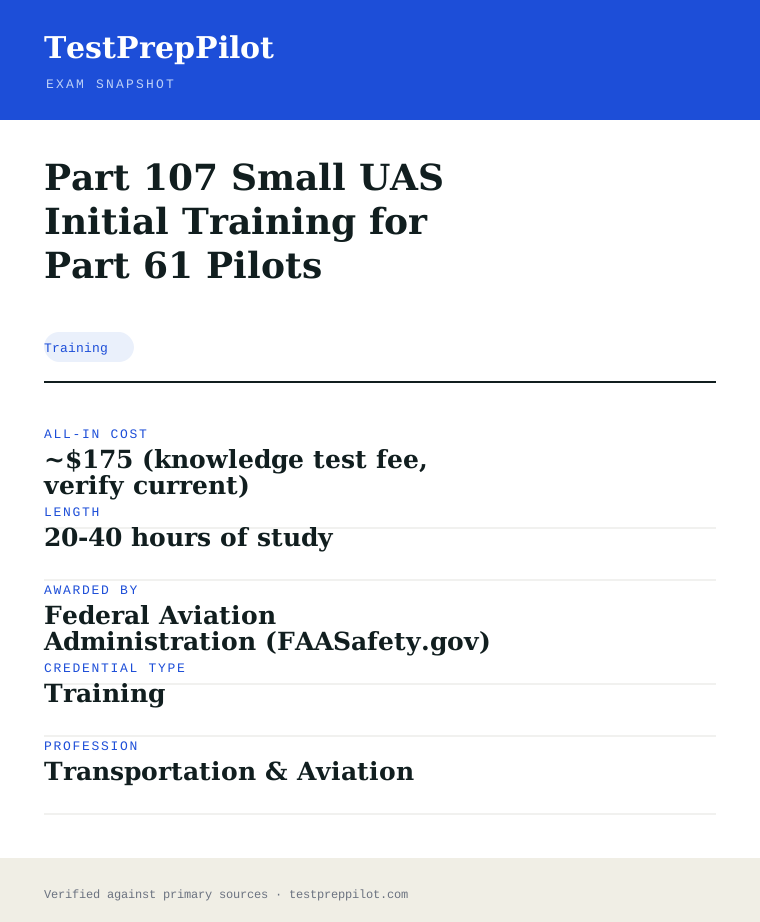
The short version
What is the Part 107 Small UAS Initial Training for Part 61 Pilots and is it worth it?
Part 107 Small UAS Initial Training for Part 61 Pilots is a professional credential administered by Federal Aviation Administration (FAASafety.gov). It validates job-ready knowledge and skills in the Transportation, Aviation & Maritime field and is used for career entry, advancement, or compliance.
- Recognized credential from Federal Aviation Administration (FAASafety.gov)
- Demonstrates verified competence in Transportation, Aviation & Maritime
- Supports career advancement and may satisfy licensing or employer requirements
What is it?
What exactly is the Part 107 Small UAS Initial Training for Part 61 Pilots?
Part 107 Small UAS Initial Training for Part 61 Pilots — Transportation, Aviation & Maritime credential from Federal Aviation Administration (FAASafety.gov)
Online course allowing current Part 61 pilots with a flight review to earn a remote pilot certificate without sitting the UAG test. Offered by Federal Aviation Administration (FAASafety.gov), it is designed for candidates who need to demonstrate verified competence in the Transportation, Aviation & Maritime field. The credential is commonly used for career entry, advancement, regulatory compliance, or employer requirements. Candidates should review the official handbook for eligibility, exam format, and scoring before registering.
The path in brief
- Confirm you meet any eligibility or prerequisites
- Review the official handbook and study materials
- Register and pay through the awarding body or authorized provider
- Schedule and take the exam (test center or online proctoring)
- Receive your score and, if passed, your credential
Before you book
Who is eligible to sit the Part 107 Small UAS Initial Training for Part 61 Pilots?
Eligibility varies; many credentials are open to all, while others require coursework, work experience, or sponsorship.
Who it is for: Professionals and candidates seeking to validate Transportation, Aviation & Maritime competence.
The test itself
What is the format of the Part 107 Small UAS Initial Training for Part 61 Pilots?
The Part 107 Small UAS Initial Training for Part 61 Pilots is administered by Federal Aviation Administration (FAASafety.gov) and runs 2 hours and contains 60 questions.
| Administered by | Federal Aviation Administration (FAASafety.gov) |
|---|---|
| Questions | 60 questions |
| Time limit | 2 hours |
| Pass mark | Passing score set by the awarding body; see the official score report |
| Exam fee | ~$175 |
| Format | Proctored, computer-based (test center or online remote proctoring) |
Content outline
What topics are on the Part 107 Small UAS Initial Training for Part 61 Pilots?
The Part 107 Small UAS Initial Training for Part 61 Pilots covers 4 content domains.
Weightings come from the official exam outline. Study time is best allocated in roughly these proportions rather than evenly across domains.
- Regulations & procedures
Topic area tested on the exam; see the official blueprint for the detailed breakdown.
- Systems & operations
Topic area tested on the exam; see the official blueprint for the detailed breakdown.
- Safety & emergency
Topic area tested on the exam; see the official blueprint for the detailed breakdown.
- Navigation & logistics
Topic area tested on the exam; see the official blueprint for the detailed breakdown.
The path
How do you register for the Part 107 Small UAS Initial Training for Part 61 Pilots?
- 1
Visit the awarding body’s official website and create an account
- 2
Select the credential and review its specific requirements
- 3
Complete any required eligibility (education, experience, or training)
- 4
Pay the registration fee
- 5
Schedule the exam at a test center or online
- 6
Take the exam and receive your results
The fine print
What are the retake and renewal rules for the Part 107 Small UAS Initial Training for Part 61 Pilots?
- Proctoring & delivery
- Proctored, computer-based delivery (test center or remote online proctoring), varying by exam.
- Retake policy
- Varies by credential — most bodies permit retakes after a waiting period and full or partial fee.
- Score reporting
- Scores are reported per the body’s timeline, typically electronically after the exam.
- Recertification
- Varies; many credentials require renewal every 2–3 years via continuing education or a recertification exam.
What it pays
How much does this credential pay?
No dedicated BLS occupation exists for drone pilots — the closest verified BLS line is Photographers at $42,520 (BLS OOH, May 2024), and commercial drone earnings vary widely by niche.
The salary answer for the Part 107 certificate requires an honest statement up front: the BLS has no occupation called "drone pilot" or "remote pilot," because commercial drone work is classified under the occupations whose duties the operator actually performs — most commonly photography and videography, surveying and mapping, and inspection work in construction and engineering — so no single BLS median applies to a Part 107 holder. The closest verified BLS line to the most common entry use of a drone license is Photographers, which had a median annual wage of $42,520 in May 2024, or $20.44 per hour, in an occupation of 151,200 jobs with 2 percent projected growth from 2024 to 2034; but that figure is a poor proxy for the full Part 107 market, because drone work spans real-estate photography, insurance inspection, agricultural monitoring, construction surveying, and film production, and earnings in those niches range from per-shoot fees in the low hundreds to full-time technical salaries well above the photographer median. The honest framing is that the Part 107 certificate is an eligibility credential, not a wage credential: it is the license that lets you charge money for drone operations, and the income it produces is a function of the niche you build, the region you work in, and whether you operate as a side-income contractor or a full-time employee of a surveying, inspection, or production company. The cost side is what candidates should weigh first: the knowledge test costs about $175, the recurrent training every 24 months is free, and the total path to a certificate — study materials, the test, the TSA vetting, and the equipment you will operate — is small relative to most aviation credentials, which is why Part 107 is the most accessible commercial aviation certificate in the U.S.
| Measure | Figure | Source / note |
|---|---|---|
| Median annual wage, photographers | $42,520 | BLS OOH, May 2024 ($20.44/hr) — the closest verified occupation to entry-level drone work |
| Photographers employment, 2024 | 151,200 jobs | BLS OOH Quick Facts |
| No dedicated drone-pilot SOC | None published | BLS classifies commercial drone work under photography, surveying, and inspection occupations |
| Part 107 knowledge test fee | ~$175 | PSI testing program; each attempt, non-refundable on no-show |
| Recurrent training | Free every 24 months | Online course via FAASafety.gov |
Job growth.BLS projects 2% growth for photographers (2024-34); no dedicated projection exists for drone pilots, and the practical outlook for Part 107 work is driven by niche demand in photography, surveying, inspection, and film rather than by any single BLS line.
Your odds
What are the pass rates?
The FAA sets the Part 107 passing threshold at 70% (42 of 60 questions) but publishes no official aggregate pass rate; industry analyses of FAA score data report a roughly 83% pass rate across 73,914 test-takers in 2025, an estimate we cite with that caveat.
The direct answer on pass rates is that the FAA publishes the passing threshold but not an official aggregate pass rate for the Part 107 knowledge test, and we state that plainly: the published and verifiable standard is that you must answer 42 of the 60 questions correctly — 70 percent — within the two-hour limit, and the FAA reports score data per test-taker rather than maintaining a single official pass-rate statistic for the whole program. The most commonly cited recent figures come from industry analyses of FAA score data, which report a pass rate of 82.96 percent across 73,914 Part 107 test-takers in 2025 with an average score of 79.31 percent — figures we present as industry-reported estimates rather than as an FAA publication, because they are compilations of FAA data by test-prep providers and have not been published by the FAA itself as a single official statistic. What is fully verifiable is the exam mechanics: the Unmanned Aircraft General – Small (UAG) knowledge test is 60 multiple-choice questions with a two-hour time limit, a passing score of 70 percent, and a required retake wait of 14 days after a failed attempt, with each attempt costing about $175. The practical read on the exam is consistent with the industry-reported figures: the content is weighted toward operations and regulations — the FAA’s published knowledge-area list covers regulations, airspace classification, weather, loading and performance, emergency procedures, and aeronautical decision-making — and the widely observed failure pattern is candidates who study passively without drilling sectional charts and weather products, which are the two areas where most test-takers lose points. A separate and important distinction: the FAASTeam ALC-451 course is not the knowledge test — it is a free online initial-training course for Part 61 pilots with a current flight review, with its own open-book end-of-course check, and it is an alternative path to the remote pilot certificate for that specific population.
Read this before quoting the number.The FAA publishes the passing threshold (70%, or 42/60) but no official aggregate pass rate; the ~83% pass rate and 79.31% average score for 2025 are industry compilations of FAA data, not an FAA publication. The ALC-451 online course is a Part 61-pilot training path, not the knowledge test itself.
Your schedule
How long should I study for it?
15-30 hours over 2-4 weeks (non-pilot path); ~2 hours for the ALC-451 course (Part 61 pilot path) of focused study
A realistic Part 107 study plan runs 15-30 hours over 2-4 weeks, because the knowledge test is 60 questions in two hours at a 70 percent passing standard, and the largest score gains come from drilling the published knowledge areas — especially airspace classification, sectional-chart reading, and weather products, which are where most candidates lose points — before sitting at a PSI testing center. The FAA Remote Pilot Study Guide and the Airman Knowledge Testing Supplement are the scope map: both are free, the supplement contains the charts and figures used on the exam, and the FAA publishes the knowledge areas the test covers — applicable regulations under 14 CFR Part 107, airspace classification and operating requirements, aviation weather sources and effects, small UAS loading and performance, emergency procedures, crew resource management, radio communication procedures, aeronautical decision-making, airport operations, maintenance and preflight inspection, and night operations. The study window should split into a rules-and-airspace phase (week 1), a weather-and-sectionals phase (week 2) that includes decoding METAR reports and reading sectional charts from the supplement, and a practice-and-readiness phase (weeks 3-4) built around timed 60-question practice exams at the 70 percent standard. Candidates with an aviation background should budget the lower end and focus on the Part 107-specific rules; candidates with no aviation background should budget the upper end and add a structured course or question bank, because the sectional-chart and weather content is genuinely unfamiliar. The final week should include at least two timed practice exams scoring 80 percent or higher before booking the ~$175 test, because each attempt costs the full fee and a failed attempt adds a 14-day wait. Existing Part 61 pilots with a current flight review should follow the separate ALC-451 route: complete the free online course on FAASafety.gov and its end-of-course check instead of the knowledge test.
- Week 15-8 hrs
Regulations and airspace
- Study the 14 CFR Part 107 rules: operating limitations, registration, Remote ID, waivers
- Learn the airspace classes (B, C, D, E, G) and their entry and altitude requirements
- Drill the Remote Pilot in Command responsibilities and accident-reporting rules
- Week 26-9 hrs
Weather and sectional charts
- Learn to decode METAR and TAF weather products
- Practise reading sectional charts and identifying airspace symbols
- Cover loading and performance, emergency procedures, and preflight inspection
- Weeks 3-46-10 hrs/week
Practice exams and readiness
- Take two to four timed 60-question practice exams, aiming for 80%+
- Re-drill the missed items, prioritising sectionals and weather
- Create the IACRA FTN, book the PSI test, and confirm the two-form ID rule
Adjusting the pace
Part 61 pilot with a current flight review.Take the free FAASTeam ALC-451 online course on FAASafety.gov instead of the knowledge test; it takes about two hours, includes an open-book end-of-course check, and is the published alternative path to the remote pilot certificate.
No aviation background.Budget the upper end and add a structured course or question bank; sectional charts and weather products are genuinely unfamiliar and are the two areas where most candidates lose points.
How to study
How do I prepare most effectively?
The dominant prep strategy for the Part 107 knowledge test is to drill the two skill areas most candidates fail — sectional-chart reading and weather products — and to practise timed 60-question exams before booking the ~$175 test, because the FAA publishes the knowledge areas but not the questions, and candidates who study passively without decoding METARs and reading charts are the ones who retake. First, use the free FAA Remote Pilot Study Guide and Airman Knowledge Testing Supplement as the anchor, because the supplement is the actual reference booklet used on the exam and contains the charts and figures you will be asked to interpret, so familiarity with it is direct exam preparation. Second, learn the Part 107 operating rules cold: the 400-foot altitude limit, visual-line-of-sight requirements, daylight and civil-twilight operations, the small-UAS weight limit, Remote ID compliance, and the waiver process, because regulations are a large share of the questions and they are the most memorisable points on the exam. Third, master airspace and sectional charts, because the exam expects you to identify airspace classes, controlled versus uncontrolled airspace, LAANC authorisation requirements, and TFRs from charts, and this is the single most commonly missed area. Fourth, learn to decode weather products — METARs, TAFs, and basic weather sources — because weather items reward knowing what each code means and how conditions affect small-UAS performance, and most candidates who fail do so on the weather and chart items, not on the rules. Fifth, take timed practice exams at the real format and treat 80 percent on practice as the readiness threshold, because the exam requires 70 percent and each attempt costs the full fee, with a 14-day wait after a fail. Finally, complete the administrative chain in order — create your FAA Tracking Number in IACRA before scheduling, book the test through PSI, and pass the TSA background check before applying for the certificate — because the test is only one step in a process that runs through IACRA.
Use the FAA study guide and testing supplement
The supplement is the actual reference booklet used on the exam; familiarity with its charts is direct exam preparation.
Learn the Part 107 rules cold
Operating limitations, VLOS, 400-foot ceiling, Remote ID, and the waiver process are the most memorisable points.
Master airspace and sectional charts
Identifying airspace classes, LAANC authorisation, and TFRs from charts is the single most commonly missed area.
Decode weather products
METARs, TAFs, and weather effects on small-UAS performance; weather and chart items separate passers from retakers.
Set an 80% practice threshold
The exam needs 70%; each ~$175 attempt adds a 14-day wait after a fail, so book only after timed 80%+ practice.
Complete the IACRA and PSI chain in order
FTN in IACRA, PSI booking, then TSA vetting — the test is one step in a multi-step certification process.
What to buy
Which study resources are worth paying for?
Part 107 prep resources split into the free FAA official set, commercial courses and question banks, and the FAASTeam ALC-451 course, and the buying logic is anchored by the free FAA materials because the Remote Pilot Study Guide and the Airman Knowledge Testing Supplement are the official sources, the supplement is the actual reference booklet used on the exam, and candidates who use only free FAA materials plus a good question bank can pass without spending anything beyond the ~$175 test fee. Commercial courses and question banks — roughly $150-200 for a one-time course, or lower for subscription question banks — add structured video lessons and large question pools with explanations, which helps candidates with no aviation background who need the sectional-chart and weather content taught systematically; the well-regarded options track the current FAA knowledge areas and Remote ID rules. The FAASTeam ALC-451 course is a different product from the prep courses: it is the free online initial-training course on FAASafety.gov that Part 61 pilots with a current flight review take in place of the knowledge test, and it includes its own open-book end-of-course check, so existing pilots should not pay for a prep course intended for the 60-question test. The footnote that anchors the comparison: prices below are approximate as of mid-2026 and change frequently, we rank nothing by commission, and the ~$175 PSI test fee is separate from any prep purchase and applies per attempt. A cheap readiness check is a free practice exam before buying anything, because a candidate who scores 80 percent or higher on a timed practice test often needs only the free FAA materials, while a candidate in the 60-70 percent range should invest in a structured course or question bank for the chart and weather content.
| Resource | Price | Format | Best for |
|---|---|---|---|
| FAA Remote Pilot Study Guide + Testing Supplement | Free | PDFs; the supplement is the exam’s reference booklet | The official anchor for every candidate |
| Commercial prep course | ~$150-200 | Video lessons + practice exams | No-aviation-background candidates needing structured chart and weather teaching |
| Subscription question bank | ~$8-25/month | Online drilling with explanations | Drilling volume after reading the FAA materials |
| Part 107 knowledge test | ~$175 per attempt | Proctored at ~700 PSI centers | The real exam; each attempt is a full fee |
| FAASTeam ALC-451 course | Free | Online course + open-book end-of-course check | Part 61 pilots with a current flight review — replaces the knowledge test |
Prices are approximate as of mid-2026 and change frequently; we rank nothing by commission. The ~$175 PSI knowledge-test fee applies per attempt and is non-refundable on no-show, and the ALC-451 course is the free Part 61-pilot alternative to the knowledge test, not a prep course for it.
Avoid these
What mistakes do candidates most often make?
The most common mistake on the Part 107 knowledge test is studying only the rules and ignoring sectional charts and weather products, because the FAA tests whether you can read the charts and decode the METARs in the testing supplement, and candidates who memorise operating limits but cannot identify airspace classes on a sectional chart are the ones who retake. The second is treating the exam as an open-book or common-sense test, when it is a proctored, closed-book, 60-question knowledge test at a 70 percent standard, and the morally intuitive answer about drone operations is frequently the FAA-regulated answer. A third recurring error is sitting the exam without a single timed practice test, underestimating the two-hour clock and discovering only at the center that the pacing and the chart-interpretation items are harder than the rules questions. Candidates also routinely confuse the two certification paths: non-pilots take the 60-question UAG knowledge test, while Part 61 pilots with a current flight review complete the free ALC-451 course — and paying for a prep course for the wrong path wastes money and time. Another pattern is neglecting the administrative chain around the test, such as creating the FAA Tracking Number only after passing, or failing to bring two forms of ID including one government-issued photo ID, which can cost the ~$175 attempt. Finally, some candidates treat the certificate as permanent, when the remote pilot certificate requires recurrent training every 24 months — the free online course on FAASafety.gov — to keep the commercial privileges current, and forgetting the cycle lets a valid certificate lapse into non-currency.
✕Studying rules but skipping charts and weather
✓Drill sectional-chart reading and METAR/TAF decoding from the FAA testing supplement; they are where most candidates lose points.
✕Treating it as a common-sense test
✓The exam is proctored, closed-book, and FAA-regulated; study the published knowledge areas rather than relying on intuition.
✕Sitting without a timed practice exam
✓Take timed 60-question practice tests and hold an 80% practice threshold before booking the ~$175 attempt.
✕Confusing the non-pilot and Part 61 paths
✓Non-pilots take the 60-question UAG knowledge test; Part 61 pilots with a current flight review take the free ALC-451 course — use the path that fits your situation.
✕Neglecting the IACRA and ID steps
✓Create your FTN before scheduling and bring two forms of ID including a government-issued photo ID; a mismatch costs the attempt.
✕Forgetting the 24-month recurrent cycle
✓Complete the free recurrent training every 24 months to keep commercial privileges current; the certificate lapses without it.
What you'll face
What question types will I see?
The Part 107 knowledge test — formally the Unmanned Aircraft General – Small (UAG) exam — is 60 multiple-choice questions with a two-hour time limit, a passing score of 70 percent (42 of 60), delivered in person at roughly 700 PSI testing centers, with a 14-day wait after a failed attempt and a fee of about $175 per attempt. The questions cover the FAA’s published knowledge areas: applicable regulations under 14 CFR Part 107, airspace classification and operating requirements, aviation weather sources and effects, small UAS loading and performance, emergency procedures, crew resource management, radio communication procedures, aeronautical decision-making, airport operations, maintenance and preflight inspection, and night operations. Many items are reference-based, meaning the question refers you to a figure or chart in the Airman Knowledge Testing Supplement — a sectional chart, an airspace diagram, or a METAR report — and asks you to interpret it, which is why candidates who study without the supplement are at a real disadvantage. The test is proctored and closed-book, with no notes or reference materials permitted beyond the supplement the testing center provides. The test is scored immediately, with the preliminary pass or fail shown on screen and a printed score report issued at the center; a passing score of 70 percent is required, and a failed attempt carries a 14-day waiting period before retaking at the full fee. Because the FAASTeam ALC-451 course is a free online alternative for Part 61 pilots with a current flight review, candidates should confirm which path applies to them before studying for the 60-question test. The samples below illustrate three of the recurring formats — a regulation item, a weather item, and a sectional-chart item. The sample items are editor-written illustrations of the published blueprint, not live exam items.
Operating limitations, VLOS, altitude, Remote ID, registration, waivers, and accident-reporting rules under 14 CFR Part 107.
Reference-based items that require identifying airspace classes, controlled versus uncontrolled airspace, and TFRs from sectional charts in the testing supplement.
Decode METAR and TAF products and reason about how conditions affect small-UAS performance and safe operation.
Loading and performance, emergency procedures, crew resource management, preflight inspection, and aeronautical decision-making scenarios.
Try these
Q1Under 14 CFR Part 107, a remote pilot in command must maintain visual line of sight of a small unmanned aircraft during the operation. Which of the following best describes the visual-line-of-sight requirement?
Answer:B
Part 107 requires the remote pilot in command or a designated visual observer to maintain visual line of sight of the small UAS at all times, without the use of corrective aids beyond normal glasses or contacts, and the aircraft must remain within a distance that allows the pilot to observe its attitude, altitude, and direction. A camera feed does not satisfy the VLOS requirement, the rule applies to all operations rather than only daylight, and while a visual observer can help, the phrase "at all times" in option A misstates who must maintain the line of sight.
Q2A METAR report includes the group "24012KT". What does this group indicate?
Answer:B
In a METAR, a wind group like "24012KT" reports the wind direction in degrees from true north (240 degrees) and the wind speed in knots (12 knots). Visibility, temperature, and altimeter settings each appear in different groups with different units, so options A, C, and D are misreadings of the code. Weather-report decoding is a standard Part 107 item and rewards learning the METAR groups before exam day.
Q3On a sectional chart, a shaded blue area that surrounds a major airport and extends from the surface upward is most likely:
Answer:A
Class B airspace is depicted on sectional charts as solid blue lines, surrounds the busiest airports, and extends from the surface upward in a layered structure, and entry requires ATC clearance. Class E airspace is depicted with magenta or blue segmented lines and is controlled airspace where VFR communication requirements are limited, and Class G is uncontrolled, shown by a lack of airspace designation rather than a blue shaded area. Reading the chart’s shading, lines, and symbology is the skill these items test.
Samples are editor-written illustrations of the published blueprint, not live exam items.
The big day
What should I expect on exam day?
The Part 107 knowledge test is a proctored, in-person exam of 60 multiple-choice questions with a two-hour time limit at one of roughly 700 PSI testing centers, and the direct exam-day answer is that you need 42 of 60 correct (70 percent), you will be issued the Airman Knowledge Testing Supplement at the center as your only reference, and you will receive a preliminary pass or fail immediately when you finish. Arrive at least 30 minutes early with two forms of identification, one of them a government-issued photo ID, because a mismatch between your IDs and your registration forfeits the ~$175 attempt; create your FAA Tracking Number in IACRA before scheduling, because it is required to book the test through PSI. The test is closed-book and proctored: phones, smartwatches, and notes are prohibited, and the supplement with the charts, figures, and weather products is provided by the center — no outside reference materials are permitted. Pace the two hours at roughly two minutes per question, and spend the extra time on the reference-based chart and weather items rather than racing through the rules questions, because the interpretation items are where candidates actually lose points. When you finish, you receive a printed score report immediately, including the 17-digit exam ID you will enter into IACRA when you apply for the remote pilot certificate; the TSA background check runs after you apply, and a temporary certificate is available from IACRA within a few days to two weeks, with the permanent card arriving by mail in six to eight weeks. On a pass, complete the IACRA application promptly while the exam ID is fresh, because the knowledge test score is valid for 24 months for application purposes. On a fail, you must wait 14 days before retaking, and each attempt costs the full ~$175 fee.
Bring
- Two forms of ID, one a government-issued photo ID (driver’s license, passport, state ID)
- Your FAA Tracking Number and PSI booking confirmation
- Any approved reference materials only if your testing center allows them (none are required — the supplement is provided)
Leave at home
- Phones, smartwatches, calculators, and notes — prohibited in the testing room
- Your own charts or weather references — the Airman Knowledge Testing Supplement is provided by the center
- Anything on the PSI prohibited-items list
How the day runs
Rules in the room
- Passing score is 70% (42 of 60 questions); the test is proctored and closed-book
- The Airman Knowledge Testing Supplement is provided by the center and is the only reference permitted
- Two forms of ID are required, one government-issued with photo; a mismatch forfeits the attempt
- No scheduled break in the two-hour test; the clock does not stop
- A failed attempt requires a 14-day wait before retaking, at the full ~$175 fee
Afterwards.Receive the preliminary result and printed score report immediately, including the exam ID for the IACRA application. Apply for the remote pilot certificate promptly with that ID — the test score is valid for 24 months — and after the TSA background check, print the temporary certificate from IACRA and expect the permanent card by mail in six to eight weeks. Remember the 24-month recurrent training cycle: complete the free online course on FAASafety.gov every 24 months to keep commercial privileges current.
Reference
What are the key facts about the Part 107 Small UAS Initial Training for Part 61 Pilots?
Part 107 Small UAS Initial Training for Part 61 Pilots is a training credential; awarded by Federal Aviation Administration (FAASafety.gov); the exam fee is ~$175; typical preparation is 20-40 hours of study; holders typically earn No dedicated SOC; survey/photo-adjacent roles (photographers $42,520).
| Credential | Part 107 Small UAS Initial Training for Part 61 Pilots |
|---|---|
| Abbreviation | ALC-451 |
| Type | Training |
| Profession | Transportation & Aviation |
| Specialty | FAA Airman Knowledge Tests |
| Awarded by | Federal Aviation Administration (FAASafety.gov) |
| Difficulty | Regulated / Specialized |
| Typical prep time | 20-40 hours of study |
| All-in cost | ~$175 (knowledge test fee, verify current) |
| Typical salary range | No dedicated SOC; survey/photo-adjacent roles (photographers $42,520) |
| Credential | Part 107 Small UAS Initial Training for Part 61 Pilots |
| Awarding body | Federal Aviation Administration (FAASafety.gov) |
| Exam format | Proctored, computer-based |
| Validity | Part 107 certificate valid 24 months (recurrent training required) |
| Languages | Varies — see awarding body |
| Scope | National / Multi-state |
| Also known as | ALC-451 |
Real questions
Frequently asked questions about the Part 107 Small UAS Initial Training for Part 61 Pilots
How do I register for the Part 107 Small UAS Initial Training for Part 61 Pilots exam?
Register through Federal Aviation Administration (FAASafety.gov)'s official portal or an authorized test provider (e.g., Pearson VUE or Prometric where applicable). Create an account, select the exam, pay the fee, and schedule a date.
How much does the exam cost?
Fees vary by location and currency. Confirm the current fee on the official registration page before scheduling.
How long is the credential valid, and how do I renew?
Validity varies by credential (commonly 2–3 years). Renewal usually requires continuing education or a recertification exam — see Federal Aviation Administration (FAASafety.gov)'s policy.
What if I do not pass?
Most bodies allow retakes after a waiting period and payment of the full or partial fee. Check Federal Aviation Administration (FAASafety.gov)'s retake policy before rescheduling.
How do I register for a Federal Aviation Administration (FAASafety.gov) credential?
Register through the official website, select your exam, pay the fee, and schedule a date.
How do I renew a credential?
Renewal policies vary by credential; check the specific program page for requirements and cycles.
In short
Is the Part 107 Small UAS Initial Training for Part 61 Pilots worth it?
- Part 107 Small UAS Initial Training for Part 61 Pilots is awarded by Federal Aviation Administration (FAASafety.gov).
- Validates job-ready competence in Transportation, Aviation & Maritime.
- Registration is through the awarding body or an authorized test provider.
- Renewal and retake policies vary — confirm before scheduling.
Trust
Where does this information come from?
Everything above is taken from the awarding body's own published material. Fees, question counts and domain weights are revised regularly — check the official page before you pay.
Research confidence: low · Last reviewed 2026-08