IT, Cloud & Cybersecurity • Certification
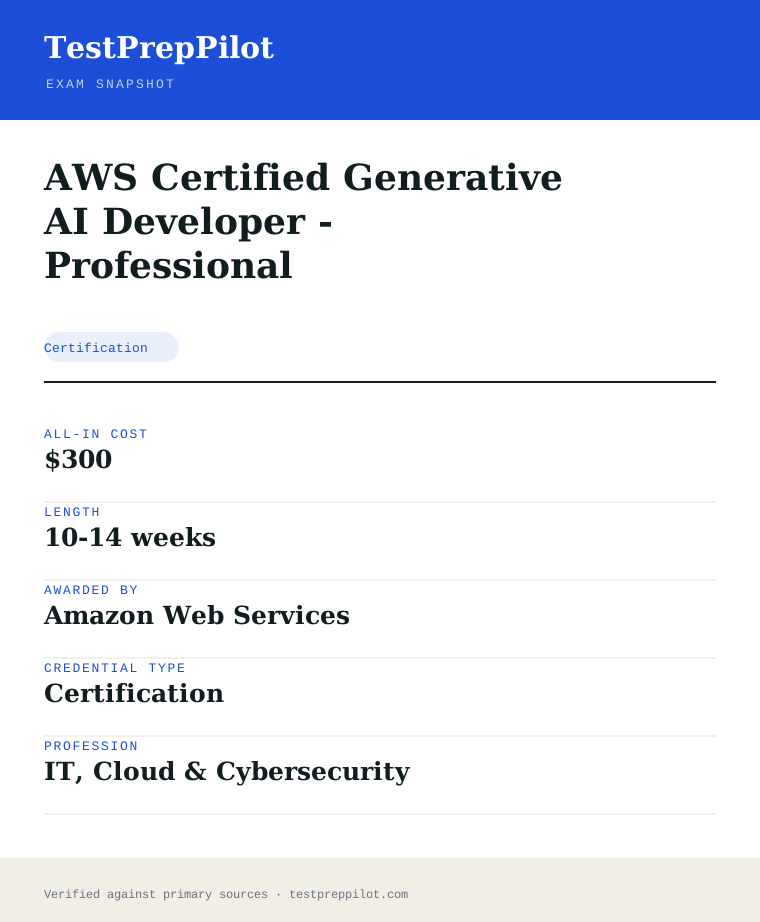
AWS Certified Generative AI Developer - Professional
Validate building production GenAI on AWS with Bedrock and agents.
Researched and maintained by TestPrepPilot Editorial BoardCloud, AI & software certifications desk · Figures last verified August 2026
The short version
What is the AWS Certified Generative AI Developer - Professional and is it worth it?
AIP-C01 is a 180-minute professional exam with 75 questions, costing $300 and requiring a 750 score to pass. It is AWS's flagship generative AI developer certification.
- Cutting-edge GenAI developer credential
- Covers Bedrock, RAG and agents
- Replaces ML Specialty focus for GenAI
- Three-year validity
- Strong for AI builder roles
What is it?
What exactly is the AWS Certified Generative AI Developer - Professional?
Validate building production GenAI on AWS with Bedrock and agents.
The AWS Certified Generative AI Developer - Professional (AIP-C01) is AWS's newest professional credential for developers who build and deploy production-ready generative AI. It covers integrating foundation models into applications and workflows, RAG and knowledge bases, Bedrock Agents, prompt engineering, AI safety and governance, and operating and troubleshooting GenAI systems at scale. It became generally available after its beta ended on 31 March 2026.
The path in brief
- Build Bedrock and RAG solutions
- Book AIP-C01
- Study agents, guardrails, optimization
- Pass at 750
- Maintain with recertification
Before you book
Who is eligible to sit the AWS Certified Generative AI Developer - Professional?
Who it is for: Generative AI application developers and ML engineers.
The test itself
What is the format of the AWS Certified Generative AI Developer - Professional?
The AWS Certified Generative AI Developer - Professional is administered by Remote proctored (Pearson VUE) and runs 180 minutes, contains 75 questions (65 scored + 10 unscored) questions and requires 750 to pass.
| Administered by | Remote proctored (Pearson VUE) |
|---|---|
| Questions | 75 questions (65 scored + 10 unscored) |
| Time limit | 180 minutes |
| Pass mark | 750 |
| Exam fee | $300 |
| Format | Multiple choice and multiple response, online proctored |
Content outline
What topics are on the AWS Certified Generative AI Developer - Professional?
The AWS Certified Generative AI Developer - Professional is weighted across 5 domains; the largest are Foundation Model Integration, Data Management, and Compliance (31%), Implementation and Integration (26%), AI Safety, Security, and Governance (20%).
Weightings come from the official exam outline. Study time is best allocated in roughly these proportions rather than evenly across domains.
- Foundation Model Integration, Data Management, and Compliance 31%
Model selection, RAG data
- Implementation and Integration 26%
Bedrock Agents, tools
- AI Safety, Security, and Governance 20%
Guardrails, responsible AI
- Operational Efficiency and Optimization for GenAI Applications 12%
Cost and performance
- Testing, Validation, and Troubleshooting 11%
Evaluation, debugging
Money & time
How much does the AWS Certified Generative AI Developer - Professional cost?
For the AWS Certified Generative AI Developer - Professional, the exam fee is $300; the all-in cost is typically $300; most candidates spend 10-14 weeks preparing.
Cost breakdown
| Exam fee | $300 |
|---|---|
| Typical total | $300 |
Standard AWS list price.
Timeline
- Study 10-14 weeks
- Exam 180 minutes
Typical prep: 10-14 weeks
The path
How do you register for the AWS Certified Generative AI Developer - Professional?
- 1
Create an AWS Certification account5 minutes
Sign in with your AWS Training account or create one at aws.amazon.com/certification; it manages your exam registration, score report and digital badge.
- 2
Choose your exam and level
Pick the credential that matches your role. Most candidates start at Foundational (CLF/AIF) or Associate (SAA, DVA, SOA) and progress to Professional or Specialty.
- Foundational: CLF-C02, AIF-C01
- Associate: SAA-C03, DVA-C02, SOA-C03, DEA-C01, MLA-C01
- Professional: SAP-C02, DOP-C02, AIP-C01
- Specialty: SCS-C03, ANS-C01
- 3
Schedule and pay10 minutes
Book through Pearson VUE at a test centre or online proctored. Foundational and Associate cost $100/$150; Professional and Specialty cost $300.
- 4
Prepare with official resources2-12 weeks
Use the free Exam Guide, AWS Skill Builder Official Practice Questions and Builder labs. Budget 2-12 weeks depending on level.
- 5
Sit the exam
Exams are scored 100-1000 against a fixed pass mark (700 Foundational, 720 Associate, 750 Professional/Specialty). Results appear immediately.
The fine print
What are the retake and renewal rules for the AWS Certified Generative AI Developer - Professional?
- Proctoring & delivery
- Delivered by Pearson VUE at a test centre or online with a live proctor. A government photo ID is required and the online environment is scanned before the session.
- Retake policy
- If you do not pass, you must wait 14 days before retaking the same exam. Each attempt is paid; there is no limit on attempts.
- Score reporting
- Exams are scored on a 100-1000 scale. Foundational pass at 700, Associate at 720, Professional and Specialty at 750. A score report shows section-level feedback under a compensatory model (no section minimum).
- Recertification
- All AWS certifications are valid for three years. Recertify by passing the latest version of the same exam, or by earning a higher-level credential that automatically refreshes lower ones (for example, DevOps Pro refreshes CloudOps Associate).
- Refunds & rescheduling
- Cancellation and reschedule rules follow Pearson VUE; refunds are generally not given for no-shows, and reschedules must occur before the cut-off window.
Context
AWS certification levels
| Level | Duration | Fee | Pass score | |
|---|---|---|---|---|
| Foundational (CLF-C02, AIF-C01) | 90 min | $100 | 700 | |
| Associate (SAA/DVA/SOA/DEA/MLA) | 130 min | $150 | 720 | |
| Professional (SAP/DOP/AIP) | 180 min | $300 | 750 | |
| Specialty (SCS/ANS) | 170 min | $300 | 750 |
What it pays
How much does this credential pay?
Software developers earned a May 2024 BLS median of $132,270, and the Generative AI Developer credential targets the fastest-growing specialization in the field.
The salary conclusion for the Generative AI Developer - Professional is anchored in the strongest tech occupation: the BLS Occupational Outlook Handbook reports a May 2024 median annual wage of $132,270 for SOC 15-1252 Software Developers, with the lowest 10 percent earning below $76,510 and the highest 10 percent above $208,620. The BLS classifies by job duty rather than certificate, so the AWS credential does not appear as its own wage line, but the value of the exam is positioning: generative-AI engineering — building production applications on foundation models, RAG architectures, vector databases, and agents — is the specialization with the most acute talent shortage of the mid-2020s, and employers pay a premium for candidates who can demonstrate it with a professional-grade credential. AWS itself reported that active AWS certifications exceeded 1.42 million as of January 2025 across more than one million certified individuals, and the AI-specific certifications are the fastest-growing slice of that portfolio. The BLS projects about 17 percent growth for software developers from 2024 to 2034 — more than triple the average occupation — with roughly 140,000 openings per year, and AI application development is a major share of that demand. Two caveats anchor the picture: first, the credential is new — the beta launched in November 2025 — so the market signal is still forming, and candidates should weigh the certification against demonstrated portfolio work, which employers weight heavily in AI hiring; second, the professional-level exam presumes existing AWS and software-development experience, so the certification is an amplifier for an experienced developer rather than an entry ticket. For a candidate asking whether the credential pays, the direct answer is that it certifies the highest-premium specialization in an occupation with a $132,270 median and triple-average growth, but the pay follows the demonstrated skill, and the certification is the signal, not the skill itself.
| Measure | Figure | Source / note |
|---|---|---|
| Median annual wage | $132,270 | BLS OOH, Software Developers (SOC 15-1252), May 2024 |
| Lowest 10% | $76,510 | Entry-level developer roles |
| Highest 10% | $208,620 | Senior and specialized developers |
| Projected growth | About 17% (2024-2034) | More than triple the average occupation |
Job growth.BLS projects about 17 percent growth for software developers (2024-2034), with roughly 140,000 openings per year from growth plus replacement demand.
Source: BLS Occupational Outlook Handbook - Software Developers
Your odds
What are the pass rates?
AWS publishes no pass rate for the Generative AI Developer exam; the professional-level passing score is 750 on the 100-1000 scale.
The direct answer on pass rates is that AWS does not publish cohort pass-rate statistics for any certification, including the new Generative AI Developer - Professional, so any percentage circulating online is a private estimate rather than an official figure, and we do not restate one here. What is published and stable is the passing standard: AWS scores certification exams on a 100-to-1000 scale, and professional-level exams require a score of 750, which is not a percentage of questions answered correctly — AWS uses psychometric scaling that adjusts for form difficulty, so the raw number of correct answers needed varies by exam form. The exam itself launched in beta in November 2025: the AWS announcement specified a beta exam of 85 questions over 204 minutes, with an Early Adopter badge for beta passers, and the general-availability exam specification (question count and time) is published on the official AWS exam page — candidates should confirm the current GA figures there, because AWS adjusts exam formats on its published cycle. The content validates a developer’s ability to integrate foundation models into production applications and business workflows: RAG architectures, vector databases, model evaluation, agents, guardrails, and the AWS services that support them (Amazon Bedrock and the related AI services), at the professional level, which presumes hands-on experience building with AWS. The practical read on difficulty: this is a professional-tier exam sitting above the AI Practitioner and associate levels, and AWS recommends substantial AWS experience before attempting it; the beta cohort of late 2025 is the first public signal, and early reports from exam-focused communities suggest a demanding, scenario-heavy paper consistent with other AWS professional exams. Candidates should study the current AWS exam guide and skill areas, use the official Exam Prep Plan (available from launch on AWS Skill Builder), and treat the 750 passing score as a scaled target rather than a raw percentage.
Read this before quoting the number.AWS publishes no pass-rate statistics for any exam; the 750/1000 passing score for professional-level exams and the beta format (85 questions / 204 minutes) are the published, verifiable facts.
Source: AWS certification announcement - Generative AI Developer - Professional and AWS exam guide
Your schedule
How long should I study for it?
120-180 hours over 8-12 weeks of focused study
An efficient Generative AI Developer - Professional study plan is 8-12 weeks of about 120-180 total hours for an experienced AWS developer, because the exam is a professional-tier breadth-and-depth test that presumes existing cloud and software skills, and the study window should build the generative-AI layer on top of that foundation: foundation-model integration, RAG and vector databases, agents, guardrails, evaluation, and the AWS services that deliver them. The published exam guide and the official Exam Prep Plan on AWS Skill Builder are the scope map — AWS released the prep plan at launch with practice assessments, hands-on SimuLearn labs, and lessons mapped to each exam domain and task statement — and candidates should complete those official resources before spending on third-party material. Candidates who already hold the AWS AI Practitioner or associate-level certifications should budget the lower end, because the service vocabulary is familiar; candidates coming from non-AWS AI work should budget the upper end and should add hands-on lab time in Amazon Bedrock, because the exam tests applied integration, not theory. The 204-minute beta format (85 questions) signals a long, scenario-heavy paper, so two or three full-length timed mocks against the current format are essential. A note on sequencing: the beta ran from November 2025 with a special Early Adopter badge, and the general-availability exam follows on AWS’s launch cycle — candidates should confirm which phase is live when scheduling, because the beta and GA formats can differ slightly in published specification.
- Week 1-230
Foundation-model foundations
- Review foundation-model concepts: models, tokens, context windows, temperature and sampling
- Study RAG: chunking, embeddings, retrieval, and generation pipelines
- Cover prompt engineering and model selection criteria
- Week 3-545
AWS services deep dive
- Build hands-on labs in Amazon Bedrock: models, knowledge bases, agents, guardrails
- Work vector databases and the data pipeline behind RAG on AWS
- Study evaluation: model evaluation, hallucination detection, and quality metrics
- Week 6-840
Architecture and integration
- Study production patterns: streaming, async, cost optimization, observability
- Cover security: data isolation, PII, access control, and compliance
- Complete the AWS Skill Builder Exam Prep Plan with its practice assessments
- Week 9-1025
Practice exams and gaps
- Take the official practice assessments and score by domain
- Re-study weak domains using the exam guide task statements
- Run one full-length timed mock at the current format
- Week 11-1230
Mocks and readiness
- Take two more full-length timed mocks scoring above 750
- Re-drill the miss log until clean
- Confirm the Pearson VUE or online-proctored booking and IDs
Adjusting the pace
Beta phase.If the beta is live, expect 85 questions over 204 minutes and an Early Adopter badge on passing; confirm current phase on the AWS exam page.
Associate-level holders.Fastest path; the service vocabulary is familiar, so weight time toward the generative-AI-specific architecture and evaluation content.
How to study
How do I prepare most effectively?
The dominant prep strategy for the Generative AI Developer - Professional is hands-on building plus official-material study, because AWS professional exams reward applied experience and the exam guide’s task statements map to real workflows: foundation-model integration, RAG with vector databases, agents, guardrails, and evaluation. First, complete the official AWS Skill Builder Exam Prep Plan — released at launch with practice assessments, SimuLearn hands-on labs, and domain-mapped lessons — because AWS’s own materials define the scope more precisely than anything third-party. Second, build: set up an AWS account and work through Amazon Bedrock hands-on — create a knowledge base, build a RAG pipeline, configure an agent, add guardrails, and evaluate the model output — because the exam tests applied integration, and the lab time converts the task statements into working knowledge. Third, drill the official practice assessments and any current question bank, and build a miss log tied to the exam guide domains; the scenario-heavy items reward rehearsal of the reasoning pattern. Fourth, run at least three full-length timed mocks at the current format, because the beta’s 204-minute profile signals a long paper and pacing is part of the test. Fifth, study the evaluation and quality-assurance content deliberately — model evaluation, hallucination detection, and quality metrics — because production readiness is a professional-level theme and the exam tests it directly. Finally, confirm which phase (beta or GA) is live when scheduling, and verify the current exam guide revision on the AWS certification page, because the exam is new and the published specification is the authoritative source. A further high-yield tactic is to study the RAG architecture in depth — chunking strategy, embedding choice, retrieval quality, and the vector database integration — because it is the core pattern the credential validates, and candidates who can reason about a RAG pipeline end to end are answering the exam’s central question across multiple domains.
Complete the official Exam Prep Plan
AWS released the prep plan at launch: practice assessments, SimuLearn labs, and domain-mapped lessons.
Build in Bedrock
Create knowledge bases, RAG pipelines, agents, and guardrails hands-on; the exam tests applied integration.
Study evaluation and quality content
Model evaluation, hallucination detection, and quality metrics are professional-level themes.
Master the RAG pattern end to end
Chunking, embeddings, retrieval quality, and vector-database integration is the exam’s core question.
Run full-length timed mocks
Three mocks at the current format build the pacing the long paper demands.
What to buy
Which study resources are worth paying for?
Generative AI Developer - Professional prep resources are anchored by the official AWS set because the exam is new: AWS released the Exam Prep Plan at launch on AWS Skill Builder with practice assessments, hands-on SimuLearn labs, and domain-mapped lessons, and that official bundle is the highest-value purchase or subscription. AWS Skill Builder itself offers subscription tiers — free and paid (roughly $29-49 per month, with the paid tier unlocking full exam-prep content) — and the paid tier is the standard recommendation for professional-level AWS exams. Third-party question banks and courses for the generative-AI developer exam are emerging but uneven because the exam launched in late 2025, so candidates should verify that any third-party material references the current exam-guide revision rather than the older AI Practitioner or associate-level content. Hands-on AWS account costs are a real budget line: building RAG pipelines, agents, and evaluations in Amazon Bedrock incurs pay-as-you-go service charges, typically tens of dollars over a study window with careful shutdown of resources. The footnote that anchors the comparison: prices below are list prices as of mid-2026 and change frequently, and we rank nothing by commission. The exam fee itself is $300 per attempt (standard AWS professional-level pricing), with a 50-percent-off retake voucher available for failed attempts — candidates should check the current retake policy on the AWS certification page because it changes on AWS’s policy cycle. A cheap readiness check is the free tier of AWS Skill Builder and the free AWS practice-question set before paying for anything, because experienced AWS developers often score closer to 750 than they expect and need mainly the official prep plan and hands-on labs.
| Resource | Price | Format | Best for |
|---|---|---|---|
| AWS Skill Builder Exam Prep Plan | Free on the paid tier | Practice assessments + SimuLearn labs | The authoritative scope map and hands-on labs |
| AWS Skill Builder subscription | $29-49/month | Online learning + labs | All AWS candidates; unlocks the prep plan |
| Third-party bank/course | $50-200 | Online, emerging | Extra reps — verify current exam-guide alignment |
| AWS account hands-on costs | Tens of $ (pay-as-you-go) | Real AWS services | Bedrock RAG, agents, and evaluation labs |
List prices as of mid-2026 and change frequently; we rank nothing by commission. Exam fee is $300 per attempt; confirm the current retake policy on the AWS certification page.
Avoid these
What mistakes do candidates most often make?
The most common mistake on the Generative AI Developer - Professional exam is studying AI theory instead of AWS applied integration, because the exam validates building production applications on AWS services — candidates who know foundation-model concepts cold but have never built a knowledge base in Bedrock find the scenario items abstract; the second is relying on third-party material written for the AI Practitioner or associate-level exams, which tests a different scope and leaves the professional-level architecture, evaluation, and security content uncovered. A third recurring error is skipping the official Exam Prep Plan and its practice assessments, which AWS mapped directly to the exam domains — the most precise scope signal available for a new exam. Candidates also routinely underestimate the hands-on requirement, reading about RAG and agents without running the labs, and then miss the applied reasoning the scenario items reward. Another pattern is treating the 750 passing score as 75 percent correct: AWS professional exams use scaled scoring, so the raw equivalent varies by form. Finally, some candidates ignore the evaluation and quality-assurance domain because it feels peripheral, when production-readiness evaluation is a professional-level theme that the exam tests directly.
✕Studying AI theory instead of AWS applied work
✓Build in Bedrock: knowledge bases, RAG pipelines, agents, and guardrails hands-on.
✕Using material written for other AWS AI exams
✓Verify any third-party material references the current Generative AI Developer exam guide.
✕Skipping the official Exam Prep Plan
✓Complete the AWS Skill Builder prep plan and its practice assessments; they map to the domains.
✕Treating 750 as 75 percent correct
✓AWS professional exams use scaled scoring; target mastery of the domains, not a raw percentage.
✕Ignoring evaluation and quality content
✓Study model evaluation, hallucination detection, and quality metrics; the exam tests production readiness.
What you'll face
What question types will I see?
The Generative AI Developer - Professional exam is a computer-based AWS certification test delivered at Pearson VUE centers or online-proctored, with the beta format set at 85 questions over 204 minutes and the general-availability specification published on the official exam page; all items are multiple-choice and multiple-response, and AWS professional exams are scenario-heavy, presenting an application requirement and asking which architecture, service configuration, or sequence applies. The content follows the exam guide’s domains: building production-ready AI solutions with foundation models, RAG architectures and vector databases, agents, guardrails, evaluation, and the AWS services that support them. The sample items below illustrate the published style across three areas — a RAG architecture item, an agent/guardrails item, and an evaluation item. The sample items are editor-written illustrations of the published blueprint, not live exam items.
An application requirement followed by the best architecture or configuration.
Select all correct options; the AWS professional-exam standard format.
Which AWS service or feature fits the described generative-AI workflow.
Try these
Q1A team must build a RAG application over thousands of internal documents that are updated continuously. Which architecture keeps the knowledge base current with the least operational overhead?
Answer:B
Continuous document updates are handled by automating ingestion into a vector store and refreshing the index on changes, which keeps the RAG knowledge base current without retraining the model or expanding the context window. The other options do not scale or do not keep the source current.
Q2Which mechanism should be added to a generative-AI application to prevent it from producing outputs on prohibited topics while still allowing legitimate queries?
Answer:A
Guardrails let an application deny specific topics and filter content while permitting legitimate queries, which is the production-standard control for this requirement. The other options change generation behavior or remove capability without enforcing the policy.
Q3Which practice is the most direct way to measure whether a generative-AI application’s answers remain grounded in the provided source documents?
Answer:A
Groundedness and hallucination are measured through model evaluation against test sets, which quantifies whether answers stay faithful to the sources. Dataset size, context length, and licensing do not measure output grounding.
Samples are editor-written illustrations of the published blueprint, not live exam items.
The big day
What should I expect on exam day?
The Generative AI Developer - Professional exam is a computer-based AWS certification test delivered at Pearson VUE centers or online-proctored, and the direct exam-day answer is that you will sit a professional-level paper — the beta was 85 questions over 204 minutes, and the general-availability specification is published on the official AWS exam page — with a passing score of 750 on the 100-1000 scale, and a preliminary pass/fail result shown at the end of the appointment. Arrive with the required government-issued photo ID, or complete the online-proctoring environment check if you chose remote delivery; check the exam confirmation email for the specific rules, because Pearson VUE centers and online proctoring have different check-in procedures. The appointment includes a tutorial before the clock starts, and there is a scheduled break option mid-exam for AWS professional-level tests — confirm the current break policy on the exam page, because AWS’s break rules have changed across exam versions. Expect a scenario-heavy paper with multiple-choice and multiple-response items; flag items for review and manage the long format’s pacing, because professional-level exams reward time discipline as much as knowledge. A preliminary pass/fail appears on screen immediately after submission, with the official score report following in the AWS Certification account within about a week; a passing score validates the certification for three years, after which recertification is required. If you do not pass, AWS offers a discounted retake voucher (commonly 50 percent off) for a second attempt within the eligibility window — check the current retake policy — and candidates should use the domain-level feedback in the score report to re-target study.
Bring
- Government-issued photo ID (Pearson VUE centers) or validated ID for online proctoring
- Exam confirmation email with the appointment details
- Approved glasses or hearing aids if used
- Snacks for before the appointment (not in the test room)
Leave at home
- Phone, smartwatch, and other electronics (stored per center rules or out of reach for remote)
- Study materials and notes
- Scratch paper from home (Pearson VUE supplies its own; online proctoring forbids it)
- Any item on the proctoring rules list
How the day runs
Rules in the room
- Valid photo ID required (center or proctored)
- Scheduled-break policy per the current AWS exam page — confirm before the appointment
- No personal electronics in the testing environment
- Multiple-choice and multiple-response items; answer every question
Afterwards.A passing score of 750 certifies the credential for three years. Maintain it with AWS recertification, and use the domain-level feedback in the score report to re-target study if you need a retake with the discounted voucher.
Reference
What are the key facts about the AWS Certified Generative AI Developer - Professional?
AWS Certified Generative AI Developer - Professional is a certification credential; awarded by Amazon Web Services; the exam fee is $300; typical preparation is 10-14 weeks; holders typically earn $150,000-$200,000.
| Credential | AWS Certified Generative AI Developer - Professional |
|---|---|
| Abbreviation | AWS GenAI Developer |
| Type | Certification |
| Profession | IT, Cloud & Cybersecurity |
| Specialty | Amazon Web Services |
| Awarded by | Amazon Web Services |
| Difficulty | Hard |
| Typical prep time | 10-14 weeks |
| All-in cost | $300 |
| Typical salary range | $150,000-$200,000 |
| Delivery | Online proctored multiple choice |
| Level | Professional |
| Validity | 3 years |
| Cost | $300 |
| Scope | National / Multi-state |
| Also known as | AIP-C01 |
Real questions
Frequently asked questions about the AWS Certified Generative AI Developer - Professional
Is AIP-C01 the replacement for ML Specialty?
It is the spiritual successor for GenAI builders. The ML Specialty (MLS-C01) retired on 31 March 2026; AIP-C01 shifts the focus from traditional ML to foundation models, RAG and agents.
What should I study most?
Domain 1 (Foundation Model Integration, Data Management, Compliance, 31%) and Domain 2 (Implementation and Integration, 26%) together are 57% of the exam, so prioritise Bedrock model selection, RAG and Bedrock Agents.
Do I need to train models?
No. The exam scope explicitly excludes model training and advanced ML theory; it focuses on integrating and operating existing foundation models.
How long is it valid?
Three years. Recertify by passing the current version or a higher AWS credential.
Which AWS cert should I start with?
Cloud Practitioner (CLF-C02) for general cloud literacy or AI Practitioner (AIF-C01) for AI/ML context. Role-based candidates often go straight to Solutions Architect Associate (SAA-C03).
Do AWS certifications expire?
Yes, after three years. You recertify by passing the current version or a higher credential that refreshes it.
Are the exams hands-on?
AWS exams are scenario-based multiple choice and multiple response, not live-terminal. They test applied judgement rather than memorisation.
How are questions scored?
Each exam has 50 scored questions plus 15 unscored items used for future research; the 100-1000 scaled score maps difficulty across forms.
In short
Is the AWS Certified Generative AI Developer - Professional worth it?
- AWS generative AI developer professional
- Covers Bedrock, RAG, agents, governance
- 750 pass, $300, 180 minutes
- Generally available from 2026
Same awarding body
What other credentials does Amazon Web Services award?
Worth comparing
How does the AWS Certified Generative AI Developer - Professional compare with similar credentials?
Trust
Where does this information come from?
Everything above is taken from the awarding body's own published material. Fees, question counts and domain weights are revised regularly — check the official page before you pay.
- Amazon Web Services Awarding body
- Official AWS Certified Generative AI Developer - Professional exam page Exam page
Research confidence: high · Last reviewed 2026-08