IT, Cloud & Cybersecurity • Certification
ITIL 4 Leader: Digital and IT Strategy
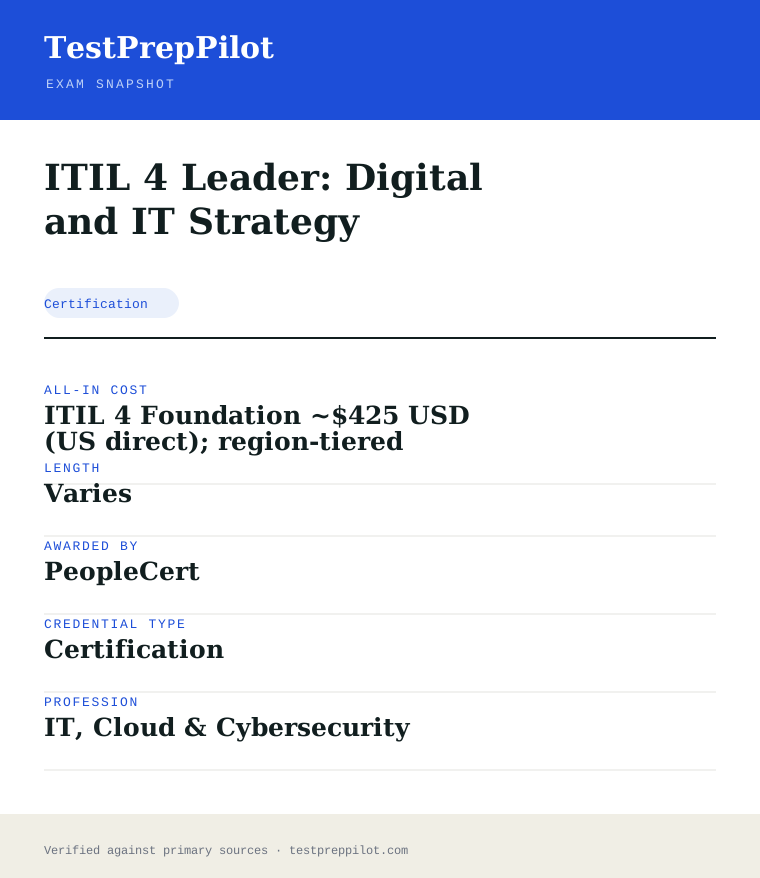
ITIL 4 Leader: Digital and IT Strategy — Technology credential from PeopleCert
Researched and maintained by TestPrepPilot Editorial BoardIT service management & framework certifications desk · Figures last verified August 2026
The short version
What is the ITIL 4 Leader: Digital and IT Strategy and is it worth it?
ITIL 4 Leader: Digital and IT Strategy is a PeopleCert credential in the Technology field. It validates job-ready competence and is used for career entry, advancement, or compliance. Exam fee: ITIL 4 Foundation ~$425 USD (US direct); region-tiered $235–$425.
- Recognized PeopleCert credential
- Demonstrates verified Technology competence
- Supports career advancement and may satisfy employer or regulatory requirements
What is it?
What exactly is the ITIL 4 Leader: Digital and IT Strategy?
ITIL 4 Leader: Digital and IT Strategy — Technology credential from PeopleCert
Strategic Leader module covering digital strategy, disruption response, operating model design and aligning IT strategy with business direction. Offered by PeopleCert, it validates job-ready Technology competence. Exam fee: ITIL 4 Foundation ~$425 USD (US direct); region-tiered $235–$425. Review the official program page for eligibility, format, and scoring before registering.
The path in brief
- Confirm eligibility and any prerequisites
- Review the official exam guide and study materials
- Purchase and schedule the exam via PeopleCert (online proctored)
- Take the exam (test center, online proctoring, or assessment)
- Receive results and your credential if passed
Before you book
Who is eligible to sit the ITIL 4 Leader: Digital and IT Strategy?
Eligibility varies; many exams are open to all, while others require coursework, experience, or sponsorship.
Who it is for: Professionals and candidates seeking to validate Technology competence with a PeopleCert credential.
The test itself
What is the format of the ITIL 4 Leader: Digital and IT Strategy?
The ITIL 4 Leader: Digital and IT Strategy is administered by PeopleCert (online proctored) and runs 90 minutes (113 minutes for non-English speakers), contains 40 multiple-choice questions and requires 28/40 (70%) — PeopleCert publishes no pass rates to pass.
| Administered by | PeopleCert (online proctored) |
|---|---|
| Questions | 40 multiple-choice questions |
| Time limit | 90 minutes (113 minutes for non-English speakers) |
| Pass mark | 28/40 (70%) — PeopleCert publishes no pass rates |
| Exam fee | ~$495 exam voucher (US); accredited training required for higher-level modules (ATO course ~$500-1,500 or PeopleCert Official eLearning) |
| Format | Online proctored exam (PeopleCert remote proctoring); some modules via accredited training organizations. |
Content outline
What topics are on the ITIL 4 Leader: Digital and IT Strategy?
The ITIL 4 Leader: Digital and IT Strategy covers 4 content domains.
Weightings come from the official exam outline. Study time is best allocated in roughly these proportions rather than evenly across domains.
- Service management concepts
Topic area for this credential; see the official blueprint for the detailed breakdown.
- Value & stakeholders
Topic area for this credential; see the official blueprint for the detailed breakdown.
- Practices & processes
Topic area for this credential; see the official blueprint for the detailed breakdown.
- Continual improvement
Topic area for this credential; see the official blueprint for the detailed breakdown.
The path
How do you register for the ITIL 4 Leader: Digital and IT Strategy?
- 1
Create an account on the awarding body’s certification portal
- 2
Select the exam/credential and review its requirements
- 3
Purchase the exam (voucher or password) and pay the fee
- 4
Schedule the exam (test center, online proctoring, or assessment)
- 5
Complete the exam within the allotted time
- 6
Receive your results and, if passed, your digital credential
The fine print
What are the retake and renewal rules for the ITIL 4 Leader: Digital and IT Strategy?
- Proctoring & delivery
- Online proctored exam (PeopleCert remote proctoring); some modules via accredited training organizations.
- Retake policy
- Take2 resit insurance available (~$140) at booking; otherwise repurchase the exam voucher.
- Score reporting
- Scores / results are released per the body’s process (usually electronically after the exam).
- Recertification
- Maintain via PeopleCert Plus (CPD) subscription (~$129/yr) or by retaking / passing a higher module before expiry. Valid 3 years.
What it pays
How much does this credential pay?
$171,200 median for computer and information systems managers (BLS, May 2024)
There is no Bureau of Labor Statistics occupation called "ITIL leader" — DITS is an ITIL 4 module, not a job, and its practitioners are IT and business directors, heads of department, transformation leads and aspiring C-suite leaders who shape digital vision and align IT and business strategy. BLS therefore classifies by job duties, and the closest official fit for the leadership-level practitioners who most often sit DITS is Computer and Information Systems Managers, SOC 11-3021, which had a May 2024 median wage of $171,200 ($82.31 per hour), with the lowest 10 percent earning roughly $104,450 and the highest 10 percent more than $239,200. The fit is deliberate: DITS sits at the leader level of the ITIL 4 scheme, the Strategic Leader stream, and its content — crafting a digital vision, shaping IT and business strategy, responding to digital disruption, driving operational excellence and strategically managing risk — is executive and director work, which is exactly the occupation BLS describes as planning, coordinating and directing computer-related activities, and the leadership tier it represents. BLS counted 667,100 computer and information systems manager jobs in 2024 and projects 15 percent employment growth from 2024 to 2034, much faster than the average for all occupations, with about 55,600 openings a year. The limitation to state plainly is that BLS does not isolate ITIL holders, and the median covers all computer and information systems managers regardless of certification, so read the figure as the relevant labour-market level for the typical DITS candidate, not as a measure of the certificate’s premium, and note that many DITS candidates already sit at or above that median in director roles that BLS counts elsewhere. The DITS credential’s value here is practical rather than a salary lever on its own: it signals that a leader understands the strategic language of digital vision, strategy and disruption inside the ITIL framework, and it is one of the two modules required for the ITIL 4 Strategic Leader designation, which is the structural reason senior candidates invest in it.
| Measure | Figure | Source / note |
|---|---|---|
| Median annual wage, computer and information systems managers | $171,200 | BLS OOH, SOC 11-3021, May 2024 |
| Lowest 10 percent | roughly $104,450 | BLS OEWS, SOC 11-3021, May 2024 |
| Highest 10 percent | more than $239,200 | BLS OEWS, SOC 11-3021, May 2024 |
| Employment, 2024 | 667,100 jobs | BLS OOH Quick Facts, 2024 |
| Projected annual openings | ~55,600 per year | BLS OOH Job Outlook, 2024-34 — 15% growth, much faster than average |
Job growth.+15% projected change 2024-34 (much faster than average) for computer and information systems managers, ~55,600 openings a year; the BLS figure covers all IT managers, not just ITIL holders, so treat it as the role’s labour-market level
Source: BLS Occupational Outlook Handbook — Computer and Information Systems Managers
Your odds
What are the pass rates?
PeopleCert publishes no DITS pass rate — the exam is 40 questions in 90 minutes with a published 70% pass mark (28/40)
PeopleCert, which delivers ITIL 4 on behalf of AXELOS, does not publish a pass rate for the ITIL 4 Leader: Digital and IT Strategy exam or for any ITIL module, and it never has. It reports only a pass or fail outcome to the candidate, and while the passing score is published — 28 of 40, or 70 percent — the cohort pass rate is not, so we have deliberately left any pass-rate figure out rather than repeating the unverified percentages that float around training forums. What is published and verifiable is the exam shape: 40 multiple-choice questions in 90 minutes (113 minutes for candidates whose first language differs from the exam language), closed book, with a published pass mark of 28 correct answers out of 40 (70 percent). The closed-book nature is a key difference from many IT certifications: you cannot rely on looking anything up, so the syllabus must be memorised, not merely understood, and the scenario items reward the ability to apply strategy, vision and disruption concepts rather than recall them. One format caveat is worth stating plainly: some older training materials and guides describe the DITS exam as a case-study-based test with 30 questions in 60 minutes, which reflects an earlier exam format, and the current PeopleCert module format is the standard 40-question, 90-minute, 70-percent structure, so candidates should confirm the current format on the PeopleCert page before preparing. The prerequisites are also published: candidates must hold ITIL 4 Foundation, and for the Strategic Leader designation must also hold the DPI module, and PeopleCert requires accredited training through an Authorized Training Organization or the official eLearning for the higher-level modules, with exam results withheld without proof of completion. The practical implication is that, because the standard is fixed at 70 percent and the items are scenario-based multiple choice drawn from a published syllabus, the exam is passable with disciplined preparation; the risk is not difficulty but complacency and version confusion. The version caveat: ITIL (Version 5) launched in early 2026, and PeopleCert has scheduled the ITIL 4 modules for sunset on 31 December 2027, so a pass now is not wasted — but candidates buying material in 2026 must not mix the two syllabi.
Read this before quoting the number.No DITS pass rate is published by PeopleCert, by AXELOS, or by the accrediting body. What is published and verifiable is the 40-question / 90-minute / 28-of-40 (70%) closed-book structure, with the ITIL 4 Foundation prerequisite. Note that older guides describe an earlier case-study format; confirm the current format on the PeopleCert page. The ITIL (Version 5) launch in early 2026 and the ITIL 4 sunset date of 31 December 2027 are separate version facts candidates must track.
Your schedule
How long should I study for it?
25-35 hours (commonly cited for a specialist or leader module) of focused study
ITIL 4 Leader: Digital and IT Strategy (DITS) is a leader-level module: it tests whether you understand how to craft a digital vision, shape IT and business strategy, respond to digital disruption, drive operational excellence and strategically manage risk — the concepts a director or aspiring C-suite leader needs to lead digital transformation. It is a 40-question, 90-minute closed-book exam (113 minutes for non-native speakers) and you need 28 correct answers (70 percent) to pass, with ITIL 4 Foundation as a prerequisite, the DPI module required for the Strategic Leader designation, and accredited training required before the result is released. The syllabus is published and stable, so the study plan is about concept discrimination and scenario application rather than hands-on labs. The plan below runs about four weeks at 6-8 hours a week (roughly 25-35 hours total), which matches the commonly cited prep time for a specialist or leader module; many candidates coming from a director or senior management background sit it in two to three weeks. The single most important planning fact in 2026 is the version choice. ITIL (Version 5) launched in early 2026, and PeopleCert has scheduled the ITIL 4 modules for sunset on 31 December 2027, so studying ITIL 4 now is not wasted — but you must buy ITIL 4 material knowingly and not accidentally mix in V5 content, because the two syllabi differ. The biggest scheduling error is treating DITS as a strategy-methodology exam rather than an ITIL exam: the items are framed in the ITIL 4 vocabulary — the service value system, the guiding principles, the four dimensions, digital business models — and candidates who answer from generic strategy experience fail on application, not recall. Build the plan around the key DITS concepts: digital strategy, digital disruption, vision, the relationship between IT strategy and business strategy, and the DITS view of the guiding principles, and rehearse the scenario style until the discriminations are instant.
- Week 16-8 hrs
Digital strategy and the DITS landscape
- The key concepts of DITS: digital strategy, digital disruption, digital business models
- How digital technology changes the relationship between IT strategy and business strategy
- Crafting a digital vision and developing a cross-organisational digital strategy
- The service value system and the four dimensions as the frame for strategy
- Week 26-8 hrs
Strategy and the guiding principles
- How the seven guiding principles apply to digital strategy and disruption
- Strategic risk management and business cases
- Sustainable business, operational excellence and responding to digital disruption
- Drill the concept discriminations until they are automatic
- Week 36-8 hrs
Leadership, culture and the four dimensions
- Developing digital leaders and driving a digital culture
- Strategy across the four dimensions: organisations and people, information and technology, partners and suppliers, value streams and processes
- Service relationships and creating value with digital services
- Build a one-page glossary of near-neighbour concepts the exam confuses
- Week 45-7 hrs
Mock exams and gap closing
- Two or three timed 40-question mocks at 90 minutes
- Log every scenario you hesitated on as a miss, even if you got it right
- Re-read the key DITS concepts and the guiding principles daily
- Confirm your exam version (ITIL 4) and that your voucher matches it, not V5
Adjusting the pace
Director or senior IT leader.Three weeks at 6-8 hrs/week. Strategy and leadership are familiar from the job; what you lack is the formal ITIL vocabulary, so protect the framework language and the scenario discriminations rather than the big ideas.
Manager moving toward the C-suite.Five to six weeks. Budget extra time on digital strategy, disruption and the guiding principles applied at the enterprise level, which operational roles do not cover, and rehearse the scenario items heavily.
Choosing between ITIL 4 and Version 5 in 2026.If you need the credential soon, the ITIL 4 modules remain bookable through 31 December 2027 — sit ITIL 4. If you are starting a longer multi-module track and can wait, evaluate the V5 track deliberately. Either way, do not study a mixed syllabus.
How to study
How do I prepare most effectively?
ITIL 4 Leader: Digital and IT Strategy rewards scenario application and vocabulary precision, because the exam is closed book and the items present strategy and disruption situations and ask which concept, principle or approach applies. The candidate who can distinguish digital strategy from digital disruption, and who can apply the guiding principles at the enterprise level, will pass comfortably; the candidate who "leads transformations every day" but cannot map the scenario to the ITIL vocabulary will hesitate and run short. The strategies below are built around concept mastery, scenario rehearsal and version clarity, which are the three things that actually move the result, and the ordering matters: learn the key DITS concepts — digital strategy, digital disruption, digital vision — before anything else, because every scenario item maps to one of them, then rehearse the scenario style until naming the concept is a reflex, and only then worry about the mocks. The version clarity strategy is specific to 2026, because ITIL (Version 5) launched in early 2026 and PeopleCert has scheduled the ITIL 4 modules for sunset on 31 December 2027, so a candidate must deliberately choose the ITIL 4 track and use only ITIL 4 material, or the alternative, deliberately plan for V5 — mixing the two syllabi is the avoidable error of the year. The candidate who skips the framework work and relies on strategy instinct answers the scenario items from gut judgement and picks the plausible-sounding but wrong concept, while the candidate who rehearsed the discriminations reads each scenario, names the concept, and eliminates the neighbour distractors in the time the format allows. The final discipline is the logistics: confirm that your ITIL 4 Foundation certificate and accredited-training proof are attached to your PeopleCert account, because results are withheld without them, and rehearse at the correct time limit so the 90-minute pace is automatic.
Master the key DITS concepts cold
Digital strategy, digital disruption, digital business models, digital vision, and the relationship between IT strategy and business strategy underpin the scenario items. For each, know what it means and how it shows up in a strategy situation, because the distractors are neighbour concepts, not absurd options.
Apply the guiding principles at the enterprise level
The seven guiding principles appear in strategy scenarios asking which principle applies to a digital initiative. Know how each principle reads at the leadership level — focus on value, start where you are, progress iteratively, collaborate, think holistically, keep it simple, optimise and automate — and rehearse the application, not just the list.
Map scenarios to the ITIL vocabulary, not strategy instinct
The items ask which concept or principle applies, and the right answer is framed in ITIL language. A candidate who answers from gut strategy experience picks the plausible-sounding but wrong concept. Rehearse by reading each scenario and naming the concept before looking at the options.
Use official or syllabus-aligned mocks only
Because the syllabus is published, good mocks are closely aligned to it. Avoid question banks that pad with Foundation terminology or, in 2026, that leak Version 5 content into an ITIL 4 voucher. Confirm the mock matches the ITIL 4 DITS syllabus you are sitting; a mismatched bank teaches the wrong vocabulary.
Choose your version deliberately in 2026
ITIL (Version 5) launched in early 2026 and PeopleCert has scheduled ITIL 4 for sunset on 31 December 2027. The ITIL 4 modules remain bookable through that date, so sitting DITS now is not wasted — but decide knowingly and use only ITIL 4 material. Mixing V5 syllabus content into an ITIL 4 voucher is the avoidable error of the year for this exam.
Confirm the training and prerequisite paperwork
PeopleCert withholds exam results without proof of ITIL 4 Foundation and completion of accredited training, and the Strategic Leader designation also requires the DPI module. Collect the certificates and training proof before booking, and confirm your ID name matches your PeopleCert account exactly.
What to buy
Which study resources are worth paying for?
The decisive buying decision in 2026 is version: ITIL 4 material versus ITIL (Version 5) material, because PeopleCert scheduled ITIL 4 for sunset on 31 December 2027 while V5 is the new track, and a candidate who buys a mixed syllabus wastes both money and study time. The ITIL 4 modules remain valid and bookable through that date, so either is defensible — but buy one version’s resources and use them, not a mix, and confirm the version on the cover of anything you purchase. The second decision is training: PeopleCert requires accredited training for the higher-level ITIL 4 modules — an Authorized Training Organization course or the PeopleCert Official eLearning — with exam results withheld without proof of completion, so the ATO course or official eLearning is effectively mandatory rather than optional, and that cost dominates the budget. PeopleCert’s official eLearning with the exam typically runs well over $1,000 in the US, while the exam voucher for a candidate who takes training through an ATO is roughly $495 before regional tax, and ATO course pricing varies widely by provider and country, roughly $500 to $1,500. The third decision is the supplement stack: the official AXELOS or PeopleCert DITS publication, roughly $40-70, is the syllabus source and pairs with the course; free glossary and flashcard sets cover the concept discriminations that are the highest-yield free resource; and a PeopleCert Plus membership, roughly $133 per year, matters for renewal rather than the exam itself, because ITIL 4 certifications are kept current with 20 CPD points per year and Plus is the standard way to log them. Because DITS is the Strategic Leader stream module that pairs with DPI, candidates pursuing the designation must budget both modules. The footnote that anchors the comparison: prices below are list prices as of mid-2026 and change frequently, and we rank nothing by commission.
| Resource | Price | Format | Best for |
|---|---|---|---|
| PeopleCert Official eLearning + DITS exam | Roughly $1,000+ with the exam (region-dependent) | Online self-paced with official content | Required — satisfies the accredited-training requirement |
| DITS exam voucher through an accredited training organization | ~$495 USD base; bundle prices vary by provider | Online proctored or test centre | Candidates who take the ATO course; confirm the voucher covers the exam |
| PeopleCert Plus membership | ~$133/year (region-dependent) | Subscription | Annual renewal (20 CPD/yr) and member pricing on vouchers |
| Official AXELOS / PeopleCert DITS publication | ~$40-70 retail | Print + eBook | The syllabus source; pairs with the training course |
| Accredited DITS classroom or live online course (ATO) | ~$500-1,500 depending on provider | Instructor-led with mock exams | Structured path guaranteed aligned to the DITS syllabus |
| Free glossary / flashcard sets | Free | Web / app | Concept discrimination — the highest-yield free resource |
Prices checked 2026-08 in USD before tax and vary widely by region, provider and promotion; PeopleCert pricing changes frequently, and the accredited-training requirement means the course cost is part of the budget, not optional. Confirm every resource is ITIL 4 (not v3, not Version 5) unless you have deliberately chosen the V5 track. We do not rank by commission.
Avoid these
What mistakes do candidates most often make?
ITIL 4 Leader: Digital and IT Strategy is often underestimated by senior candidates who assume the exam rewards their leadership experience directly, and that underestimation is the root of most failures — the exam is closed book with near-neighbour distractors drawn from the key DITS concepts, so "I run digital transformations every day" is not the same as "I can name the ITIL concept under a 90-minute clock". The mistakes below are the reliable failure modes, and the version one is specific to 2026. The most damaging mistake is answering scenarios from strategy instinct rather than the ITIL vocabulary: the items ask which concept or guiding principle applies, and a candidate who answers from gut judgement picks the plausible-sounding but wrong concept, while the candidate who rehearsed naming the concept before reading the options wins the discriminations. The second trap is confusing digital strategy with digital disruption, or applying the guiding principles at the operational level when the scenario is strategic, because these near-neighbours are the exam’s favourite distractors; the fix is to drill the pairs until the distinctions are instant. The third trap is assuming the exam is open book, when DITS is closed book with nothing to consult, and candidates who plan to look things up run out of time. The fourth trap is the version mix in 2026, buying V5 content for an ITIL 4 voucher or leftover v3 material, which teaches vocabulary that does not match the exam. The fifth trap is ignoring the logistics — PeopleCert withholds results without proof of ITIL 4 Foundation and accredited training, and the Strategic Leader designation also requires DPI, so a candidate who sits without the paperwork finds a pass unreleased. The sixth is forgetting the renewal requirement, because the credential lapses without 20 CPD points per year, commonly logged through PeopleCert Plus.
✕Answering scenarios from strategy instinct
✓The items ask which DITS concept or guiding principle applies, and the right answer is framed in ITIL vocabulary. Rehearse by naming the concept before reading the options; gut judgement picks the plausible-sounding but wrong answer.
✕Confusing digital strategy with digital disruption
✓Digital strategy is the plan for value creation in a digital world; digital disruption is the change in the environment the strategy must respond to. These near-neighbours are the exam’s favourite distractors. Drill the pairs with one-line distinctions until the discriminations are instant.
✕Assuming the exam is open book
✓DITS is closed book: 40 questions in 90 minutes (113 for eligible non-native speakers), no reference. Candidates who plan to "look it up" have no such option and run out of time. Memorise the key concepts, the guiding principles and the four dimensions; there is nothing to consult on the day.
✕Studying a mixed or wrong-version syllabus in 2026
✓ITIL (Version 5) launched in early 2026 and PeopleCert scheduled ITIL 4 for sunset on 31 December 2027. The ITIL 4 modules stay valid and bookable, so either track is fine — but use only ITIL 4 material for an ITIL 4 voucher. Mixing V5 content, or buying leftover v3 material, teaches vocabulary that does not match your exam.
✕Ignoring the training and prerequisite proof requirement
✓PeopleCert withholds exam results without proof of ITIL 4 Foundation and completion of accredited training, and the Strategic Leader designation also requires DPI. Candidates who sit without the paperwork find their pass unreleased. Collect the certificates and training proof before booking.
✕Forgetting the renewal / CPD requirement
✓ITIL 4 certifications are renewed through PeopleCert’s Continuing Professional Development scheme — 20 CPD points per year, commonly through a PeopleCert Plus membership (~$133/year). Candidates who ignore this find the credential lapsed when they need it. Diary the renewal the week you pass.
What you'll face
What question types will I see?
ITIL 4 Leader: Digital and IT Strategy is a single closed-book, multiple-choice exam: 40 questions in 90 minutes (113 minutes for candidates whose first language is not the exam language), and you need 28 correct answers out of 40 — a published 70 percent pass mark. There is no separate practical or essay component. PeopleCert uses the item styles drawn from its item-writing guidance: classical multiple choice (one correct answer from four), negative-choice (select the incorrect statement), "missing word" (complete a sentence from the syllabus), and "list" items (put options in the correct order or match them), and in a leader module like DITS the items are overwhelmingly scenario-based — a strategy or disruption situation followed by the correct concept, guiding principle or approach, with distractors that are plausible neighbour concepts rather than absurd ones. All are scored as straightforward right/wrong; there is no partial credit and the exam is closed book, so recall and discrimination are everything. The syllabus is published and stable, which means good mocks align closely to it and the distractors are predictable. The practical pacing implication is simple: with 40 items in 90 minutes you have over two minutes each, but the scenario items demand careful reading, so a candidate who has mastered the key DITS concepts finishes comfortably while one who hesitates on every near-neighbour runs short. Because the standard is a fixed 70 percent and PeopleCert publishes no pass rate, your preparation competes with the syllabus, not a cohort. The 2026 version caveat still applies: these item styles describe ITIL 4 DITS; the newer ITIL (Version 5) track uses a different exam and a different syllabus, so do not assume V5 item wording matches ITIL 4 when you sit the DITS paper.
A strategy or disruption situation followed by the correct DITS concept, guiding principle or approach. Distractors are neighbour concepts.
Asks you to identify the incorrect statement about digital strategy or a principle. Easy to misread under time pressure; the skill is the same discrimination, inverted.
A sentence from the syllabus with one term omitted; select the correct term. Rewards verbatim familiarity with the official wording.
Place items in the correct sequence or match principles to strategy situations.
Try these
Q1A new technology threatens to displace a company’s core product line, and the CIO is asked to shape the response. What is the most appropriate starting point for the organisation’s digital strategy?
Answer:A
DITS teaches that crafting a digital vision is the starting point for digital strategy — a clear picture of the future the organisation wants to create, which the strategy then pursues. Waiting, cutting investment, or copying the disruptor each avoid the strategic thinking the situation requires. This reflects the vision and strategy items in the DITS syllabus.
Q2An organisation is assessing whether its current IT investments support the long-term business strategy. Which approach aligns with the DITS guidance on IT strategy?
Answer:A
DITS teaches that in the digital era, IT strategy and business strategy must be developed together — digital technology is now part of the business model itself, not a separate cost centre. Treating IT as purely a cost centre, sequencing budgets after plans, or outsourcing strategy each contradict the co-development approach. This reflects the strategy-relationship items in the syllabus.
Q3Which of the following is NOT one of the ITIL guiding principles?
Answer:C
The seven guiding principles are: focus on value, start where you are, progress iteratively with feedback, collaborate and promote visibility, think and work holistically, keep it simple and practical, and optimise and automate. "Maximise documentation" is not one of them — in fact "keep it simple and practical" points the opposite way. This is a negative-choice item testing verbatim familiarity with the principle list; A, B and D are all genuine principles.
Samples are editor-written illustrations of the published ITIL 4 DITS syllabus, not live exam items. Item styles (classical, negative, missing word, list) follow PeopleCert’s item-writing guidance for ITIL 4. Do not assume these match the separate ITIL (Version 5) module exams.
The big day
What should I expect on exam day?
ITIL 4 Leader: Digital and IT Strategy is delivered by PeopleCert either online with remote proctoring or at a test centre, as a single 40-question, 90-minute (or 113-minute) closed-book multiple-choice exam with a published pass mark of 28/40 (70 percent), and the exam-day risks are few but specific, which is what makes this exam day manageable for a well-prepared candidate. First, the closed-book rule: you may bring nothing to consult, so everything must be in memory — there is no noteboard strategy to lean on for the key concepts, only for sketching the guiding principles if the centre issues one. Second, the version: in 2026 you are sitting the ITIL 4 DITS paper, which remains valid and bookable through 31 December 2027, so confirm at check-in that your voucher is the ITIL 4 module and not a V5 booking if you prepared for ITIL 4. Third, the identity and account logistics: your ID name must match your PeopleCert account exactly or you lose the seat, and the same account must hold your ITIL 4 Foundation certificate and accredited-training proof, because PeopleCert withholds results without them — and for the Strategic Leader designation, the DPI result must also be on your record. Fourth, the pacing: with 40 scenario items in 90 minutes you have over two minutes each, but the items demand careful reading, so work steadily, name the concept before reading the options, flag unsure items, and return to them, then submit rather than letting the clock expire. You receive a result on screen at the centre and by email, with a pass/fail and your score, and PeopleCert does not publish a pass rate, so the score report and your own mock trend are the only feedback you get. Because the standard is a fixed 70 percent and the items are scenario-based recall, the day is mostly about rested discrimination and steady pacing — the clock, not difficulty, is the only pressure.
Bring
- One government-issued photo ID whose name matches your PeopleCert account exactly
- Your PeopleCert exam booking confirmation
- For online proctoring: a phone for check-in, a clear desk, and a private room with a door
- For online proctoring: webcam, microphone and a connection already system-tested on the exact machine
- Your ITIL 4 Foundation certificate, DPI result (for the Strategic Leader designation) and training proof linked to your PeopleCert account
Leave at home
- Phones, smartwatches, fitness trackers and earbuds — away from the desk for both formats
- All notes, the official publication, and any printed ITIL reference — the exam is closed book
- Your own paper and pens unless the centre issues an erasable noteboard
- Bags, coats, hats, food and drink beyond what the centre permits
- Second monitors (unplugged and turned away for online) and any other person in the room
How the day runs
Rules in the room
- The exam is closed book: 40 multiple-choice questions, 90 minutes (113 for eligible non-native speakers).
- Pass mark is published: 28 of 40 correct (70 percent).
- Prerequisite: ITIL 4 Foundation (or equivalent), plus accredited training proof — PeopleCert withholds results without them; the Strategic Leader designation also requires DPI.
- ID name must match your PeopleCert account exactly or you will be denied the seat.
- Item styles include classical, negative-choice, missing word and list/ordering; all are right/wrong, no partial credit.
- PeopleCert publishes no pass rate; your preparation competes with the syllabus, not a cohort.
- The ITIL 4 modules remain valid and bookable through 31 December 2027 — confirm you are sitting the version you studied.
- Renewal requires 20 CPD points per year for three years, commonly via PeopleCert Plus (~$133/year).
Afterwards.Your pass/fail and score appear on screen at the centre and by email from PeopleCert; there is no published pass rate, so your own mock trend is the better preparation check. On a pass, the credential is valid for three years and renewed via PeopleCert’s CPD scheme — 20 CPD points per year, typically through a PeopleCert Plus membership (~$133/year) — so diary the renewal the week you pass rather than discovering a lapse later. Importantly for 2026 candidates: the ITIL 4 modules stay valid and bookable through 31 December 2027 and continue to serve as the prerequisites for the ITIL (Version 5) track, so a pass now is not wasted even if you later move to V5. DITS is the Strategic Leader stream module that pairs with DPI: with both on your record alongside ITIL 4 Foundation, you earn the ITIL 4 Strategic Leader designation, which is the structural reason most candidates sit this module — a strong reason to schedule DPI if you have not taken it yet. On a fail, the gap is almost always concept discrimination or scenario reading, not comprehension — re-drill the key DITS concepts, the guiding principles and the four dimensions, re-practise at the correct time limit, then re-sit; the failed attempt still cost the full voucher plus the training, so a clean first pass is also the cheap one. Whatever version you sat, protect the renewal clock immediately on a pass.
Reference
What are the key facts about the ITIL 4 Leader: Digital and IT Strategy?
ITIL 4 Leader: Digital and IT Strategy is a certification credential; awarded by PeopleCert; the exam fee is ~$495 exam voucher (US); accredited training required for higher-level modules (ATO course ~$500-1,500 or PeopleCert Official eLearning); typical preparation is Varies.
| Credential | ITIL 4 Leader: Digital and IT Strategy |
|---|---|
| Abbreviation | ITIL DITS |
| Type | Certification |
| Profession | IT, Cloud & Cybersecurity |
| Specialty | IT Service Management & Governance |
| Awarded by | PeopleCert |
| Difficulty | Mixed |
| Typical prep time | Varies |
| All-in cost | ITIL 4 Foundation ~$425 USD (US direct); region-tiered $235–$425 |
| Credential | ITIL 4 Leader: Digital and IT Strategy |
| Awarding body | PeopleCert |
| Exam fee | ITIL 4 Foundation ~$425 USD (US direct); region-tiered $235–$425 |
| Delivery | Online proctored exam (PeopleCert remote proctoring); some modules via accredited training organizations. |
| Validity | 3 years (CPD via PeopleCert Plus) |
| Scope | National / Multi-state |
| Also known as | ITIL DITS |
Real questions
Frequently asked questions about the ITIL 4 Leader: Digital and IT Strategy
How much does the ITIL 4 Leader: Digital and IT Strategy exam cost?
ITIL 4 Foundation ~$425 USD (US direct); region-tiered $235–$425. Advanced modules require accredited training (no exam-only fee). PRINCE2 Foundation ~$700. Confirm live pricing on PeopleCert.
How do I register and schedule?
Register and schedule through PeopleCert (online proctored). Create an account, purchase the exam, and pick a date (test center, online proctoring, or assessment as applicable).
How long is the credential valid, and how do I renew?
Maintain via PeopleCert Plus (CPD) subscription (~$129/yr) or by retaking / passing a higher module before expiry. Valid 3 years.
What is the retake policy?
Take2 resit insurance available (~$140) at booking; otherwise repurchase the exam voucher.
How much does a PeopleCert exam cost?
ITIL 4 Foundation ~$425 USD (US direct); region-tiered $235–$425. Advanced modules require accredited training (no exam-only fee). PRINCE2 Foundation ~$700. Confirm live pricing on PeopleCert.
How do I renew the credential?
Maintain via PeopleCert Plus (CPD) subscription (~$129/yr) or by retaking / passing a higher module before expiry. Valid 3 years.
In short
Is the ITIL 4 Leader: Digital and IT Strategy worth it?
- ITIL 4 Leader: Digital and IT Strategy is awarded by PeopleCert.
- Validates Technology competence.
- Exam fee: ITIL 4 Foundation ~$425 USD (US direct); region-tiered $235–$425.
- Renewal: Maintain via PeopleCert Plus (CPD) subscription (~$129/yr) or by retaking / passing a higher module before expiry. Valid 3 years.
Same awarding body
What other credentials does PeopleCert award?
Worth comparing
How does the ITIL 4 Leader: Digital and IT Strategy compare with similar credentials?
Trust
Where does this information come from?
Everything above is taken from the awarding body's own published material. Fees, question counts and domain weights are revised regularly — check the official page before you pay.
Research confidence: medium · Last reviewed 2026-08