IT, Cloud & Cybersecurity • Certification
HashiCorp Certified: Terraform Associate
Prove infrastructure-as-code skill with Terraform fundamentals.
Researched and maintained by TestPrepPilot Editorial BoardCloud, IT & cybersecurity certifications desk · Figures last verified August 2026
The short version
What is the HashiCorp Certified: Terraform Associate and is it worth it?
Terraform Associate is a 60-minute exam with 57 multiple-choice and multi-select questions costing $70.50. A roughly 70% score is required to pass, and one free retake is included.
- Cheapest major cloud-infra certification
- Vendor-neutral, works across all clouds
- Free retake bundled with the voucher
- Two-year validity
- Strong ROI for IaC careers
What is it?
What exactly is the HashiCorp Certified: Terraform Associate?
Prove infrastructure-as-code skill with Terraform fundamentals.
The HashiCorp Certified: Terraform Associate (003) validates knowledge of infrastructure as code and Terraform fundamentals. It covers the Terraform workflow, CLI, modules, state management, configuration authoring and HCP Terraform capabilities. It is multiple choice and multi-select, and suits cloud, DevOps, platform and SRE engineers who use Terraform day to day.
The path in brief
- Install Terraform and learn the core workflow
- Book the Terraform Associate (003)
- Study state, modules and HCP Terraform
- Pass at about 70%
- Recertify every two years
Before you book
Who is eligible to sit the HashiCorp Certified: Terraform Associate?
Who it is for: Cloud, DevOps, platform and SRE engineers using Terraform.
The test itself
What is the format of the HashiCorp Certified: Terraform Associate?
The HashiCorp Certified: Terraform Associate is administered by Remote proctored (PSI) and runs 60 minutes, contains 57 questions (multiple choice and multi-select) questions and requires ~70% (cut score not officially published) to pass.
| Administered by | Remote proctored (PSI) |
|---|---|
| Questions | 57 questions (multiple choice and multi-select) |
| Time limit | 60 minutes |
| Pass mark | ~70% (cut score not officially published) |
| Exam fee | $70.50 |
| Format | Multiple choice and multi-select, online proctored |
Content outline
What topics are on the HashiCorp Certified: Terraform Associate?
The HashiCorp Certified: Terraform Associate is weighted across 6 domains; the largest are Terraform Workflow & HCP Terraform (22%), Terraform Purpose & Workflow (20%), Terraform Basics (20%).
Weightings come from the official exam outline. Study time is best allocated in roughly these proportions rather than evenly across domains.
- IaC Concepts 14%
Benefits, declarative approach
- Terraform Purpose & Workflow 20%
init, plan, apply, destroy
- Terraform Basics 20%
Providers, resources, variables
- Terraform CLI 12%
fmt, validate, import, state
- Modules 12%
Sources, versioning, composition
- Terraform Workflow & HCP Terraform 22%
Backends, state locking, cloud
Money & time
How much does the HashiCorp Certified: Terraform Associate cost?
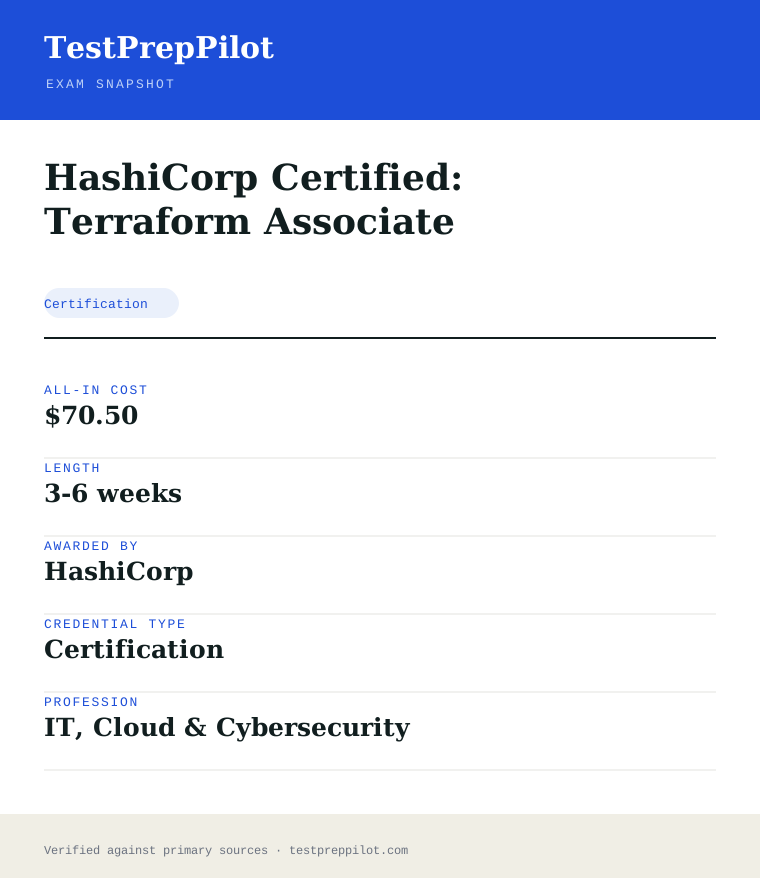
For the HashiCorp Certified: Terraform Associate, the exam fee is $70.50; the all-in cost is typically $70.50; most candidates spend 3-6 weeks preparing.
Cost breakdown
| Exam fee | $70.50 |
|---|---|
| Optional labs | $0-$50 |
| Typical total | $70.50-$120 |
Standard HashiCorp list price, plus tax where applicable.
Timeline
- Study 3-6 weeks
- Exam 60 minutes
Typical prep: 3-6 weeks
The path
How do you register for the HashiCorp Certified: Terraform Associate?
- 1
Create a HashiCorp account5 minutes
Register at the HashiCorp certification portal; it handles scheduling, score and badge.
- 2
Pick Associate or Professional
Associate exams (Terraform, Vault, Consul) suit foundational users; Professional exams (Terraform Authoring & Operations, Vault Operations) require deep production experience.
- Associate: Terraform, Vault, Consul
- Professional: Terraform Ops, Vault Ops
- 3
Schedule and pay10 minutes
Book through PSI online proctoring. Associate exams are $70.50; Professional exams are $295 and include one free retake.
- 4
Prepare with official material3-10 weeks
Use HashiCorp Learn tutorials and the official exam objectives. Professional candidates need extensive hands-on lab time.
- 5
Sit the proctored exam
Associate exams are multiple choice; Professional exams combine labs with multiple choice in a four-hour session.
The fine print
What are the retake and renewal rules for the HashiCorp Certified: Terraform Associate?
- Proctoring & delivery
- Delivered online with a live proctor via PSI. A government photo ID is required and the workspace is checked before the exam.
- Retake policy
- Associate exams: no free retake (a new voucher is required). Professional exams include one free retake. Wait times apply after a fail.
- Score reporting
- Associate exams report pass/fail with an approximate 70% cut score (not officially published). Professional lab exams report pass/fail on the completed tasks.
- Recertification
- All HashiCorp certifications are valid for two years. Recertify by passing the current version of the same exam again.
- Refunds & rescheduling
- Vouchers are generally non-refundable; review PSI terms at purchase for the specific exam.
Context
HashiCorp certification tracks
| Track | Format | Fee | Validity | |
|---|---|---|---|---|
| Associate (Terraform, Vault, Consul) | Multiple choice, 1 hour | $70.50 | 2 years | |
| Professional (Terraform Ops, Vault Ops) | Lab + multiple choice, 4 hours | $295 (1 retake) | 2 years |
What it pays
How much does this credential pay?
$132,270 median for software developers — the adjacent IaC role series (BLS, May 2024), used with an explicit caveat
There is no Bureau of Labor Statistics occupation called "Terraform Associate", so the salary story belongs to the roles the certification serves — cloud, DevOps and platform engineers — and the closest official benchmark is Software Developers, SOC 15-1252, which had a May 2024 median of $132,270, with the lowest 10 percent under $84,060 and the highest 10 percent above $208,500. Use that figure with a deliberate caveat: a Terraform Associate certification is an entry-to-associate-level signal inside the infrastructure-as-code ecosystem, and the roles it feeds span a wide band that runs from junior DevOps and cloud positions below the developer median to senior platform-engineering roles at or above it, so the median is context for the market rather than a precise wage for certificate holders. BLS counted 1,684,900 software developer jobs in 2024 and projects 17 percent growth from 2024 to 2034, with about 150,000 openings a year — the strongest growth of any series cited on this desk, and the ecosystem demand for infrastructure automation that the Terraform certification serves tracks that broader software market. The certification itself costs $70.50 and expires after two years, so the honest financial framing is that it is one of the cheapest professional credentials in the market, and its value is the hiring signal it sends in an ecosystem where job postings frequently list Terraform skills explicitly. Read the $132,270 figure as the upper-adjacent context for the role market, not as a Terraform-specific wage. Two further points sharpen the salary story for a Terraform candidate. First, the certification sits inside a specific skills market where infrastructure-as-code is increasingly table-stakes: job postings for DevOps, platform and cloud roles frequently list Terraform explicitly, and a certificate is one of the cheaper ways to signal that skill in an application — but employers ultimately hire on demonstrated ability to run the workflow, which is why the hands-on lab is inseparable from the certificate’s value. Second, the role band the certification feeds runs from associate-level cloud and operations positions, which pay below the developer median, to senior platform-engineering and infrastructure-automation roles that pay at or above it, so a candidate’s wage outcome depends far more on the job title, location and experience level than on the credential itself. The BLS projection of 17 percent growth for software developers is the strongest of any series cited on this desk and signals durable demand for the automation skills the exam validates, but treat it as market context rather than a promise tied to the certificate.
| Measure | Figure | Source / note |
|---|---|---|
| Median annual wage, software developers (adjacent series) | $132,270 | BLS OOH, SOC 15-1252, May 2024 |
| Lowest 10 percent | Under $84,060 | BLS OOH, SOC 15-1252, May 2024 |
| Highest 10 percent | Above $208,500 | BLS OOH, SOC 15-1252, May 2024 |
| Employment, 2024 | 1,684,900 jobs | BLS OOH Quick Facts, 2024 |
| Projected annual openings | ~150,000 per year | BLS OOH Job Outlook, 2024-34 |
Job growth.BLS projects 17 percent growth for software developers from 2024 to 2034, about 150,000 openings per year — cited as context for the infrastructure-automation role market.
Source: BLS Occupational Outlook Handbook - Software Developers
Your odds
What are the pass rates?
HashiCorp publishes no pass rate — the exam is 57 questions in 60 minutes, and candidates report a passing line around 700 out of 1000
HashiCorp does not publish pass-rate statistics for the Terraform Associate exam, and we state that plainly: no official percentage exists, and any figure you see online is a third-party estimate, so we do not present one as authoritative. What is published is the exam mechanics, and on the current version — Terraform Associate (004), which replaced version 003 after its January 2026 retirement — those are 57 questions in 60 minutes, delivered online through PSI proctoring in English only, with a mix of multiple-choice, multiple-select and true/false items and no command-line component. HashiCorp does not publicly disclose the exact passing score, but candidates and prep providers consistently report a cut around 700 on a 1000-point scale, which is roughly 70 percent and about 40 correct answers out of 57; because that figure is not officially published, treat it as a benchmark rather than a guarantee. The exam fee is $70.50 plus applicable taxes, and the free retake that came with version 003 is not included in 004. The credential is valid for two years, renewed by passing the current exam again or a higher-level HashiCorp exam within the expiry window. Because the question count is small and the time is tight — about a minute per question — the practical reading is that breadth across all eight objectives matters more than deep mastery of any one area, and that nothing substitutes for having run the Terraform core workflow yourself. Two structural details complete the picture. First, the exam is delivered online through PSI with live proctoring, so the practical risks on exam day are environmental — a failed system check or a room that does not meet the proctor’s requirements can cost the session before a single question is answered — which makes the pre-exam system test a genuine part of preparation. Second, because the question bank is drawn to cover all eight objectives, the small 57-question paper means a weak objective shows up as a small but consistent leak of points; a candidate who is strong on the CLI but weak on HCP Terraform can lose several questions to one gap, and the objective-level feedback report that arrives within about 48 hours of the result tells you exactly where. The reported 700/1000 cut, while not officially published, is consistent across candidate reports and translates to roughly 40 of 57 correct — roughly a 70 percent accuracy target — so practice scores should clear that line with margin before scheduling. HashiCorp recommends about six months of hands-on experience, and candidates who take the exam with real workflow practice consistently describe it as fair.
Read this before quoting the number.HashiCorp publishes no pass rate and does not publicly disclose the exact passing score; candidates report a cut around 700/1000, which we present as reported, not official.
Your schedule
How long should I study for it?
40-60 hours over 4-6 weeks of focused study
The Terraform Associate exam is 57 questions in 60 minutes on version 004, testing Terraform 1.12 and HCP Terraform, so a defensible plan runs 40 to 60 hours over four to six weeks for a candidate with some cloud or CLI experience, and a bit more for a newcomer — HashiCorp itself recommends about six months of hands-on Terraform experience before sitting it. Week 1 is orientation and baseline: read the official exam review guide and objectives for 004, confirm you are not studying 003 material, and take a practice test to see where you stand. Weeks 2-3 cover the conceptual foundation: infrastructure as code and its advantages, Terraform’s declarative model versus imperative tools, providers, resources and data sources, input variables, output values and functions, and the purpose and management of state. Weeks 3-4 go hands-on: install Terraform, run the core workflow — init, plan, apply, destroy — against a real provider on a free tier, create and reuse modules, configure backends for remote state, and use workspace commands, because the exam rewards having actually executed the workflow rather than memorised its description. Weeks 5-6 close the gaps and rehearse: cover HCP Terraform collaboration and governance, Sentinel policy as code, and the new 004 topics such as depends_on and create_before_destroy lifecycle rules, custom conditions, ephemeral values and write-only arguments; then run two timed full practice exams at the real 60-minute format and drill the objectives you miss. The single biggest planning error is studying a 003 guide, which covers a retired blueprint.
- Week 16
Version check and baseline
- Read the official 004 exam review guide and objectives
- Confirm 003 is retired and the material is current
- Take a practice exam to baseline
- Weeks 2-318
Concepts and configuration
- IaC benefits, declarative model, providers and resources
- Variables, outputs, functions and expressions
- State: purpose, local and remote backends, locking
- Weeks 3-418
Hands-on workflow
- Run init, plan, apply, destroy against a free-tier provider
- Create and source modules; configure remote state
- Workspaces, import, and state inspection commands
- Weeks 5-612
HCP Terraform and rehearsal
- HCP Terraform collaboration, governance and Sentinel
- New 004 topics: lifecycle rules, conditions, ephemeral values
- Two timed 60-minute practice exams and gap review
Adjusting the pace
Cloud engineer already running Terraform.Four weeks. Your daily workflow covers the CLI and state objectives; spend the recovered time on HCP Terraform, Sentinel and the 004-specific lifecycle and condition topics.
New to infrastructure as code.Eight to ten weeks at 6-8 hours a week. Add two weeks of cloud and CLI fundamentals before the plan and keep the hands-on lab running through all six weeks.
How to study
How do I prepare most effectively?
The Terraform Associate is a breadth exam with a hard time budget, so the dominant strategy is hands-on execution plus objective-mapped review: candidates who have actually run init, plan and apply against a real provider answer the scenario items from experience, while candidates who only read documentation lose the applied items. First, build and keep a real lab — a free-tier account on a cloud provider with Terraform installed — and run the full core workflow repeatedly, including destroy, because the exam tests the workflow’s behaviour, not its description. Second, master state as a concept: nearly every domain connects back to it — backends, locking, sensitive data, import and drift — and candidates who treat state as an afterthought lose questions scattered across the paper. Third, cover the 004-specific content deliberately: depends_on and create_before_destroy lifecycle rules, custom validation conditions, ephemeral values and write-only arguments, and HCP Terraform workspaces and projects are new to version 004 and absent from most older study material. Fourth, learn the distinction questions: declarative versus imperative IaC, Terraform versus configuration-management tools, local versus remote backends, and when workspaces are and are not appropriate. Fifth, rehearse under the real clock — 57 questions in 60 minutes leaves about a minute per question, so two timed practice exams are the calibration tool, and the pass line reported at roughly 700/1000 means aiming for consistent 75-80 percent on practice sets before scheduling. A further strategy is to read the official objectives line by line and map your lab practice to each one, because the exam can draw a question from any objective and the smaller ones — modules, maintain infrastructure, HCP Terraform — are where candidates who studied the headline topics lose points. Practise the written decision too: Terraform produces clear plan output, and the exam rewards reading a plan and predicting the outcome, so rehearse explaining in one sentence what a given plan will do and why. Use the official review guide as a checklist rather than a read-once document, returning to it at the end of preparation to confirm nothing is left uncovered. Finally, take the true/false and multiple-select items seriously, because they are all-or-nothing and punish partial certainty; the discipline of answering only when confident, and flagging rather than guessing on multiple-select items, is a real score-protection habit under the one-minute-per-question budget.
Keep a real hands-on lab
Run init, plan, apply and destroy against a real provider; the exam rewards execution, not memorised description.
Master state as a concept
Backends, locking, sensitive data, import and drift tie nearly every domain together.
Cover the 004-specific content
Lifecycle rules, custom conditions, ephemeral values and HCP Terraform workspaces are new to version 004.
Learn the distinction questions
Declarative vs imperative, Terraform vs config-management tools, local vs remote state, when workspaces fit.
Rehearse under the real clock
57 questions in 60 minutes; two timed practice exams at 75-80 percent should precede scheduling.
What to buy
Which study resources are worth paying for?
Terraform Associate prep is the cheapest of any certification covered on this desk because the official resources are free and the exam itself is $70.50. The HashiCorp Terraform certification page and the official exam review guide are the authoritative scope maps and cost nothing, and the HashiCorp developer tutorials on the Terraform Learn track build the hands-on skills the exam tests at no cost. Your own cloud free tier and the Terraform CLI provide the lab. Paid resources are optional: prep courses run from about $15-40 on sale (a popular Udemy course maps directly to the objectives), question banks and practice-test sites run from free to about $40, and the standard reference book runs about $45. The buying rule is to use the free official review guide and a free-tier lab first, then add a question bank for calibration — the question bank is the closest thing to real item style, and candidates who skip it meet the exam format cold. Add a course only for structure. A realistic total budget is $71 to $150 including the exam fee. Prices below are current as of mid-2026 and change frequently; we rank nothing by commission. The buying logic is straightforward and favours the free options hard. HashiCorp’s own documentation and tutorials are unusually good and unusually exam-relevant, so the free tier is genuinely sufficient for a candidate with some cloud experience; the question bank is the one purchase that earns its keep, because it calibrates pace and exposes the multiple-select and true/false item styles that reading alone does not. A course adds most value for candidates who need external structure or who have never run Terraform, since the guided labs compress the ramp-up. The book is a reference rather than exam prep, worth buying only for depth that outlasts the credential. One caution specific to 2026: because version 004 replaced 003 in January 2026, older 003-aligned courses and banks are still on sale and still rank well in search, so verify that any paid resource states version 004 or lists the new objectives — lifecycle rules, custom conditions, ephemeral values and write-only arguments — before purchasing. The total cost of a well-run preparation can be as low as $70.50 for the exam itself.
| Resource | Price | Format | Best for |
|---|---|---|---|
| HashiCorp Terraform Associate certification page and exam review guide | Free | Official documentation | The authoritative objectives and current exam version |
| HashiCorp developer tutorials (Terraform Learn) | Free | Hands-on tutorials | Building the core workflow skills the exam tests |
| Free-tier cloud account + Terraform CLI | Free tier | Your own lab | Real execution of init, plan, apply, destroy |
| Terraform Associate video course (Udemy, Bryan Krausen) | ~$15-40 on sale | Video with labs | Structured study mapped to the objectives |
| Question banks / practice tests | Free-$40 | Online practice items | Calibrating against the real 57-in-60 format |
| Terraform Up and Running (O’Reilly) | ~$45 | Book | Deep understanding beyond the exam scope |
| Exam registration (004) | $70.50 + tax | Online proctored via PSI | The certification itself; free retake not included |
Prices current as of mid-2026, subject to change; the exam is $70.50 with no included free retake on version 004. No commission-based ranking.
Avoid these
What mistakes do candidates most often make?
The most expensive Terraform Associate mistake in 2026 is studying for version 003: the 003 exam retired in January 2026, 004 is the current version, and older books, courses and question banks still rank highly in search results — the 004 update added lifecycle rules, custom conditions, ephemeral values and write-only arguments, and HCP Terraform workspace content, so 003 material leaves real gaps. The fix is to check the version on anything you buy and read the current exam review guide. The second mistake is preparing without executing: candidates who only read documentation fail the applied items that reward having run the core workflow. Third, candidates under-prepare state management, which threads through backends, locking, sensitive data, import and drift and appears across multiple domains. Fourth, candidates underestimate the clock — 57 questions in 60 minutes punishes dwelling, and untimed practice hides it. Fifth, candidates rely on a reported 700/1000 cut as a precise target when HashiCorp does not publish it; aim well above the reported line on practice sets. Finally, candidates forget the credential expires after two years and that recertification means passing the current exam again — a fact worth diarying the day you pass. One mistake specific to the exam’s format is underestimating the multiple-select and true/false items: they are all-or-nothing, so a candidate who is 80 percent sure on three of the four options loses the whole item, and the discipline of flagging rather than guessing on those formats protects real score. Another is studying the workflow as a sequence to memorise rather than as behaviour to predict: the exam asks what a given plan will do, why a resource will be replaced, or which backend fits a team’s needs, and those questions reward having reasoned through real runs, not having memorised the command order. Finally, candidates who ignore the free retake policy change on version 004 can be surprised on a failed attempt: 003 included a free retake and 004 does not, so every attempt costs the full $70.50 and the objective-level feedback report should be used to target the retake rather than re-booking on the same preparation.
✕Studying version 003 material
✓003 retired January 2026; read the official 004 review guide and check the version on anything you buy.
✕Reading without executing
✓Run init, plan, apply and destroy in a real lab; applied items reward experience.
✕Under-preparing state management
✓Backends, locking, sensitive data, import and drift span multiple domains.
✕Ignoring the time budget
✓57 questions in 60 minutes; rehearse timed practice exams.
✕Treating 700/1000 as an official cut
✓HashiCorp does not publish it; aim for 75-80 percent on practice sets instead.
✕Forgetting the two-year expiry
✓Diary the renewal window; recertification means passing the current exam again.
What you'll face
What question types will I see?
The Terraform Associate (004) exam is 57 questions in 60 minutes, delivered online through PSI proctoring in English only, and the item types are multiple-choice, multiple-select (choose all that apply) and true/false — there is no command-line or lab component, despite the exam rewarding real workflow experience. The questions follow the eight published objectives: infrastructure as code with Terraform, Terraform fundamentals (providers and resources), the core Terraform workflow (init, validate, plan, apply, destroy), Terraform configuration (variables, functions, dependencies, conditions and sensitive-data handling), modules, state management, maintaining infrastructure (import and state inspection), and HCP Terraform. Many items are applied rather than definitional: given a described situation, which command produces a given effect, which backend or locking behaviour fits, or which approach a team should use — and the distinction questions (declarative versus imperative, local versus remote state, when workspaces fit) are a staple. Because the passing line is reported at roughly 700 of 1000, equivalent to about 70 percent and roughly 40 correct answers, and the time budget is about a minute per question, candidates should move steadily and flag items for review rather than dwelling. The practical implication of the format is that coverage beats depth: with 57 questions drawn across eight objectives, a candidate who has studied every objective to a working level outperforms one who is an expert on the core workflow and blank on HCP Terraform or modules. The multiple-select items are the highest-risk format because they are all-or-nothing, so candidates should only select an option when confident, and use the flag function rather than committing a guess early. The true/false items are statement-level discriminations of correct concepts — knowing, for example, that state is the source of truth or that plan is non-destructive — and they reward having internalised the model rather than memorised definitions. Many items are phrased as a decision: which command, which backend, which feature fits the described team or situation, which is where genuine workflow experience separates prepared candidates from prepared readers. Samples below are editor-written illustrations of the published objectives, not live exam items.
The correct command, configuration block or approach for a described situation, with plausible distractors.
All correct options must be chosen; partial credit is not given.
Statement-level discrimination of correct concepts and behaviours.
Try these
Q1A team runs terraform plan and sees that Terraform intends to replace a resource instead of updating it in place. Which reason most commonly explains an intended replacement?
Answer:A
Some resource arguments force replacement when they change — Terraform reports these as "forces replacement" in the plan output. A deleted state file or uninitialised provider would error before planning, and a syntax error would fail validation, so none of those would produce a replacement decision.
Q2Two environments use identical Terraform configuration but must keep separate state files. Which feature is designed for exactly this case?
Answer:A
Workspaces allow multiple distinct state files within one configuration directory, suited to minor environment variations such as dev versus staging where the topology is identical. Outputs and data sources do not separate state, and a shared unlocked backend would mix the environments’ state together.
Q3A practitioner needs to move a running resource into Terraform management so it can be maintained in configuration. Which command is designed for this?
Answer:A
terraform import brings existing infrastructure into state so it can be managed by configuration. destroy removes managed resources, fmt reformats configuration files, and output prints output values — none of them import existing infrastructure.
Q4A team stores Terraform state in a remote backend so multiple engineers can work on the same configuration. Why does the backend need state locking?
Answer:A
State locking prevents concurrent operations from modifying the same state file simultaneously, avoiding lost or conflicting updates in collaborative workflows. It does not encrypt configuration, change apply speed, or remove the need for credentials.
Samples are editor-written illustrations of the published objectives, not live exam items.
The big day
What should I expect on exam day?
The Terraform Associate exam is delivered entirely online through PSI proctoring, so exam day is a home-office exercise with strict rules. You will have 60 minutes for 57 questions in English only, and the practical risks are environmental rather than content-related: a failed system check, a bad connection or a room that does not meet the proctor’s requirements can cost the session before a single question is answered. Run the PSI system test on the exact machine and network you will use, at least 24 hours before, and use the exam-day slot in a quiet private room with a door you can close, a clean desk, and no second monitor, phone or smartwatch within reach. Bring only your government-issued photo ID for the identity check, and have your registration details ready. On the exam itself, pace to about a minute per question: answer everything, flag uncertain items rather than dwelling, and use any review time at the end. The result is reported as pass/fail on screen immediately after submission, with detailed objective-level feedback delivered within about 48 hours — that report is the diagnostic tool if you fail. On a pass, your badge and credential are valid for two years from the date of passing, and recertification means passing the current exam version again or the higher-level professional exam within the expiry window, so diary that date immediately. The exam interface itself is straightforward — navigation, flagging and a countdown timer are available — but the one-minute-per-question budget means the interface is not the place to learn the format, so use the official practice material to rehearse the mechanics before the real session. On the day, complete the identity check and room scan calmly, confirm the exam is the 004 version on screen before starting, and use the flag function on uncertain items rather than committing early guesses on the all-or-nothing multiple-select questions. There is no scheduled break in the 60-minute session, so nothing that will be needed mid-exam should be left outside the room. After the result, whether pass or fail, the objective-level feedback arriving within about 48 hours is the document that should drive the next step — a badge claim and renewal plan on a pass, or a targeted re-study list on a fail.
Bring
- A government-issued photo ID for the proctored identity check
- The same machine and network you passed the PSI system test on
- Your registration and appointment confirmation details
- A quiet private room with a door you can close and a clear desk
- Water in a clear container if the proctor permits it
Leave at home
- Phones, smartwatches and earbuds — out of the room
- Notes, books and open browser tabs — the exam is closed book and closed browser
- Second monitors, which must be unplugged and turned away
- Any other person in the room during the session
- Any assumption that a 003 study guide applies to the 004 exam
How the day runs
Rules in the room
- The exam is 57 questions in 60 minutes, in English, online proctored via PSI.
- The session is closed book with no browser access beyond the exam.
- A private room, clear desk and no external devices are required by the proctor.
- HashiCorp does not publish the exact passing score; candidates report a cut around 700/1000.
- The free retake from version 003 is not included in 004.
- The credential is valid two years; recertification means passing the current exam again or the professional exam.
Afterwards.Your Terraform Associate result appears as pass/fail on screen the moment you submit, with an objective-level performance report delivered within about two days — and on a pass, the credential is valid for two years from the date of passing, which makes the diary date the most important follow-up: recertification requires passing the current exam version again, or the Terraform Authoring and Operations Professional exam, and HashiCorp’s renewal rules let you extend an unexpired credential by sitting the exam from six months before expiry, so there is no reason to let it lapse. On a fail, resist the immediate re-book: the 48-hour feedback report tells you which objectives pulled the score down, and a fortnight of focused work on those — usually state management or the applied workflow items — turns the next attempt into a different outcome; version 004 includes no free retake, so each attempt is a full $70.50. On a pass, claim your digital badge through Credly, add it to your resume and LinkedIn with the version and year, and use the platform knowledge immediately in real work, because the exam rewards practitioners and the credential is worth most while the hands-on skill is fresh. Then plan the next step — the professional exam if you are running Terraform in production, or a cloud certification that pairs with the IaC skill. Two practical notes about the day itself are worth carrying in. First, the 60-minute clock starts at the first question and there is no pause for a break, so settle into the machine before starting and keep water and your environment arranged beforehand; the proctoring rules allow only the approved room setup, so anything you might need mid-session must be arranged before check-in. Second, if the result is a pass, claim the Credly badge and add it to your profiles with the version and year, and if it is a fail, the 48-hour objective feedback is the planning document for the retake — map the weak objectives to the official study guide, rebuild those scenarios in the lab, and re-sit within a couple of weeks while the material is fresh rather than letting the failure cool into avoidance. HashiCorp’s renewal rules also allow an unexpired credential to be extended by passing the current exam from six months before expiry, so the two-year validity should never become a lapse for a candidate who keeps the diary date.
Reference
What are the key facts about the HashiCorp Certified: Terraform Associate?
HashiCorp Certified: Terraform Associate is a certification credential; awarded by HashiCorp; the exam fee is $70.50; typical preparation is 3-6 weeks; holders typically earn $110,000-$150,000.
| Credential | HashiCorp Certified: Terraform Associate |
|---|---|
| Abbreviation | Terraform Associate |
| Type | Certification |
| Profession | IT, Cloud & Cybersecurity |
| Specialty | Cloud Native & DevOps |
| Awarded by | HashiCorp |
| Difficulty | Moderate |
| Typical prep time | 3-6 weeks |
| All-in cost | $70.50 |
| Typical salary range | $110,000-$150,000 |
| Delivery | Remote proctored by PSI |
| Retake | One free retake included |
| Validity | 2 years |
| Level | Associate |
| Scope | National / Multi-state |
| Also known as | Terraform Associate 003 |
Real questions
Frequently asked questions about the HashiCorp Certified: Terraform Associate
Is Terraform Associate hard?
It is approachable if you use Terraform regularly, but the 60-minute timer on 57 questions is tight. Practising the CLI commands and variable precedence order is the most efficient preparation.
What version of Terraform does it cover?
The 003 exam reflects Terraform 1.x and current HCP Terraform features. Study the documented workflow rather than memorising version-specific quirks.
Does the free retake apply automatically?
Yes, the standard voucher includes one free retake, which lowers the risk of a first attempt. You still book the retake through the PSI scheduling portal.
Is it worth more than a cloud cert?
Terraform is cloud-agnostic, so the credential transfers across AWS, Azure and GCP work, whereas a cloud cert is provider-specific. Many engineers hold both.
How do I recertify?
Pass the current Terraform Associate again within two years. Because the exam is inexpensive, recertification is low-friction compared with professional-level certs.
What is the heaviest domain?
Terraform Workflow and HCP Terraform is weighted 22%, the largest domain, followed by Purpose and Basics at 20% each, so prioritise state, backends and collaboration features.
Do I need the Associate before the Professional?
HashiCorp strongly recommends the Associate first and it is effectively expected, but the Professional exams are not strictly gated; equivalent production experience can substitute.
Are HashiCorp certifications hands-on?
Associate exams are multiple choice. The two Professional exams are lab-based: you perform real tasks in a live environment.
How long are they valid?
Two years. You recertify by passing the current version again.
What happened to Consul Associate?
Consul Associate (003) was retired on 15 July 2026 with no announced successor; credentials earned before then remain valid for two years from the pass date.
In short
Is the HashiCorp Certified: Terraform Associate worth it?
- HashiCorp associate IaC certification
- 57 questions, 60 minutes, ~70% to pass
- $70.50 with one free retake
- Valid for two years
Same awarding body
What other credentials does HashiCorp award?
Worth comparing
How does the HashiCorp Certified: Terraform Associate compare with similar credentials?
Trust
Where does this information come from?
Everything above is taken from the awarding body's own published material. Fees, question counts and domain weights are revised regularly — check the official page before you pay.
- HashiCorp Awarding body
- Official HashiCorp Certified: Terraform Associate exam page Exam page
Research confidence: high · Last reviewed 2026-08