Accounting & Tax • Exam
CMA Part 2: Strategic Financial Management
CMA Part 2: strategic financial management for the corporate accountant.
Researched and maintained by TestPrepPilot Editorial BoardAccounting & corporate-finance certifications desk · Figures last verified August 2026
The short version
What is the CMA Part 2: Strategic Financial Management and is it worth it?
CMA Part 2 is a four-hour IMA exam of 100 multiple-choice questions plus two essays on financial analysis, corporate finance, decision analysis, risk and ethics, scored 0 to 500 with a 360 pass. It is the second of two CMA parts.
- Second CMA part on finance and strategy
- Covers analysis, corporate finance, risk
- Computer-based, available globally
- Completes the CMA with Part 1
- Strong for finance-manager roles
What is it?
What exactly is the CMA Part 2: Strategic Financial Management?
CMA Part 2: strategic financial management for the corporate accountant.
CMA Part 2, Strategic Financial Management, is the second Certified Management Accountant exam and covers financial statement analysis, corporate finance, decision analysis, risk management, investment decisions and professional ethics. It is the strategy and finance half of the CMA and is especially relevant to controllers, finance managers and analysts. Together with Part 1 and the experience requirement it completes the CMA credential.
The path in brief
- Join IMA and enroll
- Study the Part 2 topics
- Schedule with Prometric
- Pass at 360/500
- Certify with experience
Before you book
Who is eligible to sit the CMA Part 2: Strategic Financial Management?
Who it is for: Aspiring finance managers and analysts
The test itself
What is the format of the CMA Part 2: Strategic Financial Management?
The CMA Part 2: Strategic Financial Management is administered by Prometric test centers and online and runs 4 hours, contains 100 multiple-choice + 2 essays questions and requires Scaled 360 / 500 to pass.
| Administered by | Prometric test centers and online |
|---|---|
| Questions | 100 multiple-choice + 2 essays |
| Time limit | 4 hours |
| Pass mark | Scaled 360 / 500 |
| Exam fee | Exam fee per part (member rates; entrance fee separate) |
| Format | Multiple-choice and essay |
Content outline
What topics are on the CMA Part 2: Strategic Financial Management?
The CMA Part 2: Strategic Financial Management is weighted across 6 domains; the largest are Decision Analysis (25%), Financial Statement Analysis (20%), Corporate Finance (20%).
Weightings come from the official exam outline. Study time is best allocated in roughly these proportions rather than evenly across domains.
- Financial Statement Analysis 20%
- Corporate Finance 20%
- Decision Analysis 25%
- Risk Management 10%
- Investment Decisions 15%
- Professional Ethics 15%
Study materials
Which study guide should you use for the CMA Part 2: Strategic Financial Management?
Start with the exam sponsor's official content outline. If you also want one structured resource to work through, these are the Mometrix titles that match this exam.

Affiliate links We may earn a commission if you buy through these links, at no extra cost to you. Mometrix has no say in what our exam guides cover. How we make money.
Money & time
How much does the CMA Part 2: Strategic Financial Management cost?
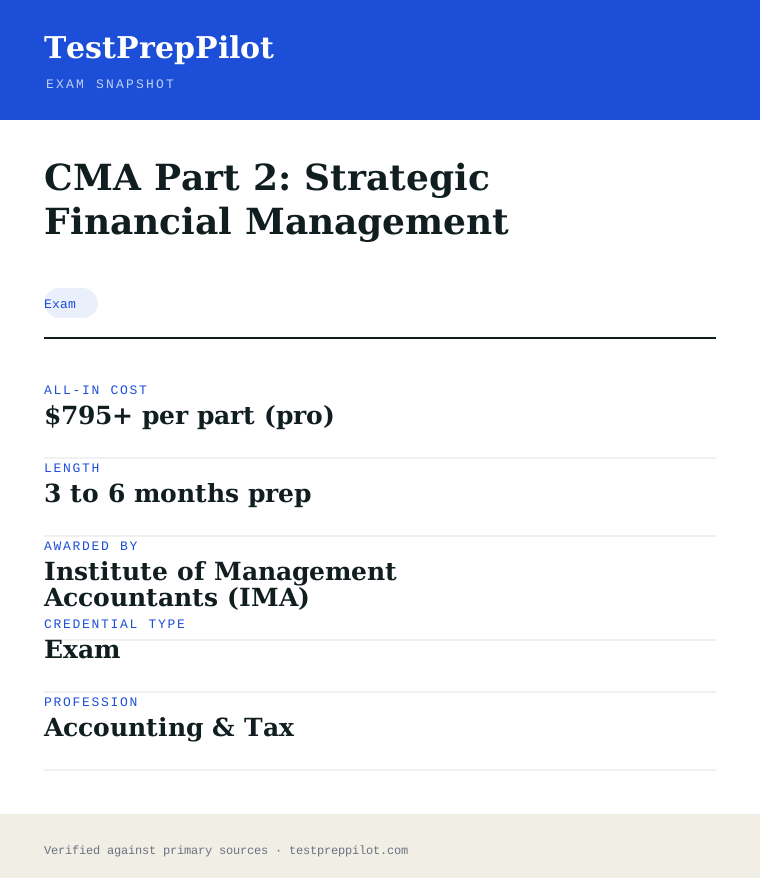
For the CMA Part 2: Strategic Financial Management, the exam fee is Exam fee per part (member rates; entrance fee separate); the all-in cost is typically $795+ per part (pro); most candidates spend 3 to 6 months prep preparing.
Cost breakdown
| IMA entrance fee | $300 (professional) |
|---|---|
| Part 2 exam fee | $495 (professional member) |
| Typical total | $795+ for Part 2 |
Student and academic rates are lower; entrance fee is one-time.
Timeline
- Study 3 to 6 months
- Test 4 hours
- Result weeks
Typical prep: 3 to 6 months prep
The path
How do you register for the CMA Part 2: Strategic Financial Management?
- 1
Join IMA and register15 minutes
Pay the IMA membership and the CMA entrance fee, then enroll in the two-part program through imanet.org.
- 2
Meet the education and experience rulevaries
Hold a bachelor degree or qualifying professional credential; you may sit the exam before finishing the two years of management accounting experience, which is required to certify.
- 3
Schedule each part15 minutes
Book Part 1 and Part 2 with Prometric at a center or online; each is four hours with multiple-choice and essays.
- 4
Pass and certifyper part
Score 360 or higher on the 0 to 500 scale for each part, then submit proof of the required experience to be certified.
The fine print
What are the retake and renewal rules for the CMA Part 2: Strategic Financial Management?
- Proctoring & delivery
- CMA exams are delivered by Prometric at test centers and via online proctoring, with photo ID and a secure check-in.
- Retake policy
- A failed part may be retaken in any testing window for the exam fee; candidates have a set period from entrance to complete both parts.
- Score reporting
- Each part is scored 0 to 500, with 360 required to pass; a score report breaks down performance by content area.
- Recertification
- CMAs maintain the credential with 30 hours of continuing education per year (120 over three years) and an annual IMA membership and CPE fee.
Context
CMA Part 1 vs Part 2
| Part | Theme | Topics | |
|---|---|---|---|
| Part 1 | Planning and performance | Reporting, budgeting, cost, controls | |
| Part 2 | Strategic finance | Analysis, corporate finance, ethics |
What it pays
How much does this credential pay?
$81,680 median for accountants and auditors (BLS SOC 13-2011, May 2024)
There is no Bureau of Labor Statistics occupation called "management accountant," so the salary case for the CMA runs through the occupation it certifies: accountants and auditors, which BLS classifies under SOC 13-2011 with a May 2024 median annual wage of $81,680, about $39.27 an hour. The honest framing is that the CMA does not move the occupation-level median in the government data; its value is as an employer-recognised signal of management-accounting and corporate-finance competency — the credential that distinguishes a financial analyst or FP&A professional from the general accounting population — and the certified premium shows up in employer pay practice and promotion eligibility rather than in any BLS line. BLS reports the lowest 10 percent of accountants and auditors earned less than $52,780 and the highest 10 percent more than $141,420, and the May 2024 medians varied by setting — finance and insurance at $87,980, management of companies and enterprises at $86,010, government at $81,120, and accounting, tax preparation, bookkeeping and payroll services at $80,510 — so the corporate-side settings where strategic financial managers work sit at the higher end of that distribution. BLS counted 1,579,800 accountant and auditor jobs in 2024 and projects 5 percent growth from 2024 to 2034, faster than the average for all occupations, with about 124,200 openings a year, most from replacement need as the profession turns over. The credential itself carries a real cost structure that a candidate should price before starting: for 2026, IMA professional members pay roughly $545 per part in exam fees plus a $300 entrance fee and IMA membership dues of about $295 a year, with materially reduced rates for students, and the certification also requires completing both parts plus two years of continuous professional experience within seven years, then 30 hours of continuing professional education a year to maintain it. The practical takeaway is that the CMA is an expensive, time-gated credential whose return comes from positioning you for strategic financial-management and corporate-finance roles in the higher-paying corporate settings rather than from moving the occupation-level median.
| Measure | Figure | Source / note |
|---|---|---|
| Median annual wage, accountants and auditors | $81,680 | BLS Occupational Outlook Handbook, May 2024 ($39.27/hr) |
| Lowest 10 percent | less than $52,780 | BLS OOH Pay tab, May 2024 |
| Highest 10 percent | more than $141,420 | BLS OOH Pay tab, May 2024 |
| Employment, 2024 | 1,579,800 jobs | BLS OOH Quick Facts, 2024 |
| Projected annual openings | ~124,200 per year | BLS OOH Job Outlook, 2024-34 |
| CMA investment | ~$545/part + $300 entrance + IMA dues (2026) | Plus 2 years of experience within 7 years, then 30 CPE hours annually |
Job growth.+5% projected change 2024-34 for accountants and auditors (faster than average), with about 124,200 openings a year; the CMA targets the strategic financial-management and corporate-finance segment of the occupation where corporate-side pay is highest.
Source: BLS Occupational Outlook Handbook — Accountants and Auditors
Your odds
What are the pass rates?
IMA does not publish official CMA pass-rate percentages — independent compilations commonly cite a first-time rate near 45% — and the published pass mark is 360 on a 0-500 scale
The direct answer on pass rates is that the IMA does not currently publish official CMA pass-rate percentages on its public program pages, and we will not invent one — the honest planning question is answered by the published mechanics and the widely cited third-party context instead. Independent prep providers that compile candidate performance commonly cite a first-time CMA pass rate near 45 percent in recent years, materially lower than the pass rates of the CPA or the CFA first level, which is exactly what a candidate should expect from a two-part, essay-inclusive professional exam with a substantial time investment; the figure is a cohort context rather than a precise auditable number, and we flag it as third-party rather than official. What IMA does publish is the complete exam specification: each CMA part is a 4-hour exam of 100 multiple-choice questions in 3 hours plus 2 essay or case-based questions in 1 hour, with the multiple-choice section worth 75 percent of the score and the written section 25 percent, scored on a 0-500 scale with a passing mark of 360, and you must also pass the multiple-choice section at roughly the 50 percent level for your essays to be graded at all — a gate that trips candidates who bank on strong essays to carry a weak multiple-choice performance. The exam is delivered at Prometric centres or through ProProctor online testing in three windows per year: January/February, May/June and September/October. Two structural facts matter more than any pass-rate number. First, you have three years from entering the program to pass both parts, and a single failed attempt in a window costs the full per-part fee and pushes the completion date, so the economics reward thorough preparation. Second, the 2026 written section is transitioning from traditional essays to case-based questions (CBQs), with candidates in the January/February 2026 window sitting essays, the May/June window able to choose, and most English-language exams using CBQs only from September/October 2026 — so a candidate should confirm which format applies to their window.
Read this before quoting the number.IMA does not publish official CMA pass-rate percentages; the ~45% first-time figure is a third-party compilation and should be treated as cohort context, not an auditable official number. The verifiable official figures are the 100-MCQ-plus-2-essay format, the 360/500 pass mark, the 50% multiple-choice gate, and the three testing windows per year.
Source: IMA — CMA (Certified Management Accountant) program pages
Your schedule
How long should I study for it?
100-160 hours over 12-16 weeks of focused study
A realistic CMA Part 2 study plan runs 12 to 16 weeks at 8 to 12 hours a week, because the part is a breadth exam with a written component and the fastest score gains come from weighting study time to the domain that carries the most points. The IMA Content Specification Outline for Part 2, Strategic Financial Management, is the scope map: Financial Statement Analysis at 20 percent of the exam, Corporate Finance at 20 percent, Decision Analysis at 25 percent, Risk Management at 10 percent, Investment Decisions at 10 percent, and Professional Ethics at 15 percent, so a candidate who studies the six domains equally will under-prepare the decision-analysis block that is the single largest on the paper. The study window should split into a content-coverage phase (weeks 1-8) working the domains in weight order — starting with decision analysis (cost-volume-profit analysis, marginal analysis, pricing, and the make-versus-buy and sell-or-process-further decisions), then financial statement analysis (ratio analysis, profitability and liquidity measures, and the effects of accounting choices on reported numbers) and corporate finance (risk and return, cost of capital, raising capital, working-capital management and corporate restructuring), then investment decisions (capital budgeting, net present value and internal rate of return), risk management and professional ethics — followed by a drilling phase (weeks 9-12) with the question bank, then a final block (weeks 13-16) of full timed practice exams at the real 4-hour format, including the written section. The written section is the part candidates underestimate: the two essay or case-based questions reward showing your calculations and reasoning, so the plan must include at least a few timed written responses, not just multiple-choice drilling. The multiple-choice section is scored first and gates the essays, so practice performance on the 100-question block should clear the bar before the exam. Confirm your testing window, your IMA membership status and the fee structure — roughly $545 per part for professionals, less for students, plus the entrance fee and IMA dues — and plan against the three-year clock to pass both parts.
- Weeks 1-210-12 hrs/week
Decision analysis (25%)
- Master cost-volume-profit analysis and marginal analysis
- Study pricing decisions and the make-versus-buy, sell-or-process-further and special-order decisions
- Drill the quantitative decision-analysis problems until they are automatic
- Weeks 3-410-12 hrs/week
Financial statement analysis (20%)
- Master ratio analysis, profitability and liquidity measures
- Study the effects of accounting choices on reported numbers
- Practise interpreting a set of financial statements under time
- Weeks 5-610-12 hrs/week
Corporate finance (20%)
- Study risk and return, and the cost of capital
- Cover raising capital, working-capital management and corporate restructuring
- Drill the cost-of-capital and working-capital calculations
- Week 710-12 hrs
Investment decisions (10%)
- Master capital budgeting: net present value and internal rate of return
- Study discounted-cash-flow analysis for project selection
- Practise the NPV and IRR calculations and the decision rules
- Week 810-12 hrs
Risk management and professional ethics (25% combined)
- Study enterprise risk identification, assessment and mitigation
- Cover the IMA Statement of Ethical Professional Practice
- Practise the ethics scenarios, which are highly coachable
- Weeks 9-1212-14 hrs/week
Question-bank drilling and written-section practice
- Drill the full question bank in volume, tagging every miss to a domain
- Practise 2-4 timed written responses, showing calculations and reasoning
- Take one full 4-hour practice exam and analyse the multiple-choice gate
- Weeks 13-1610-12 hrs/week
Full-format rehearsal and gap closing
- Two or three full 4-hour practice exams under real timing
- Re-drill the weakest domains from the error log
- Final pass over CVP analysis, capital budgeting and the ethics scenarios
Adjusting the pace
Working in financial analysis or corporate finance.Ten to twelve weeks. Your day job covers corporate finance and statement analysis; spend the recovered time on decision analysis, risk management and the written-section format.
Recent accounting graduate.Twelve weeks at 10-12 hrs/week. Your content is fresh; the risk is the exam format — the multiple-choice gate and the timed essays — so weight the plan toward full 4-hour rehearsals.
Working full-time while studying.Sixteen weeks at 8-10 hours a week. Protect the weekly question set and the written-section practice, and confirm the window and the three-year clock before you start.
How to study
How do I prepare most effectively?
The strategy that reliably passes CMA Part 2 is "weight the blueprint, drill the quantitative domains, and rehearse the written section," because the IMA outline puts Decision Analysis at 25 percent — the largest domain on the paper — and the exam rewards fluent calculation in the decision, finance and investment areas as much as concept knowledge. Start by getting the IMA Content Specification Outline and baselining with a section-level practice set, logging every miss to a domain. Second, weight the quantitative domains hardest: decision analysis (cost-volume-profit, marginal analysis, pricing and the make-versus-buy decisions), corporate finance (risk and return, cost of capital, working-capital management) and investment decisions (net present value and internal rate of return) together carry 55 percent of the paper, and the calculations that live there are the highest-yield drilling targets — a candidate who can perform CVP and NPV arithmetic fluently clears the multiple-choice gate far more reliably than one who only recognises the concepts. Third, drill the financial-statement-analysis content deliberately: ratio analysis, profitability and liquidity measures, and the effects of accounting choices on reported numbers are 20 percent of the paper and are the items that reward knowing both the ratios and what they mean. Fourth, rehearse the written section explicitly: the two essay or case-based questions reward showing your calculations and reasoning in order, and a candidate who can think through a capital-budgeting or pricing analysis but cannot write it up under time loses the 25 percent of the score the written section carries. Fifth, do not skip risk management and professional ethics: together they are 25 percent of the paper, and the ethics scenarios are the most coachable content on the exam — the IMA Statement of Ethical Professional Practice is a closed, learnable set. Finally, rehearse the full 4-hour format at least twice, because the multiple-choice-to-essay rhythm and the pacing need to be trained, and confirm the essay-versus-case-based-question format that applies to your testing window.
Weight the quantitative domains
Decision Analysis (25%), Corporate Finance (20%) and Investment Decisions (10%) carry 55% of the paper. Drill CVP, cost-of-capital and NPV calculations until automatic.
Master financial statement analysis
Ratio analysis, profitability and liquidity measures, and the effects of accounting choices are 20% of the paper — know both the ratios and what they mean.
Rehearse the written section explicitly
The two essay or case-based questions are 25% of the score and reward showing your work in order. Practise timed written responses — not just multiple-choice drilling.
Do not skip risk management and ethics
Together they are 25% of the paper, and the ethics scenarios are the most coachable content on the exam — the IMA Statement of Ethical Professional Practice is a closed, learnable set.
Rehearse the full 4-hour format
100 multiple-choice in 3 hours plus 2 written in 1 hour. Run at least two full timed exams so the multiple-choice-to-essay rhythm and the pace are trained.
Confirm the written-section format for your window
The essay-to-case-based-question transition runs through 2026 — essays in Jan/Feb, choice in May/Jun, CBQs mostly from Sep/Oct. Confirm which applies to your sitting.
What to buy
Which study resources are worth paying for?
CMA Part 2 preparation splits into the IMA official materials, the major commercial review courses, and free resources, and the buying logic is anchored by one fact: the IMA Content Specification Outline and the IMA exam practice questions are the authoritative scope, and the well-known commercial review providers — Wiley CMAexcel, Gleim, Becker and HOCK — dominate the market because the exam is too specialised for generic accounting prep to cover. The commercial review courses run roughly $500 to $1,500 depending on the package, provider and access length, and they bundle the question bank, video lectures, a study text and mock exams; the tier differences are mostly about access length, printed texts and additional practice-exam volume, so a candidate should compare the per-part versus both-parts pricing, because many providers discount the two-part bundle. The IMA itself publishes the Content Specification Outlines free, along with official practice questions and a study guide, which are the closest thing to the real exam format; for a candidate on a tight budget, the free outlines plus the official practice questions plus a question-bank subscription can be workable, but the written-section grading is where a structured course adds the most value. The exam fees themselves — roughly $545 per part for professionals plus a $300 entrance fee and IMA membership dues of about $295 a year for 2026, with reduced student rates — should be budgeted separately from prep. The honest rule: the free outlines and official practice questions first, then one commercial review course for the question bank and written-section coaching, and skip the second course, because the candidates who fail are the ones who never ran full timed exams rather than the ones who lacked a second vendor. Prices below are approximate and dated to 2026; we rank nothing by commission.
| Resource | Price | Format | Best for |
|---|---|---|---|
| IMA Content Specification Outlines and official practice questions | Free | Official PDFs and online practice | The authoritative scope — read the outlines first |
| Commercial CMA review course (Wiley, Gleim, Becker, HOCK) | ~$500-1,500 | Question bank, video, study text and mock exams | The standard package — compare per-part vs two-part pricing |
| Question-bank-only subscription | ~$150-300 | Online drilling with explanations | Volume drilling for candidates who already have a text |
| CMA Part 2 exam (IMA) | ~$545/part + $300 entrance + IMA dues (2026) | Prometric centre or ProProctor online, 4 hours | Required — plus the written section and the 360 pass mark |
| Free study communities and flashcards | Free | Forums, decks and summaries | Supplemental drilling between structured sessions |
Prices approximate and dated to 2026 and change frequently; we rank nothing by commission. The IMA fee structure for 2026 is roughly $545 per part for professionals plus a $300 entrance fee and IMA membership dues, with reduced student rates; confirm the current structure and the testing windows at imanet.org before paying.
Avoid these
What mistakes do candidates most often make?
The most common CMA Part 2 mistake is studying the six domains equally, because Decision Analysis carries 25 percent — the largest single domain on the paper — and a candidate who divides time evenly under-prepares the quantitative block that effectively decides the pass. The second is treating the written section as an afterthought: the two essay or case-based questions are 25 percent of the score, and candidates who drill only multiple choice arrive unable to show their calculations and reasoning under time, losing a quarter of the paper to format. A third recurring error is misunderstanding the multiple-choice gate: your essays are not graded unless the multiple-choice section clears roughly the 50 percent level, so a candidate who banks on strong essays to carry a weak multiple-choice performance gets no credit for them at all. Candidates also routinely under-drill the quantitative content — cost-volume-profit analysis, net present value, the cost of capital and the decision-analysis problems — because the concepts feel familiar, when the exam rewards fluent arithmetic and the calculation items are where time pressure bites. Another pattern is skipping the professional-ethics domain, which is 15 percent of the paper and the most coachable content on the exam, because traditional accountants dismiss it as soft, even though the IMA Statement of Ethical Professional Practice is a closed, learnable set. Finally, some candidates mismanage the structural clock: they sit a part without running a full 4-hour timed exam, so the multiple-choice-to-essay rhythm surprises them, or they let the three-year completion clock slip after a failed attempt, which costs the full per-part fee and a full testing window. A last pattern is confusion about the written-section transition: candidates in 2026 windows must confirm whether their sitting uses essays or the newer case-based questions, because preparing for the wrong format wastes the most expensive study hours.
✕Studying the six domains equally
✓Decision Analysis is 25% of the paper — the largest domain. Weight your hours to the blueprint, with the quantitative finance domains carrying the most time.
✕Treating the written section as an afterthought
✓The two essay or case-based questions are 25% of the score. Practise timed written responses that show your calculations and reasoning in order.
✕Misunderstanding the multiple-choice gate
✓Your essays are not graded unless the multiple-choice section clears roughly the 50% level. Protect the MCQ block rather than banking on essays to carry the part.
✕Under-drilling the quantitative content
✓CVP, NPV, cost of capital and the decision-analysis problems reward fluent arithmetic. Drill them until automatic — the calculation items are where time pressure bites.
✕Skipping professional ethics
✓Professional Ethics is 15% of the paper and the most coachable content on the exam. The IMA Statement of Ethical Professional Practice is a closed, learnable set — master it.
✕Mismanaging the structural clock
✓Run at least two full 4-hour timed exams, and treat the three-year completion clock and the per-window fee as hard constraints after any failed attempt.
✕Preparing for the wrong written-section format
✓Confirm whether your 2026 window uses essays or the newer case-based questions — the transition rolls out through the year, and the wrong prep wastes your most expensive study hours.
What you'll face
What question types will I see?
CMA Part 2, Strategic Financial Management, is a 4-hour computer-based exam of 100 multiple-choice questions in 3 hours plus 2 essay or case-based questions in 1 hour, with the multiple-choice section worth 75 percent of the score and the written section 25 percent, scored on a 0-500 scale with a passing mark of 360 and a multiple-choice gate that must clear roughly 50 percent before the essays are graded. The multiple-choice items are four-option single-best-answer questions drawn from the six domains of the IMA Content Specification Outline — Financial Statement Analysis (20 percent), Corporate Finance (20 percent), Decision Analysis (25 percent), Risk Management (10 percent), Investment Decisions (10 percent), and Professional Ethics (15 percent) — and they run from concept questions to calculation items on cost-volume-profit analysis, capital budgeting, the cost of capital and working-capital management. The written section presents two questions that combine scenario analysis with calculations and written reasoning: traditional essays ask you to compute and explain in prose, while the newer case-based questions present a business case with interactive prompts such as select-from-list, drag-and-drop and calculation entry, but both are graded for the same 25 percent of the part. The calculation items are the defining feature of Part 2: the decision-analysis problems, the net present value and internal rate of return computations, and the cost-of-capital and ratio calculations appear across the three largest domains, and candidates who can perform the arithmetic fluently clear the multiple-choice gate far more reliably than candidates who only recognise the concepts. The practical pacing is about 108 seconds per multiple-choice question, with the written section timed separately. The samples below illustrate a concept item, a calculation item and an ethics scenario; they are editor-written to the published Content Specification Outline and are not live exam items.
Definitions and applications of decision analysis, corporate finance, risk and ethics concepts — the fastest items for a candidate who studied the blueprint.
CVP, NPV, IRR, cost of capital and ratio calculations — the defining feature of Part 2, where fluent arithmetic clears the multiple-choice gate.
A described business situation asking for the correct financial, investment or risk-management decision.
A professional situation asking which course of action the IMA Statement of Ethical Professional Practice requires — the most coachable content on the exam.
A scenario requiring calculations plus written reasoning — traditional essays, or the newer case-based questions with interactive prompts, depending on the window.
Try these
Q1A company is deciding whether to make a component internally or buy it from an outside supplier. Which cost should be included in the make-versus-buy analysis?
Answer:B
Relevant-cost analysis includes only the differential, avoidable costs that change between the alternatives — the costs that differ between making and buying — and excludes sunk costs and unavoidable fixed costs. A includes costs that do not change, C and D are sunk costs that cannot be changed by the decision. The item tests the decision-analysis content of the largest domain — the relevance rules that govern the make-versus-buy, special-order and sell-or-process-further decisions, which are the heart of Part 2.
Q2A project requires an initial investment of $100,000 and is expected to generate cash inflows of $40,000 per year for 3 years. Using a discount rate of 10%, what is the approximate net present value? (Present value factors: year 1, 0.909; year 2, 0.826; year 3, 0.751.)
Answer:A
Discount the cash inflows: $40,000 times 0.909 is $36,360, times 0.826 is $33,040, and times 0.751 is $30,040, for a total present value of inflows of $99,440. The net present value is that total minus the $100,000 initial investment, which is approximately -$560, closest to -$600. B, C and D are the common miscalculations — ignoring the discounting, mis-stacking the present values, or reversing the sign. The item tests the capital-budgeting calculation of the Investment Decisions domain, where NPV fluency is exactly what the exam rewards.
Q3A management accountant is asked to classify an expense in a way that overstates a division’s reported profit, against the accountant’s professional judgment. Which course of action is most consistent with the IMA Statement of Ethical Professional Practice?
Answer:B
The IMA Statement of Ethical Professional Practice requires members to refrain from engaging in conduct that prejudices their duty of objectivity and integrity, to refuse gifts or pressures that influence actions, and to follow the company’s established policies for communicating ethical conflicts. A complies with a request that violates professional standards, C complies while privately documenting, and D delegates a professional responsibility. The item tests the ethics domain — the closed, learnable set of IMA ethical duties that is the most coachable content on Part 2.
Samples are editor-written illustrations of the published blueprint, not live exam items.
The big day
What should I expect on exam day?
CMA Part 2 is a 4-hour computer-based exam of 100 multiple-choice questions in 3 hours plus 2 essay or case-based questions in 1 hour, delivered at a Prometric centre or through ProProctor online testing, scored on a 0-500 scale with a passing mark of 360, and the direct exam-day answer is that you will work the multiple-choice section first, clear the gate, and then write the two essay or case-based responses, with the score report delivered on screen at the end. The first thing to confirm is the name on your IMA profile: it must match your government-issued ID exactly, because Prometric will turn you away on a mismatch, and the fee is forfeited. Bring the required ID and your testing confirmation; leave phones, smartwatches, notes and personal belongings in the locker, because personal electronics are prohibited in the testing room. Arrive at least 30 minutes early so check-in and the tutorial are complete before the clock starts, and for online proctoring run the system test in advance and set up in a private room with a clear desk. When the exam begins, work the 100 multiple-choice questions at roughly 108 seconds each, flagging items you want to revisit, and make sure you clear the multiple-choice gate before the essays — the written section depends on it. In the written section, show your work in order: set up the scenario, perform the calculations, state the conclusion and explain the reasoning, because the graders reward visible, ordered logic. Budget the 4 hours deliberately across both sections and protect time for the writing, because candidates who spend the whole multiple-choice window under-prepare the 25 percent of the score that comes from the written responses. On a pass, your Part 2 result is banked against the three-year clock — you must pass Part 1 and complete two years of continuous professional experience within seven years to earn the CMA — so diary the completion clock immediately, and confirm the written-section format (essays versus case-based questions) that applies to your testing window before the day.
Bring
- A government-issued photo ID matching your IMA profile name exactly (driver’s license or passport)
- Your exam confirmation with the Prometric centre address or ProProctor session link
- For online proctoring: a tested webcam, microphone and connection on the exact machine you will use
- A pacing plan — about 108 seconds per multiple-choice question, with the written section timed separately
Leave at home
- Phones, smartwatches, fitness trackers and all personal electronics
- Notes, books and study materials — the test centre provides what is allowed
- Personal calculators beyond the permitted model — the exam has a specific calculator policy
- For online proctoring, any other person in the room and any second monitor
How the day runs
Rules in the room
- The exam is 100 multiple-choice questions in 3 hours plus 2 written questions in 1 hour, 4 hours total.
- The passing mark is 360 on a 0-500 scale; the multiple-choice section must clear roughly the 50% gate for the essays to be graded.
- The result is reported as a numeric score, delivered on screen at the end of the exam.
- Your IMA profile name must match your government-issued ID exactly, or you are turned away and the fee is forfeited.
- Personal electronics are prohibited; the exam has a specific calculator policy — confirm the permitted model.
- You have three years from entering the program to pass both parts; a failed attempt costs the full per-part fee and a full testing window.
Afterwards.Your score report is delivered on screen at the end of the exam, and the immediate next step on a pass is the structural one: log the three-year completion clock, because you must pass Part 1 within three years of entering the program and complete two years of continuous professional experience within seven years to earn the CMA credential, and on a fail, use the score report to identify the weaker section — for most candidates that is either the multiple-choice gate or the written section — rehearse that section specifically, and re-sit in a later window at the full per-part fee. Once certified, the CMA requires 30 hours of continuing professional education each year, including at least 2 hours of ethics, plus the IMA membership dues, so the credential is a maintenance commitment rather than a one-time purchase. Either way, the occupation behind the credential is the context: accountants and auditors earned a BLS median of $81,680 in May 2024 with about 124,200 openings a year, and the CMA positions you for the strategic financial-management and corporate-finance segment of that occupation where corporate-side pay is highest — the practical return on a roughly $1,000-plus first-year investment and the three-year completion clock.
Reference
What are the key facts about the CMA Part 2: Strategic Financial Management?
CMA Part 2: Strategic Financial Management is a exam credential; awarded by Institute of Management Accountants (IMA); the exam fee is Exam fee per part (member rates; entrance fee separate); typical preparation is 3 to 6 months prep.
| Credential | CMA Part 2: Strategic Financial Management |
|---|---|
| Abbreviation | CMA Part 2 |
| Type | Exam |
| Profession | Accounting & Tax |
| Specialty | Accounting & Audit |
| Awarded by | Institute of Management Accountants (IMA) |
| Difficulty | Hard |
| Typical prep time | 3 to 6 months prep |
| All-in cost | $795+ per part (pro) |
| Questions | 100 MCQ + 2 essays |
| Time | 4 hours |
| Pass | Scaled 360 / 500 |
| Part | Second of two CMA parts |
| Scope | National / Multi-state |
Real questions
Frequently asked questions about the CMA Part 2: Strategic Financial Management
How hard is CMA Part 2?
Candidates often find Part 2 slightly more conceptual than Part 1, with corporate finance and decision analysis carrying the most weight.
How long should I study?
Three to six months is typical, with extra time on decision analysis and investment decisions.
Should I take it after Part 1?
Most do, but the order is flexible; Part 2 stands on its own finance and strategy content.
What is the pass mark?
A scaled 360 on the 0 to 500 scale, including the essay component.
What experience is needed to certify?
Two years of management accounting or finance experience, which you may complete after passing both exams.
Can I sit the CMA before I have the experience?
Yes. You may pass both parts first and then submit the two years of management accounting experience later to be certified; the exam result stays valid.
How is the CMA different from the CPA?
The CPA centers on audit, tax and assurance in public practice, while the CMA focuses on internal management accounting, planning and decision support inside organizations.
In short
Is the CMA Part 2: Strategic Financial Management worth it?
- Second CMA part on finance and strategy
- 100 MCQ + 2 essays, pass at 360/500
- Covers analysis, corporate finance, risk, ethics
- Completes the CMA with Part 1
Same awarding body
What other credentials does Institute of Management Accountants (IMA) award?
Worth comparing
How does the CMA Part 2: Strategic Financial Management compare with similar credentials?
Trust
Where does this information come from?
Everything above is taken from the awarding body's own published material. Fees, question counts and domain weights are revised regularly — check the official page before you pay.
- Institute of Management Accountants (IMA) Awarding body
Research confidence: high · Last reviewed 2026-08