The short version
What is the Certified Bookkeeper and is it worth it?
The AIPB Certified Bookkeeper (CB) is a four-part national credential: two closed-book Prometric tests (Adjustments & Error Correction; Payroll & Depreciation) and two open-book workbook finals (Inventory; Internal Controls & Fraud Prevention). You also need ~2 years of bookkeeping experience and must sign the AIPB Code of Ethics.
- Nationally recognized benchmark for full-charge bookkeepers
- Experience-based, not degree-based — open to working bookkeepers
- Covers the adjustments, controls, payroll, and fraud prevention employers value
- Backed by the AIPB Code of Ethics and a 300+ location Prometric network
- Renewable through AIPB-approved continuing education
What is it?
What exactly is the Certified Bookkeeper?
AIPB's four-part national bookkeeping credential — the experience-based benchmark for full-charge bookkeepers.
The Certified Bookkeeper (CB) is the national bookkeeping credential from the American Institute of Professional Bookkeepers (AIPB), established as the benchmark for full-charge bookkeepers. It is earned through a four-part exam: two closed-book tests at Prometric — Adjustments & Error Correction and Payroll & Depreciation — plus two open-book workbook finals on Inventory and Internal Controls & Fraud Prevention. Candidates also need about two years of bookkeeping experience (or 3,000 part-time hours) within three years of passing and must agree to the AIPB Code of Ethics. With a 75% pass mark on the Prometric parts and 70% on the workbook finals, the CB signals professional competence in the adjustments and controls that separate a bookkeeper from a data-entry clerk.
The path in brief
- Confirm you have (or will earn) ~2 years of bookkeeping experience
- File the paper application and pay the registration fee
- Wait for AIPB to issue your testing ID number
- Schedule and pass Prometric Parts 1 & 2 (2 hours each)
- Complete the open-book Inventory and Internal Controls workbook finals
- Submit experience proof and sign the Code of Ethics to receive the CB
Before you book
Who is eligible to sit the Certified Bookkeeper?
The CB is open to working bookkeepers without a degree. You may take the exam before finishing the experience requirement, but you must accumulate at least two years of full-time bookkeeping experience (or 3,000 hours of part-time/freelance work) within three years of passing the exam. Undergraduates may count internships and accounting-related volunteer work such as VITA. You apply by mailing a signed paper application to AIPB, which then issues a testing ID number.
Who it is for: Working bookkeepers, full-charge bookkeepers, and accounting assistants seeking a nationally recognized professional designation.
The test itself
What is the format of the Certified Bookkeeper?
The Certified Bookkeeper is administered by American Institute of Professional Bookkeepers (AIPB); Prometric delivers Parts 1–2 and runs 2 hours each for Prometric Parts 1 & 2; Parts 3–4 are untimed open-book finals and requires 75% on Prometric Parts 1 & 2; 70% on workbook Parts 3 & 4 to pass.
| Administered by | American Institute of Professional Bookkeepers (AIPB); Prometric delivers Parts 1–2 |
|---|---|
| Questions | Multiple-choice; item counts per test are not published. Six tests total: two 2-hour Prometric tests per part for Parts 1–2, plus untimed workbook finals for Parts 3–4 |
| Time limit | 2 hours each for Prometric Parts 1 & 2; Parts 3–4 are untimed open-book finals |
| Pass mark | 75% on Prometric Parts 1 & 2; 70% on workbook Parts 3 & 4 |
| Exam fee | Registration $25 member / $60 nonmember (nonrefundable) + $100 each for Prometric Parts 1 & 2; Parts 3–4 have no exam fee (study workbooks extra) |
| Format | Closed-book computerized tests at Prometric (Parts 1–2); open-book workbook finals (Parts 3–4) |
Content outline
What topics are on the Certified Bookkeeper?
The Certified Bookkeeper covers 6 content domains.
Weightings come from the official exam outline. Study time is best allocated in roughly these proportions rather than evenly across domains.
- Part 1, Test 1 — Adjustments
Accruals, deferrals, and the adjusted trial balance; month-end financial statement preparation
- Part 1, Test 2 — Error Correction & Bank Reconciliation
Locating bookkeeping errors, trial-balance analysis, and reconciling bank accounts
- Part 2, Test 1 — Payroll
Worker classification, withholding, deposits, Forms W-4/941/940/W-2/W-3, and payroll journal entries
- Part 2, Test 2 — Depreciation
Book vs tax depreciation, straight-line and accelerated GAAP methods, units-of-production, MACRS basics
- Part 3 — Inventory
Perpetual vs periodic systems, FIFO/LIFO/weighted-average, shrinkage, lower of cost or net realizable value (open-book workbook final)
- Part 4 — Internal Controls & Fraud Prevention
Segregation of duties, noncash asset theft, check/credit-card fraud, vendor scams, and computer fraud controls (open-book workbook final)
The path
How do you register for the Certified Bookkeeper?
- 1
Confirm experience trackwithin 3 years of passing
Plan to show at least 2 years of full-time bookkeeping experience (or 3,000 part-time/freelance hours) within three years of passing the exam. Students may count internships and accounting-related volunteer work.
- 2
File the paper application~4 weeks processing
Complete and mail the signed CB application with the nonrefundable registration fee ($25 AIPB member / $60 nonmember). Allow about 4 weeks for AIPB to process it.
- 3
Receive your testing IDafter approval
Once approved, AIPB mails a testing identification number you use to schedule Prometric appointments.
- 4
Schedule and pass Prometric Parts 1 & 2within 1 year of application
Book the two closed-book computer tests at a Prometric center in any order: Adjustments & Error Correction, and Payroll & Depreciation (2 hours, 75% to pass each). You get your score immediately.
- 5
Complete the workbook finals (Parts 3 & 4)within 3 years
Finish the open-book Inventory and Internal Controls & Fraud Prevention finals included in the study workbooks (untimed, 70% to pass). Submit them to AIPB for grading.
- 6
Submit experience and ethics, get the CBwithin 3 years of passing
Provide the experience evidence form(s) and sign the AIPB Code of Ethics. AIPB issues your certificate within about two weeks of the last requirement.
The fine print
What are the retake and renewal rules for the Certified Bookkeeper?
- Proctoring & delivery
- Parts 1 and 2 are closed-book, computerized tests delivered at Prometric Test Centers (300+ U.S. locations) with live center proctoring. Parts 3 and 4 are open-book workbook finals completed at home and submitted to AIPB.
- Retake policy
- If you fail a Prometric part, you may retake just that test after a 30-day waiting period for a $60 fee (you keep credit for any part you passed). The open-book workbook finals (Parts 3–4) may be retaken at no cost.
- Score reporting
- Prometric prints your score at the center immediately after Parts 1 and 2. Workbook finals (Parts 3–4) are graded by AIPB after submission; results are reported to you and reflected in your AIPB record.
- Recertification
- Certified Bookkeepers must complete 60 continuing professional education (CPE) hours every three years, measured from the anniversary of the last certification test passed. CPE must come from AIPB-recognized providers; failure to meet the requirement can result in revocation of the designation.
- Refunds & rescheduling
- The registration fee is nonrefundable. Prometric test fees are generally nonrefundable once scheduled, though you can cancel or reschedule without penalty if you contact Prometric at least two days before the appointment.
Context
Bookkeeping credentials compared
| Credential | Issuer | Exam structure | Pass / Experience | Renewal | |
|---|---|---|---|---|---|
| AIPB CB | AIPB | 4 parts (2 Prometric + 2 workbook) | 75% / 70%; 2 yr exp | 60 CPE / 3 yr | |
| NACPB CPB (license) | NACPB | 3 online exams (Bookkeeping, Payroll, QuickBooks) | 75% each; 1 yr exp | License: 24 CPE / yr (annual) | |
| Intuit QuickBooks ProAdvisor | Intuit | Single software exam (tiered) | Varies; no experience | Annual (software update) |
What it pays
How much does this credential pay?
$49,210 median for bookkeeping clerks (BLS, May 2024) — in an occupation BLS projects to shrink 6%
There is no federal wage series for "Certified Bookkeeper," so the honest anchor is the occupational group the CB sits inside: Bookkeeping, Accounting, and Auditing Clerks (SOC 43-3031). BLS puts the median annual wage at $49,210, or $23.66 an hour, in May 2024. The band is real but compressed — the lowest 10 percent earned less than $34,600 and the highest 10 percent more than $72,660 — which tells you something important before you spend a dollar on workbooks: this credential will not, by itself, move you from the middle of that band to the top of it. Now the part most certification pages bury. BLS projects employment in this group to DECLINE 6 percent between 2024 and 2034, a loss of about 94,300 jobs, as bank feeds, OCR receipt capture and cloud ledgers absorb the transaction-entry work that used to fill a bookkeeper's week. That is a genuine headwind and you should price it into your decision. Two things make the picture less bleak than the headline. First, scale: even while shrinking, the occupation still employs roughly 1.6 million people and BLS still projects about 170,000 openings a year, essentially all of them replacement demand from retirements and career changes. Second, composition: the work being automated is not the work the CB tests. Nothing in a bank feed decides whether a December invoice is an accrual or a deferral, reconstructs a botched prior-period entry, determines whether a worker is a contractor or an employee, or designs a segregation-of-duties control that survives an owner who wants to sign his own cheques. The CB is deliberately aimed at that judgment layer — AIPB states plainly that the programme "is not basic bookkeeping" and assumes you are already working or have a year of college accounting. Read the credential, then, as a defensive and differentiating move within a shrinking occupation rather than as a wage escalator: it is evidence that you belong to the part of the profession that survives automation. Industry choice moves the number more than the letters do. BLS reports May 2024 medians of $51,670 in construction, $50,180 in professional, scientific and technical services, and $48,810 in both healthcare and wholesale trade, against $45,030 in retail. AIPB's own member survey data — self-reported and promotional, so weigh it accordingly — claims 59 percent of CBs received a raise after certifying and 48 percent of freelance CBs raised their rates. Treat those as directional marketing figures, not as BLS-grade evidence.
| Measure | Figure | Source / note |
|---|---|---|
| Median annual wage | $49,210 ($23.66/hr) | BLS OOH, Bookkeeping/Accounting/Auditing Clerks (SOC 43-3031), May 2024 wage data |
| Lowest 10% | less than $34,600 | BLS OOH Pay tab, SOC 43-3031, May 2024 |
| Highest 10% | more than $72,660 | BLS OOH Pay tab, SOC 43-3031, May 2024 |
| Employment (2024) | 1,613,400 | BLS OOH Quick Facts, SOC 43-3031, 2024 |
| Projected change 2024-34 | -6% (decline), -94,300 jobs | BLS OOH Job Outlook, 2024-34 projections |
| Annual openings | ~170,000/yr | BLS OOH — despite the decline; essentially all replacement demand |
| Highest-paying top industry | $51,670 (construction) | BLS OOH Pay tab, May 2024 industry medians |
Job growth.Projected -6% decline, 2024-34 (BLS OOH, 2024-34 projections). We are not going to spin this: the occupation is shrinking. The hedge is that the CB certifies adjustment, error-correction, payroll-compliance and internal-control judgment — the work least exposed to automation — and that ~170,000 replacement openings a year still exist.
Source: BLS Occupational Outlook Handbook — Bookkeeping, Accounting, and Auditing Clerks
Your odds
What are the pass rates?
AIPB publishes no pass rate. It publishes pass marks: 75% on each Prometric test, 70% on each workbook exam
We checked AIPB's certification pages, the CB Designation booklet and the Self-Study Handbook: none of them publishes a candidate pass rate, first-time or cumulative. Nor does AIPB release volume statistics from which one could be derived. If you find a site quoting "X% of CB candidates pass," it is unsourced — treat it as invented. What AIPB does publish, and what is actually more useful for planning, is the pass-mark structure, and it has a wrinkle most summaries miss. The "four-part" exam is really six separately scored tests. Part 1, taken at Prometric, contains Test 1 (Accruals, Deferrals and the Adjusted Trial Balance) and Test 2 (Correction of Accounting Errors and the Bank Reconciliation). Part 2, also at Prometric, contains Test 1 (Payroll) and Test 2 (Depreciation). Each of those four tests requires 75 percent. Parts 3 (Inventory) and 4 (Internal Controls and Fraud Prevention) are back-of-the-workbook exams you complete at home with the book open, with no time limit and no fee, and each requires 70 percent. That five-point asymmetry is not arbitrary. The 70 percent bar sits on exams where the reference material is legally in front of you; the 75 percent bar sits on closed-book, timed tests. In practice this means the open-book halves are close to a formality if you have actually worked the workbooks, and essentially all of your genuine risk is concentrated in the two Prometric visits. Plan accordingly: the credential is not evenly hard. The retake rules reinforce the point and are unusually forgiving. Credit is granted test by test, not part by part — if you sit Part 2 and pass Payroll but fail Depreciation, you keep Payroll and retake only Depreciation, after a 30-day wait, for $60, and you receive a different test than the one you failed. Failed workbook exams may be retaken at any time at no cost at all. Two clocks constrain all of this and they catch people out. Once AIPB processes your application you have one year to complete any one part of the exam; miss that and you must register again. Separately, you must pass all parts within three years or you re-register and retake every test, including ones you had already passed. Because your score prints out at the Prometric centre the moment you finish, you will know immediately which clock you are fighting.
| Cohort | Pass rate | Source / note |
|---|---|---|
| Part 1 Test 1 — Accruals, Deferrals & Adjusted Trial Balance | 75% to pass | AIPB CB Designation booklet, exam table (aipb.org) |
| Part 1 Test 2 — Error Correction & Bank Reconciliation | 75% to pass | AIPB CB Designation booklet, exam table |
| Part 2 Test 1 — Payroll | 75% to pass | AIPB CB Designation booklet, exam table |
| Part 2 Test 2 — Depreciation | 75% to pass | AIPB CB Designation booklet, exam table |
| Part 3 — Inventory (open-book workbook exam) | 70% to pass | AIPB CB Designation booklet — no time limit, no fee |
| Part 4 — Internal Controls & Fraud Prevention (open-book) | 70% to pass | AIPB CB Designation booklet — no time limit, no fee |
| Prometric retake | $60 after a 30-day wait | AIPB CB Designation booklet, "Retests" — per test, not per part |
| Workbook exam retake | No fee, no waiting period | AIPB CB Designation booklet, "Retests" |
Read this before quoting the number.AIPB publishes no candidate pass rate — none, in any of its public materials — so we deliberately show no `rows` of pass percentages and no headline pass rate. Any site quoting a specific CB pass percentage is citing a number AIPB has never released. The pass MARKS above (75% on each of the four Prometric tests, 70% on each of the two open-book workbook exams) and the retake terms are official and are what you should plan against.
Source: AIPB — The Certified Bookkeeper (CB) Designation booklet
Your schedule
How long should I study for it?
80-120 hours total, roughly 70% weighted to the four closed-book Prometric tests of focused study
Budget 80-120 hours across the six scored tests, but do not spread them evenly — that is the single most common planning error on this credential. Roughly 70 percent of your hours belong to the four Prometric tests, because those are closed-book, timed at two hours per part, and marked at 75 percent. The two workbook exams are open-book, untimed and marked at 70 percent; they reward knowing where a method lives in the book far more than remembering it. The schedule below assumes 8-10 hours a week and lands in 12-14 weeks. It also assumes you meet AIPB's stated baseline: the CB programme is explicitly "not basic bookkeeping" and expects you to be a working bookkeeper or to have a year of college accounting. If that is not you, add four to six weeks of foundational work before week 1 or the workbooks will read as a wall of unfamiliar notation. Sequence matters more here than on most exams because of how credit and clocks interact. AIPB lets you take the parts in any order and keeps credit test by test, but it also recommends sitting Part 1 before scheduling Part 2 — sensible, because adjusting entries and the adjusted trial balance underpin how depreciation and payroll accruals land in the ledger. Meanwhile the calendar is doing two things at once: you have one year from application processing to complete any one part, and three years to pass everything or start over from zero. So book your first Prometric appointment during week 1, before you feel ready. A date on the calendar is the only reliable defence against the three-year reset. Run the experience requirement in parallel rather than after. AIPB accepts two years of full-time bookkeeping or 3,000 hours part-time/freelance, and — this is widely misreported — the experience may be earned before OR after you pass, with three years from your pass date to document it. If you are already working, you may well have satisfied it before you open a workbook; start collecting the Evidence of Experience signatures early so the certificate is not held up by an ex-employer who takes six weeks to answer email.
- Weeks 1-4 — Part 1 (both Prometric tests)8-10 hrs/week
Test 1: accruals, deferrals, unearned revenue, prepaid expenses, unadjusted-to-adjusted trial balance. Test 2: locating errors, the bank reconciliation, correcting current-period accrual and deferral errors
- Work Mastering Adjusting Entries and Mastering Correction of Accounting Errors, writing quiz answers on separate paper so you can re-do them
- Drill accrual vs deferral classification cold, with the book shut
- Automate the out-of-balance divisibility checks (÷2, ÷9) until diagnosis is reflexive
- Book your Prometric appointment for Part 1 now, not later
- Weeks 5-8 — Part 2 (both Prometric tests)8-10 hrs/week
Test 1: employee vs non-employee, federal vs state rules, withholding, deposits, W-4/941/940/W-2/W-3, who gets overtime. Test 2: GAAP depreciation (straight-line, units-of-production, declining balance, sum-of-the-years'-digits) and tax depreciation
- Work Mastering Payroll and Mastering Depreciation end to end
- Build one deadline sheet covering deposit frequencies and every form due date, then reproduce it from memory
- Compute a full depreciation schedule under each GAAP method, then redo it for tax purposes
- Sit Part 1 at Prometric during this block if not already done
- Weeks 9-11 — Part 3, Inventory (open-book, at home)6-8 hrs/week
Perpetual vs periodic recording, weighted and moving average, FIFO, LIFO, and lower of cost or net realisable value (LCNRV)
- Work Mastering Inventory and tab every cost-flow method for fast lookup
- Compute FIFO / LIFO / weighted average by hand on the same fact pattern to see the COGS divergence
- Take the back-of-the-workbook exam — untimed, open-book, no fee, 70% to pass
- Weeks 12-14 — Part 4, Internal Controls & Fraud (open-book) + close-out6-8 hrs/week
Employee theft, cheque fraud, credit-card fraud, vendor fraud, computer and internet fraud, and the red flags and dos/don'ts for each
- Work Mastering Internal Controls and Fraud Prevention and take its back-of-the-workbook exam
- Sit Part 2 at Prometric
- Submit the Evidence of Experience form and sign the AIPB Code of Ethics so the certificate is not delayed
Adjusting the pace
Working full-time.Stretch to 16-18 weeks at 5-7 hrs/week and book the two Prometric parts on separate days several weeks apart — four closed-book tests in one sitting is how tired candidates lose the 75% margin. Keep an eye on the one-year-per-part clock.
Already doing month-end and payroll daily.Compress to 8-10 weeks at 10-12 hrs/week. Your day job has already taught Parts 1-2; use the workbooks mainly to learn AIPB's notation and to bank the two open-book exams early for momentum.
No accounting background yet.AIPB states the CB programme is not for novices and assumes a working bookkeeper or one year of college accounting. Add 4-6 weeks of principles-level study first, or the Mastering series will not land.
How to study
How do I prepare most effectively?
Almost every piece of advice worth giving on the CB follows from one structural fact: two of the six scored tests let you keep the book open and four of them do not, and candidates unconsciously study for the easy half. If you always revise with Mastering Payroll within arm's reach, you are rehearsing the Part 3 and Part 4 conditions and not rehearsing the Part 1 and Part 2 conditions — and Parts 1 and 2 are the ones marked at 75 percent, timed at two hours, and sat in a room where a Prometric proctor takes your notes off you at the door. Deliberately split your practice into two modes and label them. There is a second structural quirk to exploit. Because AIPB scores and grants credit test by test rather than part by part, your risk is finely divisible: failing Depreciation costs you $60 and 30 days, not the whole of Part 2. That makes it rational to sit a part as soon as you are marginally ready rather than waiting to feel comfortable across both of its tests, especially given the one-year-per-part and three-year-overall clocks. Waiting is the more expensive error. Third, AIPB tells you something unusually candid about its own item bank in the Self-Study Handbook: the national exam questions are "similar to, but never duplicates of," the double-quizzes at the end of each workbook section, and it explicitly advises writing quiz answers on separate paper so you can re-take them repeatedly. Take that at face value. The double-quizzes are the closest published proxy for the real thing, and their value is destroyed the moment you pencil answers into the margin. Fourth, respect the calculator rule when you practise. Prometric permits only a nonprinting, nonprogrammable, self-powered calculator — so if you rehearse depreciation schedules on your phone or a graphing calculator, you are training on a tool you cannot bring. Buy the cheap battery calculator in week 1 and use only that.
Split practice into "book open" and "book shut" and never blur them
Parts 3 and 4 are open-book and untimed; Parts 1 and 2 are closed-book, two hours per part, and marked at 75%. Do at least one fully closed-book, clock-running set each week. Candidates who revise exclusively with the workbook open feel prepared and then discover at Prometric that they had been reading, not recalling.
Exploit test-by-test credit — sit early, not when comfortable
AIPB grants credit per test, so a failed Depreciation test costs $60 and a 30-day wait while your Payroll pass stands. Against that, missing the one-year-per-part window forces re-registration and missing the three-year window voids every test you had already passed. Sitting slightly early is cheap; waiting is not.
Treat the workbook double-quizzes as the official item proxy
AIPB states the exam questions are "similar to, but never duplicates of" the double-quizzes, and advises writing answers on separate paper so you can re-take them. Do exactly that — a marked-up workbook is a one-use asset, and these quizzes are the only sanctioned preview of the question style you will meet.
Build one payroll compliance calendar and reproduce it from memory
Mastering Payroll covers processing a W-4, completing the 941, 940, W-2 and W-3, who does and does not get overtime, and when withheld taxes must be deposited. Timing and form purpose are where the cheap marks are lost, because they are pure recall under a closed-book clock — condense them onto one page and rewrite it from blank until it is exact.
Make error diagnosis reflexive before you sit Part 1 Test 2
When a trial balance is out of balance, divide the difference by 2 (points to a transposition of a single entry posted twice or to the wrong side) and by 9 (points to a transposition or a slide). Under a two-hour closed-book clock, resolving these in seconds instead of minutes is what buys you review time on the bank reconciliation items.
Practise on the calculator you are actually allowed to bring
The Prometric rules permit only a nonprinting, nonprogrammable, self-powered calculator. Rehearsing depreciation and payroll arithmetic on a phone or a programmable model trains muscle memory you must abandon on the day. Buy the compliant calculator at the start and use nothing else.
What to buy
Which study resources are worth paying for?
The CB has an unusually closed prep market: AIPB writes the workbooks, sets the exam, and hosts the open-book exams in the back of two of those same workbooks, so third-party material is thin and largely unnecessary. The practical decision is not "which publisher" but "self-study or tutored," plus whether the $60 annual membership pays for itself. It does, comfortably, if you are buying the full set — membership costs $60 and saves $35 on registration plus $60 on the workbooks, so it is roughly $35 to the good on the workbook bundle alone before any of the member benefits. The all-in figures are worth stating plainly because they are frequently quoted wrong: registration ($25 member / $60 non-member) plus the two Prometric parts at $100 each plus the six workbooks ($254 member / $314 non-member) comes to $479 for a member and $574 for a non-member. Parts 3 and 4 carry no exam fee at all, and their retakes are free, which is why the total is lower than candidates expect. Budget separately for maintenance: 60 CPECs every three years, registered at $3 per credit. Prices below are AIPB list, checked 2026-08. We do not rank by commission and take no affiliate revenue from any provider listed here.
| Resource | Price | Format | Best for |
|---|---|---|---|
| AIPB Mastering series — all six workbooks | $254 member / $314 non-member | Print or e-book; Parts 3 & 4 exams are bound into two of them | Almost everyone — this is both the syllabus and the delivery mechanism for half the exam |
| AIPB Online 99-Hour Prep Course | Not published on AIPB's public page — quoted on request | Tutored online course; bundles prepaid certification registration, the six workbooks and prepaid Prometric fees | Candidates who want structure and a single all-inclusive payment |
| CB certification registration fee | $25 member / $60 non-member (non-refundable) | One-off application to AIPB; allow 4 weeks to process | Required of everyone before any test can be scheduled |
| Prometric exam fees (Parts 1 and 2) | $100 per part ($200 total) | Closed-book, 2 hours per part, at a Prometric centre | Unavoidable; retakes are $60 per test after 30 days |
| Parts 3 and 4 workbook exams | No fee, free retakes | Open-book, untimed, at home | Included with the relevant Mastering workbook — no separate purchase |
| AIPB membership | $60/year | Association membership | Pays for itself on the workbook + registration discount alone |
| CPEC registration (post-certification upkeep) | $3 per CPEC; 60 CPECs per 3 years | Ongoing | Budget from the day you certify — this is the CB's only recurring cost |
| Community-college / continuing-ed CB course | Varies by institution | Instructor-led, uses the same six AIPB workbooks | Learners who need a classroom; AIPB runs formal AA and CE programme tracks |
Prices checked 2026-08 against AIPB's CB Designation booklet and public storefront (list prices, US). All-in: $479 member / $574 non-member ($25/$60 registration + $200 Prometric + $254/$314 workbooks). The Online 99-Hour Prep Course price is deliberately left blank rather than estimated — AIPB does not publish it on the public page and we will not guess. We do not rank by commission and receive no affiliate revenue from any provider listed.
Avoid these
What mistakes do candidates most often make?
CB candidates rarely fail because they cannot do bookkeeping. They fail because they misread the shape of the programme — a certification mistaken for a licence, an asymmetric exam treated as uniform, and two overlapping deadlines nobody diarised. The errors below are drawn from the structural traps in AIPB's own published rules, and every one of them is a planning failure with a cheap fix.
✕Believing the CB is a licence, or that it lets you do licensed work
✓It is not a licence and confers no legal authority. AIPB says so directly: obtaining the designation is voluntary, and it is for employers to decide whether to require it. It does not permit you to sign audit opinions, represent clients before the IRS, or call yourself a public accountant. It is a competence signal from a private body — valuable, but do not sell it to a client as something it is not. (Contrast the NACPB CPB, which is styled as a licence with annual renewal.)
✕Under-preparing Parts 1 and 2 because Parts 3 and 4 are open-book
✓This is the defining failure mode. The open-book halves are untimed, free, freely retakeable and marked at 70%. The Prometric halves are closed-book, two hours, $100, marked at 75%, and carry a 30-day/$60 retake penalty. Effectively all of your risk lives in Parts 1 and 2 — weight your hours about 70/30 toward them and rehearse with the book shut.
✕Assuming the experience must be earned after passing
✓AIPB accepts two years full-time or 3,000 hours part-time/freelance earned BEFORE OR AFTER you pass, with three years from your pass date to document it. Many working bookkeepers already qualify on day one. Get the Evidence of Experience form signed early — a slow former employer, not the exam, is what usually delays the certificate.
✕Missing one of the two silent clocks
✓Two separate deadlines run at once. From application processing you have one year to complete any one part or you must register again. Separately, you must pass all parts within three years or you re-register and retake every test, including ones you had already passed. Diarise both dates the week your application clears.
✕Turning up at Prometric with the wrong ID or the wrong calculator
✓You must present two forms of ID, one with a photo, and both must show the same name and signature — a driving licence in a married name plus a card in a maiden name will fail. Primary ID: state driving licence, passport, state ID, military ID or student ID. Secondary: credit card, ATM card or green card. Only a nonprinting, nonprogrammable, self-powered calculator is permitted.
✕Letting the CPEC requirement lapse after certifying
✓The CB has no annual licence fee, which lulls people into thinking it is maintenance-free. It is not: you need 60 CPECs every three years from your certification date, registered at $3 per credit. Log them as you earn them; AIPB supplies information on free sources once you certify.
✕Writing quiz answers into the workbook
✓AIPB explicitly advises writing double-quiz answers on separate paper so the quizzes can be re-taken, and states exam questions are similar to but never duplicates of them. Filling in the book converts your single best practice resource into a read-only one after one pass.
What you'll face
What question types will I see?
Everything on the CB is multiple choice — at Prometric you simply select a, b, c or d — but the exam is built from six separately scored tests grouped into four parts, delivered through two entirely different channels, and that shapes how the questions behave. The four Prometric tests (Part 1: Accruals/Deferrals/Adjusted Trial Balance, and Error Correction/Bank Reconciliation; Part 2: Payroll, and Depreciation) are closed-book on a PC, two hours per part, 75% to pass, with an optional tutorial first and your score printed out the moment you finish. AIPB does not publish item counts for them. Because they are closed-book and timed, they test recall and speed of computation as much as understanding: you are expected to know that a difference divisible by nine implicates a transposition or a slide, to remember which form is due 31 January, and to run a declining-balance schedule without looking up the convention. The two remaining tests are printed in the back of the Mastering Inventory and Mastering Internal Controls and Fraud Prevention workbooks, taken at home with the book open, with no time limit and no fee, at 70% to pass. AIPB also offers a paper or online format for these. Their character is different: with the reference in front of you, the questions test whether you can select and apply the correct method — which cost-flow assumption, which control for which fraud scheme — rather than whether you memorised it. Content is stable and published. Part 1 runs from accrual-versus-cash basis through accrued revenue and expenses, unearned revenue, prepaid expenses, other adjustments such as depreciation and bad debt, and the walk from unadjusted trial balance to financial statements; its second test covers where errors occur and how to find them, the bank reconciliation, using the trial balance to find errors, and correcting current-period accrual and deferral errors. Part 2 covers payroll from employee-versus-non-employee classification through federal and state rules, overtime eligibility, deposit timing and the 941/940/W-2/W-3 cycle, then depreciation under GAAP (straight-line, units-of-production, declining balance, sum-of-the-years'-digits) and for tax, including the equipment-versus-buildings and business-versus-personal-use distinctions. Part 3 covers perpetual and periodic inventory, weighted and moving average, FIFO, LIFO and LCNRV. Part 4 covers employee theft, cheque, credit-card, vendor, computer and internet fraud with their red flags. The three samples below are written by our editors against that published outline to show the style and the arithmetic depth; they are not live exam items and never reproduce them.
Test 1 Accruals, Deferrals and the Adjusted Trial Balance; Test 2 Correction of Accounting Errors and the Bank Reconciliation. Each scored separately at 75%. Delivered on a PC, select a/b/c/d, optional tutorial first, score printed immediately. Item counts not published by AIPB.
Test 1 Payroll; Test 2 Depreciation. Each scored separately at 75%, so you can pass one and retake only the other after 30 days for $60. Heavily computational — this is where the permitted nonprogrammable calculator earns its keep.
Bound into the back of Mastering Inventory, taken at home in paper or online form, 70% to pass, free retakes. Tests correct selection and application of cost-flow methods with the book available rather than recall.
Bound into the back of Mastering Internal Controls and Fraud Prevention, same terms as Part 3. Scenario-led: match the control or the red flag to the fraud scheme described.
Try these
Q1On 1 April a company pays $7,200 for a 24-month insurance policy and debits Prepaid Insurance in full. No adjusting entries have been made. What adjusting entry is required at 31 December of the same year?
Answer:A
The policy costs $7,200 over 24 months, so $300 per month. From 1 April to 31 December is nine months, giving $2,700 of expense to recognise: debit Insurance Expense, credit Prepaid Insurance. B is the classic trap — $3,600 is twelve months' worth, which you would only recognise if the policy had run the whole year rather than starting in April. C reverses the entry, moving expense back into the asset. D writes off the entire two-year premium in year one, ignoring the deferral altogether.
Q2An employee earns $2,400 in gross wages for a semi-monthly pay period. Year-to-date earnings before this payroll are $8,000. Using a 6.2% Social Security rate and a 1.45% Medicare rate, what is the employer's share of FICA on this payroll?
Answer:C
The employer matches the employee's FICA dollar for dollar. Social Security is 6.2% x $2,400 = $148.80, and Medicare is 1.45% x $2,400 = $34.80, so the employer's share is $183.60. A counts only the Social Security element and B only the Medicare element — each is a partial answer designed to catch a rushed reading. D is $367.20, the combined employee AND employer total, which is what you would remit in aggregate but is not the employer's own share. Note the year-to-date figure of $8,000 is deliberately irrelevant here: it is nowhere near the Social Security wage base, so no cap applies.
Q3A machine costs $50,000, has a five-year life and an estimated salvage value of $5,000. Under the double-declining-balance method, what is depreciation expense in year 2?
Answer:B
The straight-line rate is 1/5 = 20%, so the double-declining rate is 40%. Critically, declining-balance ignores salvage value in the annual computation and applies the rate to the book value carried forward. Year 1 is 40% x $50,000 = $20,000, leaving a book value of $30,000; year 2 is 40% x $30,000 = $12,000. C ($10,800) is what you get by wrongly subtracting salvage first, depreciating $45,000 — that is the single most common error on this item type, because salvage subtraction is correct for straight-line and for sum-of-the-years'-digits but not for declining balance. A is year 1's figure minus a miscalculation and D applies the rate to the wrong base.
Samples are written by our editors to match AIPB's published CB blueprint and workbook section outlines. They are illustrations of question style and difficulty only — they are not real exam items and no live AIPB content is reproduced.
The big day
What should I expect on exam day?
The CB has two completely different "exam days" and pretending otherwise would be useless to you. Parts 1 and 2 are closed-book sessions at a Prometric test centre, and Parts 3 and 4 are open-book exams you take at your kitchen table with no clock running. THE PROMETRIC DAY. Arrive early and treat check-in as the first hurdle, because it is the one that turns people away. AIPB requires two forms of identification: one must carry a photograph, and both must show the same name and the same signature. This trips up candidates whose driving licence is in a married name and whose secondary card is not. Acceptable primary ID is a valid state driving licence, a valid passport, a state ID card, a military ID card or a student ID card; acceptable secondary ID is a credit card, an ATM card or a green card. Bring the calculator you have been practising on, and make sure it is the permitted kind — nonprinting, nonprogrammable and self-powered. A phone, a graphing calculator or anything that stores formulae is not allowed in the room. Personal belongings go into a locker. The test itself is delivered on a PC; every question is multiple choice, so you select a, b, c or d, and Prometric offers an optional tutorial before the clock starts, which is worth taking simply to settle. You get two hours for the part, covering both of its scored tests. Nothing may leave the room — no notes, no scratch working, no memoranda of any kind — and anyone suspected of irregularities is reported by name and ID number to AIPB. You may sit only on the day and at the time you scheduled; there is no walk-in. The compensation for all that rigidity is immediate feedback: your score is printed out for you at the centre as soon as you finish, so you leave knowing exactly where you stand and whether the 30-day retake clock has started. THE AT-HOME DAY. Parts 3 and 4 could not be more different. Each is printed in the back of its Mastering workbook, is taken open-book with no time limit and no fee, and can be submitted on paper or online. There is no proctor, no ID check and no lockers. Free retakes mean the stakes are close to zero. The only real discipline is not to let "untimed and open-book" become "never actually done" — set a date for each one the way you would for a centre appointment.
Bring
- Two forms of ID showing the SAME name and the SAME signature, one of them bearing a photograph
- Primary ID: valid state driving licence, valid passport, state ID card, military ID card or student ID card
- Secondary ID: credit card, ATM card or green card
- A nonprinting, nonprogrammable, self-powered calculator — the only type permitted in the room
- Your Prometric appointment confirmation and AIPB testing ID number
- For Parts 3 and 4 only: the relevant Mastering workbook, which you are meant to have open
Leave at home
- Phones, smartwatches and any internet-connected device — these go in the locker
- Printing or programmable calculators, and anything that can store a formula
- Notes, books, memoranda and workbooks (Parts 1 and 2 are strictly closed-book)
- Any expectation of taking your working out with you — no materials of any kind may leave the test room
How the day runs
Rules in the room
- Two IDs required, one with a photo, both matching on name AND signature — mismatches are the most common reason candidates are turned away.
- Only nonprinting, nonprogrammable, self-powered calculators may be used during the tests.
- No test materials, documents or memoranda of any kind may be removed from the test room.
- You may sit a scheduled part only on the day and at the time booked.
- Anyone suspected of irregularities has their name and ID number reported to AIPB.
- Parts may be taken in any order and credit is kept test by test, not part by part.
Afterwards.Your Prometric score prints at the centre the moment you finish. Fail one of the two tests within a part and you keep the other: retake just the failed test after a 30-day wait for $60, and you will be given a different test. Failed workbook exams can be retaken immediately at no cost. Once every test is passed, the experience requirement is documented (two years full-time or 3,000 hours part-time/freelance, earned before or after passing, with three years from your pass date to file it) and you have signed the AIPB Code of Ethics, your certificate arrives within two weeks of the last test passed. From your certification date the upkeep clock starts: 60 CPECs every three years, registered at $3 per credit. There is no annual licence fee.
Reference
What are the key facts about the Certified Bookkeeper?
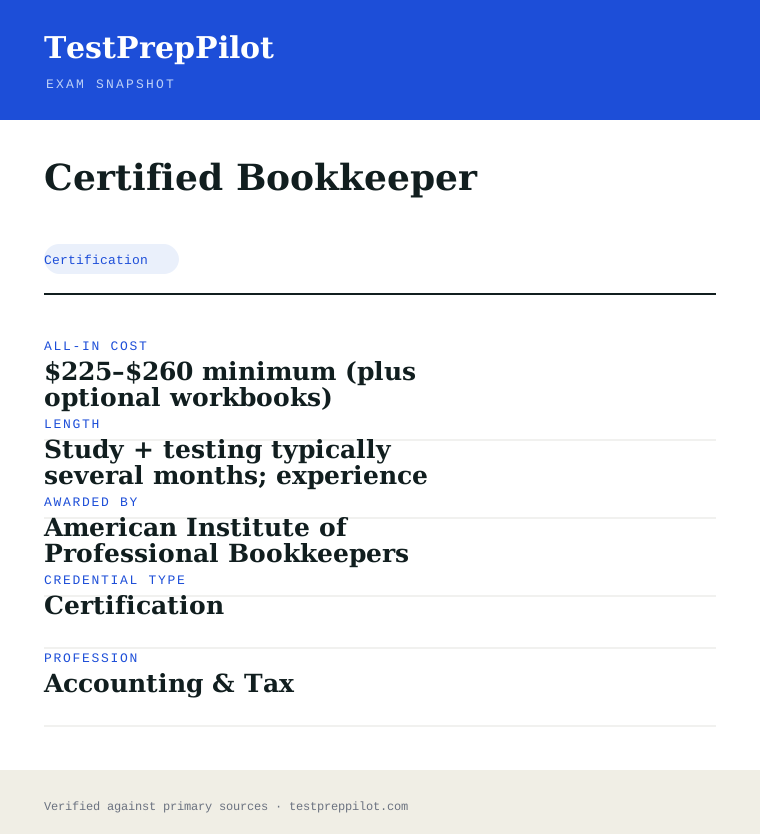
Certified Bookkeeper is a certification credential; awarded by American Institute of Professional Bookkeepers (AIPB); the exam fee is Registration $25 member / $60 nonmember (nonrefundable) + $100 each for Prometric Parts 1 & 2; Parts 3–4 have no exam fee (study workbooks extra); typical preparation is Study + testing typically several months; experience within 3 years of passing.
| Credential | Certified Bookkeeper |
|---|---|
| Abbreviation | CB |
| Type | Certification |
| Profession | Accounting & Tax |
| Specialty | Accounting & Audit |
| Awarded by | American Institute of Professional Bookkeepers (AIPB) |
| Difficulty | Challenging |
| Typical prep time | Study + testing typically several months; experience within 3 years of passing |
| All-in cost | $225–$260 minimum (plus optional workbooks) |
| Credential | Certified Bookkeeper (CB) |
| Issuing body | American Institute of Professional Bookkeepers (AIPB) |
| Structure | 4 parts (2 Prometric tests + 2 workbook finals) |
| Passing scores | 75% Parts 1–2; 70% Parts 3–4 |
| Experience | 2 yrs full-time or 3,000 hrs part-time within 3 yrs |
| Code of Ethics | Required to be awarded the designation |
| Renewal | 60 CPE hours every 3 years |
| Scope | National / Multi-state |
Real questions
Frequently asked questions about the Certified Bookkeeper
How is the AIPB CB exam structured?
It is a four-part exam. Parts 1 and 2 are closed-book, multiple-choice tests taken at a Prometric center — Adjustments & Error Correction, and Payroll & Depreciation — each with a 2-hour limit. Parts 3 and 4 are untimed, open-book finals at the back of the Mastering Inventory and Mastering Internal Controls and Fraud Prevention workbooks.
What score do I need to pass?
You need 75% on each Prometric part (Parts 1 and 2) and 70% on each workbook final (Parts 3 and 4). You can take the parts in any order and keep credit for any part you pass.
How much does it cost?
A nonrefundable registration fee of $25 for AIPB members or $60 for nonmembers, plus $100 each for the two Prometric parts — a $225–$260 minimum before study workbooks or prep. The two workbook finals carry no separate exam fee.
What are the experience requirements?
You need at least two years of full-time bookkeeping experience or 3,000 hours of part-time/freelance work, which can be completed within three years of passing the exam. Internships and accounting-related volunteer work may count for students.
How do I keep the CB active?
Certified Bookkeepers must complete 60 continuing professional education (CPE) hours every three years, beginning on the anniversary of the last certification test passed. AIPB-approved providers supply the CPE.
Do I need a degree to earn the CB?
No. The CB is experience-based, not degree-based. You need about two years of bookkeeping experience (or 3,000 part-time hours), which can be earned within three years of passing the exam.
Can I take the Prometric parts in any order?
Yes. Although labeled Part 1 and Part 2, the two Prometric tests may be taken in any order, and credit is kept for any part you pass even if you later retake another.
How do I maintain the designation?
Complete 60 AIPB-approved CPE hours every three years and stay in good standing with the AIPB Code of Ethics. Approved providers include AIPB's own courses and recognized partners.
In short
Is the Certified Bookkeeper worth it?
- Four-part exam: two 2-hour Prometric tests (75% to pass) plus two untimed open-book workbook finals (70%).
- Requires ~2 years of bookkeeping experience and signing the AIPB Code of Ethics to be awarded.
- Minimum direct cost is $225 (member) / $260 (nonmember) before study workbooks.
- Renew with 60 CPE hours every 3 years through AIPB-approved education.
Trust
Where does this information come from?
Everything above is taken from the awarding body's own published material. Fees, question counts and domain weights are revised regularly — check the official page before you pay.
- American Institute of Professional Bookkeepers (AIPB) Awarding body
Research confidence: high · Last reviewed 2026-08