Admissions & Academic Testing • Exam
Armed Services Vocational Aptitude Battery
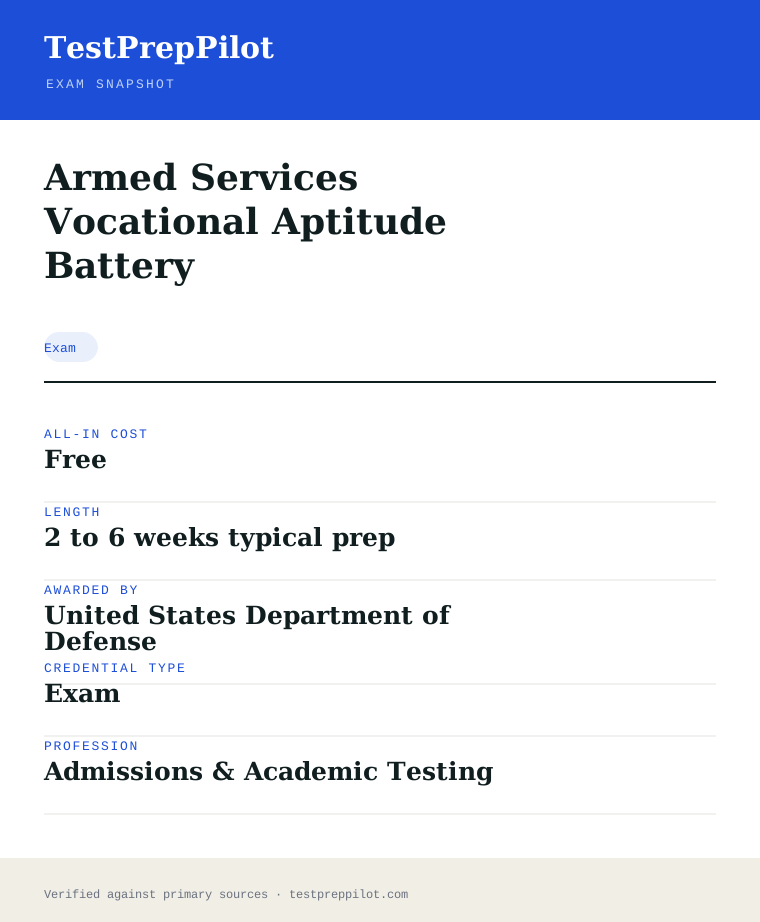
The free multiple-aptitude battery that decides US military enlistment eligibility and job qualification.
Researched and maintained by TestPrepPilot Editorial BoardMilitary aptitude & enlistment testing desk · Figures last verified August 2026
The short version
What is the Armed Services Vocational Aptitude Battery and is it worth it?
The ASVAB is a free, multiple-aptitude enlistment test given at MEPS, with about 135 computer-adaptive questions over roughly two and a half to three hours. It produces the AFQT eligibility percentile and composite line scores that match you to military jobs, and it may be retaken after 30 days, then 30 days, then every six months.
- Free to all enlistment applicants
- Determines both eligibility and job match
- Accepted by every US military branch
- Computer-adaptive and efficiently timed
- Also used by the school Career Exploration Program
What is it?
What exactly is the Armed Services Vocational Aptitude Battery?
The free multiple-aptitude battery that decides US military enlistment eligibility and job qualification.
The Armed Services Vocational Aptitude Battery (ASVAB) is the multiple-aptitude test used by all US military branches to determine enlistment eligibility and qualification for military occupations. It is free, delivered at Military Entrance Processing Stations and mobile sites, and covers ten subtests that feed both the AFQT eligibility score and composite line scores for specific jobs. The computer-adaptive version has about 135 questions and takes roughly two and a half to three hours.
The path in brief
- Contact a recruiter
- Schedule the ASVAB at MEPS
- Prepare with the official guide
- Test and receive line scores
- Match jobs with a recruiter
Before you book
Who is eligible to sit the Armed Services Vocational Aptitude Battery?
Who it is for: US military enlistment applicants and students
The test itself
What is the format of the Armed Services Vocational Aptitude Battery?
The Armed Services Vocational Aptitude Battery is administered by United States Department of Defense and runs About 2.5 to 3 hours.
| Administered by | United States Department of Defense |
|---|---|
| Questions | About 135 questions across 10 subtests (CAT-ASVAB) |
| Time limit | About 2.5 to 3 hours |
| Pass mark | No pass mark; AFQT percentile 1 to 99 |
| Exam fee | Free |
| Format | Multiple-choice, computer-adaptive or paper |
Content outline
What topics are on the Armed Services Vocational Aptitude Battery?
The Armed Services Vocational Aptitude Battery covers 5 content domains.
Weightings come from the official exam outline. Study time is best allocated in roughly these proportions rather than evenly across domains.
- General Science
- Arithmetic Reasoning
- Word Knowledge
- Paragraph Comprehension
- Mathematics Knowledge
Study materials
Which study guide should you use for the Armed Services Vocational Aptitude Battery?
Start with the exam sponsor's official content outline. If you also want one structured resource to work through, these are the Mometrix titles that match this exam.

Affiliate links We may earn a commission if you buy through these links, at no extra cost to you. Mometrix has no say in what our exam guides cover. How we make money.
Money & time
How much does the Armed Services Vocational Aptitude Battery cost?
For the Armed Services Vocational Aptitude Battery, the exam fee is Free; the all-in cost is typically Free; most candidates spend 2 to 6 weeks typical prep preparing.
Cost breakdown
| Enlistment ASVAB | Free |
|---|---|
| Typical total | Free |
There is no fee for the enlistment ASVAB or the school Career Exploration Program.
Timeline
- Study 2 to 6 weeks
- Test About 3 hours
- Scores Same or next day
Typical prep: 2 to 6 weeks typical prep
The path
How do you register for the Armed Services Vocational Aptitude Battery?
- 1
Talk to a recruiter or counselorvaries
For enlistment, contact a branch recruiter to schedule the ASVAB at a MEPS or MET site; for the CEP, ask your school counselor.
- 2
Take the testabout 3 hours
Sit the paper or computer-adaptive ASVAB under proctoring; the PiCAT version is taken unproctored at home first, then verified at MEPS.
- 3
Review scores and line scoressame day or after
Receive subtest scores, composite line scores and the AFQT percentile that determine branch eligibility and job qualification.
- 4
Use results for enlistment or careersongoing
A recruiter matches your line scores to military occupations; CEP users explore civilian careers with the same data.
The fine print
What are the retake and renewal rules for the Armed Services Vocational Aptitude Battery?
- Proctoring & delivery
- The enlistment ASVAB is administered at Military Entrance Processing Stations and mobile test sites under strict control; the CEP is given at schools. The PiCAT is unproctored at home but must be confirmed by a short verification test at MEPS.
- Retake policy
- After a first attempt, the ASVAB may be retaken after 30 days, then 30 days again, and thereafter every six months. PiCAT verification failure triggers a full ASVAB instead.
- Score reporting
- The AFQT is a percentile of 1 to 99 derived from word knowledge, paragraph comprehension, arithmetic reasoning and mathematics knowledge; the ten subtests also feed composite line scores for job qualification.
- Recertification
- Enlistment scores are valid for two years; there is no renewal, but a new test updates eligibility and line scores.
Context
ASVAB family compared
| Version | For | Where | Score | |
|---|---|---|---|---|
| ASVAB (enlistment) | Military entry | MEPS or MET | AFQT percentile | |
| ASVAB CEP | School careers | High schools | Same scales | |
| PiCAT | At-home entry | Home plus MEPS | AFQT percentile |
What it pays
How much does this credential pay?
ASVAB has no direct civilian salary — it qualifies you for military service, where pay follows rank, time in service, and the job you qualify for.
The salary answer for the ASVAB is a military-career story rather than a civilian wage line: the ASVAB is the enlistment aptitude battery that determines whether a candidate can join the US military and which military jobs they qualify for, and the BLS does not publish a wage for ASVAB scores. Military compensation is a separate system: pay is set by rank and time in service on the military pay tables, with basic pay for an E-1 around $1,900 per month in the current tables, an E-4 with two years around $2,700, and an E-7 with ten years around $4,300, and service members receive allowances for housing and food, free medical care, and education benefits such as the GI Bill on top of basic pay — a compensation package that is not directly comparable to civilian median wages. The civilian parallel the BLS does track is the veteran employment story: veterans with military technical training in fields such as mechanics, electronics, health care, and information technology transfer into civilian occupations, and the BLS Occupational Outlook Handbook covers the civilian occupations those skills map to, such as 49-9071 Maintenance and Repair Workers ($48,290 median) and 15-1231 Computer Support Specialists ($61,550). The ASVAB itself has ten subtests — General Science, Arithmetic Reasoning, Word Knowledge, Paragraph Comprehension, Mathematics Knowledge, Electronics Information, Auto and Shop Information, Mechanical Comprehension, Assembling Objects, and (in the enlisted version) the verbal composite — and the four core subtests (Arithmetic Reasoning, Mathematics Knowledge, Word Knowledge, Paragraph Comprehension) produce the Armed Forces Qualification Test (AFQT) score that gates enlistment eligibility, with the military setting minimum AFQT standards by service, currently roughly 31-36 for the Air Force and Marine Corps and lower for other branches, and higher minimums for certain jobs. The honest caveat is that the ASVAB is a qualification gate, not an occupational credential: the score does not earn pay by itself — it determines which enlistment contracts and job training pipelines are available, and the earnings trajectory then follows the military career or the transferable technical skill. For a candidate asking whether ASVAB pays, the direct answer is that it is the cheapest first step to a military career with a defined pay-and-benefits package and transferable skills, but the score itself is a key that opens doors rather than a paycheck.
| Measure | Figure | Source / note |
|---|---|---|
| Subtest count | 9 (CAT) or 10 (paper) | The AFQT uses 4 subtests for the enlistment gate |
| AFQT minimums | 31-36 by service | Service-set enlistment gates; job-specific minimums are higher |
| Military pay (E-1) | ~$1,900/mo basic pay | Plus allowances, medical care, and GI Bill benefits |
| Salary impact | Indirect | Qualifies for enlistment and military job training pipelines |
Job growth.Military recruitment volume drives ASVAB demand; the DoD administers hundreds of thousands of tests per year across enlistment, student, and national programs.
Your odds
What are the pass rates?
The ASVAB has no pass rate because it has no pass/fail standard — candidates receive an AFQT percentile and service-set line scores, and eligibility gates vary by service and job.
The direct answer on pass rates is that none exists to publish: the ASVAB is a norm-referenced aptitude battery, not a pass/fail exam, so there is no pass rate and no passing score in the certification sense. The published scoring facts are the AFQT percentile and the line scores: the four core subtests (Arithmetic Reasoning, Mathematics Knowledge, Word Knowledge, Paragraph Comprehension) combine into the AFQT score, which is reported as a percentile ranking against a reference population — an AFQT of 60 means the candidate scored at or above 60 percent of the reference group — and the military services set their own minimum AFQT enlistment gates, currently around 31-36 for the Air Force and Marine Corps, with the Army and Navy lower and job-specific minimums substantially higher. The other subtests feed the line scores that determine eligibility for military occupational specialties: electronics, mechanical, administrative, and general technical composites gate specific training pipelines, so a candidate can be fully qualified for one job and unqualified for another with the same AFQT. The test itself has two formats — the computer-adaptive CAT-ASVAB, about 3 hours with nine subtests, and the paper-and-pencil version, about 3.5 hours with ten subtests — and the Military Entrance Processing Stations and the student program administer it. The practical read on difficulty: the ASVAB is a high-school-level aptitude test, and candidates who review the official ASVAB study guide and drill the arithmetic and word-knowledge subtests reliably raise their AFQT percentile, while candidates who sit cold underperform on the math and mechanical subtests that most affect job qualification. Because the score is a percentile and the gates are service- and job-specific, the smart approach is to take the official practice ASVAB, identify the weakest subtests, study toward the AFQT and line-score targets for the desired branch and job, and retake per the military’s retest rules if the first attempt falls short of the target job’s requirements.
Read this before quoting the number.The ASVAB has no pass/fail standard and therefore no pass rate; the AFQT percentile and service-set line-score gates are the published, verifiable facts.
Your schedule
How long should I study for it?
40-60 hours over 4-8 weeks of focused study
An efficient ASVAB study plan is 4-8 weeks of about 40-60 total hours, because the test is a high-school-level aptitude battery with a predictable subtest structure and the AFQT percentile moves fastest when candidates drill the four core subtests and repair the weakest line-score areas. The first step is a practice ASVAB to establish the current AFQT percentile and the subtest profile, because the target — the desired branch’s enlistment gate and the line scores for the target job — determines the plan: a candidate aiming for an electronics job needs the Electronics Information and General Science subtests strong, not just the AFQT core. The study window should split into AFQT core work (weeks 1-3: Arithmetic Reasoning, Mathematics Knowledge, Word Knowledge, Paragraph Comprehension) and line-score repair (weeks 4-6: the subtest areas the practice test flagged), followed by full-length practice (weeks 7-8). The math subtests reward drilling the arithmetic and algebra basics the ASVAB assumes — fractions, percentages, ratios, and basic equations — and the verbal subtests reward vocabulary building and reading practice, so the plan should allocate time by the practice-test gaps rather than evenly. Candidates with recent high-school math should budget the lower end; candidates years out of school should budget the upper end and add daily math review. The final two weeks should be full-length practice tests at the real format, because the CAT-ASVAB’s adaptive pacing and the paper version’s endurance are both part of the test, and the AFQT percentile improves most from format familiarity plus targeted subtest repair.
- Week 16
Diagnostic
- Take a practice ASVAB to establish the AFQT percentile
- Record the subtest profile and identify weak line-score areas
- Set the target: branch gate + target job line scores
- Week 2-314
AFQT core
- Drill Arithmetic Reasoning and Mathematics Knowledge basics
- Build Word Knowledge vocabulary and Paragraph Comprehension practice
- Work the official ASVAB study-guide math sections
- Week 4-516
Line-score repair
- Study the weak subtests flagged by the diagnostic
- Drill Electronics Information, Auto/Shop, and Mechanical Comprehension if needed
- Practice Assembling Objects for spatial-reasoning items
- Week 6-712
Full-length practice
- Take a full practice ASVAB each week
- Log every miss by subtest and re-study the topic
- Re-measure the AFQT percentile
- Week 88
Readiness
- Take one more full practice test at the target percentile
- Re-drill the miss log until clean
- Confirm the MEPS or testing-site appointment
Adjusting the pace
Targeting a technical job.Weight time toward the line-score subtests (Electronics Information, Mechanical Comprehension) that gate the target military occupational specialty.
Years out of school.Budget the upper end and add daily math review; the math subtests assume basics that decay with time.
How to study
How do I prepare most effectively?
The dominant prep strategy for the ASVAB is diagnostic-driven study with heavy drilling of the four AFQT core subtests, because the AFQT percentile gates enlistment eligibility and the line scores gate job qualification, and both move fastest when candidates repair the specific subtest gaps the practice test reveals. First, take a practice ASVAB before any study and record both the AFQT percentile and the line-score profile, because the target job’s line-score requirements tell you which subtests deserve extra time. Second, use the official ASVAB study materials — the official study guide and the free practice tests on the official ASVAB site — because they mirror the real subtests and the official AFQT practice score is the most reliable predictor. Third, drill the math core daily: Arithmetic Reasoning and Mathematics Knowledge assume high-school basics (fractions, percentages, ratios, algebra), and candidates years out of school need deliberate review rather than a quick skim. Fourth, build vocabulary and reading speed for the verbal core: Word Knowledge and Paragraph Comprehension respond to vocabulary lists and daily reading practice. Fifth, repair the line-score subtests the diagnostic flagged — Electronics Information, Mechanical Comprehension, Auto and Shop Information, and Assembling Objects are coachable and often underweighted by candidates who only study the AFQT core. Finally, schedule the real test at the MEPS or a testing site after the practice-test progression, and review the military’s retest rules, because a candidate can retake the ASVAB after the required waiting period and the best AFQT percentile is what counts for most enlistment decisions. A further high-yield tactic is to answer every question on the real test even if guessing — the AFQT is scored on correct answers, and a blank answer is always wrong, so an educated guess beats leaving items empty.
Diagnose with a practice test
Record the AFQT percentile and line scores; the target job determines the study plan.
Use official ASVAB materials
The official study guide and free practice tests mirror the real subtests.
Drill the math core daily
Arithmetic Reasoning and Mathematics Knowledge assume high-school basics that decay with time.
Repair the line-score subtests
Electronics, Mechanical, and Auto/Shop subtests are coachable and gate technical jobs.
Never leave answers blank
The AFQT counts correct answers; an educated guess beats an empty answer.
What to buy
Which study resources are worth paying for?
ASVAB prep resources are anchored by the official DoD set, because the official ASVAB program publishes the study guide and free practice tests that mirror the real subtests, and the buying logic starts there before any paid material. The official ASVAB study guide and the free practice tests on the official site are the foundation — free to low-cost, and the closest thing to the real test. Third-party ASVAB prep books and online courses, typically $20-60, add structured lessons and extra practice tests, which helps candidates who want a complete curriculum or who need more reps than the official materials provide; reputable providers are the ones that cover all ten subtests rather than only the AFQT core. Mobile apps and flashcard sets, $5-30, help vocabulary and quick math drilling on the go. The footnote that anchors the comparison: prices below are list prices as of mid-2026 and change frequently, and we rank nothing by commission. The ASVAB itself is free to take — the military administers it at no cost to the candidate at Military Entrance Processing Stations and school testing sites — so the entire prep budget goes to materials. A cheap readiness check is the free official practice ASVAB before buying anything, because candidates within a few percentile points of the target often need only the official guide and targeted subtest drilling. Candidates should also confirm the retest rules for the service they are applying to, because the waiting period between attempts is set by the military and affects the timeline to enlistment.
| Resource | Price | Format | Best for |
|---|---|---|---|
| Official ASVAB study guide + practice | Free to ~$25 | Official book + online practice | The authoritative preparation set |
| Third-party prep book/course | $20-60 | Book or online course | A complete curriculum and extra reps |
| Mobile drill apps | $5-30 | App or flashcards | Vocabulary and quick-math drilling |
| The ASVAB itself | Free | MEPS or school testing site | The real test; no cost to the candidate |
List prices as of mid-2026 and change frequently; we rank nothing by commission. The ASVAB is administered free by the military.
Avoid these
What mistakes do candidates most often make?
The most common mistake on the ASVAB is studying only the four AFQT core subtests and ignoring the line-score subtests, because the technical jobs most candidates want gate on Electronics Information, Mechanical Comprehension, Auto and Shop Information, and Assembling Objects — a candidate can clear the enlistment gate and still miss the job they want by underweighting those areas; the second is skipping the practice test and sitting cold, when the diagnostic is the cheapest way to target study. A third recurring error is letting math skills decay go unaddressed — candidates years out of school assume the arithmetic will come back on test day, when fractions, percentages, and algebra need deliberate review. Candidates also routinely leave questions blank instead of guessing, forgetting that the AFQT counts correct answers and a blank is always wrong. Another pattern is underestimating the verbal subtests, skipping vocabulary work and then underperforming on Word Knowledge and Paragraph Comprehension, which are the other half of the AFQT. Finally, some candidates take the test before confirming the target job’s line-score requirements, and then discover the score does not qualify them for the training pipeline they wanted, wasting an attempt and waiting out the retest period. Candidates also routinely skip the spatial and mechanical subtests even when their target job gates on them, and some take the test before confirming which line scores the desired military occupational specialty requires, so the score misses the job even when the AFQT clears the enlistment gate. A further pattern is letting verbal skills decay alongside math, when Word Knowledge and Paragraph Comprehension are half of the AFQT, and a few candidates study only a single third-party source without the official practice test, so their predicted percentile is unreliable.
✕Studying only the AFQT core
✓Repair the line-score subtests that gate the target job: Electronics, Mechanical, Auto/Shop, Assembling Objects.
✕Skipping the diagnostic
✓Take the free official practice ASVAB first; the subtest profile targets the study plan.
✕Ignoring math-skill decay
✓Drill arithmetic, fractions, percentages, and algebra basics daily if you are years out of school.
✕Leaving answers blank
✓The AFQT counts correct answers; an educated guess always beats an empty answer.
✕Testing without a job target
✓Confirm the target job’s line-score requirements before the test and study toward them.
What you'll face
What question types will I see?
The ASVAB has nine subtests in the CAT version (about 3 hours) and ten in the paper version (about 3.5 hours): General Science, Arithmetic Reasoning, Word Knowledge, Paragraph Comprehension, Mathematics Knowledge, Electronics Information, Auto and Shop Information, Mechanical Comprehension, and Assembling Objects (plus the verbal composite in the enlisted version). The four AFQT subtests — Arithmetic Reasoning, Mathematics Knowledge, Word Knowledge, and Paragraph Comprehension — produce the enlistment-gating percentile, and the other subtests feed the line scores for job qualification. The samples below illustrate three subtest styles — an Arithmetic Reasoning item, a Word Knowledge item, and a Mechanical Comprehension item. The sample items are editor-written illustrations of the published format, not live test items. The General Science subtest samples biology, chemistry, and physics basics; Auto and Shop Information covers vehicle and tool knowledge; Electronics Information covers circuits and components; Mechanical Comprehension covers machines and physical principles; and Assembling Objects tests spatial reasoning. The CAT version adapts item difficulty, and the paper version has fixed subtest time limits, so candidates should practice in the format their testing site will use. The General Science subtest samples biology, chemistry, and physics basics; Auto and Shop Information covers vehicle and tool knowledge; Electronics Information covers circuits and components; Mechanical Comprehension covers machines and physical principles; and Assembling Objects tests spatial reasoning. The CAT version adapts item difficulty, and the paper version has fixed subtest time limits, so candidates should practice in the format their testing site will use, and the four AFQT subtests — Arithmetic Reasoning, Mathematics Knowledge, Word Knowledge, and Paragraph Comprehension — deserve the largest share of study time because they set the enlistment-gating percentile.
Word problems using fractions, percentages, ratios, and basic algebra.
Synonym and definition items; tests vocabulary breadth.
Physics-of-machines items: levers, pulleys, gears, and simple machines.
Try these
Q1A shipment contains 240 parts. If 15 percent are defective, how many parts are NOT defective?
Answer:B
15 percent of 240 is 36 (240 × 0.15). Subtract the defective parts from the total: 240 - 36 = 204, so 204 parts are not defective.
Q2Which word is closest in meaning to "proficient"?
Answer:B
"Proficient" means competent or skilled, so "skilled" is the closest synonym. The other options describe uncertainty or carelessness, opposite meanings.
Q3Two gears are meshed. The driving gear has 12 teeth and the driven gear has 36 teeth. How many turns of the driven gear result from one full turn of the driving gear?
Answer:B
The gear ratio is 12:36, or 1:3, so one turn of the 12-tooth driving gear turns the 36-tooth driven gear one-third of a turn. The driven gear turns fewer times because it has more teeth.
Samples are editor-written illustrations of the published format, not live test items.
The big day
What should I expect on exam day?
The ASVAB is administered free by the military at Military Entrance Processing Stations (the CAT version, about 3 hours) and at school and other testing sites (the paper version, about 3.5 hours), and the direct exam-day answer is that there is no pass/fail — you will receive an AFQT percentile and line scores that the service uses for enlistment and job qualification. Arrive with the required government-issued photo ID, and follow the testing site’s check-in instructions, which vary between MEPS and school administrations. The CAT version is computer-adaptive, so the items adjust to your performance and you cannot go back to change answers on most subtests — answer each question deliberately; the paper version allows marking and review within each subtest’s time limit. There are timed sections with breaks between them, and the proctor enforces strict rules about materials and calculators — calculators are generally not permitted, so practice arithmetic by hand. Expect a controlled testing environment with a large group at school sites or a smaller group at MEPS; bring nothing beyond what the site allows. Scores are available quickly through the service recruiting process — the AFQT and line scores are released to the service, and the recruiter shares the results; a candidate who does not clear the target job’s line scores can retake the ASVAB after the military’s required waiting period, so confirm the retest timeline with the recruiter. Afterwards, the score determines which enlistment contracts and training pipelines are available, and the recruiter uses the line scores to match the candidate to military occupational specialties.
Bring
- Government-issued photo ID
- Testing-site confirmation and any forms required
- Approved glasses or hearing aids if used
- Snacks for between sections (if the site allows)
Leave at home
- Phone, smartwatch, and other electronics (stored per site rules)
- Calculators (generally not permitted)
- Study materials and notes
- Personal stationery (the proctor supplies materials)
How the day runs
Rules in the room
- Valid photo ID required
- Calculators are generally not permitted — practice arithmetic by hand
- No personal electronics in the testing area
- CAT subtests do not allow going back to change answers on most items
Afterwards.Review the AFQT percentile and line scores with the recruiter, match them to enlistment contracts and job pipelines, and retake after the military’s required waiting period if the target job’s line scores are not met.
Reference
What are the key facts about the Armed Services Vocational Aptitude Battery?
Armed Services Vocational Aptitude Battery is a exam credential; awarded by United States Department of Defense; the exam fee is Free; typical preparation is 2 to 6 weeks typical prep; holders typically earn Military pay by rank (E-1 ~$1,900/mo basic pay).
| Credential | Armed Services Vocational Aptitude Battery |
|---|---|
| Abbreviation | ASVAB |
| Type | Exam |
| Profession | Admissions & Academic Testing |
| Specialty | Military & Aptitude |
| Awarded by | United States Department of Defense |
| Difficulty | Moderate |
| Typical prep time | 2 to 6 weeks typical prep |
| All-in cost | Free |
| Typical salary range | Military pay by rank (E-1 ~$1,900/mo basic pay) |
| Subtests | 10, feeding AFQT and line scores |
| AFQT | Percentile 1 to 99 from 4 subtests |
| Cost | Free for enlistment applicants |
| Retake | 30 days, then 30 days, then 6 months |
| Scope | National / Multi-state |
Real questions
Frequently asked questions about the Armed Services Vocational Aptitude Battery
How much does the ASVAB cost?
Nothing. The enlistment ASVAB and the school Career Exploration Program are free to test takers.
How many times can I take the ASVAB?
After a first attempt you may retake it after 30 days, then 30 days again, and after that every six months.
What is the difference between AFQT and line scores?
The AFQT decides eligibility; the line scores, built from various subtests, decide which military jobs you qualify for.
How long are ASVAB scores valid?
Enlistment scores are valid for two years from the test date.
Does the ASVAB cost money?
No. The enlistment ASVAB and the school-based Career Exploration Program are free to test takers; only a retest at MEPS carries no fee either.
What is the AFQT?
The AFQT is not a separate test but a percentile score built from four ASVAB subtests; it is the gate for enlistment eligibility in every branch.
In short
Is the Armed Services Vocational Aptitude Battery worth it?
- Free multiple-aptitude enlistment battery
- About 135 questions over 2.5 to 3 hours
- Drives AFQT eligibility and job line scores
Trust
Where does this information come from?
Everything above is taken from the awarding body's own published material. Fees, question counts and domain weights are revised regularly — check the official page before you pay.
- United States Department of Defense Awarding body
Research confidence: high · Last reviewed 2026-08