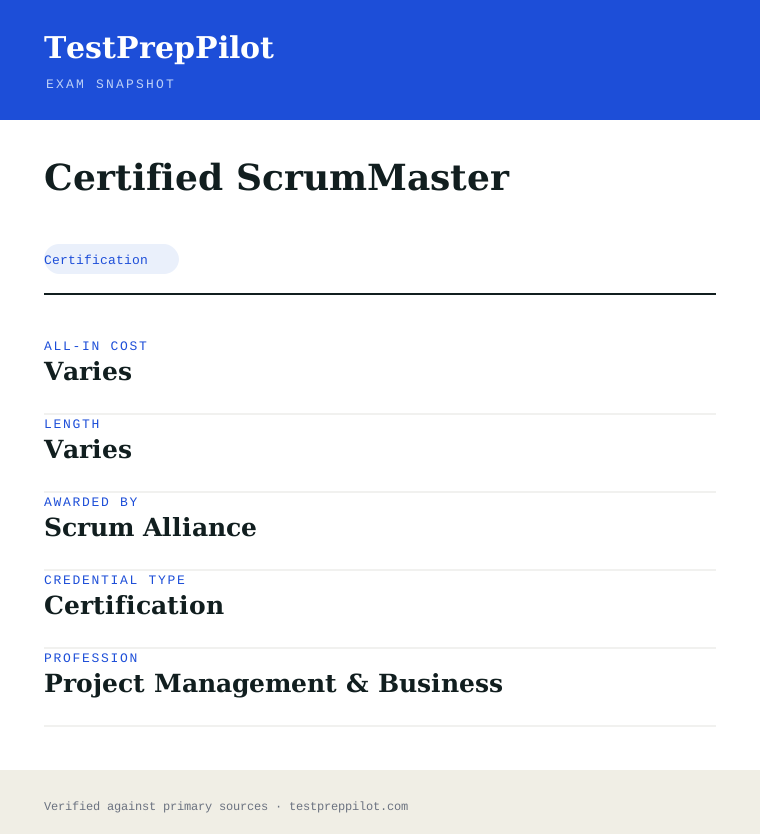
The short version
What is the Certified ScrumMaster and is it worth it?
Certified ScrumMaster is a professional credential administered by Scrum Alliance. It validates job-ready knowledge and skills in the Project & Business field and is used for career entry, advancement, or compliance.
- Recognized credential from Scrum Alliance
- Demonstrates verified competence in Project & Business
- Supports career advancement and may satisfy licensing or employer requirements
What is it?
What exactly is the Certified ScrumMaster?
Certified ScrumMaster — Project & Business credential from Scrum Alliance
Widely held entry Scrum credential requiring an accredited two-day course followed by an online knowledge test. Offered by Scrum Alliance, it is designed for candidates who need to demonstrate verified competence in the Project & Business field. The credential is commonly used for career entry, advancement, regulatory compliance, or employer requirements. Candidates should review the official handbook for eligibility, exam format, and scoring before registering.
The path in brief
- Confirm you meet any eligibility or prerequisites
- Review the official handbook and study materials
- Register and pay through the awarding body or authorized provider
- Schedule and take the exam (test center or online proctoring)
- Receive your score and, if passed, your credential
Before you book
Who is eligible to sit the Certified ScrumMaster?
Eligibility varies; many credentials are open to all, while others require coursework, work experience, or sponsorship.
Who it is for: Professionals and candidates seeking to validate Project & Business competence.
The test itself
What is the format of the Certified ScrumMaster?
The Certified ScrumMaster is administered by Scrum Alliance and runs 60 minutes and contains 50 (all scored) questions.
| Administered by | Scrum Alliance |
|---|---|
| Questions | 50 (all scored) |
| Time limit | 60 minutes |
| Pass mark | Passing score set by the awarding body; see the official score report |
| Exam fee | Included with the CSM course ($250-$2,495 depending on provider) |
| Format | Proctored, computer-based (test center or online remote proctoring) |
Content outline
What topics are on the Certified ScrumMaster?
The Certified ScrumMaster covers 4 content domains.
Weightings come from the official exam outline. Study time is best allocated in roughly these proportions rather than evenly across domains.
- Methodology & frameworks
Topic area tested on the exam; see the official blueprint for the detailed breakdown.
- Planning & execution
Topic area tested on the exam; see the official blueprint for the detailed breakdown.
- Stakeholders & communication
Topic area tested on the exam; see the official blueprint for the detailed breakdown.
- Value & governance
Topic area tested on the exam; see the official blueprint for the detailed breakdown.
The path
How do you register for the Certified ScrumMaster?
- 1
Visit the awarding body’s official website and create an account
- 2
Select the credential and review its specific requirements
- 3
Complete any required eligibility (education, experience, or training)
- 4
Pay the registration fee
- 5
Schedule the exam at a test center or online
- 6
Take the exam and receive your results
The fine print
What are the retake and renewal rules for the Certified ScrumMaster?
- Proctoring & delivery
- Proctored, computer-based delivery (test center or remote online proctoring), varying by exam.
- Retake policy
- Varies by credential — most bodies permit retakes after a waiting period and full or partial fee.
- Score reporting
- Scores are reported per the body’s timeline, typically electronically after the exam.
- Recertification
- Varies; many credentials require renewal every 2–3 years via continuing education or a recertification exam.
What it pays
How much does this credential pay?
$100,750 median for project management specialists (BLS, May 2024)
There is no Bureau of Labor Statistics occupation called "ScrumMaster", and any salary page that quotes one is quoting a job-board aggregate rather than government data. The closest official fit is Project Management Specialists (SOC 13-1082), and we have chosen it deliberately because the CSM is an entry-level Agile role credential, not a senior management certificate. A Certified ScrumMaster typically works embedded in a delivery team facilitating the Scrum framework, removing impediments and coaching the product owner and developers — the day-to-day duties land squarely inside the project-management-specialist occupation, even though the title on the business card says otherwise. That occupation had a May 2024 median wage of $100,750, with the lowest 10 percent earning under $59,830 and the highest 10 percent earning more than $165,790. The spread matters here because the CSM sits at the lower edge of it early in a career and climbs as the holder pairs it with delivery experience and subsequent credentials such as the Advanced CSM or the Product Owner tracks. BLS projects 6 percent employment growth for project management specialists from 2024 to 2034, about as fast as the average for all occupations, with roughly 78,200 openings a year arising from both growth and replacement. The single most important caveat for a CSM candidate is that the certificate does not in itself create a job title in the labour market; employers list "Scrum Master" as a role and treat the CSM as evidence the candidate understands the framework the team runs. The wage figure above therefore measures the whole project-management-specialist occupation, not CSM holders narrowly, and should be read that way rather than as a CSM premium.
| Measure | Figure | Source / note |
|---|---|---|
| Median annual wage, project management specialists | $100,750 | BLS Occupational Outlook Handbook, May 2024 |
| Lowest 10 percent | less than $59,830 | BLS OOH Pay tab, May 2024 |
| Highest 10 percent | more than $165,790 | BLS OOH Pay tab, May 2024 |
| Employment, 2024 | 1,046,300 jobs | BLS OOH Quick Facts, 2024 |
| Projected annual openings | ~78,200 per year | BLS OOH Job Outlook, 2024-34 |
Job growth.6% projected change 2024-34 (about as fast as average), with ~78,200 openings a year from growth and replacement; the CSM is an entry Agile credential rather than a guarantee of the higher deciles
Source: BLS Occupational Outlook Handbook — Project Management Specialists
Your odds
What are the pass rates?
Scrum Alliance does not publish a pass rate — but the bar is 74% (37 of 50 questions)
Scrum Alliance does not publish a pass-rate statistic for the CSM assessment, and because the assessment is gated behind a mandatory two-day approved course, the population that sits it is already filtered: nobody reaches the exam without first completing a Scrum Alliance-licensed Certified Scrum Trainer (CST) course. That makes a public pass rate of limited meaning even if it were published, and it is the reason you should ignore any "CSM pass rate" figure quoted on a blog. What is published and verifiable is the scoring rule. The CSM exam is 50 multiple-choice questions in 60 minutes, and you must answer at least 37 of 50 correctly, which is a 74 percent threshold. The assessment is open-book and taken online, unproctored, through your Scrum Alliance account after the course — so the difficulty is not the recall under invigilation but the precision of the Scrum Guide definitions, and the most common failure mode is reading more into a question than the text supports. You are allowed two attempts within a 90-day window at no extra charge, and only after those two free attempts does each further attempt cost $25. That generous retake structure is itself a reason not to cram: the first attempt is effectively a free diagnostic. The course fee, not the exam, is the real cost barrier — approved CSM courses range from roughly $250 to $2,495 depending on the trainer, format and employer subsidy, and that fee includes the exam eligibility. We have left the pass-rate table empty deliberately, because no authoritative figure exists, and any number you see circulating is an estimate at best.
Read this before quoting the number.No pass rate is published by Scrum Alliance. What is published and verifiable is the 50-question / 60-minute format and the 74% (37/50) passing threshold, plus the two-free-attempts-then-$25 retake rule. We have not invented a pass-rate figure.
Source: Scrum Alliance — Certified ScrumMaster certification
Your schedule
How long should I study for it?
16 hours of mandatory course + ~20-30 hours of reading and exam prep of focused study
The CSM has a structural quirk that reshapes any study plan: you cannot sit the exam at all without first completing a two-day (16-hour) in-person or live-online course led by a Certified Scrum Trainer. There is no self-study path to eligibility. That means the plan below is really about what to do before, during and immediately after the course — the course itself is the core of your preparation, and the exam is the capstone. Most candidates should treat the mandatory course as the single biggest block of study time and the two weeks after it as the window to pass while the material is fresh, because you get two free attempts only within 90 days of course completion. The current Scrum framework is the basis of the exam, and the assessment draws directly on the official Scrum Guide, so the most efficient plan is to read the Scrum Guide end to end before the course, absorb the trainer’s worked examples and Q&A during the two days, then sit the first attempt within a week of finishing. The exam is open-book, so the goal is not to memorise every sentence but to know where each concept lives in the framework and to be fluent in the defined accountabilities, events and artefacts. Six weeks at a light pace is more than enough if the course is attended; someone trying to prepare without the course cannot, and should not, attempt the exam. The plan below assumes you have booked the course and treats it as Weeks 1-2.
- Before the course8-10 hrs
Read the Scrum Guide and learn the vocabulary
- Read the current Scrum Guide in full, twice, and note the exact definitions of the three accountabilities (Product Owner, Scrum Master, Developers)
- Memorise the purpose, timebox and attendees of the five events: Sprint, Sprint Planning, Daily Scrum, Sprint Review, Sprint Retrospective
- Be able to list the three artefacts (Product Backlog, Sprint Backlog, Increment) and their associated commitments
- Skim the Scrum Alliance CSM learning objectives so you know what the assessment covers
- Weeks 1-216 hrs (fixed)
The mandatory 16-hour CST course
- Attend the two-day course (in person or live online) and ask questions about anything the Guide states ambiguously
- Take the trainer’s worked scenarios seriously — they mirror the judgement calls the exam tests
- Note the exact wording Scrum Alliance uses for each term, because the assessment rewards the official phrasing
- Confirm your exam eligibility is activated in your Scrum Alliance account before leaving the course
- Week 34-6 hrs
First exam attempt (free)
- Sit the 50-question / 60-minute open-book assessment online within days of the course while recall is highest
- Have the Scrum Guide open in a second window — the open-book format rewards fast lookup, not rote memory
- Read each question for what the Guide actually says, not what "agile in general" suggests
- If you fall short of 37/50, note the areas you missed — you have one more free attempt within 90 days
- Weeks 4-6 (if needed)4-8 hrs
Second attempt and gap closing
- Re-read the specific Scrum Guide sections tied to your missed questions
- Drill the definitions of events, artefacts and accountabilities until they are instant
- Sit the second free attempt well before the 90-day window closes
- Only after both free attempts are used does a further attempt cost $25 — avoid reaching that point
Adjusting the pace
Experienced agile team member.Three to four weeks total. You already live the framework; read the Scrum Guide once, attend the course, and pass on the first free attempt. Spend the saved time on exact wording rather than concepts.
New to Scrum entirely.Six weeks. Add a week before the course purely on vocabulary and the five events, because the course moves fast and assumes you have seen the terms. The exam is open-book, so concept fluency matters more than memorisation.
PMP or PRINCE2 background switching to agile.Four weeks, but watch the trap: predictive frameworks teach a different vocabulary and the exam punishes "waterfall-flavoured" answers. Re-learn the terms as Scrum defines them, not as your prior method approximates them.
How to study
How do I prepare most effectively?
The CSM is unusual among the exams on this site because the examination is open-book and gated behind a mandatory course, so preparation strategy is less about cramming facts and more about knowing the framework well enough to answer precisely under a 60-minute clock. The single most useful habit is reading the Scrum Guide as a contract: the exam rewards the exact official wording, and the distractors are usually plausible agile-sounding statements that contradict the Guide on a detail. Candidates with unrelated prior experience are the most at risk, because they answer from habit rather than from the text.
Read the Scrum Guide as the only source of truth
The assessment is built from the official Scrum Guide, and the open-book format exists precisely so you can look up the exact definition rather than guess. Read it end to end, then read it again, and internalise the precise phrasing of the three accountabilities, the five events and the three artefacts with their commitments. When two answers both sound agile, the one that matches the Guide’s wording is the correct one.
Attend the course as your core study, not a formality
You cannot sit the exam without the 16-hour CST course, so treat it as the centrepiece of preparation rather than a checkbox. The trainer’s worked examples and Q&A mirror the judgement calls the assessment makes, and the questions you ask there are the ones you will face later. Arrive having already read the Guide so you can go deep rather than catching up.
Sit the first attempt immediately after the course
You get two free attempts only within 90 days of course completion. The material is freshest in the first week, and the open-book format means you lose little by going early — the first attempt is effectively a free diagnostic that tells you exactly which Guide sections to revisit. Do not wait months and let the detail fade.
Use the open-book format as a lookup exercise
Because the assessment is unproctored and open-book, have the Scrum Guide open beside you and practise fast lookup during prep. The clock is the real constraint — 50 questions in 60 minutes is 72 seconds each — so the skill to build is finding the exact clause quickly, not reciting it. Timed open-book practice with the Guide on screen is the closest rehearsal to the real thing.
Beware the "agile general knowledge" trap
Many candidates have picked up a loose version of Scrum from past teams that quietly deviates from the framework — skipping retrospectives, merging product owner and scrum master, lengthening sprints. The exam tests the canonical framework, not your team’s variation. When an answer feels right from experience but contradicts the Guide, the Guide wins. Reset to the text.
Learn the commitments, not just the artefacts
The three artefacts each have a commitment — the Product Goal, the Sprint Goal and the Definition of Done. Questions routinely ask which commitment belongs to which artefact, and this triad is an easy, cheap source of marks that rote learners drop. Pair each artefact with its commitment and its purpose in one sentence and you cover a recurring question pattern.
What to buy
Which study resources are worth paying for?
The buying decision for the CSM is fundamentally different from a self-study certification: the course is mandatory and it is what you pay for, while the exam itself is included and the retakes are free within the window. So the resource table is dominated by the choice of course provider, not by books or question banks. Course prices vary enormously — from budget online cohorts around $250 to premium in-person bootcamps near $2,495 — and the exam eligibility, not the-branded workbook, is what you are buying. The Scrum Guide is free and is the only document the exam tests, so no paid study material is strictly required.
| Resource | Price | Format | Best for |
|---|---|---|---|
| Approved 16-hour CST course (mandatory) | ~$250 to $2,495 depending on trainer and format | In person or live online, two days | Everyone — it is the only path to exam eligibility |
| The Scrum Guide (official) | Free | PDF / web | The sole source document the exam is built from |
| Scrum Alliance CSM learning objectives | Free | Web | Checking what the assessment covers before you sit it |
| Open-book timed practice with the Guide | Free | Self-run, 60-minute timer | Building fast-lookup speed under the clock |
| Third-party CSM practice-question banks | ~$20-60 | Web / app | Supplementary drill only — verify every answer against the Guide |
| Recommended reading such as "Scrum: The Art of Doing Twice the Work in Half the Time" | ~$15-20 | Book / audiobook | Context and motivation, never exam-source material |
Course prices checked 2026-08 in USD before tax and vary widely by trainer, city and employer subsidy; the exam and two attempts within 90 days are included in course eligibility. Scrum Alliance does not license a single official paid textbook for the CSM. We do not rank by commission.
Avoid these
What mistakes do candidates most often make?
Most CSM failures are not knowledge failures — they are process and framing failures. Candidates either sit the exam too late and let the detail fade, answer from a corrupted mental model of Scrum picked up on a past team, or over-invest in paid materials the exam never draws from. A handful of mistakes account for the large majority of first-attempt shortfalls, and all of them are avoidable.
✕Sitting the exam long after the course, once the detail has faded
✓Your two free attempts are valid only within 90 days of course completion, and recall is by far best in the first week. Book the first attempt for within days of finishing the course. The open-book format means going early costs you almost nothing and lets a shortfall become a free diagnostic rather than a paid retry at $25.
✕Answering from a past team’s "Scrum" that deviates from the Guide
✓Many teams run a quietly modified Scrum — no retros, combined PO/SM, variable sprint length. The exam tests the canonical framework. When your experience and the Scrum Guide disagree, the Guide is correct. Re-learn the terms as defined, especially the separation of the three accountabilities.
✕Over-buying study material the exam never uses
✓The assessment is built solely from the free Scrum Guide plus the course. Paid practice banks and books are supplementary at best and sometimes contradictory. Spend the budget on a good course (mandatory anyway) and the time on the Guide, not on a shelf of agile literature the exam will not cite.
✕Memorising artefacts without their commitments
✓Each artefact carries a commitment — Product Goal, Sprint Goal, Definition of Done. Questions asking which commitment belongs to which artefact are common and cheap, and rote learners who know only the artefact names drop them. Pair each artefact with its commitment and purpose in a single sentence.
✕Reading more into a question than the Guide supports
✓The distractors are usually agile-plausible but Guide-contradicting. Under the 72-seconds-per-question clock, candidates who overthink and import general agile wisdom pick the attractive wrong answer. Read for what the framework actually states, use the open-book Guide to confirm, and resist adding nuance the text does not contain.
✕Forgetting the renewal obligation
✓The CSM is valid for two years and renewed by earning 20 Scrum Education Units (SEUs) and paying a $100 renewal fee. Candidates often treat it as permanent. Diary the expiry on the day you certify and bank SEUs from real agile work rather than scrambling at the end of year two.
What you'll face
What question types will I see?
The CSM assessment is 50 multiple-choice questions in 60 minutes, taken online and unproctored, and it is open-book — you may refer to the Scrum Guide during the test. The passing threshold is 37 of 50 correct, a 74 percent bar. Because the exam is gated behind a mandatory 16-hour CST course and is open-book, the question set is not a recall test; it is a precision test of whether you can apply the framework’s exact definitions under time pressure. Questions are single-answer multiple choice drawn from the Scrum Guide and the CSM learning objectives, covering the accountabilities, the five events, the three artefacts and their commitments, and the empirical pillars and values. There are no performance-based or simulation items as you would find on a technical exam; the challenge is purely the speed and accuracy of mapping a scenario to the canonical answer. The open-book nature means the clock, not memory, is the constraint — 72 seconds per question — so the skill to build is fast, accurate lookup and the discipline to accept the Guide’s wording over your intuition. You receive your result immediately on submission, and within the 90-day eligibility window you may retake at no charge twice before the $25-per-attempt fee applies.
Each item presents a Scrum scenario or definition question with one correct answer drawn from the Scrum Guide. Distractors are typically agile-plausible but framework-contradicting statements.
Asks for the exact purpose, timebox or attendees of an event, or the commitment attached to an artefact. Reward precise Guide wording over general agile knowledge.
A described team situation asking what the Scrum Master, Product Owner or Developers should do. Correct answers follow the framework even when a "real team" might do otherwise.
Try these
Q1Which statement about the Sprint Retrospective is correct according to the Scrum Guide?
Answer:B
The Sprint Retrospective is the last event of the Sprint, where the Scrum Team inspects how the last Sprint went and plans ways to increase quality and effectiveness. A is wrong because the Scrum Master facilitates it, and it inspects the team’s process rather than the product. C is wrong on both timebox (it is three hours for a one-month Sprint, not two) and facilitator (it is the Scrum Team, with the Scrum Master serving, not stakeholders). D is wrong because no Scrum event is optional; the retrospective is mandatory regardless of team performance.
Q2Who is accountable for maximizing the value of the product resulting from the work of the Scrum Team?
Answer:C
The Scrum Guide assigns the single accountability for maximizing the value of the product to the Product Owner. A is incorrect because Developers are accountable for creating a usable Increment each Sprint. B is incorrect because the Scrum Master is accountable for the effectiveness of the Scrum Team and for proper Scrum practice, not product value. D contradicts the framework, which deliberately places this accountability with one person rather than diffusing it.
Q3What is the commitment associated with the Product Backlog?
Answer:C
Each artefact has a commitment that helps it deliver value and provides focus. The Product Backlog’s commitment is the Product Goal, the long-term objective the Scrum Team is working toward. A is the commitment of the Increment, B is the commitment of the Sprint Backlog, and D is not a Scrum Guide commitment at all — a common distractor drawn from older or non-Scrum vocabulary.
Samples are editor-written illustrations of the published CSM learning objectives and Scrum Guide, not live exam items.
The big day
What should I expect on exam day?
The CSM exam is taken online, unproctored and open-book, through your Scrum Alliance account, after you have completed the mandatory 16-hour CST course. There is no test centre, no proctor and no ID-check ritual of the kind a Pearson VUE technical exam imposes — you simply log in within your 90-day eligibility window and start the 60-minute, 50-question assessment with the Scrum Guide open beside you. The practical risks on the day are therefore not about logistics but about pacing and discipline: with 72 seconds per question and an open book, the temptation is to look up everything, which bleeds the clock. Prepare a tabbed, bookmarked Scrum Guide so the common definitions are one click away. You receive your pass or fail immediately on submission, and a scaled sense of performance, and you may retake free of charge twice within the window before the $25 fee applies. The real exam-day-adjacent task is renewal discipline two years out: the CSM lapses after 24 months unless you log 20 SEUs and pay $100, and that is the obligation candidates most often forget.
Bring
- A device with a stable internet connection and a browser you can keep open alongside the assessment
- The Scrum Guide open in a second tab or window — the exam is open-book and this is permitted
- Your Scrum Alliance login, confirming your exam eligibility is active within the 90-day window
- A quiet 60-minute block with no interruptions, since the clock runs continuously once started
Leave at home
- Do not rely on unverified third-party "exam dumps" — they contradict the Guide and are the wrong source
- Do not open forums or generative AI during the assessment if that would violate the honour terms of your attempt
- Do not start without having read the Guide; the open-book format rewards preparation, not improvisation
- Do not wait until day 89 of eligibility — a technical hiccup then leaves no room for a free retake
How the day runs
Rules in the room
- The assessment is online, unproctored and open-book; you may consult the Scrum Guide during the test.
- 50 multiple-choice questions in 60 minutes; pass at 37 correct (74%).
- Two free attempts are allowed within 90 days of course completion; each further attempt costs $25.
- The exam is available only after completing a Scrum Alliance-approved 16-hour CST course.
- The result is shown immediately on submission.
- The CSM is valid for two years and renewed with 20 SEUs and a $100 fee.
Afterwards.Your pass or fail appears on screen the moment you submit, and if you pass your Certified ScrumMaster credential is recorded in your Scrum Alliance account, from which you can download the certificate and claim the digital badge. The certification is valid for two years. Treat the result, pass or fail, as information: on a pass, diary the renewal date immediately and start collecting Scrum Education Units from real agile work so the 20-SEU, $100 renewal at month 24 is painless; on a fail, use the second free attempt within the 90-day window rather than paying $25, revisit the specific Scrum Guide sections your misses exposed, and remember the open-book format means a retake is as much about lookup speed as about knowledge. The CSM is an entry credential, not a terminal one — most holders move on to the Advanced CSM, the Certified Scrum Professional or a Product Owner track, and the renewal cycle is a useful prompt to plan that next step rather than let the certificate lapse.
Reference
What are the key facts about the Certified ScrumMaster?
Certified ScrumMaster is a certification credential; awarded by Scrum Alliance; the exam fee is Included with the CSM course ($250-$2,495 depending on provider); typical preparation is Varies.
| Credential | Certified ScrumMaster |
|---|---|
| Abbreviation | CSM |
| Type | Certification |
| Profession | Project Management & Business |
| Specialty | Agile & Product |
| Awarded by | Scrum Alliance |
| Difficulty | Mixed |
| Typical prep time | Varies |
| All-in cost | Varies |
| Credential | Certified ScrumMaster |
| Awarding body | Scrum Alliance |
| Exam format | Proctored, computer-based |
| Validity | 2 years — renew with 20 Scrum Education Units (SEUs) and a $100 renewal fee. |
| Languages | Varies — see awarding body |
| Scope | National / Multi-state |
Real questions
Frequently asked questions about the Certified ScrumMaster
How do I register for the Certified ScrumMaster exam?
Register through Scrum Alliance's official portal or an authorized test provider (e.g., Pearson VUE or Prometric where applicable). Create an account, select the exam, pay the fee, and schedule a date.
How much does the exam cost?
Fees vary by location and currency. Confirm the current fee on the official registration page before scheduling.
How long is the credential valid, and how do I renew?
CSM certification is valid for 2 years and is renewed by earning 20 Scrum Education Units (SEUs) and paying the $100 renewal fee through Scrum Alliance; there is no recertification exam.
What if I do not pass?
Most bodies allow retakes after a waiting period and payment of the full or partial fee. Check Scrum Alliance's retake policy before rescheduling.
How do I register for a Scrum Alliance credential?
Register through the official website, select your exam, pay the fee, and schedule a date.
How do I renew a credential?
Renewal policies vary by credential; check the specific program page for requirements and cycles.
In short
Is the Certified ScrumMaster worth it?
- Certified ScrumMaster is awarded by Scrum Alliance.
- Validates job-ready competence in Project & Business.
- Registration is through the awarding body or an authorized test provider.
- Renewal and retake policies vary — confirm before scheduling.
Trust
Where does this information come from?
Everything above is taken from the awarding body's own published material. Fees, question counts and domain weights are revised regularly — check the official page before you pay.
Research confidence: low · Last reviewed 2026-08