Project Management & Business • Certification
ASQ Certified Six Sigma Green Belt
ASQ Certified Six Sigma Green Belt — Project & Business credential from American Society for Quality
Researched and maintained by TestPrepPilot Editorial BoardQuality, lean & six-sigma certifications desk · Figures last verified August 2026
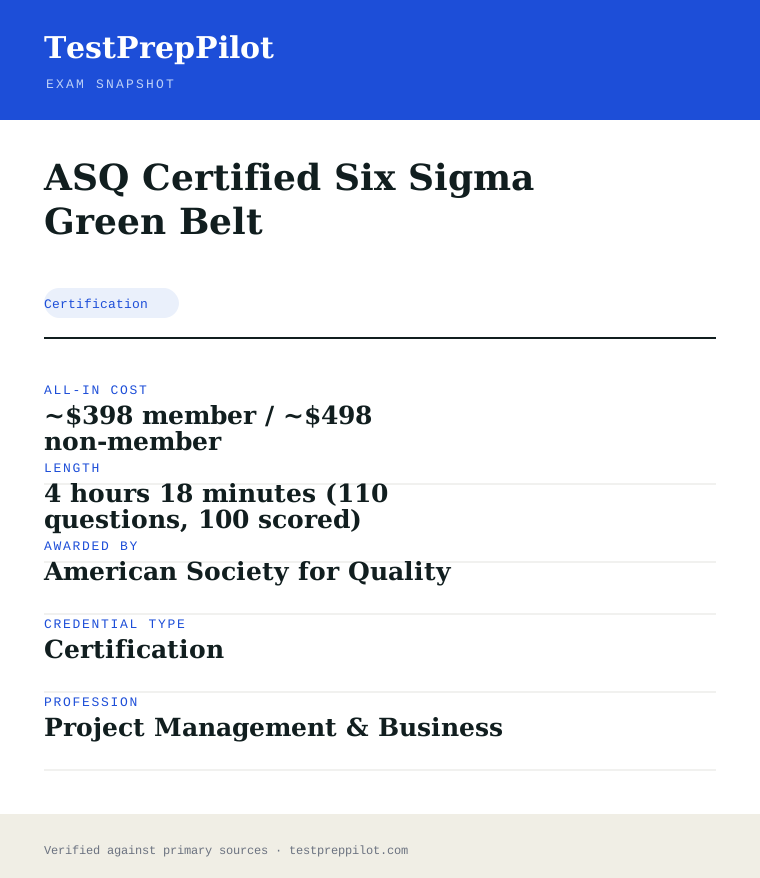
The short version
What is the ASQ Certified Six Sigma Green Belt and is it worth it?
ASQ Certified Six Sigma Green Belt is a professional credential administered by American Society for Quality. It validates job-ready knowledge and skills in the Project & Business field and is used for career entry, advancement, or compliance.
- Recognized credential from American Society for Quality
- Demonstrates verified competence in Project & Business
- Supports career advancement and may satisfy licensing or employer requirements
What is it?
What exactly is the ASQ Certified Six Sigma Green Belt?
ASQ Certified Six Sigma Green Belt — Project & Business credential from American Society for Quality
Examination covering DMAIC, process capability, control charts and basic statistics for improvement project team members. Offered by American Society for Quality, it is designed for candidates who need to demonstrate verified competence in the Project & Business field. The credential is commonly used for career entry, advancement, regulatory compliance, or employer requirements. Candidates should review the official handbook for eligibility, exam format, and scoring before registering.
The path in brief
- Confirm you meet any eligibility or prerequisites
- Review the official handbook and study materials
- Register and pay through the awarding body or authorized provider
- Schedule and take the exam (test center or online proctoring)
- Receive your score and, if passed, your credential
Before you book
Who is eligible to sit the ASQ Certified Six Sigma Green Belt?
Eligibility varies; many credentials are open to all, while others require coursework, work experience, or sponsorship.
Who it is for: Professionals and candidates seeking to validate Project & Business competence.
The test itself
What is the format of the ASQ Certified Six Sigma Green Belt?
The ASQ Certified Six Sigma Green Belt is administered by American Society for Quality and runs 4 hours 18 minutes and contains 100 scored + 10 unscored pretest items (110 total) questions.
| Administered by | American Society for Quality |
|---|---|
| Questions | 100 scored + 10 unscored pretest items (110 total) |
| Time limit | 4 hours 18 minutes |
| Pass mark | Passing score set by the awarding body; see the official score report |
| Exam fee | ~$400 member / ~$500 non-member (check current pricing) |
| Format | Proctored, computer-based (test center or online remote proctoring) |
Content outline
What topics are on the ASQ Certified Six Sigma Green Belt?
The ASQ Certified Six Sigma Green Belt covers 4 content domains.
Weightings come from the official exam outline. Study time is best allocated in roughly these proportions rather than evenly across domains.
- Methodology & frameworks
Topic area tested on the exam; see the official blueprint for the detailed breakdown.
- Planning & execution
Topic area tested on the exam; see the official blueprint for the detailed breakdown.
- Stakeholders & communication
Topic area tested on the exam; see the official blueprint for the detailed breakdown.
- Value & governance
Topic area tested on the exam; see the official blueprint for the detailed breakdown.
Study materials
Which study guide should you use for the ASQ Certified Six Sigma Green Belt?
Start with the exam sponsor's official content outline. If you also want one structured resource to work through, these are the Mometrix titles that match this exam.

Affiliate links We may earn a commission if you buy through these links, at no extra cost to you. Mometrix has no say in what our exam guides cover. How we make money.
The path
How do you register for the ASQ Certified Six Sigma Green Belt?
- 1
Visit the awarding body’s official website and create an account
- 2
Select the credential and review its specific requirements
- 3
Complete any required eligibility (education, experience, or training)
- 4
Pay the registration fee
- 5
Schedule the exam at a test center or online
- 6
Take the exam and receive your results
The fine print
What are the retake and renewal rules for the ASQ Certified Six Sigma Green Belt?
- Proctoring & delivery
- Proctored, computer-based delivery (test center or remote online proctoring), varying by exam.
- Retake policy
- Varies by credential — most bodies permit retakes after a waiting period and full or partial fee.
- Score reporting
- Scores are reported per the body’s timeline, typically electronically after the exam.
- Recertification
- Varies; many credentials require renewal every 2–3 years via continuing education or a recertification exam.
What it pays
How much does this credential pay?
$101,140 median for industrial engineers (BLS, May 2024)
There is no Bureau of Labor Statistics occupation called "Six Sigma Green Belt" — the ASQ CSSGB credential certifies Six Sigma methodology competency at the team-member and project-support level, and the wage question belongs to the role you perform with it. The closest official BLS occupation is Industrial Engineers, SOC 17-2112, which had a May 2024 median wage of $101,140, with the lowest 10 percent under $65,720 and the highest 10 percent above $139,800. The fit must be read with an honest caveat: green belts are typically process engineers, quality technicians and improvement-team members who work inside or alongside the industrial-engineering occupation, so the realistic benchmark for a green-belt holder sits at or below the median, climbing with the black-belt credential and project-leadership experience. BLS counted 315,900 industrial engineer jobs in 2024 and projects 6 percent growth from 2024 to 2034, with about 20,000 openings a year. The limitation to state plainly: the BLS median covers the whole occupation at all levels, credentialed or not, and the green-belt credential's value is as a methodology signal — it certifies that you can support improvement projects with the DMAIC toolkit. Read the number as the market for the occupation the credential connects to.
| Measure | Figure | Source / note |
|---|---|---|
| Median annual wage, industrial engineers | $101,140 | BLS OOH, SOC 17-2112, May 2024 |
| Lowest 10 percent | Under $65,720 | BLS OOH, SOC 17-2112, May 2024 |
| Highest 10 percent | Above $139,800 | BLS OOH, SOC 17-2112, May 2024 |
| Projected openings per year | ~20,000 | BLS OOH, SOC 17-2112, 2024-2034 |
Job growth.BLS projects 6 percent growth for industrial engineers from 2024 to 2034, about 20,000 openings per year.
Source: BLS Occupational Outlook Handbook - Industrial Engineers
Your odds
What are the pass rates?
ASQ publishes the format — 110 questions (100 scored) in 4 hours 18 minutes, passing 550/750 — and no cohort pass rate
ASQ does not publish cohort pass rates for the CSSGB exam, and third-party estimates are not official data, so we do not treat them as authoritative. What ASQ does publish is the format and the passing standard: the CSSGB computer-based exam has 110 multiple-choice questions — 100 scored and 10 unscored pretest questions — with 4 hours 18 minutes of exam time, and a passing score of 550 on the 300-750 scale. The exam is open book: candidates may bring bound reference materials. The exam content follows the published Body of Knowledge (BoK): Six Sigma and the organization; the DMAIC methodology — Define, Measure, Analyze, Improve and Control — with green-belt-level statistics including probability, hypothesis testing and regression; and lean concepts. The absence of a published pass rate is not an absence of standards: the 550 line is a meaningful bar, and the open-book format means the exam tests application and retrieval, not memorisation. The practical reading: prepare with the BoK as the scope map, drill the quantitative material at the green-belt depth — which is real but less demanding than the black-belt level — and build a tabbed reference binder for the open-book exam.
Read this before quoting the number.ASQ publishes the format, passing score and open-book policy but no cohort pass rate; any percentage circulating online is a third-party estimate.
Source: ASQ - Certified Six Sigma Green Belt (CSSGB) program
Your schedule
How long should I study for it?
80-140 hours over 8-12 weeks of focused study
The CSSGB exam is a 110-question (100 scored), 4-hour-18-minute open-book exam with a 550/750 passing score, and its curriculum is the published Body of Knowledge: Six Sigma and the organization; the DMAIC methodology across Define, Measure, Analyze, Improve and Control; green-belt-level statistics; and lean concepts. A defensible plan runs 80 to 140 hours over 8 to 12 weeks. Weeks 1-2: Six Sigma fundamentals and the Define phase — project selection, charters, process mapping and voice of the customer. Weeks 3-5: Measure and Analyze — statistics at the green-belt depth, including probability, hypothesis testing and regression, with measurement systems analysis. Weeks 6-7: Improve and Control — design of experiments basics, lean tools and control plans. Weeks 8-10: question-bank drilling and building the open-book binder. Weeks 11-12: two full timed practice exams at the real format. The plan is balanced between methodology and statistics; the green-belt exam tests real statistical application but at a lower depth than the black-belt, so candidates with a basic statistics background can move efficiently through the quantitative phases.
- Weeks 1-225
Fundamentals and Define
- Six Sigma and the organization
- Project selection, charters and process mapping
- Voice of the customer and CTQs
- Weeks 3-540
Measure and Analyze
- Probability and statistics fundamentals
- Hypothesis testing and regression
- Measurement systems analysis
- Weeks 6-730
Improve and Control
- Design of experiments basics
- Lean tools and process flow
- Control plans and SPC
- Weeks 8-1030
Drill and binder
- Question-bank drilling in volume
- Build the open-book reference binder
- Methodology review
- Weeks 11-1220
Timed simulations
- Two full timed practice exams
- Review every miss against the BoK
- Final statistics pass
Adjusting the pace
Quality professional.Compress the fundamentals; spend the extra time on statistics and simulations.
Management background, new to statistics.Add 2-3 weeks of statistics basics before the BoK phases.
How to study
How do I prepare most effectively?
The CSSGB exam is open book, so the dominant strategy is building a tabbed reference binder and practising retrieval: organise the ASQ references and your notes by BoK section, and practise applying the formulas quickly, because the exam rewards application under time pressure rather than memorisation. Second, balance the study between the DMAIC methodology and the statistics: the exam tests both the tool names and their application, so drill scenario items alongside the quantitative ones. Third, use the published BoK as the scope map and audit every study resource against it. Fourth, work practice questions in volume, including the calculation items, because the exam tests applied statistics. Finally, take at least two full timed practice exams at the real 4-hour-18-minute format; the stamina of a long exam is part of the test, and the open-book retrieval rhythm must be rehearsed. If you plan to continue to the CSSBB, the green-belt material is a direct foundation — study it for understanding rather than a checkbox.
Build and tab a reference binder
Open-book retrieval must be practised; tab by BoK section.
Balance methodology and statistics
The exam tests tool names and their application in scenarios.
Audit against the BoK
The published Body of Knowledge is the authoritative scope.
Drill calculations
Applied statistics is a real share of the exam.
Run two full simulations
4h18m of exam is a stamina and retrieval rhythm test.
What to buy
Which study resources are worth paying for?
CSSGB prep centres on the ASQ Body of Knowledge and the standard references. ASQ's official resources — the BoK (free), the CSSGB Study Guide and the Six Sigma Green Belt Handbook — are the core stack, with the handbook serving as the open-book reference. Prep courses from ASQ and third-party providers range from roughly $400 to $1,500. Question banks ($50-$150) provide practice volume. The exam fee is about $398 for ASQ members and $498 for non-members at the time of writing. A realistic total budget is $800 to $2,200 including the exam fee and materials. Prices below are list prices as of mid-2026 and change frequently; we rank nothing by commission.
| Resource | Price | Format | Best for |
|---|---|---|---|
| ASQ CSSGB Body of Knowledge | Free | Official PDF | The authoritative scope; read it first |
| Green Belt Handbook + Study Guide | $80-$180 each | Printed or digital | The core references for the open-book exam |
| Prep courses | $400-$1,500 | Live or self-paced | Structured walkthrough of the BoK |
| Question banks | $50-$150 | Online practice items | Scenario and quantitative drilling |
| CSSGB exam | ~$398 member / ~$498 non-member | Computer-based, open book | The certification itself |
List prices as of mid-2026, subject to change; ASQ fees vary by membership; no commission or affiliate ranking is implied.
Avoid these
What mistakes do candidates most often make?
The most common CSSGB mistake is under-preparing the statistics: candidates who focus on the DMAIC methodology vocabulary and skip the quantitative material meet the calculation items unprepared. The fix is balanced study with real statistics practice. The second mistake is treating the open-book policy as permission to skip retrieval practice — candidates who bring a binder they have never used waste exam time searching; build and drill the binder. Third, candidates study from courses instead of the BoK, losing the exact scope; audit everything against the BoK. Fourth, some candidates never run a full timed simulation and underestimate the stamina of 4 hours 18 minutes. Finally, forgetting the eligibility requirement is a quiet trap: the CSSGB requires documented experience or a qualifying education path per the program criteria, and certification cannot proceed without it — confirm eligibility before studying.
✕Under-preparing statistics
✓Drill the quantitative items; applied statistics is a real share.
✕Ignoring open-book retrieval practice
✓Build and drill the binder; searching wastes exam time.
✕Studying courses, not the BoK
✓Audit every resource against the published BoK.
✕Skipping timed simulations
✓Run two full 4h18m simulations; stamina is part of the test.
✕Forgetting the eligibility criteria
✓Confirm the experience or education requirement before studying.
What you'll face
What question types will I see?
The CSSGB exam is a 110-question (100 scored) multiple-choice exam in 4 hours 18 minutes, open book. The items span the BoK: Six Sigma fundamentals, the DMAIC methodology, green-belt statistics and lean concepts, with quantitative items requiring calculation and scenario items testing the correct tool or decision. Samples below are editor-written illustrations of the published BoK, not live exam items; they show the applied style of the real items.
DMAIC tools, outputs and decisions for described situations.
Statistics, hypothesis testing and regression at the green-belt depth.
Lean tools and Six Sigma project context.
Try these
Q1In DMAIC, which phase establishes the baseline performance of the process?
Answer:B
The Measure phase collects the data and establishes the baseline performance of the process. Define scopes the project, Improve implements solutions, and Control sustains them.
Q2A team wants to prioritise the most frequent causes of defects from a count of occurrences. The most appropriate tool is:
Answer:A
A Pareto chart ranks categories by frequency to prioritise the vital few causes — the standard prioritisation tool for defect counts. Control charts monitor variation, Pugh matrices select solutions, and FMEA analyses failure modes.
Q3A green belt tests whether two process groups have different average cycle times. The most appropriate statistical test is:
Answer:A
Comparing the means of two groups calls for a two-sample t-test. Control charts monitor stability, Pareto charts rank categories, and process maps document flow — none tests the group-mean difference.
Samples are editor-written illustrations of the published BoK, not live exam items.
The big day
What should I expect on exam day?
The CSSGB exam is a computer-based, open-book exam of 110 questions (100 scored) in 4 hours 18 minutes, delivered at Prometric centres or through remote proctoring. Bring the required identification and your approved bound reference materials; personal electronics go in the locker. Arrive early — late arrivals forfeit the appointment and fee. Organise your binder by BoK section and practise retrieval before the day. Pace at about 2.2 minutes per item, and budget extra time for the quantitative items. Your result is reported immediately for computer-based delivery, with the official score report following against the 550/750 passing line. If you fail, ASQ allows retakes at a reduced rate within two years. On a pass, the certification is valid for three years and renews through recertification units (RUs) or retesting per ASQ's policy. The afterwards matters: log your RUs as you earn them, because ASQ audits renewals, and consider the CSSBB as the next step.
Bring
- Required identification
- Approved bound reference materials organised by BoK section
- Exam confirmation
Leave at home
- Phone, smartwatch and all electronics
- Unbound notes — references must be securely bound
- Personal bags beyond what the centre allows
How the day runs
Rules in the room
- The exam is open book; references must be securely bound
- No personal electronics in the testing room
- 110 questions (100 scored) in 4 hours 18 minutes
Afterwards.On a pass, your CSSGB is valid for three years; earn recertification units (or retest) to renew. On a fail, retake at the reduced rate within two years after additional BoK study. Consider the CSSBB as the next step.
Reference
What are the key facts about the ASQ Certified Six Sigma Green Belt?
ASQ Certified Six Sigma Green Belt is a certification credential; awarded by American Society for Quality; the exam fee is ~$400 member / ~$500 non-member (check current pricing); typical preparation is 4 hours 18 minutes (110 questions, 100 scored); holders typically earn $60,000-$120,000.
| Credential | ASQ Certified Six Sigma Green Belt |
|---|---|
| Abbreviation | CSSGB |
| Type | Certification |
| Profession | Project Management & Business |
| Specialty | Quality, Lean & Six Sigma |
| Awarded by | American Society for Quality |
| Difficulty | Mixed |
| Typical prep time | 4 hours 18 minutes (110 questions, 100 scored) |
| All-in cost | ~$398 member / ~$498 non-member |
| Typical salary range | $60,000-$120,000 |
| Credential | ASQ Certified Six Sigma Green Belt |
| Awarding body | American Society for Quality |
| Exam format | Proctored, computer-based |
| Validity | 3 years — renew with recertification credits (RU) or by retaking the exam. |
| Languages | Varies — see awarding body |
| Scope | National / Multi-state |
Real questions
Frequently asked questions about the ASQ Certified Six Sigma Green Belt
How do I register for the ASQ Certified Six Sigma Green Belt exam?
Register through American Society for Quality's official portal or an authorized test provider (e.g., Pearson VUE or Prometric where applicable). Create an account, select the exam, pay the fee, and schedule a date.
How much does the exam cost?
Fees vary by location and currency. Confirm the current fee on the official registration page before scheduling.
How long is the credential valid, and how do I renew?
ASQ certifications including the CSSGB are renewed by earning recertification units (RUs) and paying the renewal fee on the ASQ recertification cycle (typically every 3 years), or by retaking the current exam.
What if I do not pass?
Most bodies allow retakes after a waiting period and payment of the full or partial fee. Check American Society for Quality's retake policy before rescheduling.
How do I register for a American Society for Quality credential?
Register through the official website, select your exam, pay the fee, and schedule a date.
How do I renew a credential?
Renewal policies vary by credential; check the specific program page for requirements and cycles.
In short
Is the ASQ Certified Six Sigma Green Belt worth it?
- ASQ Certified Six Sigma Green Belt is awarded by American Society for Quality.
- Validates job-ready competence in Project & Business.
- Registration is through the awarding body or an authorized test provider.
- Renewal and retake policies vary — confirm before scheduling.
Same awarding body
What other credentials does American Society for Quality award?
Trust
Where does this information come from?
Everything above is taken from the awarding body's own published material. Fees, question counts and domain weights are revised regularly — check the official page before you pay.
Research confidence: medium · Last reviewed 2026-08