Security & Investigation • License
Illinois Private Investigator License
Experience requirements, written examination and bonding rules for obtaining a private investigator licence in Illinois.
What is it?
What exactly is the Illinois Private Investigator License?
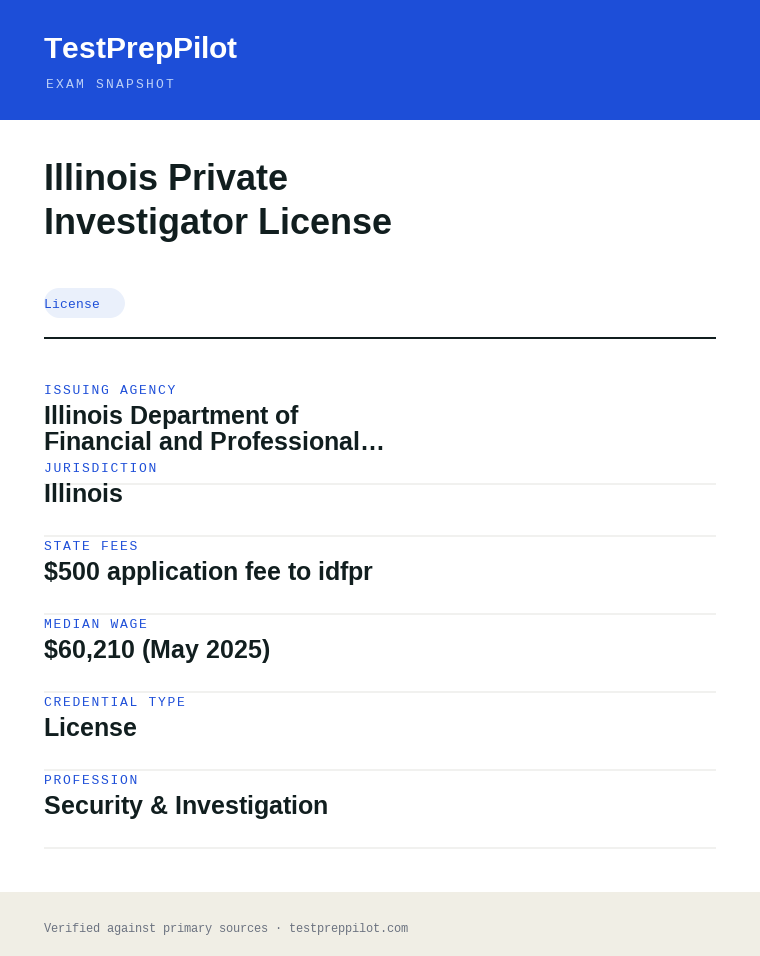
Illinois issues the Illinois Private Investigator License through the Illinois Department of Financial and Professional Regulation (IDFPR), Division of Professional Regulation - Private Detective. Minimum age: 21. Required training: None required. Application fee to IDFPR: $500. Background check: Paid to the fingerprint vendor; amounts set by ISP or the licensed fingerprint vendor agency. Renewal: Every 3 years; expiration falls on May 31.
How the private investigator license works across all 45 licensing states, and how to prepare for it: Private Investigator License requirements by state.
Can you apply?
What does Illinois require before you apply?
| Minimum age | 21 |
|---|---|
| Citizenship / status | Not required by statute |
| Education | No minimum; degree credit applies to experience |
| Experience | Three years of full-time investigative experience (1,500 or more hours annually) within the five years immediately preceding application, working for a licensed Illinois private detective agency, a licensed attorney, an in-house investigative unit of a corporation with 100 or more employees, the US armed forces, or a law enforcement agency (including a state's attorney or public defender office). A bachelor's degree in law enforcement or business credits 2 of the 3 years; an associate degree or qualifying military law enforcement training credits 1 year. |
| Required training | None required |
| Online training | Not applicable |
What the training covers: No coursework requirement; a baccalaureate degree in law enforcement or a related field or business counts for 2 of the 3 required experience years, and an associate degree counts for 1 year (225 ILCS 447/15-10(a)(6)).
Disqualifiers and other conditions: No felony conviction (or at least 10 years since full discharge from sentence), good moral character, no dishonorable discharge from the armed forces, and no alcohol or narcotic dependence (225 ILCS 447/15-10).
Source: Illinois training rules
The test itself
What does the IllinoisPrivate Investigator License exam look like?
Administered by Continental Testing Services (administers the IDFPR private detective exam). The exam fee is Set by the testing vendor and posted on the IDFPR exam schedule; the state application fee is separate.
| Part | Questions | Time | Pass mark |
|---|---|---|---|
| Illinois private detective examination | Not published | Not published | 70 (rule 1240.10(c)) |
| Exam vendor | Continental Testing Services (administers the IDFPR private detective exam) |
|---|---|
| Exam fee | Set by the testing vendor and posted on the IDFPR exam schedule; the state application fee is separate |
| Languages | English |
| Source | Official candidate material |
How it compares
Illinois vs. the other states
Renewal runs on a every 3 years; expiration falls on may 31 — a cycle shared by 3 of the 44 states researched. Neighboring states that also license the credential: Wisconsin ($127 exam) · Iowa · Missouri ($80 exam) · Kentucky ($156 exam) · Indiana.
Every dollar
What does the Illinoisprivate investigator license cost, itemised?
| Item | Fee | Source |
|---|---|---|
| Application fee to IDFPR | $500 (68 Ill. Adm. Code 1240.570) | Official source |
| Examination | Vendor fee set by Continental Testing Services and posted on the IDFPR exam schedule | Official source |
| Liability insurance | $1,000,000 general liability policy in the applicant's name (required before licensure) | Official source |
| Fingerprints | Live-scan vendor fee paid directly to the vendor | Official source |
The paperwork
How do you apply in Illinois?
Applications go through IDFPR CORE online system — processing takes Exam applications must be on file 60 days before the exam date.
- File the examination application with experience verification (VE-DET forms) and education documentation at least 60 days before the exam date; IDFPR confirms eligibility before admission.
- Complete Illinois live-scan fingerprints through ISP or a certified vendor within 60 days of applying.
- Sit for the Continental Testing Services exam; a passing score is 70 or above and remains valid for 3 years.
- After passing, submit the licensure application with proof of $1,000,000 general liability insurance, fingerprint verification, and the $500 fee through CORE.
- Renew every three years; licenses expire May 31 on the statewide IDFPR cycle.
Source: official application instructions
Keeping it
How do you renew a Illinoisprivate investigator license?
| Cycle | Every 3 years; expiration falls on May 31 |
|---|---|
| Continuing education | None published for private detectives |
| Renewal fee | $150 per year of the cycle ($450 per 3-year renewal) under 68 Ill. Adm. Code 1240.570(b)(1) |
Source: official renewal rules
Moving in (or out)
Can you transfer a private investigator license to or from Illinois?
Experience working full-time for a private detective agency licensed in another state (or in a state that does not license agencies) may be accepted in lieu of Illinois agency experience if substantially equivalent; the statute contains no licensure-by-endorsement provision.
Source: official reciprocity rules
What it pays
What does this credential pay in Illinois?
| Occupation | Private Detectives and Investigators (SOC 33-9021) |
|---|---|
| Illinois median | $60,210 |
| National median | $51,220 |
| Data year | May 2025 |
Source: BLS OEWS state wage table
What moved recently
What has changed in Illinois recently?
- 2024Public Act 103-309, effective January 1, 2024, amended the Private Detective, Private Alarm, Private Security, Fingerprint Vendor, and Locksmith Act, including the licensure qualifications at 225 ILCS 447/15-10. Source
Getting ready
How should you prepare for the Illinois exam?
Budget for the exam first: Illinois's published exam fee is Set by the testing vendor and posted on the IDFPR exam schedule; the state application fee is separate. The test is delivered by Continental Testing Services (administers the IDFPR private detective exam), so register through the vendor's own scheduling system once Illinois's board approves your application. The material itself is largely national — content outlines, question styles and study plans are shared across jurisdictions even when fees and passing rules are not. That means the highest-value preparation is the same everywhere: work from the official content outline, take full-length timed practice tests before you book, and drill your weakest domain until your practice scores clear the pass mark with room to spare. Our template-level guide collects the study plan, question-type breakdowns and common mistakes in one place, so you prepare once instead of re-researching what changed in Illinois.
See the full private investigator license preparation guide →
Reference
What are the key facts about the Illinois Private Investigator License?
Illinois Private Investigator License is a license credential; issued in Illinois by Illinois Department of Financial and Professional Regulation (IDFPR), Division of Professional Regulation - Private Detective.
| Credential | Illinois Private Investigator License |
|---|---|
| Abbreviation | IL PI |
| Type | License |
| Profession | Security & Investigation |
| Specialty | Investigations |
| State-licensed here? | Yes — Illinois Department of Financial and Professional Regulation (IDFPR), Division of Professional Regulation - Private Detective |
| Application fee to IDFPR | $500 |
| Jurisdictions licensing it | 45 of 51 |
| Scope | Illinois (IL) |
| Region | Midwest |
| Also known as | Illinois PI license, Illinois detective license |
Real questions
Frequently asked questions about the Illinois Private Investigator License
How many years of experience does Illinois require and can a degree reduce it?
Three years of full-time investigative work (at least 1,500 hours per year) within the five years before applying. A bachelor's degree in law enforcement or a related field or business credits 2 of the 3 years, and an associate degree or approved military law enforcement training credits 1 year.
What score do I need on the Illinois private detective exam and how long is it good for?
A passing grade is 70 or above under 68 Ill. Adm. Code 1240.10(c). A successful score remains valid for 3 years; after that it is void and the applicant must reapply and retest.
Does Illinois require a surety bond?
No bond is required for individual licensure. Instead, applicants must file proof of at least $1,000,000 in general liability insurance in their own name before the license is issued, and letting the coverage lapse cancels the license without a hearing.
When do Illinois private detective licenses expire?
Every three years on May 31, aligned with IDFPR's uniform renewal calendar. Renewal runs $150 per year of the cycle, or $450 total, filed through the CORE portal.
Can out-of-state investigative experience count in Illinois?
Yes, in part. The Department may accept alternative experience working full-time for an agency licensed in another state, or in a state that does not license agencies at all, if the experience is substantially equivalent to Illinois agency work.
How many states require a PI license?
As of 2026, 45 of 51 jurisdictions require a state-level PI license. The six that do not are Alaska, Colorado (discontinued 2020), Idaho, Mississippi, South Dakota, and Wyoming.
Is there a PI exam?
About half of states require a written exam (e.g., California, Florida, Illinois, Louisiana, Maryland, Nevada, New Mexico, New York, Wisconsin). Others rely on experience and background review.
Same credential elsewhere
Which states license the Private Investigator License?
Requirements, fees and issuing agencies differ in every jurisdiction. Pick a state to see its rules.
Trust
Where does this information come from?
This page is built from primary regulatory sources. Rules and fees change — confirm with the issuing body before you pay for anything.
- 225 ILCS 447/15-10 - Private Detective Act qualifications for licensure Checked 2026-10
- 68 Ill. Adm. Code 1240.10 - Application for examination and licensure (passing score, fingerprints, insurance) Checked 2026-10
- Illinois WorkNet - Detectives, Private licensing summary (IDFPR requirements) Checked 2026-10
- Illinois private detective fees and renewal breakdown (cites 68 Ill. Adm. Code 1240.570) Checked 2026-10
- Illinois Department of Financial and Professional Regulation (IDFPR), Division of Professional Regulation - Private Detective Issuing agency
- National reference for Private Investigator License Standards body
Research confidence: medium · Last compiled 2026-10