Security & Investigation • License
Hawaii Private Investigator License
Experience requirements, written examination and bonding rules for obtaining a private investigator licence in Hawaii.
What is it?
What exactly is the Hawaii Private Investigator License?
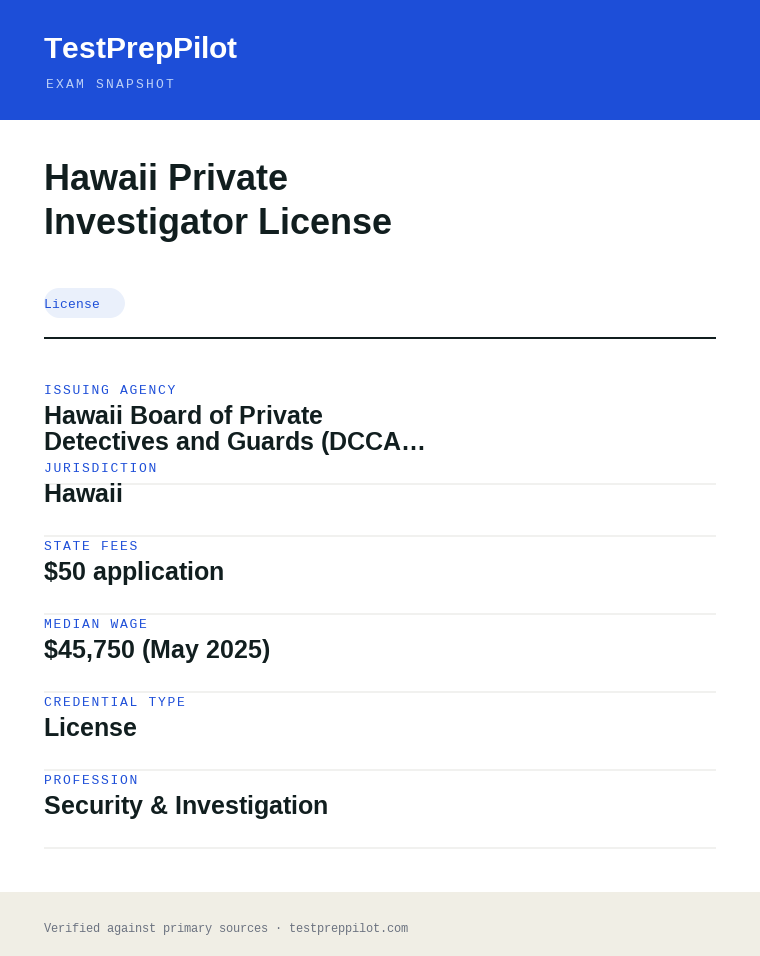
Hawaii issues the Hawaii Private Investigator License through the Hawaii Board of Private Detectives and Guards (DCCA Professional and Vocational Licensing). Minimum age: 18. Required training: None. Application: $50. Background check: $17.50 Fieldprint + $16.50 FBI + $30.00 Hawaii state criminal history check. Renewal: Biennial - renews by June 30 of every even-numbered year.
How the private investigator license works across all 45 licensing states, and how to prepare for it: Private Investigator License requirements by state.
Can you apply?
What does Hawaii require before you apply?
| Minimum age | 18 |
|---|---|
| Citizenship / status | Not expressly required for individuals by statute; principals and entities must meet board character standards |
| Education | High school education or equivalent |
| Experience | Four years of full-time investigational work. The board accepts employment under a licensed private detective, as a police officer, as a government investigator (federal, state, county, or municipal), or as an investigator for an attorney or law firm. No education substitutes for the experience requirement. |
| Required training | None |
| Online training | Not applicable |
What the training covers: No coursework is required; the board lists recommended study materials including Hawaii Revised Statutes chapter 463, Hawaii Administrative Rules title 16 chapter 97, and The Process of Investigation (Sennewald and Tsukayama).
Disqualifiers and other conditions: Applicant must not have been convicted of a crime reflecting unfavorably on fitness for the profession (unless annulled or expunged), must not suffer from a directly detrimental psychiatric or psychological disorder, and must possess a history of honesty, truthfulness, financial integrity, and fair dealing (HRS 463-6).
Source: Hawaii training rules
The test itself
What does the HawaiiPrivate Investigator License exam look like?
Administered by State board (in-person examination administered after board approval). The exam fee is $50.
| Part | Questions | Time | Pass mark |
|---|---|---|---|
| Private detective examination | Not published | Not published | 75% |
| Exam vendor | State board (in-person examination administered after board approval) |
|---|---|
| Exam fee | $50 |
| Languages | English |
| Source | Official candidate material |
How it compares
Hawaii vs. the other states
Its published exam fee sits above 20% of the 16 states with a published fee. Renewal runs on a biennial - renews by june 30 of every even-numbered year — a cycle shared by 28 of the 44 states researched.
Every dollar
What does the Hawaiiprivate investigator license cost, itemised?
| Item | Fee | Source |
|---|---|---|
| Application (principal / sole proprietor) | $50 | Official source |
| Application (entity / agency) | $100 | Official source |
| Examination | $50 | Official source |
| Fingerprint and criminal history checks | $17.50 + $16.50 + $30.00 | Official source |
| License (private detective, prorated by biennium) | $210-$260 depending on when issued in the two-year cycle | Official source |
| Surety bond | $5,000 bond (HRS 463-12); premium paid to a licensed surety | Official source |
The paperwork
How do you apply in Hawaii?
Applications go through Paper application filed with the PVL Licensing Branch (MyPVL used for license management) — processing takes Driven by the board meeting calendar; applications must arrive 30 days before a meeting.
- Complete the private detective application and assemble the required attachments, including a 2 x 2 photograph and employment history documentation on board experience forms.
- File the application with fee at least 30 days before the board meeting at which it will be considered; the board meets on a published schedule.
- After board approval, register for the examination using the approval letter and pass the 75% threshold exam.
- Appear before the board for an in-person interview after passing the examination.
- Submit the $5,000 surety bond and the prorated license fee, then complete FBI and Hawaii criminal history checks through Fieldprint.
Source: official application instructions
Keeping it
How do you renew a Hawaiiprivate investigator license?
| Cycle | Biennial - renews by June 30 of every even-numbered year |
|---|---|
| Continuing education | None for private detective licenses; the 4-hour continuing competency training requirement applies to guard employees |
| Renewal fee | $344 (private detective, active) / $408 (private detective agency, active) |
Source: official renewal rules
Moving in (or out)
Can you transfer a private investigator license to or from Hawaii?
None. The board states that Hawaii has no reciprocal agreements and all applicants must meet the same licensing and examination requirements.
Source: official reciprocity rules
What it pays
What does this credential pay in Hawaii?
| Occupation | Private Detectives and Investigators (SOC 33-9021) |
|---|---|
| Hawaii median | $45,750 |
| National median | $51,220 |
| Data year | May 2025 |
Source: BLS OEWS state wage table
What moved recently
What has changed in Hawaii recently?
- No regulatory changes recorded as of October 2026. Source
Getting ready
How should you prepare for the Hawaii exam?
Budget for the exam first: Hawaii's published exam fee is $50. The test is delivered by State board (in-person examination administered after board approval), so register through the vendor's own scheduling system once Hawaii's board approves your application. The material itself is largely national — content outlines, question styles and study plans are shared across jurisdictions even when fees and passing rules are not. That means the highest-value preparation is the same everywhere: work from the official content outline, take full-length timed practice tests before you book, and drill your weakest domain until your practice scores clear the pass mark with room to spare. Our template-level guide collects the study plan, question-type breakdowns and common mistakes in one place, so you prepare once instead of re-researching what changed in Hawaii.
See the full private investigator license preparation guide →
Reference
What are the key facts about the Hawaii Private Investigator License?
Hawaii Private Investigator License is a license credential; issued in Hawaii by Hawaii Board of Private Detectives and Guards (DCCA Professional and Vocational Licensing).
| Credential | Hawaii Private Investigator License |
|---|---|
| Abbreviation | HI PI |
| Type | License |
| Profession | Security & Investigation |
| Specialty | Investigations |
| State-licensed here? | Yes — Hawaii Board of Private Detectives and Guards (DCCA Professional and Vocational Licensing) |
| Application | $50 |
| Jurisdictions licensing it | 45 of 51 |
| Scope | Hawaii (HI) |
| Region | West |
| Also known as | Hawaii PI license, Hawaii detective license |
Real questions
Frequently asked questions about the Hawaii Private Investigator License
Does Hawaii offer any education shortcut instead of the four-year experience requirement?
No. The board explicitly rejects academic courses, degrees, and home study in place of the four years of full-time investigative work. Qualifying employment includes working under a licensed private detective, as a police officer, as a government investigator, or for an attorney or law firm.
How does the two-step application and exam sequence work?
You file the application first and the board reviews it at a scheduled meeting; applications must arrive at least 30 days before that meeting. Only after board approval can you register for the 75% exam ($50 fee), and passing applicants then appear for an in-person board interview before paying the license fee.
What does the $5,000 bond cover and when is it due?
HRS 463-12 requires a surety bond of not less than $5,000 issued by a surety authorized in Hawaii. It does not need to be submitted with the application, but it must be in place before licensure and kept current thereafter.
When do Hawaii private detective licenses renew and what does it cost?
All licenses renew by June 30 of every even-numbered year. A private detective license in active status costs $344 to renew ($408 for an agency), and a lapsed license can be restored for $419 within one year of expiration.
Can I hold a Hawaii private detective license based on my license from another state?
No. The board publishes that Hawaii has no reciprocal agreements, so every applicant must meet the four-year experience and examination requirements in full regardless of licensure elsewhere.
How many states require a PI license?
As of 2026, 45 of 51 jurisdictions require a state-level PI license. The six that do not are Alaska, Colorado (discontinued 2020), Idaho, Mississippi, South Dakota, and Wyoming.
Is there a PI exam?
About half of states require a written exam (e.g., California, Florida, Illinois, Louisiana, Maryland, Nevada, New Mexico, New York, Wisconsin). Others rely on experience and background review.
Same credential elsewhere
Which states license the Private Investigator License?
Requirements, fees and issuing agencies differ in every jurisdiction. Pick a state to see its rules.
Trust
Where does this information come from?
This page is built from primary regulatory sources. Rules and fees change — confirm with the issuing body before you pay for anything.
- Hawaii Board of Private Detectives and Guards - licensing, renewals, and fee notices Checked 2026-10
- Board of Private Detectives and Guards - Frequently Asked Questions (fees, requirements, reciprocity) Checked 2026-10
- Hawaii Revised Statutes chapter 463 - Private detectives and guards (HRS 463-6 qualifications, HRS 463-12 bonds) Checked 2026-10
- Hawaii PVL - PDG application and exam reference material Checked 2026-10
- Hawaii Board of Private Detectives and Guards (DCCA Professional and Vocational Licensing) Issuing agency
- National reference for Private Investigator License Standards body
Research confidence: medium · Last compiled 2026-10